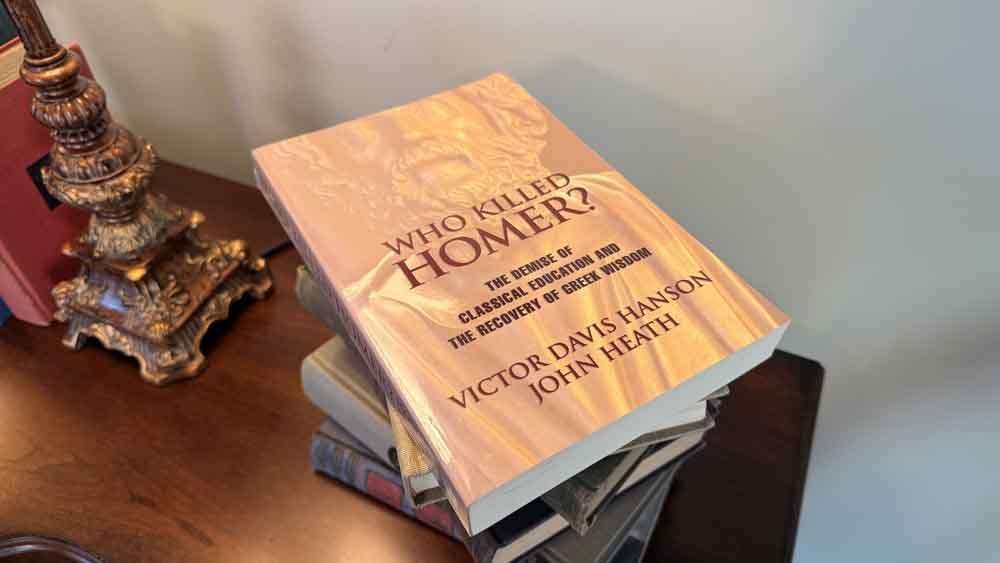
Few academic books arrive with both the fury of a polemic and the grief of an elegy. Who Killed Homer? The Demise of Classical Education and the Recovery of Greek Wisdom, first published in 1998 by classicists Victor Davis Hanson and John Heath, is exactly that — a prosecution brief, a lament, and a call to arms all compressed into a single, merciless argument: the people charged with keeping the ancient Greeks alive have instead quietly buried them.
The target is not students. It is not budget committees or philistine politicians. The target is the academy itself — the professors, department chairs, and tenure-hungry specialists who traded Homer, Thucydides, and Sophocles for conference papers, ideological credentialing, and the careerism of the modern university. Hanson and Heath name names, describe the pathology, and ask a question that every educated person should be forced to answer: What exactly did we lose when we let classical education die, and did we even notice while it was happening?
The Argument at the Core
The book’s thesis arrives early and without apology. The Greeks invented something historically unprecedented: the idea that a free citizen — not a priest, not a king, not a courtier — could look at the world honestly and try to understand it on its own terms. Science, tragedy, democracy, history as a discipline, the idea of the West itself — all of it traces back to a civilization that produced its greatest literature when Homer composed (or assembled) The Iliad and The Odyssey.
Hanson and Heath write with unmistakable conviction: “The Greeks were the first Westerners to suggest that knowledge could be won rather than received, that humans could discover the nature of their own world without recourse to divine revelation.”
That tradition, the authors argue, did not die from neglect or indifference outside the walls of the university. It was killed from within by people who were paid to protect it.
The Killers and Their Methods
The book’s most bracing chapters document the mechanisms of destruction: the fragmentation of classical studies into hyper-specialized subfields, the politicization of the curriculum through identity-driven theory, and the profound irony that professors who built careers on “Greek studies” simultaneously presided over the near-elimination of Greek from American universities.
Hanson and Heath reserve their sharpest scalpel for what they call the therapeutic university — an institution that replaced the difficult, uncomfortable truths of classical literature with a curriculum optimized for comfort, career placement, and political affirmation. In their reading, the professor who publishes a deconstructionist paper on the “male gaze in Homeric epic” while never teaching The Iliad to undergraduates is not a scholar of the Greeks — they are a parasite feeding on the prestige of a tradition they have abandoned.
The indictment is deliberately uncomfortable. It is meant to be.
“Classics departments have become expert at talking about the Greeks without transmitting them — at producing scholars who know everything about antiquity except how to make a twenty-year-old give a damn about it.”
What the Greeks Actually Taught
The book does not wallow in complaint. Its most powerful passages describe, in plain and sometimes beautiful prose, what Greek wisdom actually contains and why it remains irreplaceable.
The Greeks understood that life is tragic — not in the sentimental sense, but in the structural sense. Suffering is not an aberration; it is the condition. Thucydides did not write the History of the Peloponnesian War to entertain future academics. He wrote it because he had watched rational men, in a democratic society, make catastrophically irrational decisions under pressure and wanted posterity to understand how it happens. The Iliad is not a poem about glory. It is a poem about the cost of glory — about what Achilles loses in the gaining of it, about the grief of Priam at the feet of the man who killed his son.
“Homer gives us not a hero who wins but a hero who understands, too late, that winning was never the point. That is not a Greek lesson. That is the human lesson.”
Hanson and Heath are making a case that the Greeks were not a quaint historical curiosity. They were the inventors of the specific kind of thinking that built Western civilization and that — at this particular moment in history — is most under pressure.
The Prescient Warning
Published in the late 1990s, the book reads today like a prophecy that was largely ignored. The trends Hanson and Heath identified have only accelerated. Enrollment in classical languages at American universities has collapsed. The number of classics departments has shrunk dramatically. The cultural common ground that once allowed an educated person to reference The Odyssey or cite Heraclitus without explanation has all but vanished.
What replaces it is not nothing. Something always fills the vacuum. What fills this one is a culture oriented almost entirely toward the immediately useful, the algorithmically optimized, and the personally validated. There is nothing in that culture that teaches a person how to face genuine loss, how to think about death, how to make a decision under conditions of radical uncertainty. Homer taught all three. He taught them to farmers and soldiers, not just to scholars.
The Dissenting Notes
The book is not without its tensions. Hanson and Heath can slip from righteous indignation into nostalgia, and their portrait of the pre-theoretical classics department — where scholars simply loved the Greeks and transmitted that love to students — is probably more idealized than the historical record supports. The academy has never been a simple meritocracy of devotion.
Their political coloring, particularly Hanson’s, is visible at the edges. Critics have argued that the book is less a defense of the Greeks than a defense of a particular cultural conservatism dressed in Greek garb. That critique is not entirely unfair, though it does not invalidate the core argument. You do not need to share the authors’ politics to agree that The Odyssey should be taught, that Thucydides remains indispensable, and that a civilization’s relationship with its own foundational texts is not a trivial matter.
Why This Book Still Belongs on the Shelf
Who Killed Homer? has not aged into irrelevance. If anything, it has aged into urgency. The forces it describes have not retreated. The classical tradition it mourns is even further from the center of American education than it was when the book first appeared. And the question it raises — what a civilization loses when it severs its connection to the people who first invented its defining ideas — has not been answered.
The Greeks did not build the Parthenon because they had surplus time. They built it because they believed that certain forms of human expression were worth extraordinary effort, that beauty and truth were not decorative but structural, that a culture reveals its actual values not in what it says about itself but in what it builds and what it remembers.
Hanson and Heath are asking whether we still believe any of that. The answer, if we are being honest, is less clear than it should be.
Who Killed Homer? is available from Amazon and from independent booksellers. For readers interested in the broader argument about classical education, Hanson’s later work The Other Greeks and Heath’s The Talking Heads extend and deepen the conversation.
If this review resonated with you, my earlier piece on Thus Spoke Zarathustra by Friedrich Nietzsche explores a different but related thread — the question of what happens when a civilization loses its philosophical anchor and what it costs to rebuild one.
Sources
- Hanson, Victor Davis, and John Heath. Who Killed Homer? The Demise of Classical Education and the Recovery of Greek Wisdom. Free Press, 1998. Amazon
- Hanson, Victor Davis. The Other Greeks: The Family Farm and the Agrarian Roots of Western Civilization. Free Press, 1995.
- National Endowment for the Humanities. “Classics in Crisis.” Humanities Magazine, 2013. neh.gov
- The American Philological Association (now Society for Classical Studies). Enrollment data in classical languages, 1970–2020. classicalstudies.org
- Kermode, Frank. “The Uses of Error.” The New York Review of Books, 1991. nybooks.com