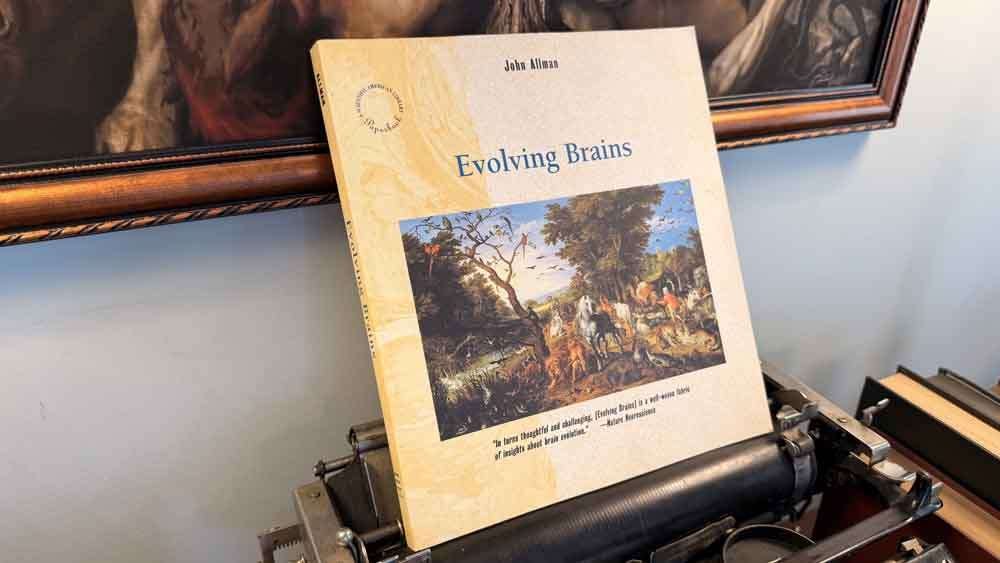
Somewhere inside the three pounds of tissue behind your eyes is a history that stretches back nearly a billion years. Not a metaphor — a literal, biochemical record. The circuits that regulate your sleep, your hunger, your fear, your capacity to recognize a face across a crowded room: all of it assembled incrementally, layer by layer, through an evolutionary process so slow and so relentless it makes human history look like a footnote. John Allman’s Evolving Brains, published in 1999 through the Scientific American Library, is one of the most coherent attempts yet made to trace that journey from its bacterial beginnings to the extraordinary complexity of the primate mind — and to ask, without flinching, what it cost.
Allman is no casual observer of this terrain. As Hixon Professor of Biology at the California Institute of Technology and a recipient of the Golden Brain Award from the Minerva Foundation, he spent decades mapping the visual cortex of primates and played a central role in identifying that the visual system comprises not one unified processing area but many — a discovery that reshaped how neuroscience understood perception itself. His laboratory later identified a class of large spindle-shaped neurons, now called Von Economo neurons, found uniquely in humans and the great apes, concentrated in regions of the brain associated with social awareness, empathy, and rapid intuitive decision-making. This is a man who has looked at brain tissue under a microscope for a career and come away with something rarer than data: genuine wonder.
It Begins With Bacteria
The book’s most disarming move is its opening. Allman does not begin with primates or mammals or even vertebrates. He begins with Escherichia coli — the bacterium that lives in the human gut — and its capacity to detect chemical gradients in its environment, moving toward nutrients and away from toxins. This, he argues, is the ur-function of every brain that has ever existed: sensing environmental variation and navigating toward survival. The brain, in Allman’s framing, is not primarily a thinking organ. It is a buffer against an unpredictable world.
That single organizing idea — “brains exist because the distribution of resources necessary for survival and the hazards that threaten survival vary in space and time” — carries the entire book. It sounds almost reductive until you follow Allman as he builds it out across five hundred million years of evolutionary pressure, climate shifts, extinction events, and the slow elaboration of neural architecture from reflex arcs to cortical columns to the frontal lobe’s capacity for planning and moral reasoning. By the time you reach that endpoint, the sentence feels less like a simplification and more like a key that opens a very large door.
The Cost of a Big Brain
One of Evolving Brains‘ most persistent and underappreciated arguments is economic. Large brains are expensive — metabolically, developmentally, reproductively. The human brain accounts for roughly two percent of body weight but consumes around twenty percent of the body’s energy at rest. That is an extraordinary tax to pay, and evolution does not subsidize luxury. Every gram of additional neural tissue had to earn its keep against competing demands: faster legs, thicker hide, a more efficient gut.
Allman traces the evolution of warm-blooded animals, weaving together modern neuroscientific findings with anthropological data, and notes that fruit-eating primates tend to have larger relative brain sizes than leaf-eating primates — a detail that connects dietary complexity to cognitive demand. Finding ripe fruit requires spatial memory, color discrimination, and seasonal planning. Leaves are always there. The brain followed the food.
This cost-benefit framework runs through the book’s treatment of every major evolutionary transition. Warm-bloodedness, for instance, gave mammals a metabolic engine capable of sustaining large, energy-hungry brains — but it also made them hostage to constant caloric need in a way that cold-blooded competitors were not. Allman makes you appreciate why mammals, burdened by the cost of warm-bloodedness, were unable to unseat the dinosaurs for the better part of two hundred million years. The brain that eventually produced Beethoven and the Pantheon spent most of its evolutionary history hiding from things that wanted to eat it.
Gene Duplication and the Architecture of Complexity
A central technical theme of the book is the role of gene duplication in building neural complexity. Allman argues that duplication was fundamental in the evolution of brains — gene duplications providing a substrate for diversification of structures that would expand the brain’s repertoire. This connects to the broader molecular genetics literature and to ideas that will feel familiar to anyone who has followed the science of evolutionary developmental biology, or evo-devo, in the decades since the book’s publication.
The brain does not invent new functions from scratch. It repurposes, duplicates, and elaborates existing structures. The same basic genetic toolkit that builds a worm’s simple nerve cord is deployed, with modifications, to build a mammalian cerebral cortex. Evolution is a tinkerer, not an engineer — it works with what is already there, modifying existing parts rather than designing new ones. This is one of biology’s most elegant and counterintuitive truths, and Allman renders it accessible without losing its depth. His background as an anthropologist before becoming a neuroscientist gives him an unusual facility for moving between scales — from molecules to organisms to populations to geological time — without losing the thread.
This evolutionary parsimony has a direct parallel in our piece on horizontal gene transfer and Darwin’s tangled web — the principle that life does not build from scratch, it borrows, repurposes, and recombines across lineages.
Primate Vision and the Social Brain
The chapters on primate brain evolution are where Allman is most visibly in his element, and they are the strongest in the book. His account of how the primate visual cortex expanded into multiple specialized areas — each processing different aspects of a visual scene, from motion to color to object identity — is lucid and precise. The evolutionary pressure driving this expansion, he argues, was the particular demands of arboreal life: navigating three-dimensional space at speed, judging the ripeness of fruit by color, and — critically — reading the faces and intentions of other primates in an increasingly complex social environment.
That last point opens into one of the book’s most forward-looking arguments. The social brain hypothesis, developed more fully by Robin Dunbar and others in the years surrounding this book’s publication, holds that the cognitive demands of living in large, hierarchically complex social groups were a primary driver of primate — and eventually human — intelligence. Managing alliances, tracking reputations, anticipating the behavior of rivals and allies: these are computationally expensive tasks. The brain that can do them well has a survival advantage that compounds over generations.
Allman does not pursue this thread as far as some readers might wish, but he lays the groundwork honestly. The Von Economo neurons his laboratory would later characterize — large, fast-conducting spindle cells concentrated in regions associated with social emotion and rapid intuitive judgment — fit neatly into this framework. They appear to be biological infrastructure for the kind of split-second social reading that complex group life demands.
The Shrinking Human Brain
Among the book’s most provocative passages is its treatment of a question most popular accounts of human evolution ignore entirely: why has the human brain been getting smaller for the past thirty-five thousand years? Average brain volume in modern humans is measurably less than in our ancestors from the Upper Paleolithic. This is not cognitive decline — behavioral complexity, symbolic culture, and technological sophistication have all increased over the same period. But the trend is real and demands explanation.
Allman does not offer a definitive answer, which is the honest response given the state of the science. What he does do is use the question to reinforce his core argument about neural cost. If the social environment — rather than the physical one — is increasingly the primary selective pressure on human cognition, and if social coordination reduces the need for individual problem-solving capacity, then some reduction in raw neural volume might be expected without any corresponding loss of adaptive fitness. A well-organized community can distribute cognitive load in ways a solitary organism cannot. The brain may, in some sense, have outsourced a portion of its work to culture.
This idea sits in productive tension with everything Allman has said about the individual cost of a large brain. It suggests that human intelligence is not simply a property of individual skulls but of networked minds — a conclusion that raises questions about identity, cognition, and what we even mean by intelligence that the book wisely declines to fully resolve.
What Has Aged and What Has Not
Evolving Brains was published in 1999, and some of its specifics have been overtaken by subsequent research. The genomic revolution of the early 2000s, the identification of additional archaic human species beyond Neanderthals, and advances in understanding the developmental genetics of neural tissue have all added complexity and in some cases correction to the picture Allman drew. Readers coming to it today should treat certain claims as starting points for further inquiry rather than settled conclusions.
What has not aged is the book’s intellectual architecture — the organizing framework of environmental variability, neural cost, and evolutionary constraint. That structure remains as useful as ever for thinking about why brains are the way they are, and Allman’s gift for making comparative neuroscience feel immediately relevant to questions about human experience is undiminished by the passage of twenty-five years.
For readers drawn to the intersection of evolutionary biology and the nature of mind, the conversation between Allman and Dawkins is worth having — Dawkins’ account of the selfish gene as the unit of selection sits alongside Allman’s account of the brain as evolution’s most complex phenotypic product. If you have already spent time with The God Delusion and Dawkins’ broader argument about what biology reveals about human nature, Evolving Brains offers a detailed anatomical and evolutionary substrate for those same questions. The two books do not overlap — they stack.
A Clear Map of a Very Long Road
Evolving Brains is not the last word on any of the questions it raises. It was not intended to be. What it offers is something rarer in science writing: a coherent, non-condescending account of how a single functional principle — buffer against environmental variation — scaled across geological time into the organ that allows you to read these words, form opinions about them, and decide whether they matter to you.
Zooming from the microworld of genes to the macroworld of evolution and behavior, the book shows how large brains developed as a buffer against the perilous hazards of an ever-shifting environment. That is a genuine intellectual achievement, and Allman accomplishes it without mystifying the material or dumbing it down. The brain, by the end, feels neither miraculous nor mechanical — it feels like the product of a very long negotiation between life and the world it finds itself in. Which, it turns out, is exactly what it is.
Evolving Brains by John Morgan Allman — Scientific American Library / W.H. Freeman, 1999. Available in hardcover and paperback.
You Might Also Like:
- Horizontal Gene Transfer: Why Darwin’s Tree of Life Is Actually a Tangled Web
- The God Delusion by Richard Dawkins: A Review
Sources
- Allman, John Morgan. Evolving Brains. Scientific American Library / W.H. Freeman, 1999. amazon.com
- Allman, John Morgan. “Moral intuition: Its neural substrates and normative significance.” Journal of Physiology – Paris, 101(4–6), 2007. pp. 179–202.
- Allman, J., Hakeem, A., Watson, K. “Two phylogenetic specializations in the human brain.” The Neuroscientist, Vol. 8, No. 4, 2002. pp. 335–346.
- Dunbar, Robin. “The Social Brain Hypothesis.” Evolutionary Anthropology, 6(5), 1998. pp. 178–190.
- Nature Neuroscience review of Evolving Brains. nature.com
- John Allman — Wikipedia. en.wikipedia.org