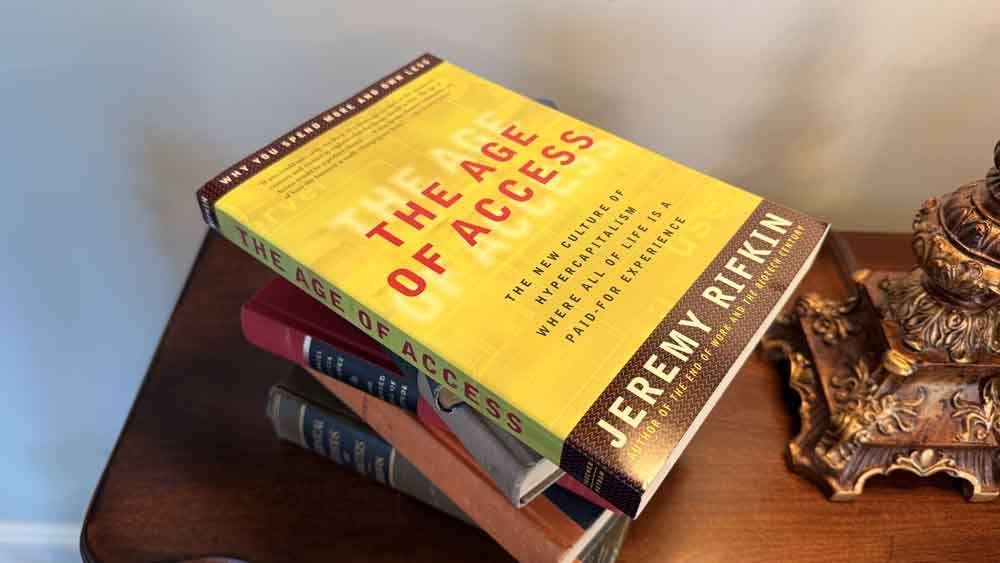
Jeremy Rifkin has a habit of being right too early. The Age of Access, published in 2000, reads today less like a business forecast and more like a field report from the present — a world in which almost nothing you use is actually yours. You rent your music, lease your software, subscribe to your television, finance your car, and stream your books. Ownership, Rifkin argued a quarter century ago, was becoming an antiquated concept — a relic of an industrial era being quietly dismantled by a new economic logic built entirely on access.
He was describing our Monday morning.
What Rifkin Actually Argued
The central thesis of The Age of Access is deceptively clean: capitalism is shifting from markets built around the exchange of goods to networks built around the sale of experiences and services. Physical property — the kind you could hold, deed, and pass on — was giving way to subscriptions, memberships, licenses, and time-limited access agreements. Rifkin wrote that “sellers are becoming suppliers of services and short-term experiences, while buyers become users paying fees, rentals, and retainers for the temporary use of what others own.”
The manufacturer becomes the service provider. The product becomes the platform. The customer becomes the subscriber.
He traced this logic through every major sector: entertainment, telecommunications, agriculture, automotive, education, healthcare. Each was converging on the same model — strip out the physical asset, monetize the access, capture the recurring revenue stream. What looked like convenience to the consumer was, from the supply side, a profound consolidation of ownership. Fewer and fewer entities would own the actual infrastructure of daily life, while more and more people would simply pay to use it.
The Seduction of Frictionless
It is worth sitting with why this model spread so completely. The access economy, in its early form, genuinely solved real problems. Streaming ended the tyranny of the DVD case. Cloud storage dissolved the anxiety of the crashed hard drive. Ride-sharing eliminated the calculus of parking. The friction of ownership — the maintenance, the storage, the depreciation, the insurance — was quietly absorbed into a monthly fee and, in the process, made invisible.
Rifkin saw this clearly but also saw what it would cost. “When one has to pay for access to the very building blocks of existence,” he wrote, “one has lost the most basic form of freedom — the ability to be self-sufficient.” The concern was not merely economic. It was existential. A civilization that rents its tools is a civilization that depends on the goodwill of whoever holds the lease.
That goodwill, as we have learned in the twenty-five years since publication, is contingent. Platforms change their terms. Algorithms shift. Subscriptions are discontinued. Libraries are deleted. The music you “purchased” on one platform disappears when the service folds. The software you relied on for a decade becomes a monthly obligation or a memory. The access economy, it turns out, does not merely sell you the use of something — it retains perpetual leverage over it.
Ownership as Resistance
This is where Rifkin’s diagnosis becomes most useful as a cultural argument rather than simply an economic one. If the access economy represents the complete commodification of daily life — the metering of every experience, relationship, and resource through a commercial gate — then ownership is not merely a financial preference. It is a form of resistance.
Consider what it means to own a house outright. Not as a financial instrument or a leveraged asset, but as a place with a deed, a history, and a claim that requires no monthly permission. On the North Shore of Long Island — where the land carries deep layers of history, where families have held ground for generations — the distinction between owning and accessing is not abstract. It is the difference between permanence and permission, between a home and a rental arrangement dressed up to look like one.
Or consider a well-made object. A cast-iron skillet seasoned over decades. A handmade briefcase built from English bridle leather that will outlast the person who commissioned it. These are not products — they are counterarguments. They exist in defiance of the subscription model. They cannot be updated remotely, discontinued, or revised per new terms of service. They age into meaning rather than depreciating toward irrelevance.
Rifkin did not foresee the particular backlash these objects would inspire — the resurgence of craft, of repair culture, of heirloom goods and locally grown food — but his framework explains it perfectly. When access becomes the dominant mode of economic life, ownership becomes the luxury.
The Colonization of Culture
Perhaps the most provocative chapter in The Age of Access concerns what Rifkin called the commodification of human experience itself. As companies moved from selling goods to selling experiences — tourism, entertainment, personal development, social interaction — the cultural sphere was increasingly absorbed into the commercial one. Everything that had once been free and unmediated became a product with a price point.
He drew on the language of enclosure — the historical process by which common lands in England were privatized and fenced off from ordinary use — and applied it to culture. The commons of shared stories, rituals, traditions, and relationships were being enclosed by commercial entertainment, packaged recreation, and brand-mediated community. People would pay to belong, to celebrate, to grieve, to connect.
Reading this now, it is impossible not to think of the algorithmic curation of social connection, the monetization of personal milestones, the subscription-based communities, the branded experience economy. The local diner, the neighborhood hardware store, the independent bookshop — these were always more than commercial operations. They were nodes in a network of unmediated human exchange. Their disappearance is not merely an economic story. It is, in Rifkin’s terms, an enclosure.
The diner that has operated for twenty-five years on the same stretch of Long Island road understands something the access economy cannot quantify: that the meal is the easy part. The thing people are actually paying for — the thing that cannot be subscribed to — is recognition, continuity, and the faint but indelible sense that some places still belong to the people who use them.
Where Rifkin Falls Short
The Age of Access is not without its blind spots. Written at the peak of the first dot-com boom, Rifkin was perhaps too impressed by the organizational novelty of the network economy and occasionally overreached in his predictions about the speed of transition. The death of physical goods has proven slower and more complicated than he anticipated — people still buy things, still want objects, still find meaning in possession.
He also underestimated the degree to which the access economy would segment along class lines. The wealthy, it turns out, have moved in exactly the opposite direction from his predictions — toward more ownership, more physical assets, more tangible stores of value. Art, land, rare craft objects, rare editions, functioning farms. The access economy has largely captured the middle and working classes, while those with capital have quietly consolidated ownership of the infrastructure everyone else rents access to. The irony is perfect, and Rifkin did not fully see it coming.
Why It Stays Relevant
What makes The Age of Access worth reading a quarter century after publication is not the accuracy of its predictions, which are mixed, but the quality of its questions. What do we actually own? What does ownership mean for individual autonomy and cultural continuity? What is lost when every experience passes through a commercial intermediary? What kind of civilization do we become when permanence itself is no longer the default?
These are not economic questions. They are philosophical ones, and they are becoming more urgent, not less, as artificial intelligence accelerates the pace at which the physical economy is abstracted into digital services, platform dependencies, and algorithmic mediation.
Rifkin wrote that “the great irony of our time is that the marketplace, long considered to be the arena of human freedom, is now the very institution undermining freedom.” That sentence has aged without losing a single gram of its weight.
The Age of Access is available through Penguin Putnam.
Sources
- Rifkin, Jeremy. The Age of Access: The New Culture of Hypercapitalism, Where All of Life Is a Paid-For Experience. Penguin Putnam, 2000. https://www.penguinrandomhouse.com/books/297676/the-age-of-access-by-jeremy-rifkin/
- Hardin, Garrett. “The Tragedy of the Commons.” Science, 1968. https://www.science.org/doi/10.1126/science.162.3859.1243
- Zuboff, Shoshana. The Age of Surveillance Capitalism. PublicAffairs, 2019. https://www.publicaffairsbooks.com/titles/shoshana-zuboff/the-age-of-surveillance-capitalism/9781610395694/
- Rifkin, Jeremy. Foundation on Economic Trends. https://www.foet.org