
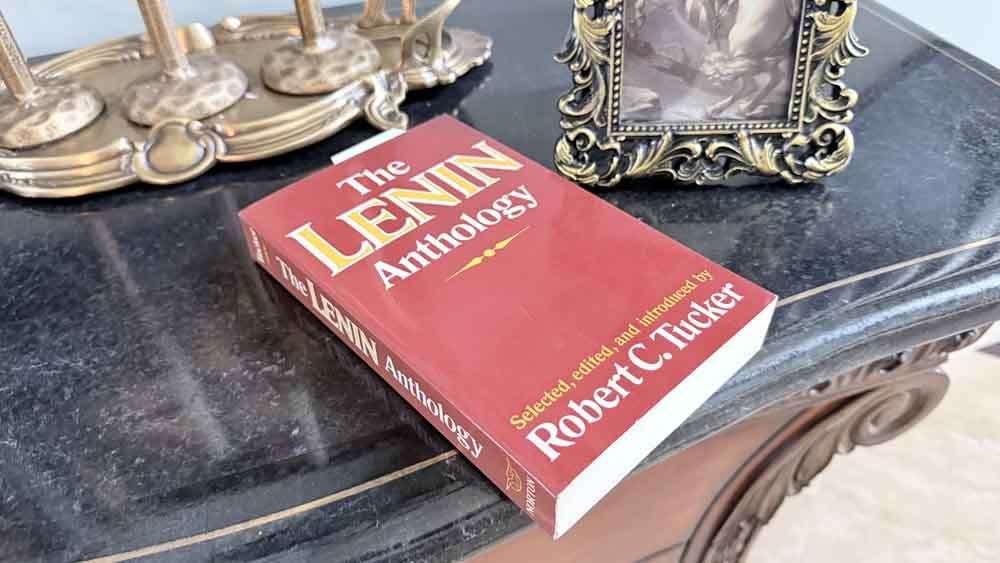
Eight hundred and thirty-two pages distilled from over fifty volumes of a dead man’s writing — and yet the tension never leaves the room. The Lenin Anthology, edited by Princeton political theorist Robert C. Tucker and published by W. W. Norton in 1975, is not a biography, not an apology, and not a condemnation. It is something rarer and more demanding: a primary source collection that forces you to sit across the table from Vladimir Ilyich Lenin and take him seriously as a thinker before you pass judgment on him as a man. Tucker, who also edited the landmark Marx-Engels Reader, brought the same disciplined curatorial hand here — brief introductory commentaries before each selection, a general biographical introduction, and a chronology spanning Lenin’s birth in 1870 to his death in 1924. The result is the most accessible single-volume entry point into a body of thought that shaped the political geography of an entire century.
Robert C. Tucker and the Architecture of the Anthology
Tucker’s editorial method is quiet but purposeful. He does not editorialize heavily. Each section opens with a few paragraphs of context — historical placement, the conditions under which Lenin wrote, the argument’s significance within the broader arc of Bolshevik theory — and then steps aside to let Lenin speak. Tucker’s introductory essay is the most substantial editorial contribution, and its key observation anchors everything that follows: “Lenin must be understood both as a creator of a distinctive version of Marxism as a revolutionary theory and also as a person steeped in the native Russian, non-Marxist revolutionary tradition.” That sentence is the spine of the entire volume. Lenin was not simply Marx’s executor. He was a synthesizer — fusing German dialectical materialism with the conspiratorial urgency of Russian populist movements like Narodnaya Volya, the organization whose members had assassinated Tsar Alexander II and whose execution of Lenin’s older brother, Alexander, left a permanent mark on the young Vladimir.
Tucker organizes the anthology thematically rather than strictly chronologically. Part I covers the revolutionary party and its tactics. Part II addresses imperialism and the global dimensions of capitalism. Parts III and IV move through the theory of the state, socialist construction, and the cultural challenges of building a new society. It is a sensible architecture, and it holds.
What Is to Be Done? — The Blueprint That Built a Party
The single most consequential document in the anthology, and perhaps the most influential pamphlet written in the twentieth century, is What Is to Be Done?, composed by Lenin in late 1901 and published in March 1902. It is the founding document of Bolshevism as an organizational philosophy, and reading it in full — as Tucker includes it — is to understand precisely why Lenin’s movement succeeded where so many others dissolved into sentiment and argument.
Lenin’s central claim is cold and unambiguous: the working class, left to its own devices, will develop only what he calls “trade union consciousness” — the capacity to fight for better wages, shorter hours, improved conditions. Genuine socialist revolution requires something more: a vanguard of professional revolutionaries, disciplined, theoretically trained, operating with the cohesion of a military unit rather than the looseness of a discussion circle. “Without revolutionary theory,” he writes, “there can be no revolutionary movement.” He is not romanticizing the masses; he is building an instrument to move them.
The critics of this position have never stopped writing. Rosa Luxemburg argued that Lenin’s model contained the seed of authoritarianism — that centralizing revolutionary consciousness in a professional party elite inevitably subordinated the proletariat to its supposed liberators. History, in the form of Stalin, offered her an uncomfortable vindication. But the debate is more layered than that verdict suggests. Lenin himself acknowledged that What Is to Be Done? was a “blunt formula” written for a specific historical moment — a small, underground movement in a police state, operating under conditions that made loose organization not merely inefficient but fatal. Read in that context, his argument is less a theory of governance than a theory of survival. The tragedy is that the organizational habits of the underground became the governing habits of the state.
The State and Revolution — Written on the Eve of Power
If What Is to Be Done? is Lenin’s organizational blueprint, The State and Revolution, written in August and September of 1917 with Bolshevik seizure of power weeks away, is his philosophical one. Tucker includes it in its entirety, and it earns that privilege. It is Lenin’s most sustained theoretical work — lucid, polemical, and in places genuinely compelling.
The argument proceeds from Marx and Engels: the state is not a neutral arbiter standing above class conflict, but the instrument through which the dominant class maintains its domination. Whether a dictatorship or a democracy, the state remains the means of social control of the ruling class. What distinguishes Lenin’s reading from the reformist social democrats — the Mensheviks, the German revisionists, Eduard Bernstein — is his insistence that this state cannot be reformed from within. It must be smashed, replaced by the dictatorship of the proletariat, which would itself, over time, “wither away” as class antagonisms dissolved.
The withering-away argument is where The State and Revolution is most vulnerable to scrutiny, and most interesting to read. Lenin was writing it not as a theoretician in comfortable exile but as a man who believed, correctly, that he would be governing Russia within months. Italian political philosopher Lucio Colletti called it “Lenin’s greatest contribution to political theory.” Others have read it as a document of lethal naivety — a vision of democratic workers’ councils and elected, recallable officials at workmen’s wages that bore no relation to what the Bolsheviks actually built. The gap between the Lenin of The State and Revolution and the Lenin of War Communism is one of the great unresolved tensions in modern political history, and Tucker’s anthology, by placing them in sequence, makes that tension impossible to ignore.
Imperialism and the Global Frame
The anthology gives substantial space to Imperialism: The Highest Stage of Capitalism (1916), and it deserves it. This is Lenin at his most empirically engaged — drawing heavily on J. A. Hobson’s earlier work and the German economist Rudolf Hilferding, synthesizing data on finance capital, monopoly formation, and colonial extraction into a theory of why advanced capitalist states go to war. His argument: capitalism, having exhausted domestic markets, exports capital to the periphery, and the great powers then compete militarily to protect those investments. World War I was not an accident or a failure of diplomacy; it was capitalism doing what capitalism does.
Whether or not one accepts the full framework, it forces a reckoning with questions that remain unresolved: the relationship between economic interest and military policy, the structural incentives for empire, the ways in which prosperity in the core depends on extraction at the margin. These are not merely historical questions. The vocabulary has changed, but the underlying dynamics Lenin was describing have not disappeared. Tucker’s decision to include long sections of the imperialism writings gives the anthology a reach beyond the parochial concerns of Russian Social Democracy into something genuinely global in scope.
Lenin on Culture, Nationality, and the Limits of Revolution
The final sections of the anthology — covering national self-determination, cultural revolution, and the practical problems of building socialism in a peasant society — are less read but arguably more relevant to understanding where the Soviet experiment went wrong. Lenin on nationality is surprisingly nuanced. He supported the right of nations to self-determination, including the right of secession, as a political principle — not because he was a nationalist, but because he believed that voluntary union was more durable than coercion, and that national resentments, if unaddressed, would fracture the revolutionary project from within. The subsequent history of the Soviet Union suggests he was right about the diagnosis and wrong about whether his successors would follow the prescription.
His late writings — the so-called Testament, his notes on the Workers’ and Peasants’ Inspection, his increasingly alarmed observations on the bureaucratization of the party — read like a man watching his own creation turn into something he no longer recognized. He warns explicitly against Stalin’s rudeness and concentration of personal power. The warnings went unheeded. Tucker includes these late documents, and they are among the most sobering pages in the collection.
What the Anthology Does and Does Not Do
The Lenin Anthology is not without its critics. Some serious students of Leninism argue that Tucker’s selections, while solid, skip too lightly over Lenin’s writings on cultural autonomy and the internal debates of the party in ways that soften the harder edges of Bolshevik practice. There is some justice to that critique. An anthology is by definition an act of editorial judgment, and Tucker’s are sometimes conservative — he gives you the Lenin of ideas more than the Lenin of orders.
But that may be precisely the point. The Lenin of ideas is the Lenin that still needs to be confronted, argued with, understood. His analysis of capitalism’s structural tendencies, his theory of organization, his insistence that political consciousness does not arise spontaneously but must be cultivated — these are not museum pieces. They are living arguments that have shaped every serious left political movement since 1917, and that have been distorted, misread, and weaponized in ways that would have appalled their author, just as Nietzsche’s work was distorted by fascists a generation earlier.
A Difficult Book, Indispensable for the Serious Reader
Tucker closes his introduction with a line that captures what this volume asks of its reader: to understand Lenin not as a symbol — neither the secular saint of Soviet iconography nor the monster of Cold War demonology — but as a thinker whose ideas had consequences that must be examined with precision. That is harder work than either hagiography or condemnation, and it is the work this anthology demands.
Reading The Lenin Anthology is not an act of political allegiance. It is an act of intellectual seriousness. The twentieth century cannot be understood without Lenin, and Lenin cannot be understood without engaging his actual words in their actual sequence, shaped by the actual crises he was responding to. Tucker has made that engagement possible in a single, rigorous volume. Whether you emerge convinced, repelled, or — most likely — somewhere between the two, you will have read something that mattered, and that continues to matter.
[The Lenin Anthology, edited by Robert C. Tucker. W. W. Norton & Company, 1975. 832 pp. Available at Amazon.]
You Might Also Like
- Thus Spoke Zarathustra by Friedrich Nietzsche — The Book That Rewired My Understanding of Everything
- The God Delusion by Richard Dawkins — A Review
Sources
- Tucker, Robert C., ed. The Lenin Anthology. W. W. Norton & Company, 1975. Amazon
- Lenin, Vladimir Ilyich. What Is to Be Done? (1902). Marxists Internet Archive
- Wikipedia. “The State and Revolution.” https://en.wikipedia.org/wiki/The_State_and_Revolution
- Wikipedia. “What Is to Be Done?” https://en.wikipedia.org/wiki/What_Is_to_Be_Done%3F
- Cambridge Core. Review of The Lenin Anthology, Slavic Review, Vol. 35, Issue 2. https://www.cambridge.org/core/journals/slavic-review/article/