Published: 1999 | Author: Martin Rees | Category: Book Reviews, Science | Pages: 208
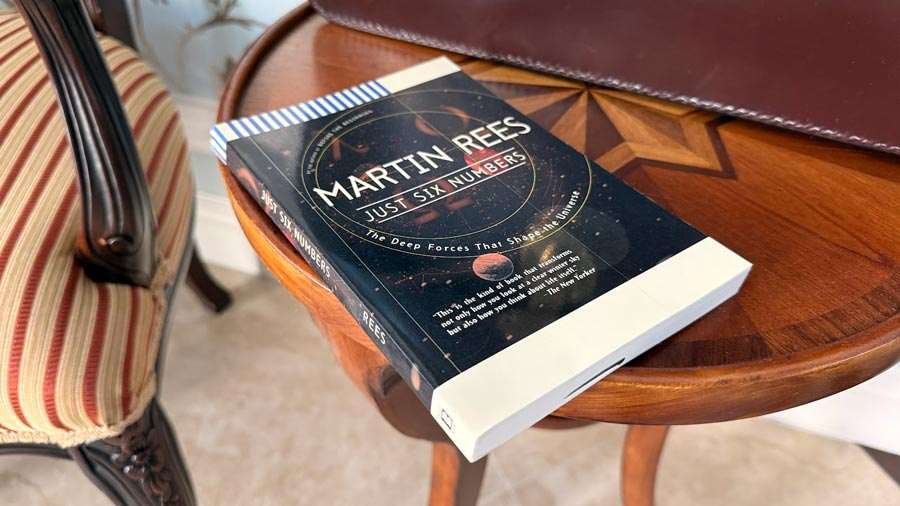
Six numbers. Not six hundred. Not six thousand pages of equations written in the private language of theoretical physics. Six numbers — and if any one of them were even slightly different, you would not be here to wonder about them. No stars, no carbon, no philosophers, no arguments about whether or not there are philosophers. Nothing. Just a smooth, dead universe expanding into eternal dark.
That is the setup Martin Rees hands you in Just Six Numbers: The Deep Forces That Shape the Universe, and he delivers it with the calm authority of someone who has spent a career at the edge of what human minds can actually know. Rees is a cosmologist of the old school — rigorous, restrained, more interested in getting the picture right than in dazzling you with his prose. He was Astronomer Royal of Britain. He helped map the large-scale structure of the universe. He is not a showman. Which is exactly what makes this book so unsettling.
The Numbers Themselves
The six numbers Rees identifies are not arbitrary. Each one governs a different layer of physical reality, and together they function like tolerances in a machine built to specifications that no engineer drew up. N is the ratio of the electromagnetic force to gravity — a number so large (roughly 10 to the power of 36) that gravity’s relative weakness across cosmic distances is what allows stars to burn for billions of years rather than collapsing in an instant. Epsilon (ε) describes how efficiently hydrogen fuses into helium inside stars — 0.007. If it were 0.006, the universe would be hydrogen and nothing else. If it were 0.008, no hydrogen would have survived the Big Bang.
Then there is Omega (Ω), the density of matter in the universe — the difference between a cosmos that collapses back on itself and one that flies apart too fast for gravity to ever pull anything together. Lambda (λ), the cosmological constant, governs the expansion rate of the universe and was considered essentially zero until 1998, when astronomers discovered that the expansion is not slowing down but accelerating — a discovery that blindsided even Rees, who is careful enough to say so. Q is the amplitude of irregularities in the cosmic microwave background — too smooth and you get no galaxies, too rough and you get violent black holes but nothing as gentle and long-lived as a solar system. And D, the dimensionality of space itself: three dimensions, not two, not four. Three is what allows stable planetary orbits and the wiring of a nervous system. Any other number, and complexity as we understand it is foreclosed.
Each of these constants sits in what physicists call the anthropic range — the narrow corridor within which intelligent life can develop. The margins are not generous. They are, in some cases, vanishingly thin.
Rees as a Reluctant Existentialist
What makes Just Six Numbers philosophically interesting — and what Rees himself seems almost reluctant to admit — is that the numbers force a question he is not fully equipped to answer. He is a scientist of the highest order. He is not Kierkegaard or Nietzsche. He did not set out to write an existentialist text. But the existentialist question arrives anyway, uninvited, the way it always does: why this, and not something else?
Rees presents three possible answers. First, the numbers are what they are by necessity — some future Theory of Everything will explain why they could not be any different. He finds this unsatisfying, and so do I. The precision is too surgical for logical necessity. Second, there was a designer. Rees dispatches this possibility in about a paragraph, not dismissively but cleanly, the way a good scientist acknowledges a hypothesis and moves on. The third option — the one he finds most plausible and most troubling — is the multiverse. If there are vastly many universes, each with different values for these constants, then the anthropic range is inevitable somewhere. We observe the numbers we observe because we are here to observe them. You cannot stand in a universe incompatible with your existence.
The multiverse is a respectable scientific hypothesis. It is also, when you sit with it long enough, vertiginous in a way that has nothing to do with physics and everything to do with what the philosopher Derek Parfit called the question of why anything exists at all. Rees is intellectually honest enough to name the abyss without pretending to fill it.
This is where the book earns its place alongside Richard Dawkins’ work — and where it differs from it. My review of The God Delusion noted that Dawkins approaches the question of existence with a kind of militant confidence: natural selection explains the appearance of design, full stop, move on. Rees is quieter than that, and his quietness is more honest. The six numbers do not appear to be selected by evolution or by any process that favors complexity. They were fixed — if that word even applies — at or before the Big Bang. Dawkins’ answer does not reach that far back. Rees knows it.
The Silence Between the Numbers
There is a passage in the book where Rees describes the cosmic microwave background — the faint thermal echo of the Big Bang, the oldest light in the universe, now cooled to just 2.7 degrees above absolute zero. He describes the tiny fluctuations in that background, the ripples that would eventually become galaxies and the space between galaxies, and he does so with a precision that makes the scale almost meaningless. You are reading about the childhood of the universe. The childhood of everything.
And then you close the book and you are back in your life, with its ordinary coordinates — the specific city you live in, the particular people you know, the coffee cooling on the counter. The contrast is not comfortable. That is not a flaw in the book. It is the book working.
This is the gap that existentialism was always trying to close and never quite could: the distance between the vastness of what is and the smallness of the one experiencing it. Nietzsche’s response was will — force the universe to mean something by the sheer intensity of living. Kierkegaard’s was a leap — toward something he could not prove. Heidegger’s was attention — to be-here, deliberately, in the face of the abyss. Rees offers none of these remedies. He is not in the remedy business. He is in the measurement business, and his measurements, taken together, leave you with a sensation that is somewhere between awe and vertigo, without a handrail.
That is not a criticism. Some books are meant to disturb you into thinking better, and this is one of them.
What Rees Gets Right About Wonder
Where Just Six Numbers succeeds most completely is in making cosmological physics legible without softening it. Rees does not write down to his reader. He trusts you to sit with a difficult idea long enough for it to become familiar. The chapters on dark matter, on the early universe, on the mechanism by which stars forge heavy elements from hydrogen and helium, are as clear as anything in popular science writing. He uses analogy sparingly and well. He does not reach for false drama. The drama is already there in the material.
The book also rewards reading alongside other work in this vein. I recently wrote about the Fermi Paradox and the Great Filter — the eerie question of why, if the universe is old and vast, we have not encountered other intelligent life. Rees’ six numbers offer one partial answer: the conditions for complexity are fine-tuned enough that life, even given a universe of a trillion galaxies, may be genuinely rare. The silence of the cosmos and the precision of these constants rhyme with each other in ways Rees does not fully develop but that you cannot help but notice.
And the piece on horizontal gene transfer — Darwin’s tree of life revised — sits in the same neighborhood intellectually: the picture of how we got here keeps getting more complicated, more contingent, more improbable. Just Six Numbers is the cosmological layer of that same argument. Life needed the right universe before it needed the right chemistry.
Who Should Read This Book
Just Six Numbers is not a long book. At 173 pages of actual text, it moves quickly and does not overstay. But it is dense in the way that good short books are dense — ideas packed without being compressed into illegibility. Anyone who has looked up at a clear sky on a cold night and felt the specific unease that comes from understanding, however faintly, what is actually out there — this book is for you.
It is not a book that resolves anything. Rees does not tell you what the six numbers mean. He does not know. No one does. But he tells you, with extraordinary precision and a scientist’s hard-won humility, what they are. And that, it turns out, is enough to make the question impossible to ignore.
Just Six Numbers is available on Amazon in paperback and digital editions.
You Might Also Like
- The God Delusion by Richard Dawkins — A Review
- The Fermi Paradox and the Great Filter: Why the Silence of the Cosmos Might Be the Loudest Warning We’ll Ever Receive
- Horizontal Gene Transfer: Why Darwin’s Tree of Life Is Actually a Tangled Web
Sources
- Rees, Martin. Just Six Numbers: The Deep Forces That Shape the Universe. Basic Books, 1999. Amazon
- Weinberg, Steven. Dreams of a Final Theory. Pantheon, 1993.
- Barrow, John D. and Frank J. Tipler. The Anthropic Cosmological Principle. Oxford University Press, 1986.
- Parfit, Derek. Reasons and Persons. Oxford University Press, 1984.
- Perlmutter, S. et al. “Measurements of Omega and Lambda from 42 High-Redshift Supernovae.” The Astrophysical Journal, 1999. NASA ADS
- Rees, Martin. Our Cosmic Habitat. Princeton University Press, 2001. Princeton UP