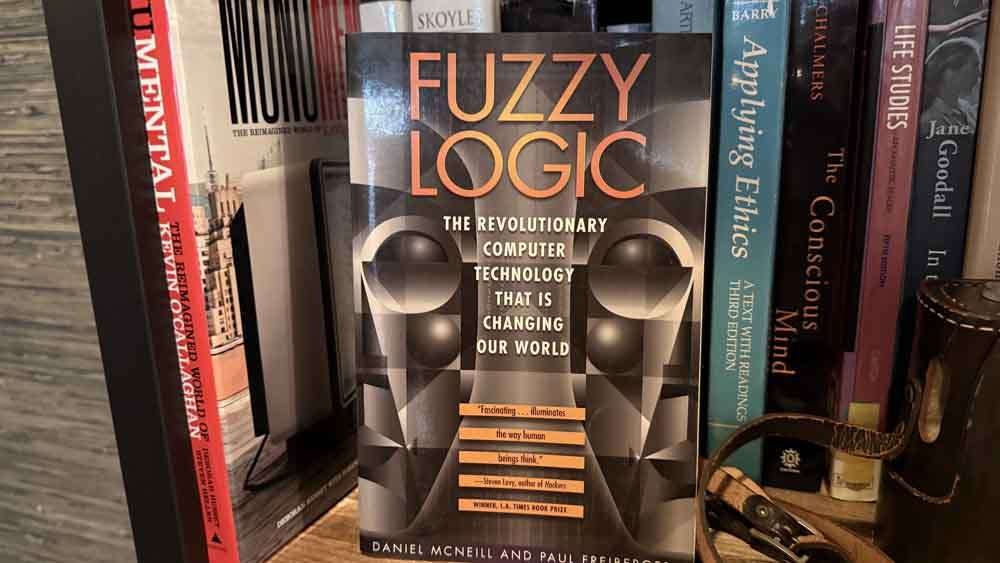
Most people assume that computers work the way courtrooms are supposed to — everything is guilty or not guilty, one or zero, black or white. And for most of computing history, that was true. The transistor either fires or it doesn’t. The answer is yes or no. The logic is crisp, Aristotelian, absolute. What McNeill and Freiberger’s Fuzzy Logic argues — with real narrative force and surprising elegance — is that this was always a limitation masquerading as a feature, and that the man who dared to say so spent the better part of two decades being laughed out of rooms.
That man was Lotfi Zadeh, a professor of electrical engineering at UC Berkeley, who in the summer of 1964 was alone in his parents’ New York apartment when the idea struck him. He had been wrestling with what he called the “unsharpness of class boundaries” — the failure of real-world phenomena to conform to classical binary logic. A dog is clearly an animal. A rock is clearly not. But what about a virus? The world doesn’t sort itself into clean categories, and any system that insisted it did was going to keep running into walls. Zadeh’s 1965 paper, “Fuzzy Sets,” published in the journal Information and Control, proposed something radical: that membership in a category doesn’t have to be all-or-nothing. It can be a matter of degree, represented by any value between zero and one. The concept seems almost obvious in hindsight. At the time, it was treated like heresy.
The Ridicule Was Formal and Sustained
What makes Fuzzy Logic more than a technology primer is that McNeill and Freiberger understood they had a genuine drama on their hands. The academic resistance to Zadeh’s ideas wasn’t polite skepticism — it was contempt. William Kahan, a distinguished professor at Berkeley itself, called the theory “wrong, wrong, and pernicious.” R. E. Kalman, in 1972, compared fuzziness to scientific permissiveness, suggesting the whole enterprise was politically motivated softness dressed up as mathematics. Senator William Proxmire nominated fuzzy logic research for a Golden Fleece Award — his famous honor reserved for what he considered government-funded waste. The establishment closed ranks with an almost comic hostility.
The authors document all of this without turning it into melodrama. What they give you instead is a portrait of how paradigm resistance actually works — not through malice, exactly, but through the enormous inertia of institutional thinking. People who have built careers on a certain way of understanding the world do not easily welcome a framework that implies they may have been working with a flawed map. The history of science is littered with this pattern, and Fuzzy Logic is a clean and readable case study in it.
Common Sense as Engineering Problem
The real intellectual payoff of the book is in how it explains what fuzzy logic actually does, and why it matters. The core insight is that human reasoning — the kind we use every day without effort — operates in gradients. When you adjust the shower temperature, you don’t run a calculation. You apply judgment: too hot, not hot enough, about right, a little cooler. When a skilled driver navigates traffic, they are processing continuous, overlapping impressions and making adjustments in real time. No single variable is discrete. Everything is approximate, contextual, weighted.
Classical computing, built on Boolean logic, could not replicate this. It could calculate faster than any human, but it couldn’t replicate the kind of approximate, proportional reasoning that makes a washing machine notice that the load is medium-sized and moderately dirty and adjust accordingly. Fuzzy logic gave engineers a mathematical framework for encoding that kind of graduated judgment into a system. You could define rules like “if the temperature is somewhat too high, reduce heat moderately” — and the machine could execute those rules with real nuance, because “somewhat” and “moderately” had been given mathematical structure.
This is what the book means when it invokes the phrase “the common sense machine.” Not common sense in any deep cognitive sense, but the engineering approximation of it — a system that could handle the messy, continuous, imprecise nature of the physical world rather than forcing it into artificial binaries.
Japan Understood Before America Did
The most striking section of the book for anyone paying attention to technology and industrial history is the account of how fuzzy logic was embraced. Not in the United States, where it was born. In Japan. Companies like Matsushita, Hitachi, and Sony took Zadeh’s framework seriously while American engineers were still rolling their eyes at the name. By the late 1980s, fuzzy logic was embedded in Japanese consumer electronics — camcorders that stabilized images by calculating degrees of motion blur, air conditioners that modulated output based on approximate readings of room conditions, and most famously, the Sendai subway system, which used fuzzy control to produce starts and stops so smooth that passengers stopped holding the overhead straps.
McNeill and Freiberger are pointed about what this cost American industry. The technology was there. The math was there. The applications were obvious, once someone was willing to look past the name and the stigma. Japan looked. The U.S. didn’t — not until it had already conceded years of advantage. The book was published in 1993, when the gap was still wide and the wound still fresh.
What the Book Gets Right, and Where It Dates Itself
Fuzzy Logic won the Los Angeles Times Book Prize, and it deserves it. The writing is clear, the research is thorough, and the authors manage the rare feat of making mathematical ideas legible to a general reader without condescending to either the reader or the ideas. The biographical portraits of the researchers involved — not just Zadeh but the broader community of engineers, mathematicians, and contrarians who built the field — give the book texture and warmth.
What dates it is unavoidable. Published three decades ago, the book’s projections about where fuzzy logic was headed — stock market prediction software, self-driving cars, what the authors rather optimistically described as “molecule-size soldiers of health” roaming the bloodstream — land somewhere between prescient and quaint. Some of those futures arrived, in modified forms. Others are still pending. And the rise of neural networks and deep learning has, to some extent, offered a different answer to the same underlying problem: how do you get a machine to reason about an uncertain, continuous world? Fuzzy logic and machine learning are not mutually exclusive — they have been combined in what researchers call neurofuzzy systems — but the landscape has shifted since 1993.
None of that diminishes the book’s value as both a history and an argument. The argument — that rigid binary thinking is a poor fit for most real problems, and that systems designed to handle ambiguity gracefully will outperform those that pretend ambiguity doesn’t exist — has only grown more relevant, not less. If anything, the whole arc of machine learning can be read as a prolonged vindication of Zadeh’s original intuition, arrived at by a different mathematical route.
Who Should Read This
Anyone curious about how ideas actually move through the world — through resistance, derision, international arbitrage, and eventual grudging acceptance — will find Fuzzy Logic worth the time. It’s not a technical manual. You won’t come away knowing how to build a fuzzy controller. What you’ll come away with is a clearer sense of how a single counterintuitive idea, proposed by a Berkeley professor in 1964, eventually found its way into the appliances in your home and the vehicles on your road. And a useful reminder that the experts who dismissed it were not stupid. They were just wrong in the particular way that experts tend to be wrong — confidently, institutionally, and for a long time.
If this kind of intellectual history appeals to you, my review of Steppenwolf by Hermann Hesse covers another figure who spent years navigating the gap between accepted frameworks and a more complicated reality. And for the pure literary side of ideas pushed to their extremes, No Exit by Jean-Paul Sartre is a compact study in what happens when human systems of judgment get trapped in absolutes.
Fuzzy Logic by Daniel McNeill and Paul Freiberger is available on Amazon.
Sources
- McNeill, Daniel and Paul Freiberger. Fuzzy Logic: The Revolutionary Computer Technology That Is Changing Our World. Simon & Schuster, 1993. Amazon
- Roberts, Siobhan. “Remembering Lotfi Zadeh, the Inventor of Fuzzy Logic.” The New Yorker, September 2017. Read
- “Lotfi Zadeh and the Birth of Fuzzy Logic.” IEEE Spectrum, June 1995. Read
- Zadeh, Lotfi A. “Fuzzy Sets.” Information and Control, Vol. 8, No. 3, 1965, pp. 338–353.
- Zadeh, Lotfi A. “Fuzzy logic — a personal perspective.” Fuzzy Sets and Systems, 2015. Read
- Zadeh, Lotfi A. Wikipedia entry. Read