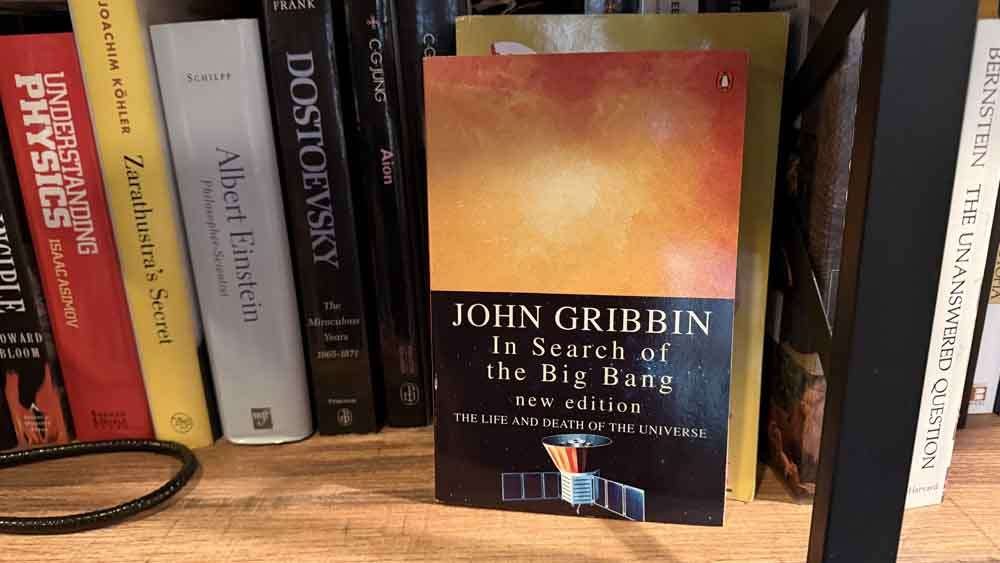
Every serious reader has a shelf that functions less like storage and more like autobiography. The spines facing out — Dostoevsky, Einstein, Jung, Asimov — are not just titles; they are timestamps, each one marking when a particular door swung open. John Gribbin’s In Search of the Big Bang: The Life and Death of the Universe has held its spot on mine for years, and every time I pull it down I remember exactly why I put it there in the first place.
The Book That Made Cosmology Feel Personal
Gribbin published the first edition in 1986, then substantially revised it. What he accomplished — and what so few popular science writers manage — was to make the origin of the universe feel like something with emotional stakes. Not in a sentimental way. In the way that good philosophy makes you feel: that the question isn’t abstract, it’s urgent, and you are implicated in the answer.
The book opens with the observational evidence — Hubble’s redshift data, the expanding universe, the logic of running the film backward to a single point of incomprehensible density. Gribbin is methodical here, and deliberately so. He wants you to feel the weight of the evidence before he pulls back the curtain on the theory itself. By the time he arrives at the Big Bang proper, you haven’t just learned about it — you’ve been argued into it, the way a good lawyer argues a jury.
What Gribbin Does Better Than Almost Anyone
The man writes physics the way a craftsman works leather: with patience, with respect for the material, without shortcuts. He doesn’t dumb anything down, but he also never uses complexity as a shield. Quarks, leptons, the inflationary epoch, the cosmic microwave background radiation — each concept is introduced when it’s earned, not before. The result is a reading experience that feels cumulative rather than encyclopedic.
His treatment of the cosmic microwave background — the faint thermal echo of the Big Bang itself, detectable across the entire sky — is particularly good. He explains not just what it is, but why its discovery by Penzias and Wilson in 1965 was so significant. These two radio astronomers at Bell Labs kept picking up an annoying background noise they couldn’t explain. They checked their equipment. They cleaned pigeon droppings from their antenna. They did everything short of praying. And what they had accidentally found was the oldest light in the universe: the afterglow of creation, now cooled to just under three degrees above absolute zero. Gribbin tells that story with the relish it deserves.
The section on the life and death of stars is equally strong. Gribbin traces the full arc — stellar nurseries, main sequence burning, the catastrophic collapse of massive stars into neutron stars and black holes — and connects it explicitly to the chemistry of life. The calcium in your bones and the iron in your blood were forged inside stars that exploded billions of years ago. You are not separate from the cosmos. You are made of it. That idea — Carl Sagan’s “we are starstuff” expressed in more rigorous terms — lands harder in Gribbin’s telling than almost anywhere else I’ve encountered it.
Why It Lives on the Shelf
I keep In Search of the Big Bang not because cosmology is my field — it isn’t — but because the questions it raises are the kind that refuse to stay in their lane. A universe that had a beginning raises the question of what preceded it, and whether “preceding” even makes sense outside of time. A universe with an eventual death — whether by heat death, big crunch, or some version of the big rip — raises the question of what meaning looks like in the face of thermodynamic inevitability. These are philosophical questions wearing scientific clothes, and Gribbin is honest enough to acknowledge that the physics doesn’t dissolve them. It sharpens them.
That intersection — where cosmology bleeds into metaphysics — is exactly the territory I find most alive. I’ve written before about how the Boltzmann Brain paradox takes statistical physics to its most disorienting conclusion, and about how the Fermi Paradox turns the silence of the cosmos into a warning. Gribbin’s book is the foundation under all of that. It’s where the scaffolding was first assembled.
The New Edition and What Changed
The version I have is the updated Penguin edition, revised to account for the intervening decades of cosmological research — COBE satellite data, early work on dark matter and dark energy, refined measurements of the Hubble constant. Gribbin integrates the new material cleanly without disrupting the structure of the original argument. The book feels updated rather than patched.
What he could not have fully anticipated — and what the latest generation of cosmologists are still wrestling with — is the tension in the Hubble constant itself. Different measurement methods keep producing slightly different values, which either means there’s a systematic error somewhere or that the standard cosmological model is incomplete. It’s the kind of productive discrepancy that would have made Gribbin’s eyes light up. The search, as his title implies, is never entirely finished.
Who Should Read It
If you have any curiosity about how the universe began, how it works on the largest scales, and where it might be headed, this book remains one of the clearest and most intellectually honest guides available. It is not a textbook. It is not a manifesto. It is closer to what the best popular philosophy does: it lays out the evidence, presents the argument, and then leaves you alone with the implications.
Gribbin wrote it for the kind of reader who takes ideas seriously without needing credentials to justify the interest. That description covers more people than you’d think — mechanics, restaurateurs, leather workers, anyone who has ever looked up at a clear night sky and felt the size of the question pressing down.
The universe doesn’t explain itself. But Gribbin gets you a good deal closer.
You Might Also Like
- The Boltzmann Brain Paradox: When Statistical Physics Predicts You Shouldn’t Exist
- The Fermi Paradox and the Great Filter: Why the Silence of the Cosmos Might Be the Loudest Warning We’ll Ever Receive
- Decoding the Next Generation of Exoplanets: The Atmospheric Chemistry of Habitable Zones Found by the James Webb Space Telescope
Sources
- Gribbin, John. In Search of the Big Bang: The Life and Death of the Universe (New Edition). Penguin Books. https://www.penguinrandomhouse.com
- Penzias, A.A. & Wilson, R.W. “A Measurement of Excess Antenna Temperature at 4080 Mc/s.” The Astrophysical Journal, 1965. https://ui.adsabs.harvard.edu/abs/1965ApJ…142..419P
- NASA COBE Mission Overview. https://science.nasa.gov/mission/cobe/
- Di Valentino, E. et al. “In the realm of the Hubble tension.” Classical and Quantum Gravity, 2021. https://iopscience.iop.org/article/10.1088/1361-6382/ac086d
- Sagan, Carl. Cosmos. Random House, 1980. https://www.penguinrandomhouse.com/books/116767/cosmos-by-carl-sagan/