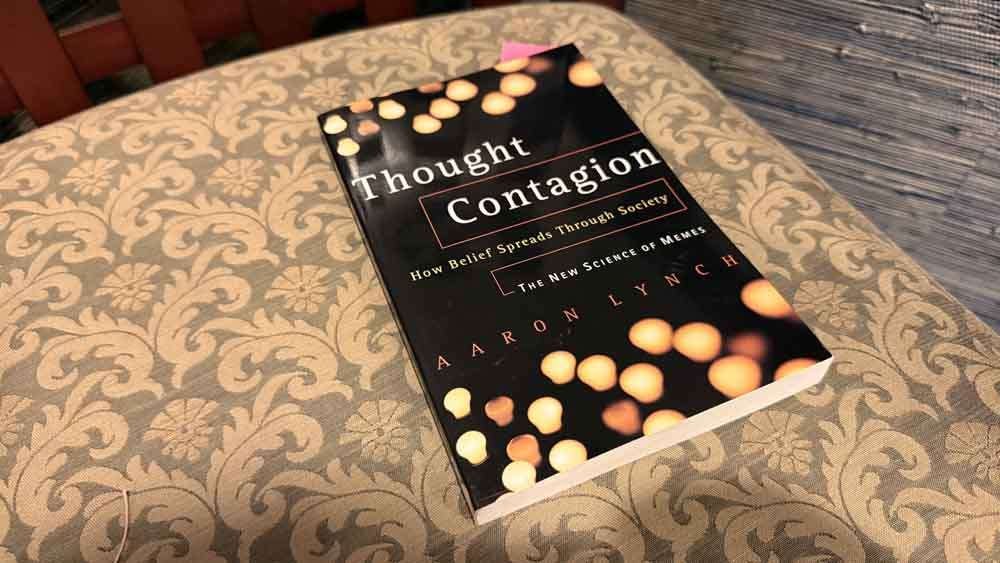
Aaron Lynch published Thought Contagion: How Belief Spreads Through Society in 1996, two decades after Richard Dawkins introduced the word “meme” to the world in The Selfish Gene. Dawkins named the thing and gave it a philosophical passport. Lynch handed it a dissection kit. Where Dawkins was poetic and sweeping — drawing the meme into the grand theater of evolutionary biology — Lynch was clinical, almost ruthless in his precision. He wanted to know not just that ideas spread like genes, but how, mechanically, they propagate, replicate, and crowd out competitors in the limited real estate of the human mind.
Reading these two books in sequence is one of the more disorienting intellectual experiences available to a curious person. The Selfish Gene opens a door. Thought Contagion walks you through it and shows you the wiring behind the walls.
What Lynch Actually Argues
The core claim of Thought Contagion is deceptively simple: beliefs that survive are not necessarily the truest, the most beautiful, or the most useful to the people who hold them. They are the ones best adapted to getting themselves copied. Lynch called this framework “mnemonics” — the science of self-replicating mental information — and he applied it with the rigor of an epidemiologist tracking a pathogen across a population.
A thought contagion, in Lynch’s model, spreads through what he called “modes of transmission.” These are the mechanisms by which a belief gets from one mind to another. Parental transmission — beliefs passed from parent to child — is the most powerful, because it operates before critical thinking has developed and because it runs for decades. Proselytic transmission is the second major mode: beliefs that actively instruct their holders to go out and convert others. Lynch observed that religious doctrines commanding missionary work are not accidental. A belief that commands its own spread is, in evolutionary terms, playing the game on a higher level.
What makes the book genuinely unsettling is what follows from this logic. Lynch demonstrates, through case study after case study — religious belief, political ideology, reproductive attitudes, cultural practices — that the most self-replicating ideas are not always the ones that help the people who carry them. A belief system that commands large families spreads numerically even if it impoverishes its adherents. An ideology that demonizes apostasy survives by making exit psychologically catastrophic. The idea is the organism. The believer is the host.
The Selfish Gene’s Unfinished Business
When Dawkins introduced the meme in the final chapter of The Selfish Gene, he was making a philosophical claim: that Darwinian logic does not require DNA. Any replicator — any entity capable of being copied with variation, competing for resources, and differentially surviving — can become the substrate for evolution. Culture, he argued, is exactly such a substrate. Ideas, tunes, catch-phrases, fashions — these are replicators. They copy themselves through human brains the way genes copy themselves through human bodies.
But Dawkins was a biologist, not a sociologist, and the meme remained in The Selfish Gene what it was in that final chapter: a provocation, a thought experiment, a structural analogy offered to show that Darwinism was larger than biology. He was not, at that point, building a working model of cultural transmission. That work fell to others. Susan Blackmore would later take it further in The Meme Machine. Daniel Dennett would fold it into his philosophy of mind. But Lynch, writing independently and largely without the fanfare those others enjoyed, built something arguably more useful: a functional taxonomy of how memes actually propagate.
His seven modes of transmission — parental, proselytic, preservational, adversative, cognitive, motivational, and sexual — give you an analytical vocabulary that The Selfish Gene never provides. When you encounter a belief system in the wild and want to understand why it’s winning, Lynch gives you a checklist. Dawkins gave you the concept. Lynch gave you the tool.
I wrote about this connection in more depth in my review of The Extended Phenotype, where Dawkins himself returned to the idea that the gene’s influence reaches far beyond the body that carries it. Lynch is doing something parallel at the cultural level — showing that a belief’s influence extends far beyond any individual mind, shaping institutions, family structures, and demographic patterns across centuries.
Why the Book Was Largely Ignored
Lynch was a self-taught theorist working outside the academy, and Thought Contagion shows both the strengths and the costs of that position. The strengths are real: he writes without the defensive hedging that academic culture demands, he makes large claims and tests them against observable reality, and he doesn’t spend fifty pages reviewing the literature before saying anything. The cost is that the book feels undercooked in places — the case studies are sometimes thin, the framework occasionally strains under the weight he puts on it, and Lynch never quite resolved whether he was doing social science or philosophy or something else entirely.
The academic reception was accordingly cool. Memetics as a formal discipline never fully cohered. Its critics — and they were numerous and often credentialed — argued that the gene-meme analogy was too loose to do real work, that there was no discrete “meme” the way there was a discrete gene, and that treating cultural transmission as analogous to genetic replication obscured more than it revealed. These were not trivial objections. The biologist David Hull raised them carefully. The philosopher David Buller raised them carefully. They deserved answers that the memeticists, including Lynch, never fully supplied.
And yet. Whatever the formal deficiencies of Lynch’s framework, the basic phenomenology he described — the way certain ideas out-replicate others not through truth but through transmission efficiency — is observable everywhere. It was observable in 1996. It is observable in an era of social media algorithms designed, whether intentionally or not, to maximize the spread of emotionally activating content regardless of its accuracy. Lynch didn’t predict social media, but his framework describes it with uncomfortable precision.
Reading It Now
Thought Contagion turns thirty years old next year. It has aged the way genuinely prescient books sometimes do: dismissed when it arrived, quietly vindicated by the world it was trying to describe. The mechanisms Lynch catalogued — beliefs that spread by commanding their own spread, that survive by making departure painful, that replicate through family structure and social pressure more than through persuasion — these are not abstractions. They are the operating logic of every ideological movement you have watched metastasize on your phone screen in the past decade.
Lynch wrote before the phrase “going viral” existed in its current sense. He wrote before recommendation algorithms. He wrote before the information ecology that now surrounds us had fully emerged. But he was describing the underlying logic that those technologies would later amplify to a scale he couldn’t have imagined.
The book is not perfect. It is occasionally repetitive, sometimes reductive, and its author’s outsider status left it without the rigorous peer review that might have tightened its claims. Read it as what it is: a first-principles attempt to apply Darwinian logic to the propagation of belief, by a man who thought the question was so important that he couldn’t wait for credentialed permission to ask it.
Read The Selfish Gene first if you haven’t. Then read Thought Contagion immediately after. By the end of the second book, you will find yourself looking at every belief you hold — about food, family, politics, meaning — and asking the question Lynch spent his career teaching people to ask: is this idea in my head because it’s true, or because it’s good at being there?
The distinction, it turns out, is everything.
You Might Also Like:
- The Selfish Gene by Richard Dawkins — The Book That Unlocked Darwin for Me
- The Extended Phenotype: How Your Genes Build Structures Beyond Your Body
Sources:
- Lynch, Aaron. Thought Contagion: How Belief Spreads Through Society. Basic Books, 1996. https://www.basicbooks.com
- Dawkins, Richard. The Selfish Gene. Oxford University Press, 1976. https://global.oup.com
- Blackmore, Susan. The Meme Machine. Oxford University Press, 1999. https://global.oup.com
- Dennett, Daniel C. Darwin’s Dangerous Idea. Simon & Schuster, 1995. https://www.simonandschuster.com
- Hull, David L. “Taking Memetics Seriously: Memetics Will Be What We Make It.” Darwinizing Culture: The Status of Memetics as a Science, ed. Robert Aunger. Oxford University Press, 2000.
- Aunger, Robert, ed. Darwinizing Culture: The Status of Memetics as a Science. Oxford University Press, 2000. https://global.oup.com