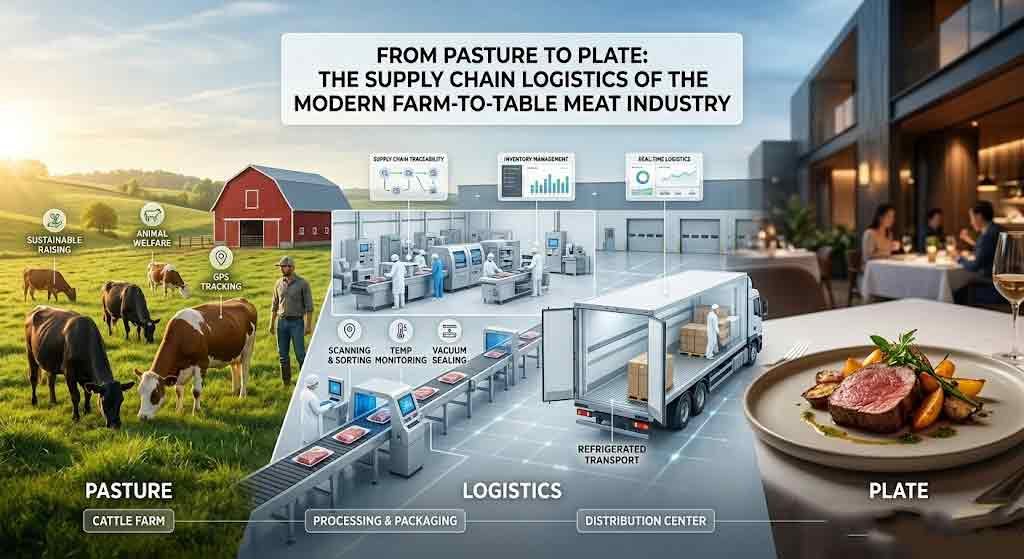
Somewhere in the rolling grasslands of upstate New York, a Black Angus steer is grazing in open pasture, completely unaware of the extraordinary logistics network that will carry it — transformed, portioned, temperature-controlled, and inspected — to a cast-iron skillet in a restaurant kitchen 200 miles away. That journey, invisible to almost everyone who eats the final plate, is one of the most complex and consequential supply chains in American food culture. It is also, increasingly, the supply chain that restaurants like ours care most deeply about getting right.
The farm-to-table movement was born from a rejection of anonymity. At its core, it is a demand for traceability — a diner’s desire to know not just what is on the plate, but where it came from, how it was raised, and who made the decision to bring it there. But the romance of the phrase masks a formidable operational challenge. Between the pasture and the plate lies a gauntlet of slaughter, processing, cold-chain logistics, distribution, and regulatory compliance that can make or break the integrity of even the most well-intentioned sourcing philosophy.
The Animal Comes First: Raising with Intent
Every conversation about supply chain logistics must begin with an honest accounting of how the animal lived. This is not sentimentality — it is science. Cattle raised on pasture with low-stress handling protocols produce measurably different meat than those raised in confined feedlot conditions. The chemistry is straightforward: stress triggers cortisol, cortisol depletes glycogen, and depleted glycogen leads to what the industry calls “dark cutting beef” — meat with an undesirable texture, shortened shelf life, and flat flavor.
The best farm-to-table producers understand that the supply chain begins at birth, not at the slaughterhouse gate. Rotational grazing, access to clean water, and humane handling aren’t marketing language — they are the foundational inputs that determine the quality of everything downstream. Farms that raise animals with this philosophy tend to be smaller, more geographically specific, and often family-operated. They are also, not coincidentally, the farms that independent restaurants with serious culinary standards gravitate toward.
The trade-off is real. Smaller farms operating on pasture-based models have lower output and less predictable availability than industrial operations. A restaurant that commits to this sourcing model must build relationships, not just purchase orders. That distinction changes the entire character of the supply chain.
The Processing Plant: Where the Chain Gets Tested
When cattle leave the farm for processing, the supply chain enters its most logistically demanding phase. The processing plant — or packing house — is where the animal is transformed into product. It is a world of USDA inspectors, temperature-monitored kill floors, and precise cut specifications. It is also, historically, one of the most fragile links in the entire chain.
The pandemic made this painfully visible. In the spring of 2020, a handful of major processing facilities shut down or significantly reduced capacity, and grocery stores ran short of beef and pork nationwide — not because there was a shortage of animals, but because the processing infrastructure had been so concentrated into so few facilities that any disruption cascaded immediately and severely across the entire market.
For the farm-to-table sourcing model, this concentration problem is one of the most compelling arguments for regional processing. Small and mid-sized farms increasingly rely on local meat processing facilities — often USDA-inspected but independent — that can handle lower volumes, maintain traceability by lot, and allow for custom cut specifications. The meat that leaves these facilities is often vacuum-sealed, labeled with the farm of origin, and delivered within a much shorter cold-chain window than product coming out of a national distribution center.
Shorter chains mean fresher product. They also mean the restaurant that receives that delivery can tell you, with precision, where it came from.
The Cold Chain: An Unbroken Promise
Once processed and packaged, meat enters what the industry calls the cold chain — a continuous, temperature-monitored corridor from processing plant to kitchen. Beef must be maintained between 32°F and 39°F at every single point in that journey. Break that chain, even briefly, and you accelerate bacterial growth, compromise texture, and risk food safety failures that can have serious consequences.
The cold chain is a logistics masterpiece when it works well. Refrigerated trucks equipped with real-time IoT sensors now transmit temperature data continuously, alerting drivers and dispatchers the moment conditions drift out of tolerance. Distribution hubs use similar monitoring infrastructure. For international shipments or long-haul transport, deep-freeze protocols and insulated packaging extend that window further, though at the cost of some product quality compared to fresh-never-frozen.
For independent restaurants sourcing locally, the cold chain is usually far simpler — a regional distributor, a refrigerated delivery van, and a receiving dock with a thermometer. The elegance of a shorter supply chain is that there are fewer failure points. Every additional stop, transfer, or staging facility is another opportunity for temperature excursions, mislabeling, or contamination. The farm-to-table model, at its most logistically coherent, is also its most food-safe.
The Distributor: The Invisible Architect
Between the farm and the restaurant kitchen, the food distributor is the invisible architect of everything. They aggregate product from multiple farm sources, manage warehousing, route deliveries, handle compliance documentation, and absorb the operational complexity that most restaurants cannot manage independently.
For large restaurants and national chains, major distributors like Sysco and US Foods dominate this space. Their scale is remarkable — national cold storage networks, fleets of refrigerated trucks, and purchasing leverage that independent farms simply cannot match. But scale comes with its own costs to the farm-to-table philosophy: aggregation tends to dilute traceability, and the volume requirements of large distributors often exclude smaller farms entirely.
The more interesting story, and the one more relevant to independent restaurants with serious sourcing commitments, is the growth of regional food distributors who specialize in connecting local farms with local restaurants. These operations are smaller, slower, and often more expensive per unit. But they know the farms they work with personally. They can answer the question “where did this brisket come from?” with a name and a county, not a commodity lot number. For restaurants whose identity is built around provenance, that distinction is the entire value proposition.
Technology’s Role: Traceability at Scale
The supply chain’s most significant recent development is not logistical — it is informational. Blockchain technology, IoT sensors, and AI-driven inventory platforms have begun to give all participants in the food supply chain — from rancher to retailer — something they never had before: real-time, tamper-resistant visibility across every step of the journey.
Blockchain-based tracking systems allow a restaurant to scan a QR code on a meat package and trace that product back to a specific animal, on a specific farm, processed on a specific date. This kind of transparency was, until recently, available only to those with deep supply chain relationships and the patience to maintain them manually. Now it is being engineered into the infrastructure itself.
AI is playing a parallel role in demand forecasting and inventory optimization. Restaurants and distributors using predictive systems can better anticipate how much product to order, reducing both over-purchasing (which leads to waste) and under-purchasing (which leads to 86’d menu items on a Saturday night). For perishable proteins with tight shelf lives, this is operationally transformative.
None of this technology replaces the relationship between a restaurant and its farm partners. But it does extend the integrity of that relationship across a supply chain that might otherwise make accountability impossible to maintain at scale.
What It Costs — and Why It’s Worth It
Farm-to-table meat sourcing is more expensive than conventional procurement. There is no argument against that fact, only context for it. Pasture-raised cattle require more land, more time, and more labor than feedlot operations. Regional processing facilities charge more per head than high-volume industrial plants. Shorter supply chains with careful cold-chain management carry higher per-unit logistics costs. And the farmers themselves — operating without the purchasing power of industrial agriculture — need margins that allow their operations to be sustainable.
The price differential shows up clearly on a restaurant menu. A heritage-breed pork chop sourced from a regional farm will cost the kitchen more than commodity pork, and that cost is reflected in what the diner pays. But what the diner is actually purchasing, beyond the protein itself, is a supply chain with integrity: an animal raised humanely, processed responsibly, transported safely, and delivered with full accountability for its provenance.
That is not a premium for its own sake. It is the actual cost of doing things correctly.
A Quarter-Century of Watching the Chain
Twenty-five years of running a restaurant teaches you things about supply chains that no textbook captures. You learn that the best ingredients never arrive by accident — they arrive because someone, somewhere upstream, made a decision to care when cutting corners would have been easier and cheaper. You learn that the farms worth building relationships with are the ones that answer the phone, that remember your name, and that call you when something isn’t right before you discover it yourself.
The farm-to-table movement at its most sincere is not a marketing trend. It is a restoration of the supply chain logic that existed before industrial agriculture compressed quality out of the system in the name of efficiency. The logistics are more complex. The costs are higher. The relationships require maintenance. But the plate at the end of it — the one that arrives at a diner’s table with a story attached to it — is different in kind, not just in degree, from what passes for food when no one along the chain knew or cared where it began.
That difference is worth understanding. It might even be worth paying for.
Sources:
- National Restaurant Association, Restaurant Trends 2025, nationalrestaurantassociation.com
- Feta Farm, Farm-to-Table Beef Supply Chain: From Pasture to Plate, fetafarm.com, January 2025
- Folio3 FoodTech, Meat Industry Outlook 2025: Challenges & ERP Solutions, foodtech.folio3.com
- Straits Research, Global Meat Packaging Market Forecast 2025–2033, via foodtech.folio3.com
- Toward FNB, Meat Market Size to Capture USD 1.23 Trillion in 2025, towardsfnb.com
- Food Logistics / Semtech, Tracking Food Supply from Farm to Table, foodlogistics.com
- AGDAILY, Farm to Table — Ensuring Quality and Sustainability in the Supply Chain, agdaily.com, August 2024