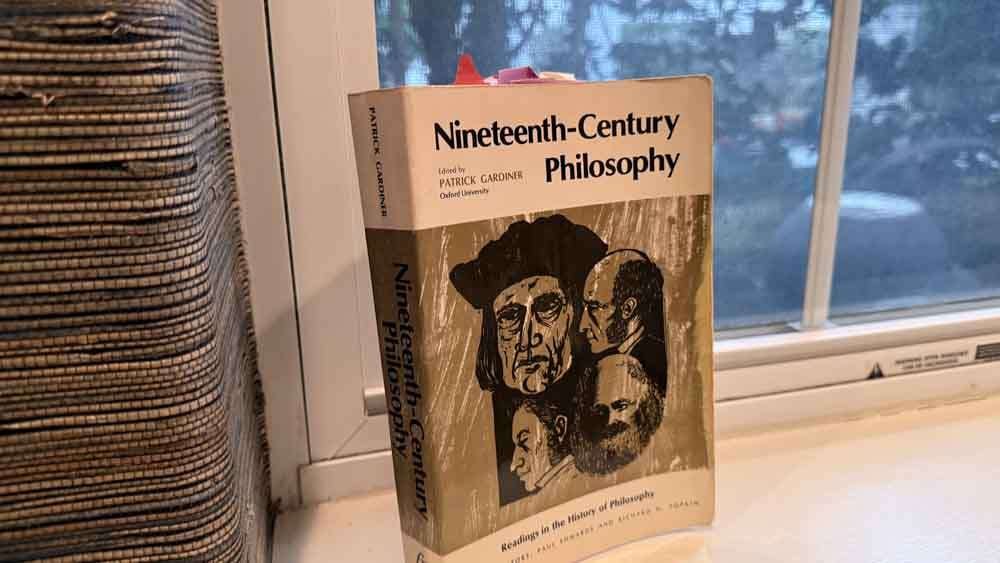
Three men who never shared a dinner table, never corresponded, and would have despised each other’s company managed to ask the same question from three different directions and reshape every assumption humanity held about itself. Charles Darwin peered into the fossil record and asked what kind of animal we are. Karl Marx looked at the factory floor and asked what kind of society we build. Friedrich Nietzsche stared into the mirror of Western culture and asked whether any of it was worth building at all. Between them, in the span of roughly fifty years, they made the nineteenth century the most consequential philosophical era since the ancient Greeks — and Patrick Gardiner’s anthology Nineteenth-Century Philosophy, part of the Oxford University Press “Readings in the History of Philosophy” series edited by Paul Edwards and Richard H. Popkin, is one of the more reliable maps of that territory.
A Century That Earned Its Reputation
The nineteenth century is easy to underestimate. It sits between the Enlightenment’s grand promises and the twentieth century’s grand catastrophes, and historians often treat it as a corridor rather than a room — something you pass through to get somewhere else. Gardiner refuses that framing. His anthology opens with Kant’s critical inheritance still warm and walks the reader through the full arc: Hegel’s system-building, Schopenhauer’s pessimism, Comte’s positivism, Mill’s empiricism, Kierkegaard’s revolt against the system, Marx’s inversion of Hegel, and Nietzsche’s hammer. What you get is not a corridor. What you get is a collision.
The organizing logic of the book is chronological, which is the right choice. Philosophy in the nineteenth century was unusually reactive — each thinker was consciously responding to predecessors, often in the same cultural conversation. Hegel without Kant is incomprehensible. Kierkegaard without Hegel is half a joke. Nietzsche without Schopenhauer is a different animal entirely. Gardiner preserves those dependencies by letting the sequence speak.
Darwin as the Earthquake Beneath Everything
Here is the thing that the purely academic treatment of nineteenth-century philosophy tends to suppress: Darwin was not a philosopher, and yet he broke philosophy more thoroughly than anyone in the century who was. When On the Origin of Species arrived in 1859, it did not merely revise biology. It pulled the metaphysical floor out from under every system that had been built since Aristotle. The idea of a fixed human nature — the image of man as a special creation, rational by essence, destined by design — collapsed the moment you accepted that species were not fixed, that human beings were continuous with the animal world, and that the shaping force behind life was not reason or will but blind variation and selection.
I wrote at length about that book in my review of On the Origin of Species, and the argument I kept returning to there was that Darwin’s real disruption was not scientific but ontological. He did not just change what we knew about life. He changed what kind of thing we understood ourselves to be.
Gardiner’s anthology does not include Darwin directly — it is a philosophy collection, not a science reader — but Darwin’s shadow falls across almost every later thinker in the volume. Mill was already publishing before Origin, but his successors in the empiricist tradition would have to reckon with it. Marx read Darwin and famously wanted to dedicate Das Kapital to him (Darwin politely declined). Nietzsche absorbed the Darwinian shock and then took it somewhere Darwin himself would have found alarming — toward a vision of human beings as creatures who must become something new by an act of will, because nature would not do it for them.
Marx and Nietzsche: Two Answers to the Same Diagnosis
What Marx and Nietzsche share, despite being almost polar opposites in temperament and prescription, is the diagnosis: the present arrangement of human life is unacceptable, and the inherited justifications for it are fraudulent. Marx located the problem in material conditions — in who owned the means of production, in how surplus value was extracted, in the way economic relations generated the ideologies that made those relations seem natural and inevitable. Nietzsche located the problem in values themselves — in the slave morality that had crept through Western culture dressed as virtue, in the resentment of the weak that had been sanctified as ethics, in the death of God that Europeans had not yet had the honesty to acknowledge.
The remedies could not be more different. Marx prescribed collective action, historical materialism, the seizure of productive power by the working class. Nietzsche prescribed nothing collective at all — he had contempt for mass movements of every kind — but rather the emergence of individuals with the strength and honesty to create new values from scratch.
What Gardiner’s anthology allows you to see, by placing these thinkers in the same volume and the same sequence, is that both were responding to the same post-Darwinian vertigo. If there is no fixed human nature, if there is no divine author guaranteeing the moral order, if history is not teleologically marching toward the good — then what holds us? Marx said: the material dialectic, tending toward liberation. Nietzsche said: nothing holds us, and that is the point.
Richard Dawkins took Darwin’s insight and extended it into genetics and memetics in a way that reframes both of them — I explored that in my review of The Selfish Gene, where the argument is essentially that Darwin gave us not just a theory of biology but a theory of information propagation through time. The memes that Marx and Nietzsche launched into culture in the nineteenth century are still replicating.
Hegel and Schopenhauer: The Roads Not Taken (and Then Taken Anyway)
One of the anthology’s great services is its treatment of Hegel and Schopenhauer, who are often read in isolation but benefit enormously from being placed side by side. Hegel built the most ambitious philosophical system since Aristotle — a vision of history as the progressive self-realization of Spirit, moving through contradiction toward ever-higher forms of freedom and rationality. It is a beautiful machine, internally consistent, and almost entirely wrong in the ways that matter most. Its failure is instructive: when you build a system that comprehensive, reality has a way of finding the exact pressure points.
Schopenhauer built the counter-argument. The world is not the unfolding of rational Spirit. The world is Will — blind, striving, purposeless. Human beings are not the apex of a teleological process. We are temporary condensations of a force that wants nothing and goes nowhere. The appropriate response is not Hegelian optimism but a kind of cultivated resignation, aesthetic contemplation, and compassion — a position closer to Buddhist thought than to anything in Western philosophy at the time.
Nietzsche began as Schopenhauer’s disciple and eventually turned against him, but the debt never fully cleared. His concept of will-to-power is in many ways Schopenhauer’s Will refracted through Darwin — not a force to be quieted but a force to be consciously directed by the rare individual capable of the task.
Why This Book Still Earns Its Place on the Shelf
Gardiner edited this volume for Oxford in 1969, and there are more recent anthologies with wider selections and better apparatus. But what the Gardiner has that many of those lack is economy. The editorial choices are disciplined. The introductory material is lean and accurate. It does not try to be everything; it tries to be useful, and it succeeds. For anyone coming to nineteenth-century philosophy seriously — not as a tourist but as a reader willing to sit with the difficulty — it remains a worthy entry point.
The faces on the cover, rendered in that spare mid-century woodcut style, stare out with the particular severity of thinkers who believed the stakes were real. They were right about that, at least. The questions they were asking — about what we are, what we owe each other, and whether the inherited answers can be trusted — have not been answered. They have only been inherited again, which is precisely the problem Nietzsche identified and which my review of Thus Spoke Zarathustra tries to take seriously.
Pick this one up if you find it. The century it maps is the century that made us.
You Might Also Like:
- On the Origin of Species by Charles Darwin: The Book That Changed Everything We Thought We Knew About Life
- The Selfish Gene by Richard Dawkins — The Book That Unlocked Darwin for Me
- Thus Spoke Zarathustra by Friedrich Nietzsche — The Book That Rewired My Understanding of Everything
Sources
- Gardiner, Patrick, ed. Nineteenth-Century Philosophy. Free Press / Collier-Macmillan, 1969. Series: Readings in the History of Philosophy, eds. Paul Edwards and Richard H. Popkin.
- Darwin, Charles. On the Origin of Species by Means of Natural Selection. John Murray, 1859. https://www.gutenberg.org/ebooks/1228
- Marx, Karl, and Friedrich Engels. The Communist Manifesto (1848). Penguin Classics edition. https://www.marxists.org/archive/marx/works/1848/communist-manifesto/
- Nietzsche, Friedrich. Thus Spoke Zarathustra (1883–85). Trans. Walter Kaufmann. Penguin Classics.
- Schopenhauer, Arthur. The World as Will and Representation, Vol. 1 (1818). Trans. E.F.J. Payne. Dover Publications.
- Hegel, G.W.F. Phenomenology of Spirit (1807). Trans. A.V. Miller. Oxford University Press.
- Dawkins, Richard. The Selfish Gene. Oxford University Press, 1976. https://global.oup.com/academic/product/the-selfish-gene-9780198788607
- Stanford Encyclopedia of Philosophy — Hegel: https://plato.stanford.edu/entries/hegel/
- Stanford Encyclopedia of Philosophy — Nietzsche: https://plato.stanford.edu/entries/nietzsche/
- Stanford Encyclopedia of Philosophy — Marx: https://plato.stanford.edu/entries/marx/