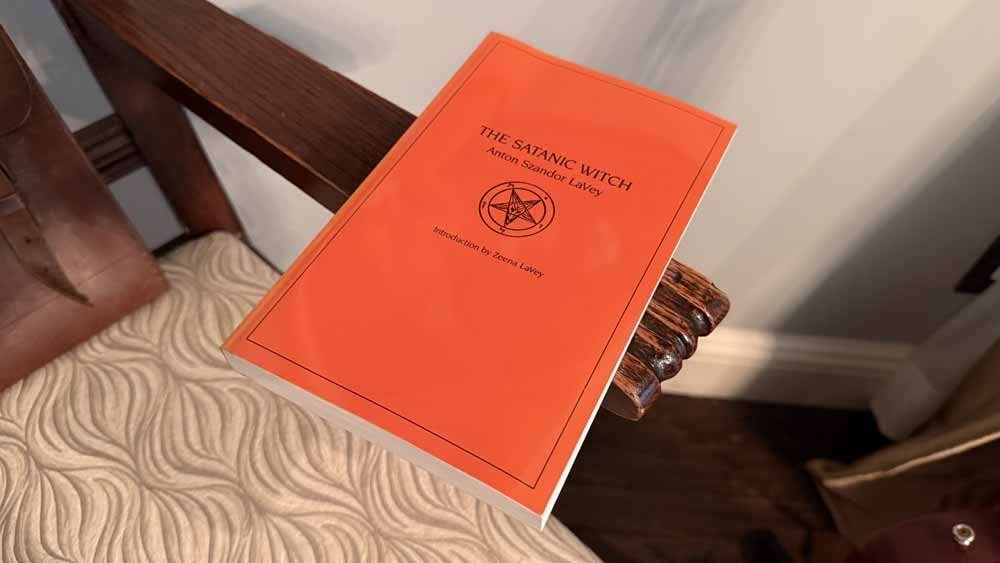
Forget the sulfur. Forget the black candles and the inverted pentagram. Strip away every piece of theater that makes Anton LaVey so easy to dismiss, and what you find at the center of The Satanic Witch is something far more interesting — and far more pragmatic — than its reputation suggests. This is a book about mastery. About reading people, reading yourself, and deploying both kinds of knowledge with the precision of a trained craftsman. That it was written by a man who kept a lion in his backyard and billed himself the Black Pope is almost beside the point.
LaVey first published this work in 1971 under the original title The Compleat Witch, or What to Do When Virtue Fails — a title that tells you more about his sensibility than any biography could. The “compleat” is deliberate, an echo of Izaak Walton’s 17th-century fishing manual The Compleat Angler, which wasn’t really about fishing either. It was about patience, observation, and the art of making circumstances work in your favor. LaVey understood that framing.
A Manual, Not a Manifesto
The book is addressed to women, and specifically to women cunning enough to use it. LaVey draws on his years working carnival circuits, burlesque houses, and what he calls “mitt camps” — the fortune-telling tents where con artists and gifted observers learned to read strangers in seconds and give them exactly what they came for. This is the real education behind the book. Not the occult. The carny.
What LaVey assembled was a working system of what he calls “lesser magic” — not spells or rituals, but the applied psychology of attraction, influence, and social control. The distinction he draws between lesser magic and greater magic is sharp: lesser magic is what you do in the world, with your body, your voice, your environment, your timing. It is, in his framing, the most powerful magic there is, because it operates on people as they actually are, not as spiritual philosophy might wish them to be.
The core framework is what LaVey called the LaVey Synthesizer Clock — a personality and body-type typology built on William Sheldon’s somatotyping system but expanded with a fourth archetype LaVey considered missing: the purely feminine type, placed diametrically opposite the mesomorphic male at twelve o’clock. The clock maps four fundamental types across opposing axes: masculine versus feminine, cerebral versus social. The witch’s job, in LaVey’s system, is to first locate herself on the clock, then identify where her target sits — and position herself as his psychological and physical complement. Attraction, he argues, follows the law of opposites. A twelve is drawn to a six. A three needs a nine.
It reads, on the surface, like a manipulation manual. And it is. But calling it only that is like calling a chess opening a trick. The depth is in the study it demands.
The Craft Beneath the Glamour
Here is what struck me reading this book: LaVey is describing a discipline. Not a shortcut, not a trick you pull once and forget. A sustained practice of self-knowledge and human observation that requires years to develop and constant maintenance to keep sharp. The witch who uses this system well is not the woman who applies red lipstick and waits. She is the woman who has spent serious time understanding her own type, her own tendencies, her own reflexive behaviors — and learned to modulate them with intention.
That is the structure of any real craft. You cannot make a proper leather briefcase without first understanding the animal the hide came from — its grain, its tensile direction, its memory. You cannot build a sourdough loaf worth eating without knowing your starter’s personality, the humidity in your kitchen, the specific behavior of your flour. The knowledge is particular, accumulated, and non-transferable to shortcuts. What LaVey is asking his reader to develop is exactly that kind of knowledge — but applied to the most complex material there is: another human being.
He frames this through what he calls the “Law of the Forbidden” — the principle that people want what is kept slightly out of reach, hinted at but never fully disclosed. The witch who understands this doesn’t offer everything at once. She creates a perimeter of mystery around herself, a sense that the most interesting part of her is just beyond where you’re standing. This is not dishonesty, in LaVey’s view. It is craft. The same way a well-made object conceals the effort it required — stitching that disappears into the leather, a crust that gives no indication of the fermentation that built it — the skilled practitioner makes the art invisible.
There is a section in the book on the strategic use of environment — how the spaces you inhabit and the objects you surround yourself with communicate meaning before you’ve said a word. LaVey is essentially writing about semiotics before semiotics had become fashionable in American popular culture. The furniture, the smell of a room, the light — all of it reads as part of a presentation. He is not wrong. Anyone who has ever walked into a place and felt something they couldn’t explain has experienced this. The difference is that LaVey is asking you to build that feeling deliberately.
What Ages Well and What Doesn’t
To read The Satanic Witch in 2026 is to read a book with one foot in a world that no longer exists. The gender architecture LaVey builds the whole system around — a world of hunters and prey, of women who enchant and men who are enchanted — is both limiting and, at its edges, genuinely outdated. He is writing for a specific mid-century vision of heterosexual dynamic, and the more prescriptive sections of the book — the specific sartorial instructions, the heavy reliance on pheromone theory and undisguised biological determinism — feel like field notes from another era.
The scholarly one-sidedness has also been noted by more rigorous critics. Darryl Marks, writing in his long-form library review of the book, observed that the entire architecture of the system is built on Sheldon’s somatotyping research, which modern psychology has largely discarded. LaVey was drawing on the available science of his time, and he drew on it with genuine enthusiasm and research — the book’s bibliography runs to over 170 titles across psychology, biology, anthropology, and sexuality — but the empirical foundations have shifted under his feet in the decades since.
What does not age is the underlying insistence that charm is not an accident. That the people who seem to effortlessly command rooms and hold attention have, in most cases, done work that is simply invisible to the observer. LaVey’s stripping away of the romantic notion that seduction is a gift rather than a practice is, in its way, deeply egalitarian. The carny understood something the self-help industry still profits from obscuring: nobody is born knowing how to read a room. But almost anyone can learn.
LaVey as Observer
The book that emerges when you get past the Satanic branding is, as one Goodreads reviewer noted, less about the psychology of others and more a transparent record of one man’s psychology — his obsessions, his aesthetics, his particular vision of what makes a woman dangerous in the best possible sense. LaVey’s fondness for the “six o’clock” type, the soft and full-bodied feminine ideal, bleeds into his instructions in ways that reveal more about him than about any universal truth. His voice is present on every page, which is to say the book is honest in the way that all genuinely personal work is honest, even when it’s also self-serving.
He is, at his best, a close observer of human nature writing in a tradition that runs from Machiavelli through Dale Carnegie — the tradition of practical philosophy, of asking not how people should behave but how they actually do. That tradition often makes polite readers uncomfortable. It shouldn’t. Understanding the mechanics of influence is not the same as choosing to use them cynically, any more than understanding how a lock works makes you a thief.
It’s worth noting that LaVey drew intellectually from thinkers I’ve spent considerable time with myself — particularly Nietzsche, whose fingerprints are all over the anti-egalitarian individualism running beneath The Satanic Witch, and whose work I explored at length in my review of Thus Spoke Zarathustra. The Nietzschean insistence on self-overcoming, on becoming what you are through will and study rather than inheriting it, is present in LaVey’s model of the witch as a woman who has done the work of self-knowledge and emerges from it with genuine power.
Worth Reading — With Both Eyes Open
The Satanic Witch is not a great book in the literary sense. It is uneven, occasionally dated to the point of comedy, and invested in a worldview that benefits from being examined critically rather than swallowed whole. But it is a useful book — which is its own kind of achievement. The underlying argument, that seduction is a craft built on self-knowledge and the careful study of other people, is correct. The framework LaVey builds to support that argument is imperfect but not worthless, in the same way that an old tool is still a tool.
If you’re going to read it, read it the way you’d approach any book that has an agenda — with curiosity and some skepticism, looking for the structural insight beneath the provocations. The Satanic branding is a performance, and LaVey would be the first to tell you so. What he built underneath the performance is a manual for paying close attention to the world, to other people, and to yourself. Whatever you think of the man, that’s not nothing.
Sources
- LaVey, Anton Szandor. The Satanic Witch. Feral House, 2003 (2nd ed.). Amazon
- Wikipedia: The Satanic Witch
- Wikipedia: LaVeyan Satanism
- Faxneld, Per; Petersen, Jesper Aa. The Devil’s Party: Satanism in Modernity. Oxford University Press, 2013. Google Books
- Marks, Darryl. “The Satanic Witch by Anton Szandor LaVey.” Darryl’s Library, December 12, 2010. darrylslibrary.wordpress.com
- Viewpoint Books product description. viewpointbooks.com
You Might Also Like