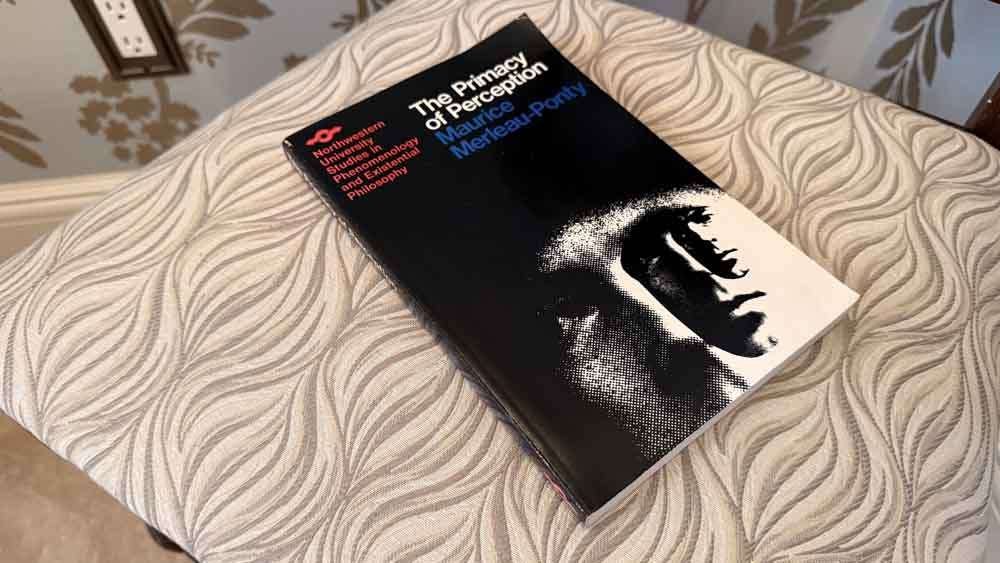
Before you think, you perceive. Before you reason, you feel the floor under your feet, the temperature in the air, the weight of a cup in your hand. Western philosophy spent roughly four centuries trying to explain this away — to insist that the real business of knowing happens upstairs, in the mind, behind the eyes, in the clean corridors of reason untouched by flesh. Maurice Merleau-Ponty spent his career arguing that this was not just wrong, but precisely backwards. The Primacy of Perception, a collection of his lectures and essays first published in French in 1964 and assembled for English readers by Northwestern University Press, is the closest thing to a compressed introduction to that argument. It doesn’t replace Phenomenology of Perception, his major work, but it does something that book — dense, long, philosophically demanding — cannot always do: it makes the stakes legible.
What the Book Actually Is
The Primacy of Perception collects several pieces: the title lecture Merleau-Ponty delivered to the Société française de philosophie in 1946, along with subsequent discussion; his essay “The Primacy of Perception and Its Philosophical Consequences”; and a handful of related texts on the eye and mind, the film, and the relations between philosophy and sociology. The 1946 lecture and its discussion are the heart of it — a dense, agile piece of thinking that runs only about thirty pages but pulls the ground out from under centuries of Cartesian assumption.
For those unfamiliar with the tradition Merleau-Ponty is working inside: phenomenology is the philosophical method concerned with the structure of experience itself — not the brain mechanisms that produce it, not the physical world that causes it, but the first-person texture of what it is like to be a conscious creature encountering the world. Edmund Husserl founded the tradition. Martin Heidegger deepened and transformed it. Merleau-Ponty brought it into the body.
The Cartesian Problem He’s Solving
René Descartes, in the seventeenth century, cut the world in two: mind on one side, matter on the other. The body belongs to matter — it is extended, mechanical, governed by the same laws as any other physical object. The mind is something else entirely: a thinking substance, non-extended, immaterial, somehow lodged inside the body like a pilot in a ship. This dualism solved certain theological problems Descartes cared about, but it created a philosophical problem that has never been fully resolved: how, exactly, do these two radically different substances communicate? How does a non-material mind receive information from a material body? How does it issue commands that move fingers and legs?
This is not just a historical puzzle. It lives on in how modern cognitive science tends to think about perception: as a process by which the sensory organs collect raw data, transmit it inward, and deliver it to the brain where the real interpretive work — the knowing — happens. The body, on this picture, is a sophisticated antenna. The mind is the receiver. Merleau-Ponty’s target is exactly this picture.
The Body That Already Understands
His central claim is disarmingly simple in statement, revolutionary in implication: perception is not a mental act performed on raw material delivered by the senses. Perception is itself already a form of understanding. The body does not transmit neutral data upward to a mind that then interprets it — the body is already engaged in interpretation, already oriented toward a world that it understands in a pre-reflective, pre-linguistic way.
He draws on clinical cases — patients with lesions, phantom limb phenomena, cases of agnosia — to show that the lived experience of the body cannot be accounted for by either the purely physiological account (the body as mechanism) or the purely mentalist account (the mind operating on body-delivered inputs). The patient who reaches to scratch a limb that no longer exists is not confused about the contents of his mind; he is manifesting a body-schema, an implicit understanding of space and boundary and reach that precedes and outlasts conscious knowledge. The body has its own intentionality — its own directedness toward the world.
This is the move that matters: intentionality, the technical phenomenological term for the mind’s directedness toward objects, is not the exclusive property of consciousness. The body is intentional. When a pianist’s fingers find a chord without deliberation, when a carpenter’s hand adjusts pressure mid-cut without a conscious instruction being issued — this is not mindless mechanism. It is a form of knowing that does not pass through explicit representation at all.
Perception as the Foundation, Not the Starting Point
Where Merleau-Ponty goes further — and where this book earns its title — is in arguing that perception is not merely one mode of access to the world among others. It is the ground upon which all other modes of access are built. Science abstracts from perceptual experience. Mathematics builds formal structures that ultimately derive their meaning from perceived relations. Language is anchored, at its base, in bodily gesture and situated encounter. None of these higher-order activities floats free of the perceptual body that gave rise to them.
This might sound deflationary — as if he is reducing science or logic to mere sensation. He is doing the opposite. He is insisting that perception, properly understood, is already rich, already structured, already meaningful — not a chaos of raw inputs waiting to be organized by reason, but an articulate engagement with a world that the body has always already begun to understand. What gets added by reflection and abstraction is not meaning where there was none, but a different kind of meaning, built on top of the original.
The philosophical consequence he draws is sharp: if perception is primary, then the Cartesian picture of a mind looking out at an external world through the window of the senses is finished. There is no view from nowhere. There is no unmoved mind surveying raw matter. There is only the embodied perceiver, always already in the world, always already engaged, always already understanding — even before understanding begins.
The Discussion That Follows
One of the unusual values of this collection is the transcript of the discussion that followed the 1946 lecture, in which philosophers including Émile Bréhier, Jean Hyppolite, and others pressed Merleau-Ponty hard on what his view implies. Does the primacy of perception lead to relativism? If all knowledge is grounded in the perspective of an embodied, situated perceiver, does that mean there is no objective truth? His answer is careful: acknowledging that knowledge is always perspectival is not the same as saying it is merely subjective. Perspectives can converge. The intersubjective world — the world we build together through shared perception and shared language — is not merely a private construction. It is, he argues, precisely the task of philosophy to think through how objective knowledge is possible from within embodied experience, not despite it.
This exchange is worth the price of the book on its own. It shows Merleau-Ponty under pressure, clarifying, defending, refining — and it shows that the primacy of perception thesis is not a retreat into irrationalism but a genuine attempt to reconstruct how knowledge works from the ground up.
Why This Book, and Why Now
There is a particular irony in reading Merleau-Ponty in an era when artificial intelligence dominates conversations about mind and knowledge. The dominant paradigm in AI — large models trained on text, processing symbolic inputs, generating outputs — is, in a sense, the purest possible realization of the Cartesian picture: intelligence as computation, fully disembodied, operating on abstract representations with no body, no perception, no world to be in. Researchers in robotics and embodied AI have been pushing back against this for decades, arguing that the kind of general intelligence we actually have is inseparable from having a body that moves through space and encounters resistance. Merleau-Ponty, writing in the 1940s and 1950s, anticipated the terms of that debate with remarkable precision.
Who Should Read It
The Primacy of Perception is not a beginner’s book, but it is far more accessible than most of what surrounds it in the phenomenological tradition. The title lecture can be read in an evening. The discussion that follows rewards slow attention. The later essays on the eye and mind — written in Merleau-Ponty’s final years, before his sudden death in 1961 at fifty-three — are among the most beautiful pieces of philosophical prose he ever produced, moving through painting, vision, and the reversibility of the sensing body with a kind of controlled lyricism that is rare in academic philosophy.
Read it before Phenomenology of Perception if the full work feels daunting. Read it after, if you want to see the major argument in compressed, tested form. Read it because it makes a simple, devastating case that the life of the mind begins not in the head but in the hands, the feet, the skin — in the body’s ancient, wordless conversation with the world it was born into.
Sources
- Merleau-Ponty, Maurice. The Primacy of Perception and Other Essays on Phenomenological Psychology, the Philosophy of Art, History and Politics. Edited by James M. Edie. Northwestern University Press, 1964. https://www.nupress.northwestern.edu/9780810101647/the-primacy-of-perception/
- Merleau-Ponty, Maurice. Phenomenology of Perception. Translated by Donald Landes. Routledge, 2012. https://www.routledge.com/Phenomenology-of-Perception/Merleau-Ponty/p/book/9780415834339
- Stanford Encyclopedia of Philosophy: Maurice Merleau-Ponty. https://plato.stanford.edu/entries/merleau-ponty/
- Gallagher, Shaun. How the Body Shapes the Mind. Oxford University Press, 2005. https://global.oup.com/academic/product/how-the-body-shapes-the-mind-9780199271955
- Wheeler, Michael. “Embodied Cognition.” Stanford Encyclopedia of Philosophy. https://plato.stanford.edu/entries/embodied-cognition/