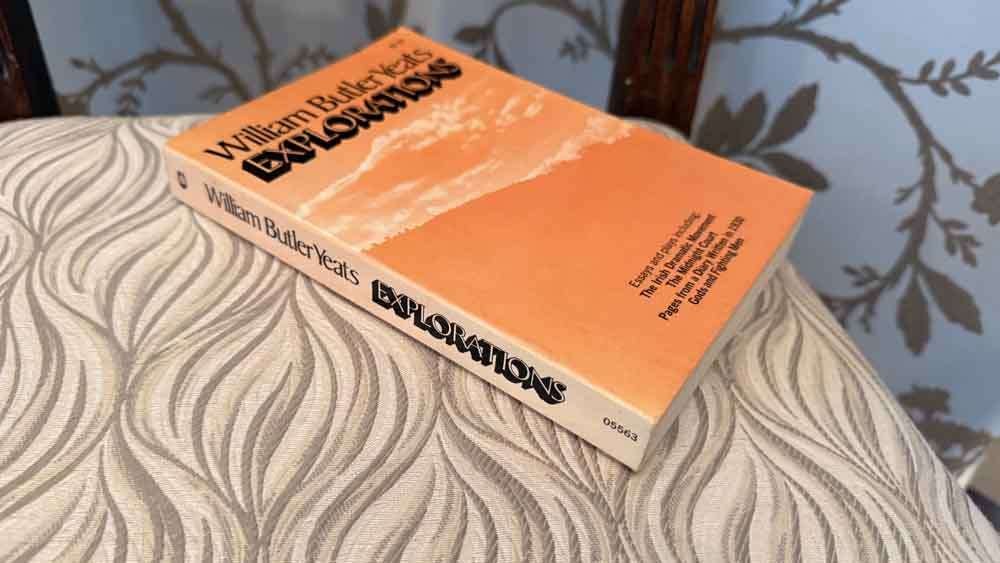
Every serious reader eventually encounters a book that operates less like an argument and more like a workshop — sawdust on the floor, tools laid out in no particular order, half-finished objects on every bench. W.B. Yeats’s Explorations, compiled posthumously from his essays, prefaces, and prose meditations spanning nearly four decades, is exactly that kind of book. It does not march toward conclusions. It circles, returns, hammers at the same shapes again and again. Reading it is less like following a philosopher and more like watching a craftsman who cannot leave the material alone.
That distinction matters. Yeats is remembered above all as a poet — probably the greatest in the English language of the twentieth century, depending on whom you ask — but Explorations reveals something that the poems only hint at: the sheer constructive will behind the work. He was not a man waiting for inspiration to strike. He was a builder of symbolic systems, a deliberate architect of Irish mythology, theatrical practice, and spiritual cosmology. These essays document the scaffolding.
The Problem of Making Something That Lasts
Yeats opens several of these pieces with a question that every craftsman, cook, and artist eventually faces: what endures? Not what sells, not what flatters the audience, but what survives the moment of its making and retains its force a generation later. His answer, arrived at through years of work with the Abbey Theatre and through his study of Noh drama, folk tradition, and Renaissance poetics, is essentially this: the thing that lasts is the thing that carries ritual within it.
By ritual he does not mean ceremony in any hollow sense. He means the quality of an act or an object that contains reference beyond itself — that points outward to something larger than its immediate function. A poem that achieves this quality is not merely an arrangement of beautiful words. It becomes, in Yeats’s framework, a vessel. The making of such a vessel requires the kind of concentrated, even obsessive attention to technique that we associate not with inspiration but with craft: the repeated working and reworking until the object says what you intended it to say and nothing it did not.
This is the strand I kept returning to throughout Explorations. Yeats writes about his theatrical experiments at the Abbey with the same detailed attention he gives to symbol and myth — the angle of an actor’s mask, the movement of a folding screen, the rhythm of verse spoken from a bare stage. He was not interested in theater as spectacle. He was interested in it as a controlled environment for transmitting something ineffable between performer and audience, and he understood that control required mastery of every material element, down to the placement of light.
Myth as Raw Material
One of the defining features of Yeats as a maker is that he refused to invent his materials from scratch. He went instead to the oldest available sources — Irish myth, Arthurian legend, Platonic cosmology, Hermetic tradition — and treated them the way a craftsman treats prime leather or aged timber: material already tested by time, already bearing the grain of countless previous uses, worth working precisely because it has proven it can hold.
His essays on Irish mythology and the folk imagination of the West of Ireland are not the work of an antiquarian. He is not cataloguing the material for its own sake. He is assessing it for structural potential. What can this carry? What weight will it hold? When he writes about fairy belief and the stories of the Aran fishermen, the question underneath is always: what does this material know about human experience that my own century has forgotten?
That question drives Explorations from beginning to end. The book is, among other things, a sustained argument that modernity has impoverished itself by discarding the symbolic inheritance of older cultures — not because the old beliefs were literally true, but because they encoded, in story and image, a kind of knowledge that discursive prose cannot carry. Yeats was not anti-rational. He was anti-reductive. He believed that a civilization which can only speak in the language of measurement has cut itself off from the deeper registers of human experience, and that the artist’s job is to maintain access to those registers by keeping the symbolic vocabulary alive and supple.
His debt to William Blake is visible throughout, particularly in the conviction that every great artist must construct a private mythology — a coherent symbolic world — rather than simply reflecting the consensual reality of the age. Where Blake built Jerusalem, Yeats built the system he would later formalize in A Vision. Explorations shows that system in formation, piece by piece, tested against theatrical practice and folk tradition before it hardened into doctrine.
The Abbey Theatre Years
The middle section of the book, drawn largely from Yeats’s prefaces to his plays and his notes on the Abbey’s early seasons, is where the craftsman’s discipline becomes most visible. He is working in a material — language performed in a physical space before a live audience — that resists control at every turn. Audiences bring their own expectations. Actors bring their bodies and habits. The text, once spoken, becomes something different from what it was on the page.
Yeats’s response to all of this resistance is not to simplify. It is to become more precise. He writes about verse rhythm in performance with the focused attention of someone who has spent years discovering exactly what an audience can absorb before the pattern breaks down. He writes about staging with the eye of someone who understands that every visual element either supports or undermines what the words are doing. In one memorable passage, he describes his attraction to the Japanese Noh theater — its masked figures, its bare stage, its inherited ritual gestures — as a recognition that the Japanese had solved problems he was still working on: how to depict the interior life without psychological naturalism, how to give myth a physical form that does not reduce it.
Anyone who has spent time working in a medium that resists — leather that won’t take the tool, dough that won’t develop, language that keeps going slack when you push it — will recognize the temperament on display in these pages. Yeats is not frustrated by the resistance. He is energized by it. The resistance is what makes the work worth doing.
Reading Explorations Alongside the Poems
Explorations is not a book to read before the poems. It is a book to read after you already love the poems and want to understand the kind of mind that could make them. The essays illuminate the work not by explaining it — Yeats was suspicious of explanation, which he associated with the analytical intellect he distrusted — but by showing you the working premises, the aesthetic convictions, the historical sources. You come away with a clearer sense of why the late Yeats poems are as strange and dense as they are: not because he was obscuring meaning, but because he was building vessels capable of holding more than ordinary language can carry.
If you’ve spent any time with the Dawkins-influenced framework of cultural transmission — how ideas propagate, mutate, and survive across generations — you’ll find an interesting counterpoint in Yeats. Where Dawkins traces the mechanics of cultural inheritance through the lens of natural selection, Yeats approaches the same phenomenon from the inside, as a practitioner trying to understand what gives a symbol enough staying power to survive the death of the culture that created it. They are asking related questions from opposite ends of the problem.
Explorations also rewards reading alongside the existentialists, particularly Nietzsche, whose shadow falls across these pages in the form of Yeats’s own recurrent interest in the heroic personality, the artist who refuses the comfort of received wisdom and builds a world adequate to human greatness. Yeats arrived at similar positions through different routes — Irish nationalism, the occult, Platonic philosophy — but the underlying conviction that the individual will is capable of genuine creative world-making connects them. Where Nietzsche’s Zarathustra announces the philosopher as creator, Yeats’s essays enact it — quietly, practically, through decades of work on the Abbey stage and in the pages of his notebooks.
The Limitation and the Value
Explorations is not a perfect book. It was not designed as a book at all — it is a posthumous assembly, edited by Yeats’s widow, and it shows. The pieces are uneven in depth and occasion. Some are occasional prefaces, written quickly under deadline pressure, and they read like it. The mystical framework that underpins so much of his thinking — the Hermetic symbolism, the theory of masks, the doctrine of the antithetical self — is never fully explained here; readers unfamiliar with A Vision will sometimes feel they are catching half a conversation. And Yeats’s politics, particularly his flirtation with authoritarian ideas in the 1930s, make certain passages uncomfortable in ways that require historical awareness rather than excusing.
None of that diminishes what the book offers to a reader willing to meet it on its own terms. What you are getting is something rare: access to the working mind of a major artist at every stage of his development, thinking out loud about the problems of his craft. The uncertainty, the revision, the return to the same questions under different conditions — this is not a weakness. It is the record of serious work carried on over a lifetime.
The makers — anyone who works in a medium that pushes back, who has spent years developing the skill to say something true through material — will find a fellow traveler here. Yeats earned every word in these pages the hard way, and the essays carry that weight. They are worth your time.
You Might Also Like
- Thus Spoke Zarathustra by Friedrich Nietzsche — The Book That Rewired My Understanding of Everything
- The Selfish Gene by Richard Dawkins — The Book That Unlocked Darwin for Me
- No Exit by Jean-Paul Sartre — The Play That Diagnosed Modern Life Before Modern Life Knew It Was Sick
Sources
- Yeats, W.B. Explorations. Selected by Mrs. W.B. Yeats. Macmillan, 1962.
- Yeats, W.B. A Vision. Macmillan, 1937. https://archive.org/details/avision00yeat
- Foster, R.F. W.B. Yeats: A Life, Vol. I: The Apprentice Mage. Oxford University Press, 1997.
- Foster, R.F. W.B. Yeats: A Life, Vol. II: The Arch-Poet. Oxford University Press, 2003.
- Ellmann, Richard. Yeats: The Man and the Masks. Macmillan, 1948. https://archive.org/details/yeatsmanmasks00ellm
- Vendler, Helen. Yeats’s Vision and the Later Plays. Harvard University Press, 1963.
- The Abbey Theatre — Historical Archive: https://www.abbeytheatre.ie/archives/