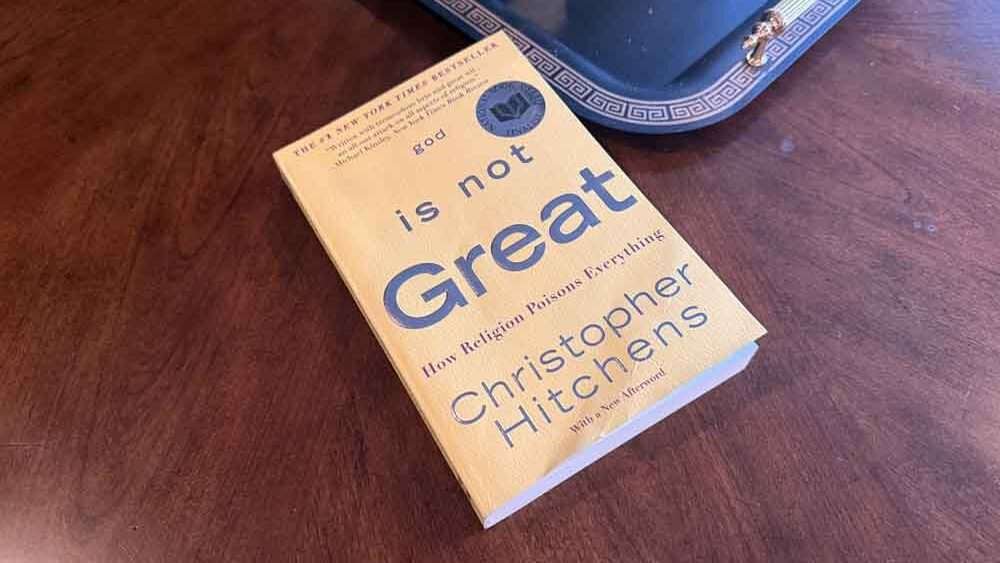
Hitchens died in December 2011. Esophageal cancer. He knew it was coming and he said so, publicly, in the same voice he used to dismantle cardinals. No deathbed conversion. No hedge. He checked out the same way he lived — clear-eyed, unafraid, and completely unwilling to give religion a courtesy call on his way out.
I picked up God Is Not Great: How Religion Poisons Everything years ago and I’ve read it more than once. Reading it now, after his death, is a different experience. It reads less like a polemic and more like a testament. Not a religious testament — that would have made Hitchens furious — but a testament of a particular kind of courage. The courage to say the thing exactly as you see it, all the way to the end, with no safety net.
That’s what holds up. Not every argument. Not every chapter. But the posture of the man. That holds.
What the Book Actually Is
People who haven’t read it assume it’s 300 pages of atheist triumph-lapping. It isn’t. It’s a scholarly, frequently funny, sometimes vicious tour through the history of religious atrocity, epistemological fraud, and institutional abuse — but it’s also a love letter to human reason. Hitchens genuinely believed that the capacity to think clearly was the most beautiful thing about us. He didn’t write this book to make believers feel small. He wrote it because he thought they deserved better than what their institutions were selling them.
The subtitle — How Religion Poisons Everything — is the provocation. The book itself is the evidence. He moves from the absurdities of the Old Testament to the sexual abuse scandals in the Catholic Church to the complicity of faith in every major organized genocide of the 20th century. He doesn’t cherry-pick. He stacks the record.
And then, between the indictments, he does something that nobody quite gives him credit for: he admits what religion gets right. The community. The ceremony around death. The fact that human beings are meaning-making animals and that this impulse is not pathological. He just thinks religion is the wrong answer to a real question.
Where It Ages Well
The strongest sections of God Is Not Great are the ones dealing with religious epistemology — how religions claim to know what they know, and why those methods wouldn’t survive a single semester of freshman logic. I was reading An Introduction to Logic and Scientific Method by Morris R. Cohen and Ernest Nagel around the same period I came back to this book, and the two texts have a conversation with each other that Hitchens would have appreciated. Cohen and Nagel spend hundreds of pages building the machinery for how claims should be evaluated. Hitchens applies that machinery to the most protected set of claims in human civilization and finds them hollow.
That project doesn’t age. The arguments religion makes for its own authority haven’t improved since 2007. Neither has Hitchens’s dissection of them.
The sections on Martin Luther King Jr. are particularly sharp. Hitchens had no patience for the argument that King’s Christianity was the source of the movement’s moral power. His position — that King was a great man despite the metaphysical scaffolding, not because of it — is uncomfortable, maybe wrong in some particulars, but impossible to dismiss. When Hitchens says that a man doesn’t need God to command him to free the enslaved, he’s saying something that lands harder in 2025 than it did in 2007. The secular case for human dignity is not weaker than the religious one. It might be stronger, precisely because it requires no supernatural underwriting.
His treatment of evolution is bulletproof. Darwin’s case against design has only gotten stronger in the years since God Is Not Great was published. Hitchens understood this and made the argument with the confidence of a man who had read the science, not just borrowed the conclusions. He was furious that religion kept inserting itself into classrooms, not out of some reflexive anti-clericalism, but because he understood what was being stolen from children who deserved to learn how things actually work.
Where It Shows Its Age
The weakest parts of the book are the political ones. Hitchens was a complicated man, and by 2007 he had already staked positions on Iraq and the so-called war on terror that put him in uncomfortable proximity to people he would have otherwise despised. Some of that bleeds into the book — a tendency to single out Islam for a rhetorical intensity that occasionally outpaces the parallel intensity toward Christianity and Judaism. The comparative critique is there, but the temperature isn’t always the same.
This is not a fatal flaw. But it’s worth noting. The book is at its best when it’s philosophical and historical. When it gets too close to the geopolitical moment it was written in, it narrows.
There’s also an occasional problem of register. Hitchens could not help performing. Some chapters read like a very good lecture — dazzling, quotable, built for an audience to react to. That serves certain arguments. It undermines others, where the gravity of the subject needs a quieter voice.
Reading Him Now, After He’s Gone
Here’s what reading this book in 2025 actually does to you if you come to it honestly: it makes you miss him.
Not because every argument lands. Not because I agree with every position. But because the intellectual landscape he occupied — willing to be wrong publicly, willing to change his mind in print, willing to take the thing seriously enough to fight about it — has gotten thinner since his death. Debate has gotten louder and stupider simultaneously. The people who argue loudest about religion now, on either side, seem less interested in the actual question than in the performance of their team’s position.
Hitchens was interested in the question. That’s what made him dangerous and that’s what made him worth reading.
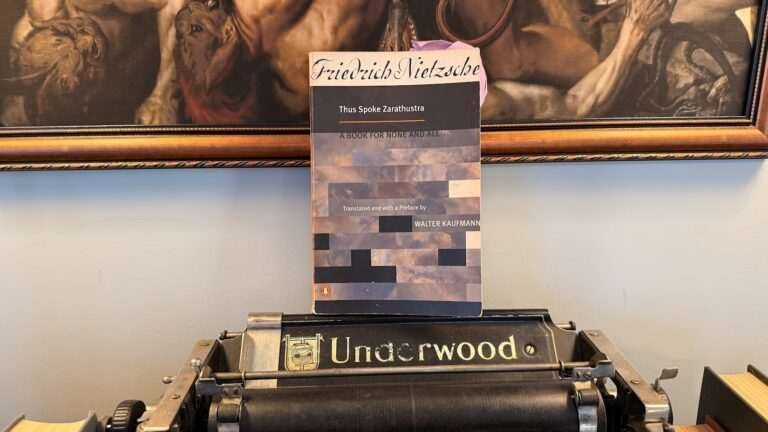
He also had the rare quality of being entertaining while saying something that mattered. When Nietzsche wrote that God was dead, he was writing a tragedy — the death of the divine framework had created a crisis of meaning that Western civilization was not prepared for. Hitchens read that same diagnosis and responded with something close to relief. The crisis, for him, was the opportunity. Reason could fill the vacuum. Human solidarity didn’t need a supernatural guarantee. We could earn it ourselves.
Whether you think he was right about that is less important than understanding what he was asking. He was asking whether human beings were capable of building an ethical life without the structure of organized religion. His answer was yes, emphatically yes, obviously yes — and he backed it up with the example of his own life, which was, whatever else you want to say about it, fully lived and entirely his own.
There’s a passage near the end of the book where he acknowledges the reality that he will die, that everyone will die, and that this fact is not a tragedy requiring consolation. It requires only honesty. Reading that now, knowing that he did die, knowing he kept that posture straight to the end — it’s not comforting exactly. But it is something. Something like respect.
I’ve seen men face terrible things. My son nearly died. My brother did die. I know what it looks like when people reach for something bigger than themselves in those moments, because that’s what humans do. I understand the reach. What Hitchens is saying is not that the impulse is wrong — it’s that the hand reaching back may not be there. And we should be brave enough to handle that.
Whether the hand is there or not is a question nobody has settled. Not Hitchens. Not Augustine. Not Kierkegaard, whose collected writings take the opposite position with equal force and equal seriousness. The question remains open. But God Is Not Great is one of the most serious attempts anyone made to close it — and even if it doesn’t close it, it clarifies it. That’s worth something.
Read it. Argue with it. That’s exactly what Hitchens would have wanted.
You Might Also Like:
- The Gay Science by Friedrich Nietzsche: God Is Dead, and Heavy Metal Has Known It Longest
- The Selfish Gene by Richard Dawkins — The Book That Unlocked Darwin for Me
- The God Delusion by Richard Dawkins — A Review
Sources
- Hitchens, Christopher. God Is Not Great: How Religion Poisons Everything. Twelve Books, 2007. https://www.hachettebookgroup.com/titles/christopher-hitchens/god-is-not-great/9780446579803/
- Hitchens, Christopher. “Topic of Cancer.” Vanity Fair, September 2010. https://www.vanityfair.com/culture/2010/09/hitchens-201009
- Dawkins, Richard. “A Welsh Treasure.” The Guardian, December 2011. https://www.theguardian.com/books/2011/dec/16/christopher-hitchens-friend-richard-dawkins
- Nietzsche, Friedrich. The Gay Science. Trans. Walter Kaufmann. Vintage, 1974.
- Stanford Encyclopedia of Philosophy: “Religion and Science.” https://plato.stanford.edu/entries/religion-science/