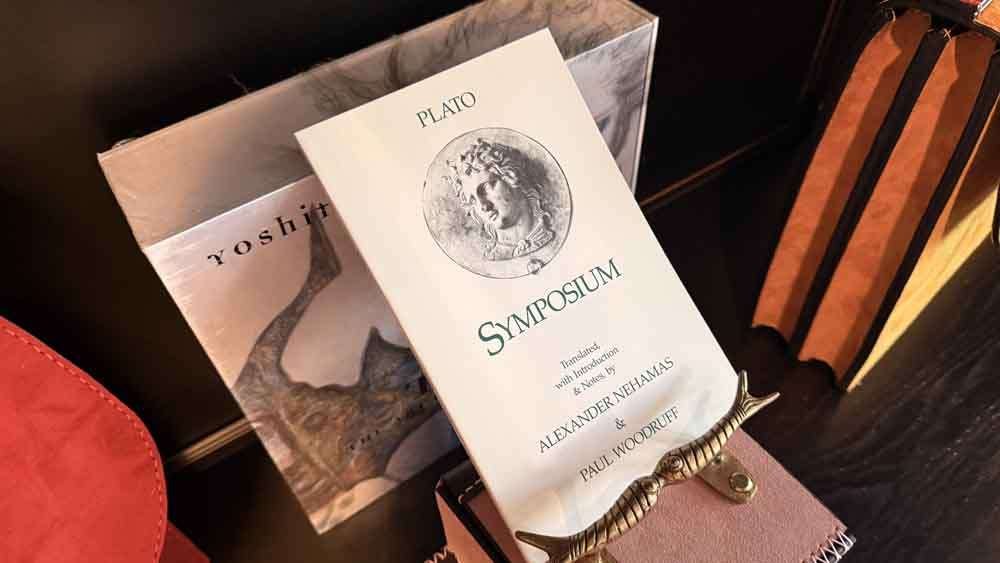
Plato wrote a dinner party. Grown men reclining on cushions, wine moving around the room, one of them sick from the night before. The agreement is simple: everyone gives a speech in praise of Eros, the god of love. What follows is one of the strangest and most honest documents in the history of Western thought — and it has nothing to do with romance.
I picked up the Symposium the first time expecting philosophy at a safe distance. What I got was something more like a gut-punch wrapped in rhetoric. Plato is not writing about love as most people understand the word. He is writing about a force that disorients the self, strips away comfortable illusions, and — if you follow it far enough — drags you toward something that can’t be held in the hand or kept in a bed.
Everybody Gets It Wrong First
Before Socrates speaks, five others take their turn. Phaedrus, Pausanias, Eryximachus, Aristophanes, Agathon — each of them eloquent, each of them wrong in a way that reveals exactly who they are. Phaedrus praises Eros as the oldest and most honorable of gods, a force that produces courage and noble deeds. Pausanias splits love into common and heavenly, which is really just a sophisticated way of distinguishing between what he wants and what he can justify wanting. Eryximachus, the physician, medicalizes it — love as a harmony of opposites, present in the body the same way it’s present in the cosmos.
Then Aristophanes tells the myth of the split humans. Zeus cuts us in half for hubris, and ever since, we’ve been searching for our other half. It’s the story everyone still cites at weddings. It’s also the only speech that’s genuinely poetic, which is probably why Plato puts it before Agathon, the actual poet, whose speech is beautiful, empty, and immediately demolished by Socrates in about three sentences.
What you notice, reading these speeches in sequence, is that each man praises love in the shape of his own life. The lover of honor praises love’s honor. The physician finds love in medicine. The comic playwright finds love in myth and longing. These are not descriptions of Eros. They are self-portraits.
What Socrates Actually Says
Socrates does something none of the others do. He refuses to invent a flattering description. Instead, he claims he learned about love from a woman — Diotima of Mantinea — and proceeds to report her argument.
Diotima begins by taking apart the premise. Eros is not a god, she says. The gods are beautiful and good. Eros is always lacking, always hungry. Eros is the son of Poros (resource, fullness) and Penia (poverty, need). Born at a party, conceived at the moment of lack. That parentage is the whole point. Love is not a state of completion. Love is the recognition of incompleteness.
This is the part that most people quietly skip past, because it means that the experience we call love — the overwhelming pull toward another person, the ache that doesn’t resolve — is not the endpoint. It’s a symptom. A signal pointing somewhere else.
Diotima’s ladder is what she describes next, and it is one of the strangest arguments in all of philosophy. You begin by loving a single beautiful body. Then you recognize that the beauty in that body is the same beauty in all beautiful bodies, and your attachment expands. Then you realize that beauty of soul exceeds beauty of form. Then you move toward beautiful practices, beautiful laws, beautiful knowledge. The particular person — the one whose face launched a thousand ships — is the first rung. The ladder goes up from there, toward something Diotima calls Beauty Itself. Eternal, unchanging, not located in anything that lives and dies.
I read this sitting in a diner booth on a Tuesday afternoon, and my first honest reaction was that it sounded cold. The face of the person you love reduced to a rung on a ladder. But that’s not quite what Diotima says. She says the ascent happens through love, not away from it. The particular is where it starts. You can’t skip the first rung. The madness is necessary.
The Madness Is the Point
What Plato is really arguing — or what Diotima argues through Socrates — is that desire is not a problem to be solved. It is a form of knowledge. The longing itself is information about the structure of reality. The reason love destabilizes you is that it is pointing you toward something real, something your ordinary, defended, comfortable self is not equipped to encounter without being shaken.
This is where the Symposium diverges sharply from every pop psychology account of love I’ve ever encountered. The dominant modern story about desire is that it should eventually resolve into contentment. Find the right person, build the right life, and the longing quiets down. Diotima’s story says the longing doesn’t quiet down — it deepens and clarifies. The person who learns to follow it finds that it was never really about the person who first triggered it. Which sounds brutal until you understand that Plato isn’t dismissing the beloved. He’s saying the beloved opened a door.
I’ve heard this idea called mystical and dismissed as impractical. I’ve also seen what happens when people treat love as a transaction — what is owed, what is deserved, what the contract specifies. That version gets negotiated, litigated, and concluded. Diotima’s version has no conclusion. It just keeps ascending. I know which one has more pull on me, even when the other seems safer.
Alcibiades Walks In Drunk
Then the door bangs open and Alcibiades arrives, crowned with ivy, stumbling, and furious. He has no interest in praising Eros. He wants to praise Socrates.
What follows is one of the most devastating passages in ancient literature. Alcibiades is beautiful, politically powerful, admired by everyone in Athens. He pursued Socrates. He arranged to be alone with him. He offered everything — his company, his body, his ambition, the kind of attention most men in Athens would have died for. Socrates declined. Not cruelly, not dismissively. He simply was not moved.
Alcibiades describes what it feels like to be near Socrates: a bite, a sting, a pain in the chest that won’t leave. He says Socrates is like those carved boxes — the ones that look crude on the outside but contain golden figures of gods. He says the speeches Socrates gives are the only speeches that leave him genuinely ashamed of himself.
The humiliation Alcibiades describes is not the humiliation of rejection. It’s deeper than that. Socrates reflects back to him the gap between what he is and what he could be, and Alcibiades cannot stand it. So he runs. He goes back to politics, back to the crowd, back to the flattery of Athens. He knows, as he says this, that running is a mistake. He says so explicitly. He just can’t stop.
This is Plato’s real argument about desire. Socrates is the person who has actually followed Diotima’s ladder high enough to be transformed by it. Around him, everyone else’s loves are exposed as smaller than they imagined. Alcibiades fell in love with Socrates and found himself wanting to be better. He was not strong enough for that. The wanting scared him more than anything.
A Book for People Who Have Felt Something They Couldn’t Name
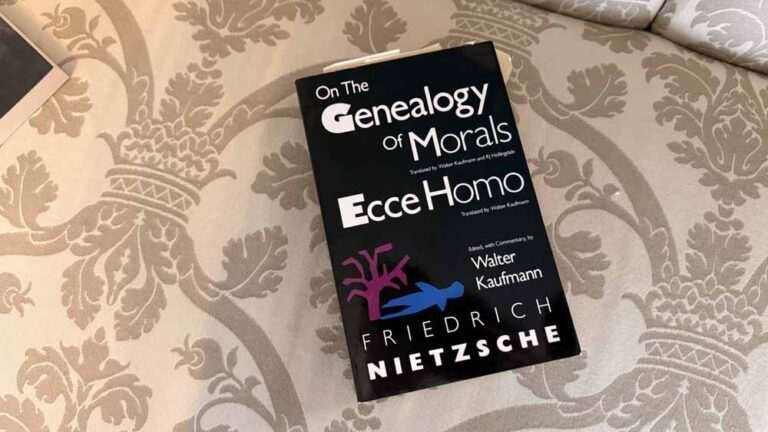
I came to the Symposium through years of reading that started with Nietzsche — whose own wrestling with desire and power is documented in Thus Spoke Zarathustra — and continued through Augustine, who spent half of The City of God arguing with Plato’s ghost. The Symposium sits at the root of all of it. Philosophy, theology, psychology — all of Western thought about the inner life has been, in some sense, a long argument with this one dinner party.
What the Symposium finally said to me, after a couple of readings, is that the intensity of the feeling is not the mistake. The ordinary thing to do with overwhelming desire is to either indulge it or suppress it. Plato offers a third option: follow it. Find out what it’s actually pointing at. Take the sting seriously. What Socrates demonstrates — sitting calm and sober while everyone around him gets drunk and recites their own flattering self-portraits — is that the examined desire is the one that transforms you. The unexamined one just bounces you around.
I have seen Socrates depicted in art at his most dramatic moment — the hemlock, the disciples, the raised finger making a point even as he’s dying. That painting captures conviction. The Symposium captures something else. It captures what it looked like to be around someone who was actually free. Not free from desire. Free through it.
What the Text Leaves You With
The Symposium ends with a small, almost comic image. It is almost dawn. Most of the guests are asleep on the couches. Aristophanes and Agathon — the comic playwright and the tragic poet — are being forced by Socrates to agree that the same person ought to be able to write both comedy and tragedy. They’re barely awake. Socrates, who has been awake all night, gets up and goes to the gymnasium to wash, and from there goes about his day.
He is the last man standing. He always is.
This is not, in the end, a book about what love is. It’s a book about what love does — to the people who pursue it without understanding it, and to the very rare person who follows it all the way down to where it’s actually pointing. The Symposium is 2,400 years old and still manages to make you feel like you have been missing something obvious your whole life.
Read it. Then read it again and pay attention to the speeches before Socrates. The distance between what those men say and what they mean is the entire subject.
Sources
- Plato. Symposium. Translated by Alexander Nehamas and Paul Woodruff. Hackett Publishing Company, 1989. https://www.hackettpublishing.com/symposium
- Plato. Symposium. Translated by Benjamin Jowett. Internet Classics Archive, MIT. http://classics.mit.edu/Plato/symposium.html
- Nussbaum, Martha C. The Fragility of Goodness: Luck and Ethics in Greek Tragedy and Philosophy. Cambridge University Press, 1986. https://www.cambridge.org/core/books/fragility-of-goodness/
- Vlastos, Gregory. “The Individual as an Object of Love in Plato.” Platonic Studies. Princeton University Press, 1973. https://press.princeton.edu/books/platonic-studies
- Stanford Encyclopedia of Philosophy. “Plato’s Symposium.” https://plato.stanford.edu/entries/plato-symposium/