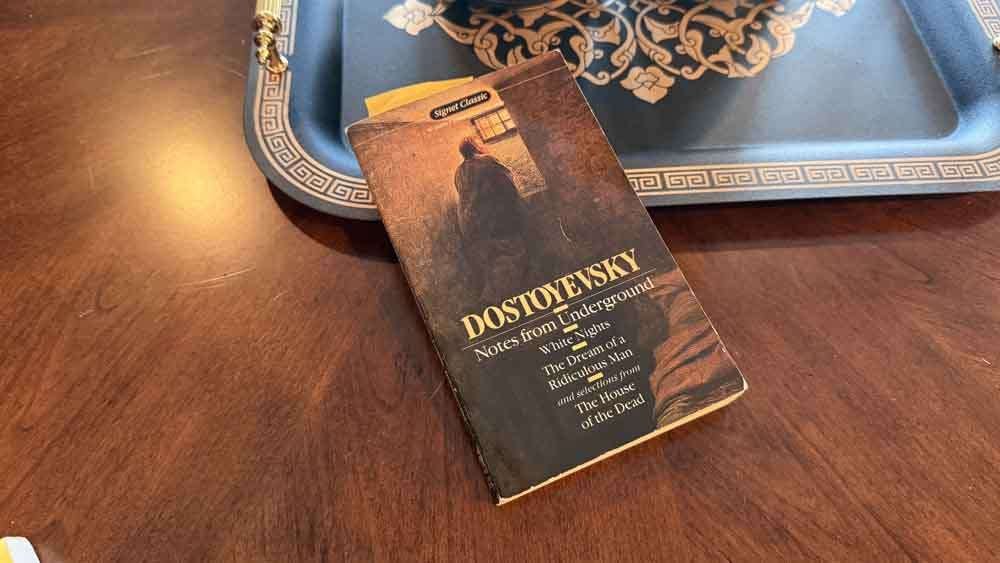
Dostoevsky wrote this in 1864. The Underground Man has been living rent-free in my head ever since I cracked it open.
He has no name. He has no friends — or rather, he has people he calls friends only to confirm that he despises them and they despise him. He is a former minor government official who has retreated into a hole in St. Petersburg, and from this hole he narrates forty pages of the most jagged, self-lacerating, intellectually electric prose in the Western canon. Then he tells a story. The story is worse than the monologue. Which means it is better.
This is not a comfortable book. It was not written to comfort you.
The Man Who Sees Through Everything and Does Nothing
The Underground Man’s central problem is not that he is weak. It is that he is too aware. He understands his own psychology with surgical precision — the vanity, the resentment, the way he tortures people he admires and sabotages every relationship he could conceivably have. He sees all of it. He narrates all of it. And it changes nothing.
That’s the trap Dostoevsky built. Consciousness without the power to act. Intelligence weaponized entirely against the self.
Most literary protagonists suffer from ignorance. The Underground Man suffers from the opposite. He knows exactly why he will walk back and forth in front of an officer on the Nevsky Prospect for two years working up the courage to bump shoulders with him — a man who has never once acknowledged his existence. He knows it is humiliating. He knows it is insane. He does it anyway. Then he goes home and writes about how he knew it was insane while he was doing it.
That is not a character flaw. That is a philosophical position. His self-sabotage is not incidental to the book — it is the book’s argument.
Against the Crystal Palace
The Underground Man is Dostoevsky’s answer to the utopians. The rational optimists. The men who built their Crystal Palace — the great exhibition hall of human progress in London, 1851, which became shorthand for the whole Enlightenment bet that reason would fix everything, that science would cure human suffering, that given enough information, people would reliably choose what was good for them.
The Underground Man says: no.
Not because people are stupid. Because people do not want to be optimized. They want to want. They want to choose — even the wrong thing, especially the wrong thing — because the act of choosing is the last proof they have that they are alive and not cogs in a machine. He would rather stick his tongue out at the whole edifice of rational progress than submit to being a piano key struck in a predetermined sequence.
This is the part that hit me hardest. Dostoevsky saw something in 1864 that most people still resist seeing: the will is not a servant of reason. It is not even interested in reason most of the time. It wants what it wants, and sometimes what it wants is chaos. Not because people are evil. Because freedom requires the possibility of the irrational, and any system that removes that possibility — however well-intentioned — has removed the person along with the irrationality.
I’ve spent enough time around people who seem to be acting against their own interests to know he was onto something real.
The Anti-Hero Before There Were Anti-Heroes
Every damaged, self-aware, self-defeating narrator who came after this book owes it a debt. Raskolnikov in Crime and Punishment — Dostoevsky’s own creation, written two years later. Humbert Humbert. Holden Caulfield. Patrick Bateman. The entire lineage of first-person narrators who cannot stop talking, cannot stop analyzing, and cannot stop making things worse.
The Underground Man is the template. He is the first character in fiction who uses intelligence as a weapon against himself with full knowledge that this is what he is doing.
What makes him revolutionary — and what makes the book more than just a study in pathology — is that he is also right about a lot of things. His diagnosis of social hypocrisy is accurate. His critique of sentimental romanticism, of the idea that the poor are noble and suffering ennobles you, is devastating. He is not wrong. He is just unable to translate being right into any kind of human connection or forward motion. He is right and ruined at the same time.
Dostoevsky does not ask you to pity him. He barely asks you to like him. He asks you to recognize him.
Liza and the Cost of Being Seen
The second half of the book — the story of Liza — is where the abstract philosophy becomes flesh. The Underground Man encounters a young woman who is a prostitute, delivers a passionate, theatrical speech about the misery of her situation, and watches her open up to him completely. She trusts him. She comes to see him.
Then he destroys it. Methodically. Out of fear.
Because being seen — genuinely seen, the way Liza sees him in that moment — is the one thing he cannot survive. He is safe in the underground. He is safe in his contempt and his monologues. What he cannot tolerate is someone standing in front of him with open hands.
He gives her money. Not because he is generous. Because it converts the moment from human to transactional, and transactional is a language he knows how to speak. It kills what was there. He knows it kills what was there. He writes it all down with complete precision and no mercy for himself.
That is the Dostoevsky move. Not the cruelty — the lucidity about the cruelty.
What the Underground Sounds Like
The prose, in the Pevear and Volokhonsky translation, is combative and kinetic. The Underground Man argues with an imaginary audience throughout the first section, anticipating objections and batting them away, changing direction mid-sentence, contradicting himself on purpose and then defending the contradiction. It reads less like a novel and more like a court transcript from a case where the defendant is also the prosecutor, the judge, and the only witness.
It is exhausting in the best way. You can feel the coiled energy in every paragraph. You can feel how much he needs to talk and how completely talking has replaced living.
Dostoevsky was forty-three when he wrote it. He had done hard labor in Siberia. He had epilepsy. He had debts. He knew something about what it meant to be at the bottom of a system that did not see you, and he poured all of that into this strange, bracingly ugly little book that refuses to resolve into anything clean.
Why It Still Matters
The Underground Man is not a historical curiosity. He is everywhere.
He is in every online argument conducted not to persuade but to wound. He is in every person who sees the right thing to do and manufactures reasons not to do it. He is in every relationship destroyed not by hatred but by the terror of being actually known by another person. He is in every ideology that promises to optimize human beings and the resistance those ideologies always eventually provoke, because human beings will burn down a rational system just to prove they can.
He is also, if you are honest, in you. In me. In anyone who has ever chosen the harder, worse path simply because it was the one they chose themselves.
That’s not a comfortable thought. Dostoevsky wasn’t writing comfortable thoughts. He was writing the truth about what the inside of a mind looks like when it is too smart to lie to itself and not strong enough to change.
One hundred and fifty-eight years later, it still lands like a punch from someone who knew exactly where to hit you.
Sources
- Dostoevsky, Fyodor. Notes from the Underground. Translated by Richard Pevear and Larissa Volokhonsky. Vintage Classics, 1994. https://www.penguinrandomhouse.com/books/286479/notes-from-underground-by-fyodor-dostoevsky/
- Frank, Joseph. Dostoevsky: The Stir of Liberation, 1860–1865. Princeton University Press, 1986. https://press.princeton.edu/books/paperback/9780691014470/dostoevsky
- Bakhtin, Mikhail. Problems of Dostoevsky’s Poetics. Translated by Caryl Emerson. University of Minnesota Press, 1984. https://www.upress.umn.edu/book-division/books/problems-of-dostoevskys-poetics