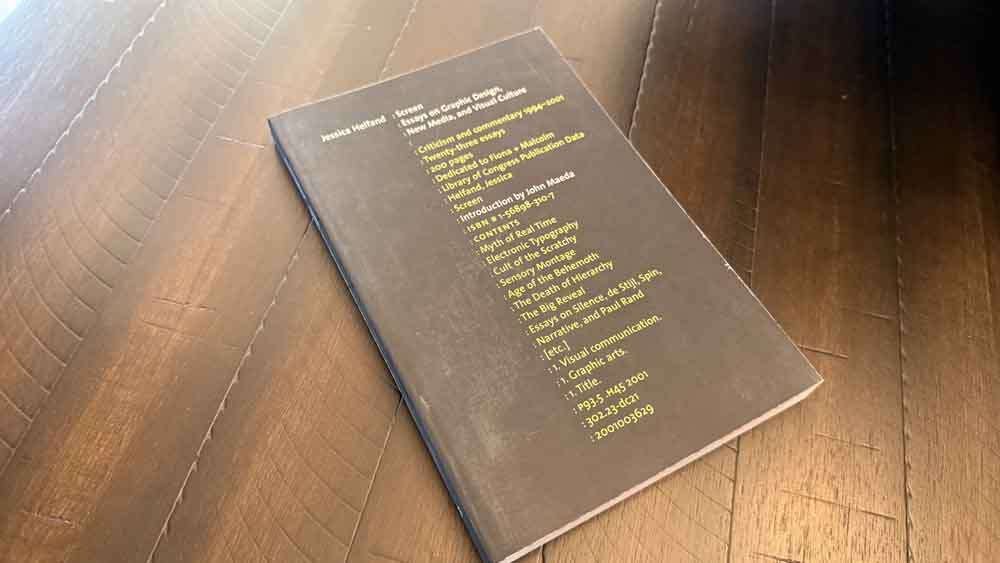
Twenty-three essays. Two hundred pages. Published in 2001, when most people were still calling the internet a fad or a miracle, depending on their mood. Jessica Helfand saw it as neither. She saw it as a design problem — and by extension, a cultural problem — and she sat down and wrote about it with the kind of precision that makes you feel retroactively embarrassed for not having figured it out yourself.
Screen: Essays on Graphic Design, New Media, and Visual Culture is not a how-to book. It’s closer to a courtroom transcript, except Helfand is both prosecutor and witness. She doesn’t tell you how to design a better website. She asks what it means that we design websites at all — and whether the way we’re doing it is quietly dismantling the visual intelligence we spent centuries building.
The Problem She Named
The central argument runs through every essay like load-bearing steel: the screen is not neutral. It is a frame with its own appetite. Typography bends to it. Narrative gets swallowed by it. The hierarchy that once told a reader where to look — the headline, the body, the caption, the gutter — dissolves into a clickable flatland where everything competes and nothing wins.
Helfand calls out what she names “the myth of real time” — the idea that instantaneous delivery is a virtue in itself, that speed is sophistication. It isn’t. Speed without grammar is just noise with bandwidth. The essay tears into the assumption that because technology can produce something immediately, that immediacy constitutes a kind of authority. It doesn’t. It constitutes chaos with better hardware.
This is what she understood before the rest of the conversation caught up: the internet didn’t invent new problems. It industrialized old ones. The degradation of visual hierarchy, the surrender of craft to convenience, the collapse of the thoughtful pause — these tendencies existed before the modem. The screen just gave them unlimited real estate.
The Typography Chapter Is the One That Stays With You
Her essay on electronic typography is where the book earns whatever you paid for it. She is not nostalgic in the way of someone who simply prefers the old. She is grieving something specific: the loss of type as argument. In print, a typeface makes a claim. The weight, the spacing, the leading — these are decisions that carry meaning. You can read a well-set page the way you read a room: the furniture arrangement tells you something about the people who live there.
On the screen in 2001, and for a long time after, type was a delivery mechanism. Get the letters there. Make them legible. Hope for the best. Helfand isn’t interested in the hope. She wants the intention back.
I’ve spent twenty years watching people eat at the diner with their eyes on their phones. I’m not blaming them. But I’ve thought about what it means that the thing in their hand is designed to make the next thing come faster than the last thing, and the one after that faster still, and nowhere in that system is there a design for pause. For sitting with something. Helfand wrote that critique before the iPhone existed. That’s what a good prophet does — they don’t wait for the evidence to be obvious.
Maeda’s Introduction and Why It Matters
John Maeda’s introduction sets the frame cleanly. He positions Helfand not as a Luddite — which would be the lazy read — but as someone who brings print literacy to bear on digital culture with enough rigor to make both disciplines uncomfortable. That’s the right way to come at it. She isn’t opposed to the screen. She’s demanding that the screen justify itself in terms that go beyond speed and novelty.
This is also what makes the book unusual among design writing from that era. Most of it was cheerleading. The late nineties and early 2000s produced an ocean of breathless prose about what digital media was about to become. Helfand wasn’t writing about the future. She was already asking what we were giving up to get there.
The Behemoth and the Boutique
Her essay on what she calls “The Cult of the Behemoth” holds up with a kind of awful precision. She’s describing what happens when scale becomes the primary measure of a thing’s value — when bigness is taken as proof of rightness. The dot-com boom had produced a class of media companies that mistook volume for vision. Helfand saw it plainly. The bigger the platform, the more pressure to flatten everything that passes through it.
What she’s describing, without quite naming it that way, is the industrial logic applied to culture. The same logic that produces a mass-market anything — a mass-market briefcase, a mass-market meal, a mass-market design aesthetic — is the logic that tells you differentiation is inefficiency. I’ve made things by hand long enough to know that the opposite is true. The detail is not the decoration. The detail is the argument. Helfand would agree.
Paul Rand and the Weight of Influence
The essays on Paul Rand and de Stijl feel like they belong to a slightly different book — more historical, less polemical — but they earn their place. Rand comes through as a man who understood that every visual decision is a philosophical decision, whether the designer knows it or not. The ignorant design choice and the intentional design choice both communicate. One communicates by accident, the other by will. Helfand uses him not as a monument to point at but as a measuring stick for what gets lost when the field stops insisting on that kind of rigor.
Her writing on Rand is also some of the most personally felt writing in the book. You can sense her frustration — not anger exactly, but something close to it — that the lessons he spent a career demonstrating could evaporate so quickly in the face of technological novelty.
Why It Still Reads True
The temptation with a book like this is to say: well, things have changed. And they have. The design discourse has matured. There are people now who think carefully about user experience, about typographic systems on responsive interfaces, about the ethics of attention engineering. But Helfand’s core argument — that visual culture is a form of intellectual culture, and that degrading the former degrades the latter — hasn’t been answered. It’s been largely ignored.
I keep books that won’t let me be stupid about something. The Selfish Gene did that with biology. No Exit did it with freedom. Screen does it with the built visual world — the stuff we swim in so constantly that we forget it was designed by someone, for reasons, and that different reasons would have produced a different world.
She saw the wreckage before the crash. That’s not a small thing.
You Might Also Like
- The Ghost in the Machine: Descartes, Dennett, and the Mind That Built the Modern World
- Rembrandt’s Aristotle with a Bust of Homer — A Portrait of the Mind in Conflict
Sources
- Helfand, Jessica. Screen: Essays on Graphic Design, New Media, and Visual Culture. Princeton Architectural Press, 2001. Amazon
- Maeda, John. Introduction to Screen. Princeton Architectural Press, 2001.
- Princeton Architectural Press: papress.com