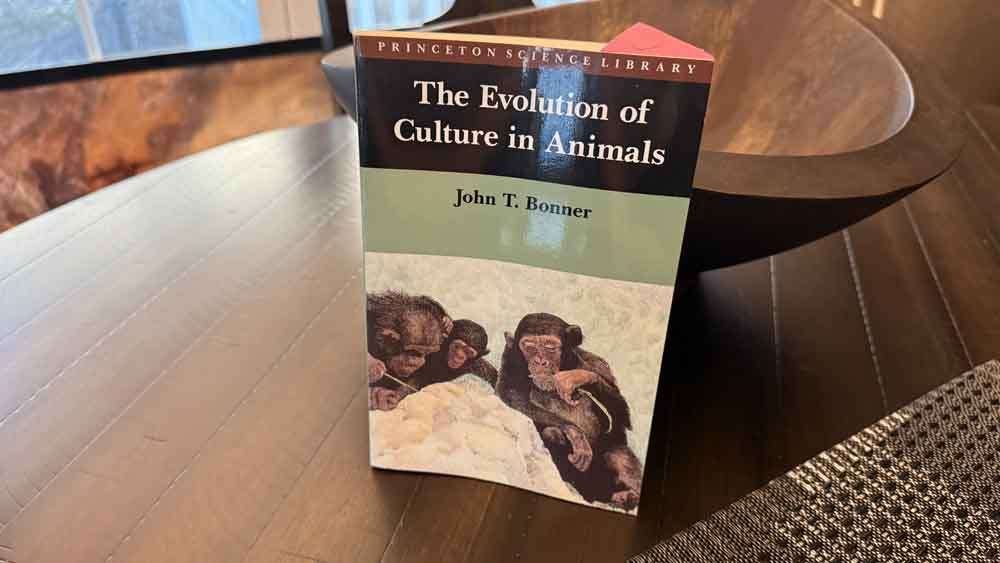
Culture, most people assume, is the thing that separates us from the rest of life. Language, tradition, tool use, the transmission of knowledge from one generation to the next — these are the hallmarks of the human animal, the features we point to when we want to explain why we built cathedrals and wrote symphonies while everything else just ate and slept and died. John Tyler Bonner, a Princeton biologist writing in 1980, spent a careful and beautifully illustrated book dismantling that assumption. His argument is not that animals are like us. His argument is that we are like animals — further along a spectrum that started long before we arrived, but on the same spectrum nonetheless.
That distinction matters more than it sounds.
What Bonner Actually Means by Culture
The first thing Bonner does is strip the word down to something defensible. Culture, he proposes, is the transfer of information by behavioral rather than genetic means — through teaching, imitation, and learning, not through the double helix. That’s it. No museums required. No written language. No philosophy degree.
By that definition, a Japanese macaque that learns to wash sweet potatoes in the ocean and teaches the habit to her offspring is engaging in culture. A chaffinch that picks up a regional song dialect from older birds and passes it to the next generation is engaging in culture. A rat that learns to avoid a poisoned bait and whose avoidance behavior influences the caution of other rats is engaging in culture. None of these animals called it that. But the mechanism — behavioral transmission across generations — is the same one operating when a craftsman teaches an apprentice to read leather by feel, or when a grandmother in a Brooklyn kitchen teaches a grandchild to make spanakopita without measuring anything.
Bonner isn’t collapsing all distinctions. He’s showing that the distinctions are of degree, not kind. The species that look most like us in this regard — the great apes, cetaceans, certain corvids — are the species with the largest brains and the longest developmental periods. That’s not coincidence. It’s the architecture of learning. A bigger brain and a longer childhood give a creature more time to absorb behavioral information before it has to act independently. Culture, in this reading, is partly a function of processing power and the time available to use it.
The Spectrum From Bacteria to Bach
What makes Bonner’s book unusual — and what keeps it worth reading decades after publication — is how far back he traces the thread. He doesn’t start with chimpanzees. He starts with bacteria.
Bacterial flagella spin in a particular direction. That spin is not always genetically fixed — it can be influenced by what the bacterium has encountered. Whether that constitutes proto-culture is a stretch, and Bonner knows it. But he raises it to make a point: the capacity for non-genetic information transfer has roots older than we imagine. The question is not when culture appeared from nowhere. The question is how a property present in dim form at the very base of life became, in one lineage, the dominant force shaping the organism’s world.
From there, Bonner works up through the animal kingdom with five categories of behavior that constitute the building blocks of nonhuman culture: physical dexterity, relations with other species, auditory communication within a species, knowledge of geographic locations, and invention or innovation. Each category gets examined across multiple taxa. Each builds a cumulative case that what we call culture is not a bolt of lightning from the sky but the result of slow biological accumulation — the same process that built the eye from a light-sensitive patch of cells, except operating at the level of behavior rather than anatomy.
Stephen Jay Gould, reviewing the book in the New York Review of Books, described it as a survey marching up the chain of being toward bigger brains, increasing behavioral complexity, and freedom from rigid genetic programs. That captures the architecture of the argument. The chain itself is the point. We did not spring from it. We are its current leading edge.
The Speed Differential
One of the book’s cleanest ideas concerns the difference in tempo between genetic and cultural evolution. Genetic evolution is, in Bonner’s phrase, slow and ponderous. A population adapts genetically across generations, measured in thousands or millions of years. Cultural evolution can happen in a single lifetime, sometimes in a season. A bird colony that discovers a new food source, a pod of dolphins that develops a new hunting technique, a human community that adopts a new farming practice — these changes can propagate through a group in years rather than eons.
This speed differential is not trivial. It means that for species capable of cultural learning, the adaptive response to environmental change is no longer limited to the genetic lottery. They can learn their way out of a problem faster than they can evolve their way out of it. The bigger the brain, the longer the developmental window, the more powerful this capacity becomes. In human beings it became so powerful that it largely decoupled us from environmental selection pressures that still govern every other species. We don’t grow thicker fur. We make coats.
That’s not a reason for pride. It’s a description of a mechanism. Bonner never confuses the two.
Where the Book Sits in 1980
The Evolution of Culture in Animals was published the same year that E.O. Wilson’s Sociobiology was still generating academic warfare, and just four years after Richard Dawkins introduced the meme as the cultural analog to the gene. Bonner’s project shares intellectual territory with both but handles the terrain differently. Where Wilson leaned hard into genetic determinism and drew fire for it, Bonner was more measured — willing to acknowledge the genetic scaffolding of social and behavioral capacities without reducing behavior to genetics. Where Dawkins proposed a theoretical unit of cultural transmission and built a framework around it, Bonner went to the animals themselves and let the examples carry the argument.
The result is a book that doesn’t feel like a manifesto. It feels like a field report from a scientist who has spent a career paying attention to living things and noticed something the rest of us keep missing. E.O. Wilson himself called the book’s greatest virtue the re-creation of culture and culture-mimicking behaviors throughout the animal kingdom — an essential step, he wrote, in understanding the probable origins and unique qualities of human sociality.
That’s a generous endorsement from a man whose own work was stirring up considerably more controversy at the time. It also tells you something about where the intellectual lines were drawn in that moment — and why a book like Bonner’s, quieter and more patient than the others circulating around it, offered something the louder arguments couldn’t.
The Honest Implication
Here is what Bonner’s argument costs us, if we accept it. It costs us the clean separation between nature and culture — the idea that biology is what we share with the animals and culture is what lifts us above them. That separation has done a lot of work, philosophically and theologically, for a long time. It underwrites a certain kind of human exceptionalism that feels natural until you sit with this book for a few hours.
I’ve spent time with this question from the other direction — thinking about how ideas propagate, what it means for a behavior to be transmitted and modified across generations, the way patterns replicate through populations not in DNA but in imitation. Bonner was working on the same problem from the biological end, and the two approaches arrive at the same uncomfortable place: the line between us and everything else is real, but it is a matter of degree. We have more of something that was already there. That is both humbling and, if you think about it honestly, more interesting than the alternative. Being the apex of a long process is a different kind of remarkable than being a special creation. It requires you to look at the whole process, not just yourself.
What Bonner gives you is that process — patient, illustrated, argued without heat. In a moment when the adjacent books were generating culture war in academic biology, this one was just watching birds learn songs and asking what that meant. It still means something.
You Might Also Like: Understanding Media: The Extensions of Man — Marshall McLuhan
Sources
- Bonner, John Tyler. The Evolution of Culture in Animals. Princeton University Press, 1980. https://press.princeton.edu/books/paperback/9780691023731/the-evolution-of-culture-in-animals
- Gould, Stephen Jay. Review of The Evolution of Culture in Animals. New York Review of Books, 1980.
- Wilson, E.O. Blurb/endorsement. Princeton University Press edition.
- Young, J.Z. Review. London Review of Books, 1980.
- De Gruyter/Princeton University Press listing: https://www.degruyterbrill.com/document/doi/10.1515/9780691186986/html