June 1999. My father-in-law at the time, Carl L. Marcellino — New York State Senator from Long Island, a man who spent years in Albany fighting for environmental legislation that most people never knew existed — invited me and his daughter to the grand opening of the Congo Gorilla Forest at the Bronx Zoo. Senator Marcellino was the kind of man who showed up for things. Groundbreakings, ribbon cuttings, the serious business of institutional moments. He knew why this exhibit mattered, and he wanted us there to see it.
I walked in and never really left.
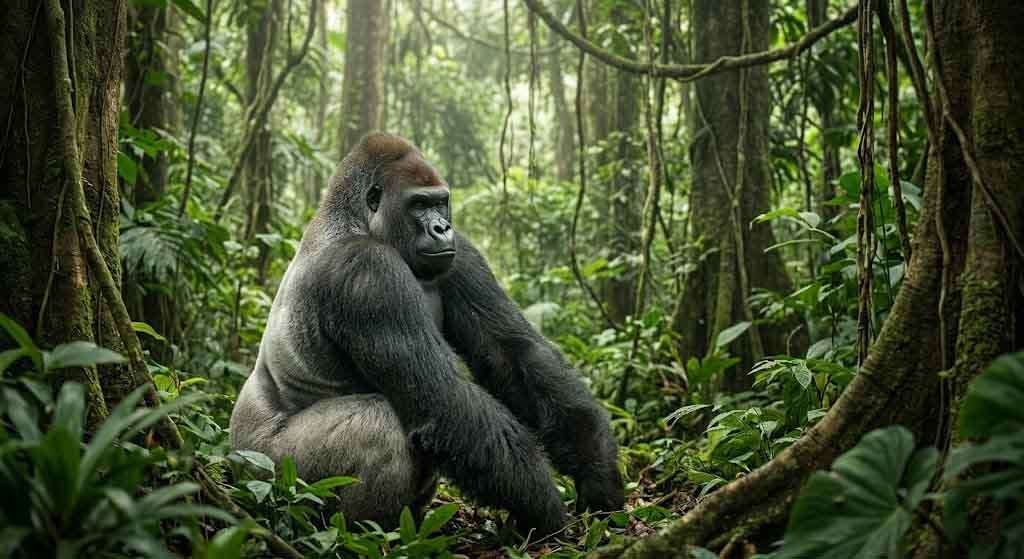
That is the honest version. I have been back more times than I can count. Something about the Congo Forest got into me on that first day and has stayed there — the density of the plantings, the particular quality of the air inside, the silverback moving through his constructed world with a slowness that reads, depending on your frame of mind, as either serenity or resignation. I still think about that distinction. Carl passed away recently, and the memory of that opening day is one I find myself returning to — not with the practiced grief of a public statement, but with the quiet weight of something irreplaceable. He brought me to a place I came to love, and that is a gift that does not expire.
I tried for years to pass that love on to my daughter (his grand daughter). Brought her back through the years as she was growing up, hoping something would catch. It didn’t. Maybe her children will feel it someday. I hope so.
The Congo Gorilla Forest opened in June 1999 and covers exactly 6.5 acres — what the Wildlife Conservation Society calls the most ambitious project in its 104-year institutional history. That is not marketing copy. More than 15 million people have walked its third-of-a-mile trail since opening day. Over $3 million in direct conservation support has been raised through the exhibit’s “Conservation Choice” model, which lets visitors designate their admission fee to a specific WCS field project in Central Africa. No other zoo exhibit in the world does that. It houses 400 animals across 55 species — okapis, mandrills, red river hogs, DeBrazza’s monkeys, colobus — and at its center, one of the largest breeding groups of western lowland gorillas in North America.
Two hours from Mount Sinai. Here is what they’re doing right — and what they’re still getting wrong.
The Animal at the Center
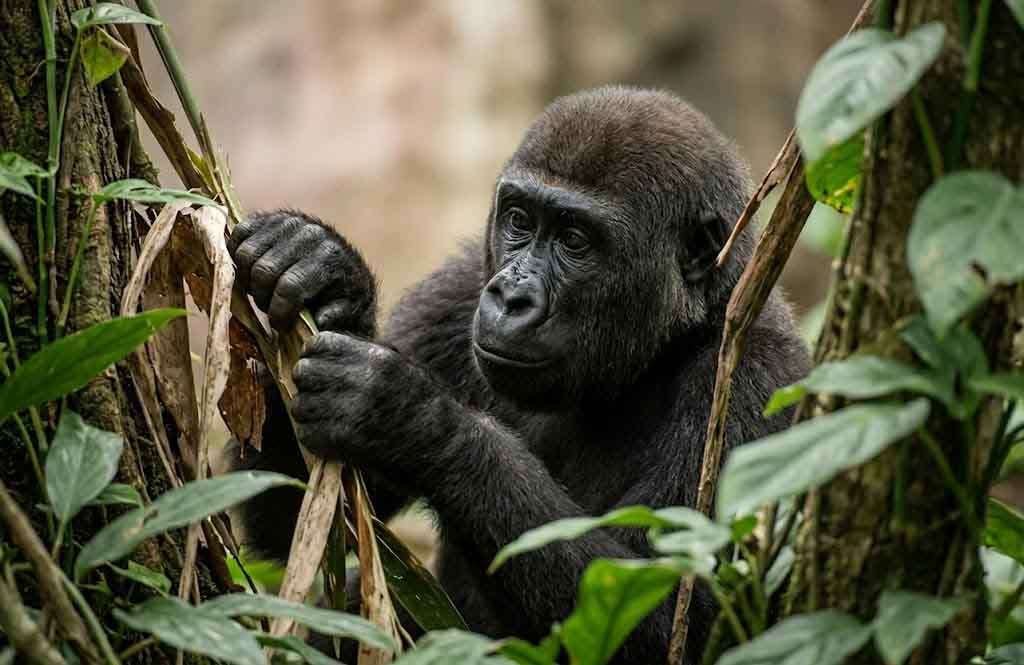
The western lowland gorilla, Gorilla gorilla gorilla, is a critically endangered subspecies. Its wild population has declined by more than 60 percent over the past 20 to 25 years — driven by bushmeat poaching, the Ebola virus, and the steady erasure of forest habitat across the Congo Basin. Even if every threat disappeared tomorrow, scientists calculate the population would need 75 years to recover. Ebola alone is estimated to have killed roughly one-third of wild gorillas in the early 2000s, with mortality rates in some outbreak zones reaching 95 percent. The numbers are brutal. In North Korea, you execute a political prisoner with a firing squad. In the Congo Basin, you erase an entire troop with a hemorrhagic fever, and the world barely registers it.
So the stakes at Congo Gorilla Forest are not trivial. What happens there — how these animals are housed, who they’re with, what they’re given to do — connects directly to a species survival conversation playing out across 51 AZA-accredited zoos in North America, where approximately 350 western lowland gorillas live in coordinated management under the Gorilla Species Survival Plan.
What 6.5 Acres Actually Means
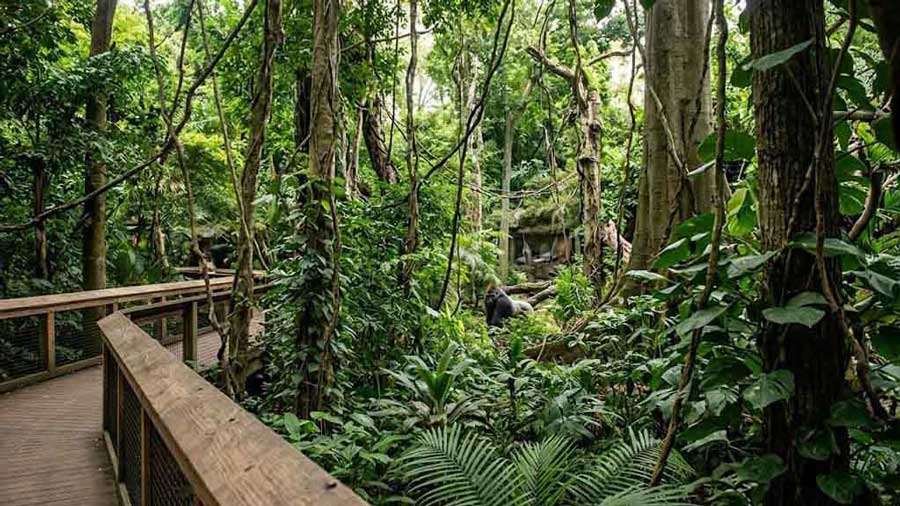
The Congo Forest exhibit is engineered to a remarkable degree of ecological specificity. Over 14,000 plants representing 400 species were planted for the exhibit, many never before cultivated in the New York area. Some are edible for the gorillas — African tulip trees, wild banana relatives, specific ferns. Others are chosen for sensory complexity, because gorillas in the wild do not simply walk through space; they read it. Smell, texture, wind, the quality of light filtering through canopy — these are data streams for an animal whose brain processes social and environmental information at a level well above what most zoo visitors are thinking about when they press their faces to the glass.
But here is the hard fact that no exhibit brochure leads with: a western lowland gorilla in the wild ranges between 9 and 14 square miles. The Congo Gorilla Forest gives them 6.5 acres. That is not a rounding error. It is a different order of magnitude. A wild gorilla troop covers more ground in a single morning than the entire exhibit. When you sit with that number, what you are really looking at is not a habitat. You are looking at a very sophisticated enclosure. That distinction matters for everything that follows.
The WCS and the zoo’s curatorial staff know this. The design response — and it is worth understanding as a genuine design response, not a cover story — is enrichment. The logic is: if you cannot give an animal the space it would use to express its full behavioral repertoire, you can build into the enclosure a density of stimuli, choices, and social complexity that keeps the brain engaged and cortisol levels down. Puzzle feeders. Climbing architecture. Foraging opportunities that require the animal to work. Variable feeding schedules that prevent anticipatory pacing. The ability to move between interior and exterior spaces on the animal’s own schedule.
Social Structure: The Part That Actually Works
Gorilla welfare research has consistently found that social structure matters more than raw acreage. In the wild, western lowland gorillas live in groups averaging five individuals: one dominant silverback, one or more subordinate blackback males, adult females, and their offspring. Wild bachelor groups are transient — males without reproductive access to females form temporary alliances before eventually challenging or joining a breeding group.
In captivity, the AZA manages both family troops and bachelor groups, and it’s in the management of bachelor groups where the science gets genuinely interesting. A peer-reviewed study out of the Saint Louis Zoo tracked what happens behaviorally when bachelor group composition changes — when new males are introduced or when the dominant animal dies. The data show that these transitions are high-risk periods. Cortisol rises. Aggression escalates. The hierarchical relationships that give individuals predictability, and therefore calm, get scrambled. The zoo’s job is to manage those transitions carefully, reading behavioral data the way a diner operator reads a kitchen: who’s accelerating, who’s shutting down, where’s the tension building before it becomes a problem.
The Congo Forest’s breeding group structure gives the gorillas something that is genuinely hard to replicate anywhere else at this scale: a real social world. The animals have relationships with specific individuals. They have status. They have the low-grade politics of group life — who gets access to which female, which juveniles play together, which adult female grooms with whom. Research into gorilla social behavior suggests that females show preferential grooming toward males rather than female kin, and that affiliative behavior between related females is actually limited compared to what intuition might predict. These are not soft behavioral observations. They’re the architecture of gorilla cognition in action, and the Congo Forest’s group size and structure makes them possible to observe.
Studies on captive gorilla welfare have also found something counterintuitive about visitor effects. High crowd density increases stereotypic behavior — repetitive, purposeless movement that signals stress — but the relationship between crowd size and welfare is not linear. Individual personality matters enormously. Some animals tolerate visitor presence well. Others don’t. Visitor viewing access from 360 degrees, which research has shown can suppress welfare indicators, is a design problem the Congo Forest partially addresses through sightline management and the exhibit’s one-way glass viewing areas, which let visitors observe without the animals tracking a constant parade of faces.
Enrichment Protocols: The Science and the Limits
Behavioral enrichment at a facility like Congo Gorilla Forest is not the zoo handing a gorilla a toy. It is a structured program coordinated with the AZA’s Gorilla Behavior Advisory Group, informed by a body of research on what captive primates actually need to prevent the development of abnormal behaviors — repetitive rocking, coprophagy, self-directed aggression — that appear at higher rates in captivity than in the wild.
The exhibit gives animals choices throughout the day: where to rest, what to approach, which part of the habitat to use. Choice is not trivial. The psychological literature on captive animal welfare increasingly treats the ability to exercise agency — to initiate or terminate interactions with the environment — as a primary welfare indicator, distinct from and in addition to physical health. A gorilla that cannot choose is a gorilla under chronic low-grade stress, regardless of how clean the enclosure is or how nutritionally complete the diet.
Diet is its own subject. Captive gorillas are given vegetables, greens, browse, alfalfa, and low-starch biscuits — a diet designed to approximate the high-fiber, low-calorie profile of wild gorilla food. In the wild, gorillas avoid high-fat food sources like African oil palm fruit despite its abundance; evolution tuned their preference away from it. But captive gorillas, in part because of diet composition and sedentary comparison with wild kin, show elevated rates of cardiovascular disease. Gorillas in the wild regularly consume seeds of the “grains of paradise” plant, which researchers believe confers cardiovascular benefits. Some zoos have begun incorporating it. The Bronx Zoo’s nutritional protocols are among the most sophisticated in North America — but the cardiovascular problem is real, and it is a direct artifact of captivity that no amount of enrichment can fully offset.
What Captivity Cannot Accomplish
Here is where I want to be straight with you, because the Bronx Zoo’s Congo Gorilla Forest is excellent at what it is — and what it is, it is not obligated to pretend otherwise. It cannot give these animals the thing Darwin would have recognized as most essential: the pressure of a real world. Wild gorillas range because ranging is how food security is maintained across seasons. They build night nests because each new location reduces parasite load. They migrate between groups because genetic diversity and reproductive fitness depend on it. These are not behaviors shaped by preference. They are behaviors shaped by 10 million years of selection pressure. An exhibit, no matter how well designed, cannot replicate selection pressure. It can only mitigate the consequences of its absence.
The SSP model — coordinating breeding across 51 institutions through the AZA Species Survival Plan — addresses the genetic piece. Gorillas are transferred between facilities to maintain genetic diversity. Studbook data track lineages. Breeding recommendations are made to avoid inbreeding and to keep the managed population viable as a genetic reservoir. This is unglamorous, committee-driven work that operates on decadal timescales, and it is the most serious conservation contribution captive programs make.
The honest assessment: Congo Gorilla Forest is not a substitute for protecting the Congo Basin. The 350 western lowland gorillas in North American zoos represent a tiny fraction of even the captive population worldwide, let alone the estimated 360,000 remaining in the wild. What the exhibit does accomplish — and it accomplishes this better than almost any other zoo exhibit in the world — is create a context in which people become emotionally literate about an animal they would never otherwise encounter. You cannot read about the social intelligence of a silverback the same way you can watch him negotiate access to resources in real time. The affect transfers in a way that data does not. That is not nothing. In fact, given that public conservation support is ultimately a political phenomenon — driven by what people care about, not what scientists measure — it may be the most important thing.
Planning the Day Trip from Long Island
From Mount Sinai, the Bronx Zoo is roughly two hours by car depending on traffic — take the LIE west, pick up the Cross Island or the Throgs Neck, and follow signs to the Bronx River Parkway north. The zoo sits at Fordham Road and the Southern Boulevard entrance is the most convenient for parking. The Southern Boulevard Lot and the Bronx River Lot are the two main options; get there before 10 AM on weekends if you want a space without circling.
Admission tickets are available at bronxzoo.com. Congo Gorilla Forest is included in the standard admission ticket and is worth noting as a “STAR Attraction” on the zoo’s own designation. The exhibit closes 30 minutes before the rest of the zoo, so plan accordingly. Winter season runs through March — as of now, all animals are on view indoors, which actually makes for excellent gorilla observation in the two-story viewing structure where you can watch the troop from above and below simultaneously. Spring and summer open the exterior habitats and give you the full 6.5 acres.
For the best experience: arrive early, go to Congo Gorilla Forest first before the crowds arrive, and then take the rest of the zoo at your own pace. Wear layers — the climate-controlled interior of the Congo Forest exhibit is humid and warm, which the gorillas prefer, and you will transition in and out of it several times. I’ve written before about the Extended Phenotype — the way genes build structures beyond the organism itself — and standing inside the Congo Forest, surrounded by 14,000 intentionally planted species, watching an animal that shares roughly 98 percent of its DNA with you choose where to sit and what to do next, you feel that idea viscerally in a way no text can achieve. The Selfish Gene made me want to look at animals differently. Congo Gorilla Forest is a place where that different looking becomes impossible to avoid.
The Honest Bottom Line
The Bronx Zoo’s Congo Gorilla Forest does what almost no other institution can claim: it runs a financially self-sustaining, scientifically grounded, publicly engaged primate exhibit that has raised millions for in-field conservation, maintained one of the most successful captive western lowland gorilla breeding programs in North America, and brought a critically endangered species into the emotional awareness of more than 15 million people. The exhibit has won the American Association of Museums’ Exhibition Excellence Award, the AZA’s Exhibit Award, and the Association of Zoological Horticulture’s Conservation Award. Those are not participation trophies.
What it cannot do is give a gorilla its wild life back. The 6.5 acres will always be 6.5 acres. The population will always be managed rather than free. The behaviors you observe are the behaviors available within a constructed world. Understanding that constraint is not a reason to dismiss what the zoo accomplishes. It is a reason to hold both things at once — gratitude for what’s been built, and honesty about what it costs.
I keep going back. Carl brought me there the first time, and I have never needed a reason to return. Some things get into you like that. You just hope, eventually, someone else in your life feels it too.
Sources
- Wildlife Conservation Society / Bronx Zoo — Congo Gorilla Forest exhibit page: bronxzoo.com/things-to-do/exhibits/congo-gorilla-forest
- WCS Newsroom — “The Bronx Zoo Celebrates 25 Years of Congo Gorilla Forest” (June 7, 2024): newsroom.wcs.org
- ZooLex Exhibition Gallery — Congo Gorilla Forest technical overview: zoolex.org/gallery/show/154
- Smithsonian National Zoo — Western Lowland Gorilla species profile: nationalzoo.si.edu/animals/western-lowland-gorilla
- World Wildlife Fund — Western Lowland Gorilla: worldwildlife.org/species/western-lowland-gorilla
- AZA SAFE Gorilla Program: aza.org/connect-stories/stories/aza-safe-gorilla-program-conservation-partnerships
- Gorilla SSP — Western Lowland Gorilla Species Survival Plan overview: gorillassp.org
- Funkhouser JA, Gregory M, Sanz C — “Behavioral changes following alterations in the composition of a captive bachelor group of western lowland gorillas,” PubMed: pubmed.ncbi.nlm.nih.gov/30371940
- O’Malley M, Woods JM, Bryant J, Miller LJ — “How is Western lowland gorilla behavior and physiology impacted by 360° visitor viewing access?” Animal Behavior and Cognition, 8(4), 2021: animalbehaviorandcognition.org
- Wikipedia — Western Lowland Gorilla: en.wikipedia.org/wiki/Western_lowland_gorilla