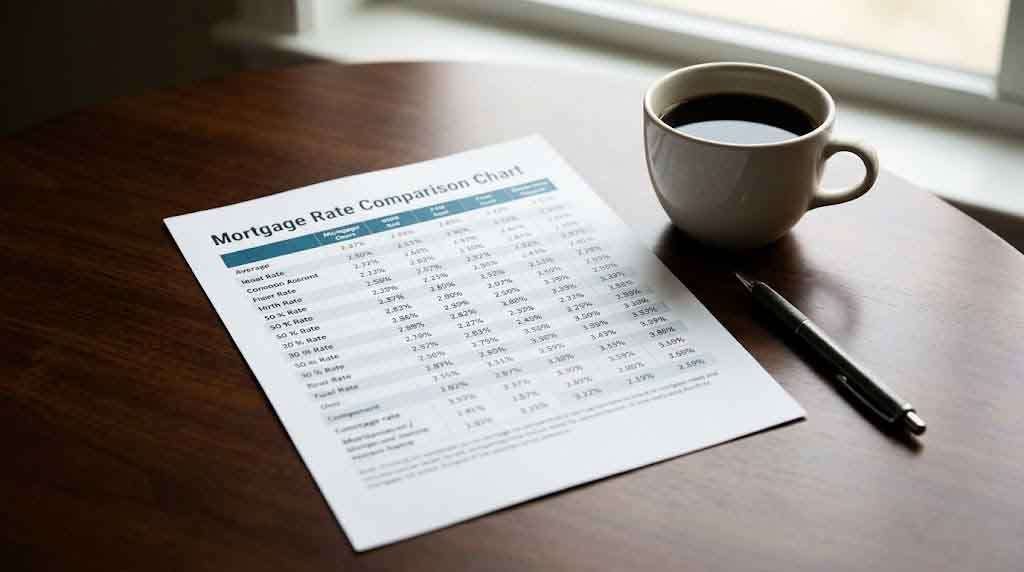
The effective mortgage rate on a jumbo loan hit 6.8% this week. For a $750,000 North Shore home, that’s roughly $387 more per month than it was in January. That’s not an abstraction. That’s a car payment. That’s a kid’s activity budget. That’s the difference between a buyer who moves and a buyer who waits.
Rates have been volatile in 2026 — and that word “volatile” does a lot of work. It sounds like market talk. What it means practically is this: a buyer who got a rate quote last Tuesday is looking at a different number this Sunday. The national 30-year fixed for conforming loans is hovering around 6.1% to 6.2% depending on the source and the day. But most North Shore transactions — especially in Port Jefferson, Smithtown, and St. James — clear the conforming loan limit. That pushes buyers into jumbo territory, where lenders price in their own risk premium. The spread between conforming and jumbo rates this spring has been running anywhere from 25 to 60 basis points. At the upper end of that range, you’re at 6.8% and above.
That spread matters. It changes the math in ways that buyers do not always see until they’re sitting across from a lender.
What the Numbers Actually Look Like
Run the math on a $750,000 purchase with 20% down — a $600,000 loan — at three different rate scenarios:
- At 5.8% (where rates briefly touched in late January): monthly principal and interest comes to approximately $3,528
- At 6.3% (where conforming rates are today): that number climbs to $3,720 — a difference of $192 per month
- At 6.8% (current jumbo rate reality): the monthly payment lands at $3,915 — up $387 from January’s low
Over a year, that $387 swing is $4,644 out of pocket. Over five years, it’s $23,220 — before you consider that the earlier buyer was also building equity faster on a lower total interest accrual.
Now run that same scenario on a $900,000 purchase — which is not unusual in Port Jefferson Village or in sections of Smithtown with waterfront access — with 20% down, a $720,000 loan:
- At 5.8%: approximately $4,234 per month
- At 6.8%: approximately $4,698 per month
That’s a $464 monthly gap. The house hasn’t changed. The neighborhood hasn’t changed. The rate did.
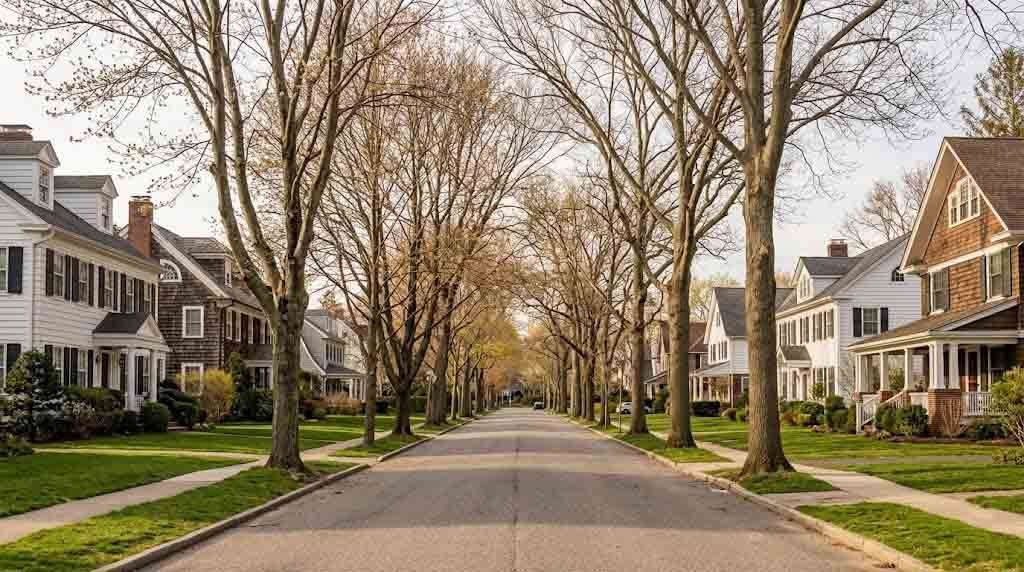
Port Jefferson, Smithtown, and St. James: Where the Market Sits Right Now
These three communities are not the same market. They look adjacent on a map but they price, sell, and behave differently.
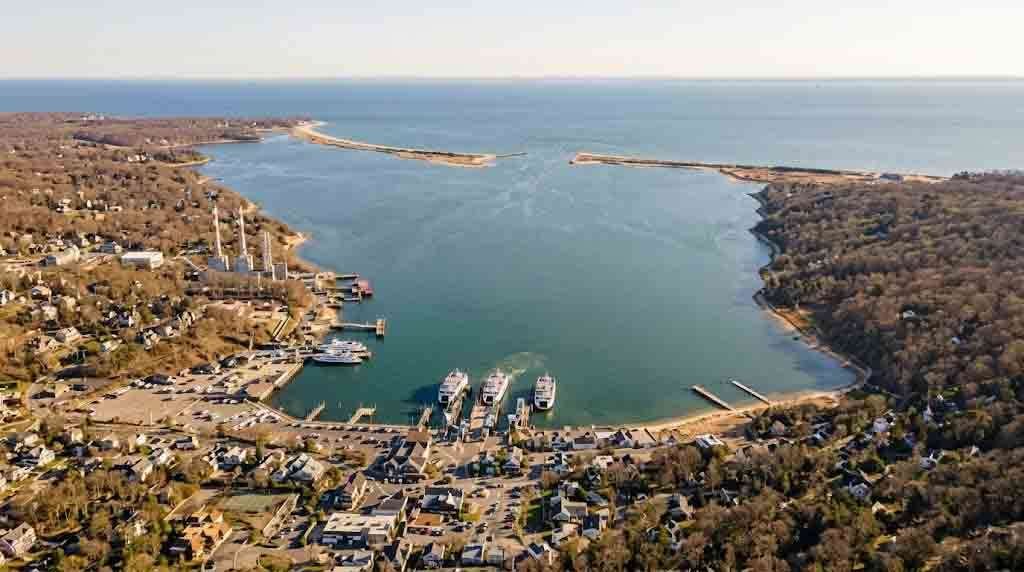
Port Jefferson Village carries a premium that doesn’t negotiate much. The harbor, the walkability, the ferry connection to Bridgeport — these are structural advantages that compress inventory and hold price floors even when rate pressure mounts. Median sale prices here have been running in the $650,000 to $850,000 range depending on proximity to the water. At 6.8%, that upper range puts buyers squarely into jumbo territory with payments that test household budgets qualified at lower rates. Sellers here have not meaningfully reduced asking prices yet. What’s changed is days on market — slightly longer, with fewer multiple-offer situations than in 2023.
Smithtown is a larger, more diverse market. You have everything from modest ranch homes in the $450,000s that stay conforming, to larger colonials and expanded ranches in the $700,000s and above that don’t. The buyers priced out of Port Jefferson often land here. That’s kept demand stickier than the rate environment alone would predict. Inventory is thin — as it has been across the North Shore for several years, a pattern I wrote about in detail in What Never Hits Zillow: The Hidden Inventory Problem on Long Island’s North Shore. When supply is compressed and demand has nowhere else to redirect, rate increases create hesitation but not collapse.
St. James is the quiet one in this comparison. It doesn’t have the name recognition of Port Jefferson or the volume of Smithtown, but it offers character — older homes, mature trees, proximity to Nissequogue and Short Beach — at prices that can still come in under conforming limits if a buyer moves quickly on the right property. For buyers who have flexibility on where they land, St. James is worth the attention. The rate math is the same but the base price is lower, which keeps monthly payments in a range that more households can absorb.
The Fed, the Bond Market, and Why Nobody Can Tell You Where Rates Go Next
The Federal Reserve is meeting March 17–18. Virtually every economist watching this cycle expects them to hold the federal funds rate steady. That expectation is already priced into the bond market — but “priced in” doesn’t mean inert. What the Fed says about future rate trajectory matters as much as what they do. A single sentence in the statement about inflation persistence or labor market softening can move the 10-year Treasury yield, which moves mortgage rates within 24 hours.
The complication in 2026 is that the Fed is reading contradictory signals. The job market has softened. Inflation is being pushed higher by oil price increases connected to geopolitical instability. These two forces pull in opposite directions on rate policy. The MBA’s chief economist noted this week that despite weaker-than-expected employment data, rate cuts are unlikely given the inflation risk. That’s not a green light for buyers hoping rates fall by spring. It’s a yellow light. Possibly a long one.
Paola’s Advice: Rate Locks, ARMs, and Timing Strategy for 2026
My wife Paola, broker at Maison Pawli Realty, works with North Shore buyers across exactly these communities. Here’s what she’s advising clients right now.
On rate locks: Lock sooner than you think you need to. The temptation is to float — to wait for a better number before committing. But in a week where rates moved 19 basis points on the refinance side alone, floating is a gamble on timing that most buyers don’t have the information advantage to win. A 30-day or 45-day lock costs nothing in most cases. Use it.
On ARM products: The 5/1 ARM is back in the conversation for North Shore buyers, particularly those in the $700,000–$900,000 range who plan to sell or refinance within five to seven years. The 5/1 ARM rate this week is running around 5.4% — more than a full percentage point below the 30-year fixed jumbo rate. On a $720,000 loan, that’s approximately $480 per month in savings during the initial fixed period. The risk is real: after year five, the rate adjusts annually. But for buyers who don’t plan to hold for 30 years, the arithmetic favors the ARM. Talk to your lender about caps — specifically the lifetime cap and the adjustment cap — before committing.
On timing: The spring market on the North Shore activates in late March. Inventory that has been sitting since fall tends to move, and new listings arrive. Buyers who are pre-approved and positioned to move in April have leverage that buyers who are still shopping in June often lose. Paola’s consistent advice: get your financing sorted before the market heats up, not after. The rate environment may shift between now and closing, but a prepared buyer closes. A hesitant buyer watches someone else close.
The Broader Calculation: Waiting Has Its Own Cost
Rate anxiety produces a specific kind of paralysis. The logic goes: rates might come down, so I’ll wait. It’s not unreasonable. Fannie Mae and the MBA are both forecasting rates near 6% through year-end. If that holds, waiting until late 2026 might save a quarter point. On a $600,000 loan, that’s roughly $97 per month. But the median North Shore sale price has been rising at a pace that easily absorbs that monthly savings in the form of a higher purchase price. A buyer who waits six months for a 0.25% rate improvement and buys at a price $20,000 higher than today has not saved money. They’ve moved the debt around.
This isn’t an argument that rates don’t matter. They matter enormously, as the payment comparisons above show. It’s an argument against treating rate-watching as a substitute for buying strategy.
For a first-look at how to position yourself competitively in a market where inventory is still tight despite rate pressure, the How to Win a Bidding War in a Low-Inventory Market post is worth your time. And for buyers earlier in the process trying to understand where they can realistically land on the North Shore with current financing, Buying Your First Home on Long Island: The Neighborhoods Nobody Talks About maps out options that don’t always show up in the obvious searches.
What to Do This Week
If you are a North Shore buyer in the $650,000–$950,000 range, here is the short list:
Get pre-approved with a lender who can offer both conforming and jumbo products. Know which side of the conforming limit your target homes sit on — it changes your rate options. Ask specifically about 5/1 and 7/1 ARM products and model the payment scenarios honestly. If a property you like comes available, lock the rate at application rather than at commitment. And talk to a broker who knows these specific communities — not a national platform that treats Port Jefferson and Smithtown as the same data point.
The rate environment in 2026 is not forgiving. But it is navigable for buyers who understand what they’re actually paying for, and why.
You Might Also Like:
- What Never Hits Zillow: The Hidden Inventory Problem on Long Island’s North Shore
- Global Markets and Local Impact: How the U.S.-Iran Conflict Is Shifting Energy Costs for Long Island Estates
- First-Time Homebuyer’s Roadmap for Long Island in 2026
Sources:
- Freddie Mac Primary Mortgage Market Survey, week ending March 12, 2026: https://www.freddiemac.com/pmms
- Bankrate, “Today’s Mortgage Rates, March 13, 2026”: https://www.bankrate.com/mortgages/todays-rates/mortgage-rates-for-friday-march-13-2026/
- CBS News, “What are today’s mortgage interest rates: March 13, 2026?”: https://www.cbsnews.com/news/todays-mortgage-interest-rates-march-13-2026/
- Yahoo Finance, “Mortgage and Refinance Interest Rates Today, March 15, 2026”: https://finance.yahoo.com/personal-finance/mortgages/article/mortgage-refinance-interest-rates-today-sunday-march-15-2026-100000241.html
- Norada Real Estate, “Mortgage Rates Today, March 15, 2026”: https://www.noradarealestate.com/blog/mortgage-rates-today-march-15-2026-30-year-refinance-rate-rises-by-19-basis-points/
- Mortgage Bankers Association, chief economist Mike Fratantoni statement on FOMC outlook, March 2026: https://www.bankrate.com/mortgages/todays-rates/mortgage-rates-for-thursday-march-12-2026/
- Maison Pawli Realty, About: https://maisonpawli.com/about/