You’re not weak. Your appetite isn’t broken. You’re just eating in a world designed to starve you of the one macro that matters.
That’s the blunt summary of a scientific framework called the Protein Leverage Hypothesis — and once you understand it, a lot of things stop being mysterious. Why you can put down an entire bag of chips but can’t stop eating at 75 grams of steak. Why you finished dinner an hour ago and your hand is already in the cabinet. Why the low-fat, high-carb food environment of the last fifty years didn’t make people thinner. It made them hungrier.
What the Protein Leverage Hypothesis Actually Says
The hypothesis was first formally proposed in 2005 by biologists David Raubenheimer and Stephen Simpson, working out of the Charles Perkins Centre at the University of Sydney. Their thesis was not that protein is a magic macronutrient. Their thesis was something more precise: that animals — including humans — have a dominant regulatory drive to hit a protein target, and they will keep eating until they hit it.
Not a calorie target. A protein target.
This means if your meals are diluted with fat and carbohydrate but low in protein, your body doesn’t say “enough calories, shut it down.” It says “still waiting on the protein” — and it keeps the hunger signal running until the target is met. In practice, this means eating more total calories than you need in the pursuit of a protein quota your diet was never actually designed to deliver.
Raubenheimer and Simpson ran these studies on locusts first, then crickets, then a remarkable range of vertebrates. In every case, the animal would eat past its caloric needs to satisfy protein requirements. When researchers diluted dietary protein with non-protein calories, total food intake went up. When protein density was high, total consumption dropped.
Then they turned the lens on humans.
A landmark controlled trial published in PLOS ONE in 2011 — the “Protein Leverage in Lean and Obese Individuals” study — fed subjects diets at three protein levels: 10%, 15%, and 25% of total calories. The 10% group ate significantly more total food. The 25% group ate less, felt more satisfied, and stopped naturally. Appetite tracked protein intake, not calorie intake. The body was doing exactly what Raubenheimer and Simpson predicted.

The Modern Diet as a Protein Dilution Machine
Here’s where the hypothesis becomes an indictment of modern food culture.
The processed food industry builds products dense in refined carbohydrate, seed oils, and sodium. They are engineered for palatability. But their protein percentage is almost always low — often below 10% of total calories. A bag of crackers. A loaf of supermarket bread. A bowl of breakfast cereal. Even most fast food, when you back out the protein from total calories, delivers protein at around 12–15% — right at the edge of the threshold where leverage kicks in.
Your body reads these foods and keeps running the hunger program. It isn’t a failure of willpower. It’s a regulatory system doing exactly what it evolved to do, running against a food environment it was never built to face.
When protein percentage in the diet falls below roughly 15% of total energy intake, Raubenheimer and Simpson’s model predicts that calorie consumption will increase to compensate. The global decline in dietary protein density — driven by a shift toward cheap, carbohydrate-heavy processed foods — corresponds almost precisely to the timeline of rising obesity rates in Western populations. The timeline isn’t a coincidence. The mechanism explains the timeline.
Where Keto Gets This Right — and Why Animal Protein Is the Core
A well-structured ketogenic diet is not primarily about carbohydrate restriction, though that’s usually how it’s described. It is, at its foundation, a diet that is protein-adequate and fat-sufficient, which means it dismantles the protein leverage trap almost by default.
When you remove the refined carbohydrate scaffolding from your meals and replace it with animal protein and fat, two things happen. First, you hit your protein target faster, so the hunger signal has an actual reason to power down. Second, fat — which has no specific regulatory drive the way protein does — fills the remaining energy balance without triggering overconsumption behavior.
The practical target that emerges from the research is somewhere between 1.2 and 1.6 grams of protein per kilogram of body weight per day for sedentary adults, rising to 1.6–2.2 grams per kilogram for people doing resistance training. For a 180-pound man, that’s roughly 100–140 grams of protein daily just for baseline satiety and muscle maintenance. Most people eating a standard American diet don’t come close. They eat too many calories and not enough protein, simultaneously — which is exactly what the hypothesis predicts.
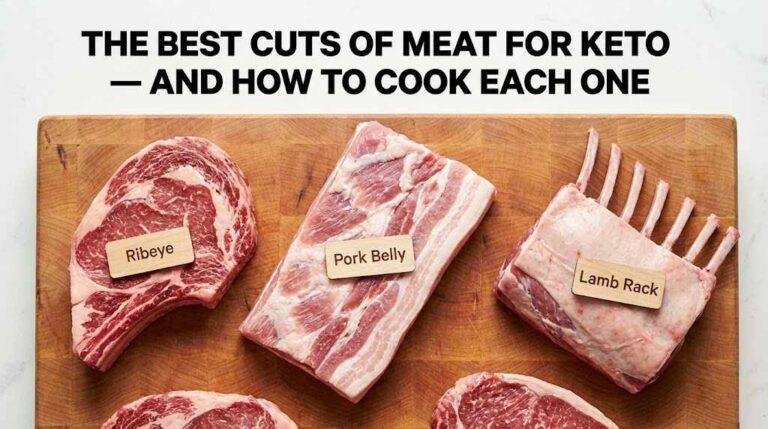
The foods that get you there efficiently are not complicated. Beef. Eggs. Whole fish. Chicken thighs and legs rather than breast meat skinned and stripped of everything that makes it filling. These are not luxury items. They are the oldest human foods. They are what the body was calibrated against before the modern protein dilution machine was built.
What Adequate Protein Actually Looks Like on a Plate
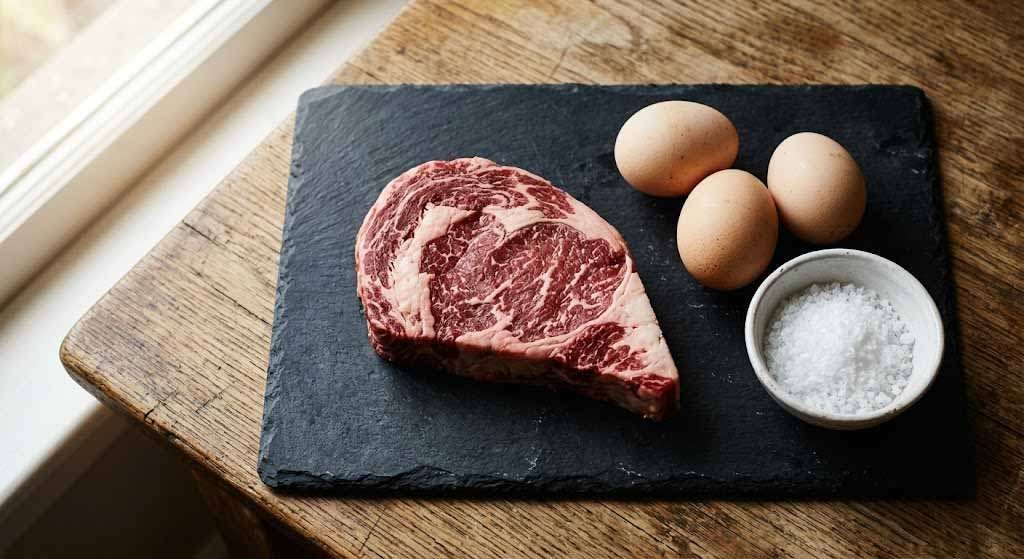
Most people have no intuition for how much protein is in what they’re eating. A slice of deli turkey has maybe 5 grams. A whole egg has 6. A cup of Greek yogurt has 15–20 depending on the brand. A 6-ounce grass-fed ribeye has roughly 42 grams.
The math makes the problem obvious. If you’re building meals around bread, pasta, and small incidental amounts of protein — a couple slices of turkey on a sandwich, some cheese on pasta — you’re nowhere near the target, and the hunger drive knows it before you do. You’ll eat the whole sandwich and still feel like something’s missing. That missing thing is the protein quota your body was waiting to close.
Hitting 120 grams of protein in a day on a keto diet is not difficult. Three eggs at breakfast plus two slices of bacon: roughly 25 grams. A 6-ounce piece of salmon at lunch: roughly 34 grams. A 8-ounce grass-fed burger patty at dinner: roughly 55 grams. That’s 114 grams before you’ve added any sides. The hunger signal has nothing left to chase.
This is why the keto adaptation timeline often feels so different from other approaches — the appetite doesn’t just diminish, it becomes comprehensible. You eat, you feel done. There’s no phantom hunger running in the background three hours later demanding something it never got.

Finding Quality Animal Protein on Long Island’s North Shore
The protein leverage hypothesis isn’t an abstract laboratory finding. It has immediate, practical implications for what you buy, where you buy it, and how much processing stands between the animal and your plate.
Heavily processed protein foods — deli meats loaded with fillers, protein bars built on soy isolate and sugar alcohols, flavored chicken breast products with ingredient lists that run to a paragraph — deliver protein with a lot of interference. The protein is there in the label. Whether it performs the same regulatory function as a clean whole food source is a reasonable question.
On Long Island’s North Shore, the sourcing options are strong. Four Season Farm Stand in Smithtown carries pastured eggs and locally sourced meats when in season. Whole Foods in Commack maintains a reliable grass-fed beef section and wild-caught fish counter. The North Fork — about an hour east along Route 25 — is home to several farms with direct-to-consumer beef and pork programs. Catapano Dairy in Peconic sells goat cheese and whole milk products at consistently high protein-to-calorie ratios.
For the freezer-stocking approach that makes weeknight protein targets achievable, a quarter or half share of a local grass-fed cow — sourced through farms in Calverton or Aquebogue — runs competitively against supermarket prices once the per-pound math is worked out. The anti-inflammatory eating guide covers some of these sourcing options in more detail if you want a broader framework.
Eggs remain the most underrated protein food available to anyone on a budget. A dozen pastured eggs from a farm stand runs $6–8 on the North Shore and delivers roughly 72 grams of complete protein. There is no protein bar, powder, or supplement that comes close to that ratio of cost to nutrition and satiety.
The Structural Problem No One Wants to Name
The protein leverage hypothesis is, at its core, a critique of the food environment — and the food environment was built by an industry that profits from the hunger it creates. A bag of chips engineered to hit every palatability cue while delivering almost no protein keeps you eating, keeps you buying. A grass-fed ribeye doesn’t. The ribeye closes the loop.
This is not a conspiracy claim. It is an observation about incentive structures. The cheapest, most shelf-stable, most margin-friendly foods are built on carbohydrate and fat. Protein is expensive to source, store, and deliver. The entire architecture of processed food — from breakfast cereal to granola bars to flavored rice cakes — is built on cheap macros that the body will never register as sufficient.
Understanding the protein leverage hypothesis doesn’t require rejecting carbohydrates categorically or adopting any particular dietary ideology. What it requires is recognizing that your hunger is not random. It is directional. It is looking for something specific. And if the food environment you live in doesn’t provide it in sufficient density, you will eat past your caloric needs while the hunger drive keeps waiting.
The fix is not complicated. It is just increasingly countercultural.
Eat the steak. Eat the eggs. Close the loop before it runs you around the kitchen at 10 PM looking for something that was never going to be in the cracker box.
Sources
- Raubenheimer, D., & Simpson, S.J. (2005). Obesity: The protein leverage hypothesis. Obesity Reviews, 6(2), 133–142. https://onlinelibrary.wiley.com/doi/10.1111/j.1467-789X.2005.00178.x
- Gosby, A.K., et al. (2011). Testing protein leverage in lean humans: A randomised controlled experimental study. PLOS ONE, 6(10), e25929. https://journals.plos.org/plosone/article?id=10.1371/journal.pone.0025929
- Simpson, S.J., & Raubenheimer, D. (2012). The Nature of Nutrition: A Unifying Framework from Animal Adaptation to Human Obesity. Princeton University Press.
- Hall, K.D., et al. (2019). Ultra-processed diets cause excess calorie intake and weight gain. Cell Metabolism, 30(1), 67–77. https://www.cell.com/cell-metabolism/fulltext/S1550-4131(19)30248-7
- Morton, R.W., et al. (2018). A systematic review, meta-analysis and meta-regression of the effect of protein supplementation on resistance training–induced gains in muscle mass and strength. British Journal of Sports Medicine, 52(6), 376–384. https://bjsm.bmj.com/content/52/6/376
- Martens, E.A., & Westerterp-Plantenga, M.S. (2014). Protein diets, body weight loss and weight maintenance. Current Opinion in Clinical Nutrition & Metabolic Care, 17(1), 75–79. https://journals.lww.com/co-clinicalnutrition/Abstract/2014/01000/Protein_diets,_body_weight_loss_and_weight.12.aspx
You Might Also Like: