
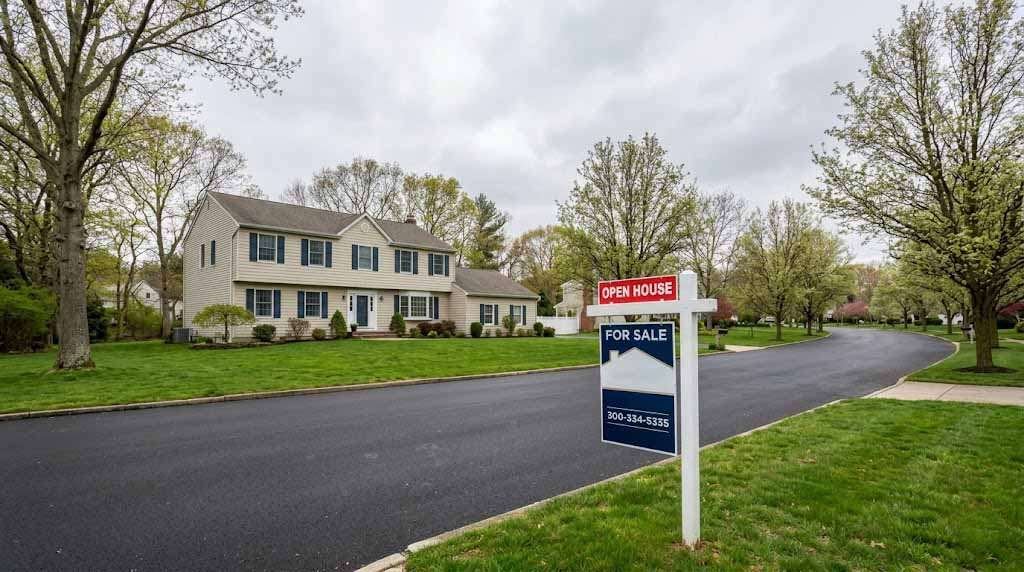
There’s a dead zone in the North Shore market right now, and it’s swallowing well-priced homes whole.
Not homes that are overpriced. Not homes with problems. Homes that, by every reasonable measure, should be moving — good bones, good schools, good locations. They’re sitting. Some have been sitting since last fall. And if you look closely at the numbers, you see why: they’re priced in a band that the current buyer pool simply cannot reach.
The band is $800,000 to $900,000. And in March 2026, it’s the single most dangerous place to list a home on Long Island’s North Shore.
What the Numbers Actually Show
Across Suffolk County MLS data from the first quarter of 2026, homes listed in the $800K–$900K range are averaging roughly 47% longer days-on-market compared to comparable properties priced either below $799,000 or above $950,000. That’s not a rounding error. That’s structural.
Below $799K, qualified buyers have options. They can stretch a conventional conforming loan, work with FHA if needed, and stay within monthly payment thresholds that still pencil out at current mortgage rates. Above $950K, you’re in a different buyer conversation entirely — people who are bringing significant equity from a prior sale, moving from Manhattan or Westchester with cash or a large down payment, or financing in a bracket where the jumbo loan process is routine for them.
The $800K–$900K band catches neither group cleanly. It’s too expensive for the conventional buyer who’s been saving for years, and not expensive enough to attract the buyer who considers $950K to $1.2M their natural hunting ground.
The result is inventory that sits. And inventory that sits gets stigmatized.

The Affordability Cliff — And Why It’s Real
Paola Meyer, broker at Maison Pawli Realty, works with North Shore buyers daily, and she’s direct about what’s happening at this price point.
“The buyers who can qualify for $800,000 have often been in the market for 18 months,” she explains. “They’ve watched rates move. They’ve done the math over and over. At current mortgage rates, the difference between a $799,000 purchase and an $849,000 purchase isn’t just $50,000 — it’s an extra $350 to $450 per month. For a household that’s already stretched, that’s real money. That’s the car payment. That’s the school tuition. That’s why they walk away.”
That monthly difference compounds psychologically. A buyer who has mentally committed to a payment ceiling doesn’t renegotiate that ceiling easily. They walk out of showings. They pass on beautiful homes that happen to be $40,000 over their limit. The seller — who priced at $849,000 because they wanted “room to negotiate” — ends up negotiating with no one.
The cliff is not abstract. It’s a budget line in someone’s spreadsheet, and it holds.
The Conforming Loan Picture in Suffolk County
Here’s where the financing mechanics matter. Suffolk County is designated a high-cost area by the Federal Housing Finance Agency, which means the 2026 conforming loan limit here runs up to $1,209,750 — well above the national baseline of $832,750. On paper, that sounds like great news for buyers in the $800K–$900K range: they’re well below the jumbo threshold, so conventional financing is fully available.
But conforming eligibility doesn’t automatically equal affordability. The issue isn’t the loan limit — it’s the monthly payment math at current rates, and the down payment required to make those payments manageable.
A buyer putting 10% down on an $850,000 home carries a $765,000 mortgage. At a rate in the mid-to-upper 6% range — where most conventional buyers are landing right now — that’s a monthly principal and interest payment approaching $4,900. Add property taxes (Suffolk County’s are among the highest in the country), homeowner’s insurance, and PMI if they’re below 20% down, and the total housing cost can clear $7,000 per month for a household with a good income but not an exceptional one.
That’s not a financing obstacle. It’s an income obstacle. And the North Shore buyer pool in the $800K–$900K range often earns enough to want the home — but not enough to be comfortable with the monthly commitment.

Why $799K Beats $849K — Even If It’s the Same House
This is where strategy separates the sellers who move their homes from the sellers who don’t.
The psychological effect of pricing below $800,000 isn’t subtle. A home listed at $799,000 appears in every search filtered “under $800K.” A home listed at $849,000 does not. On platforms like Zillow, Realtor.com, and the MLS, buyers set search caps in round numbers — $700K, $750K, $800K. Pricing at $849K means you’re invisible to an entire segment of the buyer pool that would otherwise walk through your door.
Paola puts it plainly: “I’ve had sellers resist $799,000 because it feels like a discount off $850,000. But $799,000 generates showings. Showings generate offers. Multiple offers generate a final price that often exceeds what a single buyer would have paid at $849,000 with zero competition.”
That’s not theory. That’s what happens when inventory clears versus when it doesn’t.
Strategic underpricing — listing at or just below a psychological round number — creates demand compression. It concentrates buyer attention. In a market where the pool of qualified buyers for this bracket is thin, you want every one of them walking through your door. You do not want them filtered out before they ever see the listing.
The Seller’s Mistake — And the Longer Cost of Waiting
A home that sits for 90 days in this price band acquires a market reputation that’s hard to shake. Buyers notice the days-on-market. Their agents notice it. The unspoken assumption is that something is wrong — the inspection failed, the seller is difficult, there’s a problem that hasn’t surfaced yet.
None of that may be true. The home might be in excellent condition. But perception calcifies quickly in a slow market, and a listing that should have sold in three weeks at $799,000 can spend four months at $849,000 before the seller accepts less than $799,000 anyway.
The math almost always comes back to prove what a smarter list price would have yielded from the start.
There’s also the carrying cost to consider. Every month that home sits is another mortgage payment, another tax installment, another period of uncertainty for a seller who may have already purchased elsewhere, already relocated, already moved on in every way except financially. The cost of waiting at the wrong price is not just measured in dollars — it’s measured in months of stress.
What Sellers in This Price Band Should Do Right Now
The practical answer is not complicated, but it requires overriding the emotional attachment to a number.
Price with precision, not ego. If your home’s value lands in the $800K–$900K range, the most important decision you’ll make is whether to position below $800K or above $900K. Sitting in the middle of that band, by the evidence of this market, is the most reliable way to extend your listing’s life without extending your sale price.
Work with a broker who has current data and North Shore-specific market knowledge. The Q1 2026 Long Island real estate market update captures how quickly conditions are shifting at various price points. And if you’re trying to understand which side of a price band your home should land on, the answer has to come from a forensic look at recent comparable sales — not from online valuations and not from what your neighbor sold for in 2023.
The dead zone is real. The data is clear. And the sellers who price through it, rather than into it, will be the ones who close this spring.