A Brooklyn Family Takes the Wrong Train
The story of how Stony Brook became Stony Brook begins with an accidental train ride. At the turn of the twentieth century, Brooklyn residents Frank and Jennie Melville were heading to the Hamptons for a summer retreat with their son Ward. They accidentally boarded the wrong train and instead traveled to the hamlet of Stony Brook — and fell in love with the quaint village.
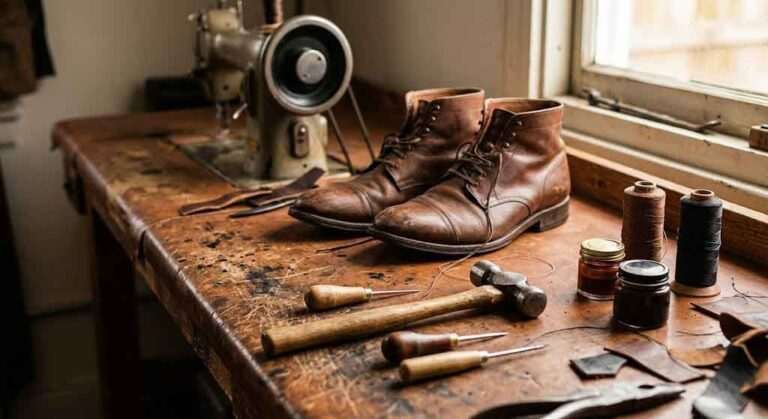
Frank Melville was the founder of the Melville Shoe Corporation, which by the time Ward took it over would become, according to the Stony Brook Village Center’s own records, the third largest retailer in the United States, with chains that would later include CVS Drugs, Marshalls, and KB Toys. These were not modest people. When Ward succeeded his father, he inherited not only a retail empire but his parents’ sentimental attachment to the village they’d stumbled into.
Troubled by the growing effects of the Great Depression and the area’s collection of rundown buildings, Jennie Melville urged civic cooperation among the three neighboring communities of Stony Brook, Old Field, and Setauket — dubbing them the “Three Villages.” When Jennie died, the project passed entirely to Ward. He had a plan in mind that his family had been thinking about for nearly a decade.
The plan was called a “living Williamsburg.”
The Living Williamsburg Problem
That phrase is worth sitting with. Colonial Williamsburg, the Virginia restoration project, opened to the public in 1932 after John D. Rockefeller Jr. poured tens of millions into recreating an eighteenth-century colonial town — much of which involved demolishing existing nineteenth-century buildings that got in the way of the idealized colonial aesthetic. The result is one of the most visited historical attractions in the country and one of the more debated acts of historical erasure in American preservation history. Historians have long noted that Williamsburg’s vision of the colonial era was selective, sanitized, and built around a white middle-class narrative that conveniently minimized the role of the enslaved people who actually made the economy of that era run.
Melville’s “living Williamsburg” for Stony Brook operated on a similar logic. The goal was not to preserve what was there — it was to build what should have been there, according to an idealized image of colonial New England village life.
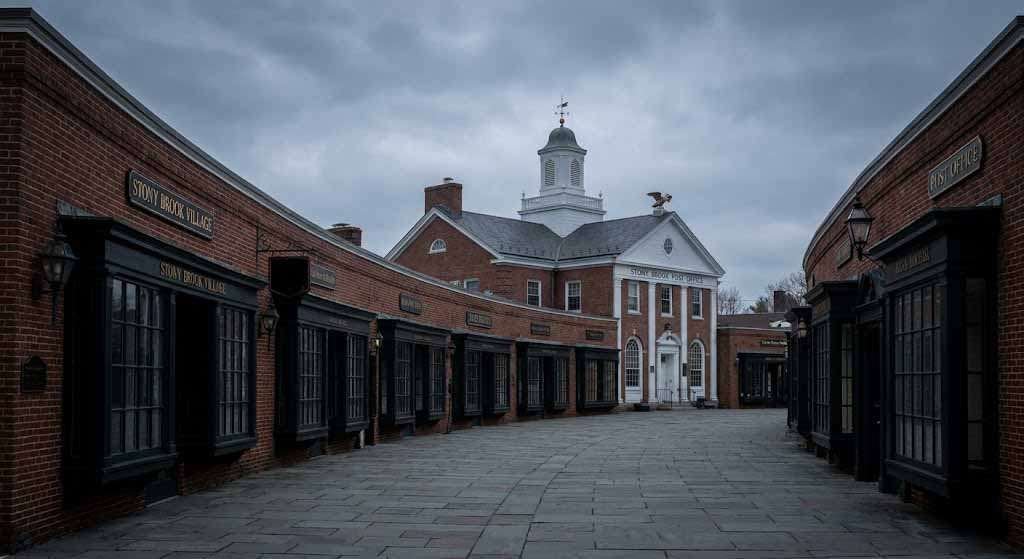
Ward Melville envisioned the rehabilitated Stony Brook as a beautification project, an economic engine, and a community social undertaking. He hosted a community dinner at the Three Village Inn in January 1940 and presented his plan: a crescent-shaped Village Center with connected shops grouped around a federalist-style post office. The proposal passed with majority approval.
What followed was comprehensive demolition. He relocated, demolished, or modified some thirty-five buildings in the downtown area. The enormous undertaking also included the rerouting of roads, the relocation of large trees, and moving one million cubic yards of dirt. He paid for all of it personally — a figure that in today’s money clears eight million dollars.
What Was Actually There Before
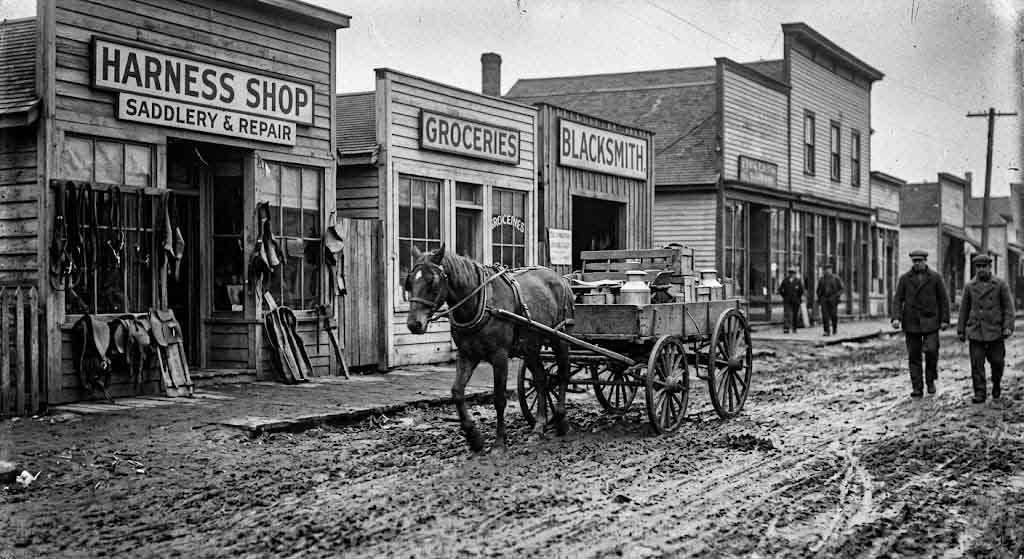
Before Melville remade it, old Stony Brook was a working harbor village with a commercial life that had developed organically over two centuries. There were several small homesteads and farms, a harness maker’s shop, a blacksmith shop, and a schoolhouse. The business area included an ice cream parlor, drug store, hardware store, tea room, secondhand clothing store, Chinese laundry, a tailor shop, a butcher shop, a barber shop, a livery stable, a shoemaker’s shop, a post office, and at least two general stores.
Read that list again. A Chinese laundry. A shoemaker. A secondhand clothing shop. A saloon. These are not the businesses of wealthy preservationists enjoying a curated colonial experience. They’re the businesses of working people trying to get through the week. The harness maker became a butcher shop around 1900. The soda fountain changed hands. The bank building, featuring a shingled mansard roof, housed a library, a dance hall, a lodge, and a drug store in addition to the bank. That building was torn down as part of the rehabilitation of the Stony Brook shopping area in 1941.
The village that existed before 1941 was not picturesque by anyone’s account — it had weathered the Depression badly and looked it. But it was actual. It had accumulated its character the way real places do: through commerce and need and accident and time. People had lived and worked and argued and gotten drunk at Jacinsky’s Saloon. They had real grievances. They left no plaques.
Melville’s Village Center preserved some of the existing businesses — they moved into the new colonial-style storefronts — but the physical fabric of the old working village, its organic clutter and its street-level reality, was gone. In its place was a crescent of coordinated brick with cast-iron lampposts and bluestone walkways, radiating around a two-acre green that opened to the harbor.
It is beautiful. It really is. But beautiful is not the same as real.
The Shoe Magnate as Urban Planner
What makes the Stony Brook project historically interesting — and historically uncomfortable — is the class dynamic embedded in it. Ward Melville was, by any measure, a wealthy and in many ways genuinely benevolent man. He donated land to what became Stony Brook University. He funded institutions and churches and conservation trusts. He was not a robber baron squeezing workers. But he was still a man whose inherited shoe fortune gave him the standing to bulldoze a working village and replace it with his own vision of what a village should look like.
The village residents voted to approve the plan, yes. But the vote was held six years out from the Great Depression. The existing buildings were in disrepair. Melville was offering to pay for everything himself and keep the existing businesses. The alternatives were not great. Under those conditions, majority approval is not exactly a ringing democratic mandate.
Melville saw Stony Brook as a community where people would walk, greet one another, converse, discuss the day’s politics and be responsible, involved citizens. That vision is not cynical — it comes from a real belief in civic life. But it is the vision of a man with money, not the vision of the man who ran the harness shop. The man who ran the harness shop wanted his customers to be able to find the place and have a drink afterwards. He did not particularly care whether the lampposts were cast iron.
This is the consistent logic of American planned communities and “heritage” redevelopment projects from the mid-twentieth century forward: the people who fund them get to decide what history looks like. Sometimes they make decisions that are genuinely good for the community. Often, they make decisions that are genuinely good for aesthetics. These are not the same decision.
What the Eagle Means
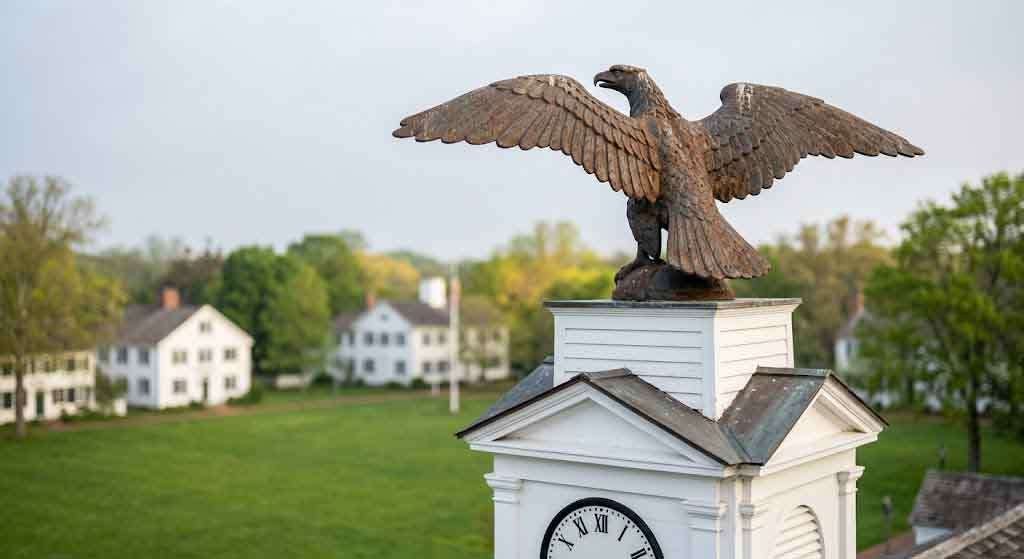
The mechanical eagle on top of the Stony Brook Post Office flaps its wings every hour on the hour, from eight in the morning to eight at night. Ward Melville planned it and instituted it himself. It was recently restored after eighty-three years of service. It is, by all accounts, charming. Kids love it. Tourists photograph it. It is exactly the kind of thing you put in a place you are building to feel like it has always been there.
The Heritage Organization that carries Melville’s name continues to do genuine preservation work in the area — the grist mill, the historic properties, the environmental conservation. Some of it is excellent. The Long Island Museum is legitimately good. The Jazz Loft is legitimately good. These are not small things.
But the origin story is what it is. Stony Brook Village looks the way it looks because a shoe magnate from Brooklyn decided it should look that way, spent the money to make it happen, and hired an architect named Richard Haviland Smith to design the crescent. What survived was curated. What was demolished was real. The result is one of the most photographed village centers on Long Island, and one of the most artfully constructed illusions.
I have eaten lunch there. The deli is fine. I have walked past the post office and watched the eagle. I’ll probably do it again.
But when people talk about Stony Brook as though they are touching something genuinely old, I think about the harness maker’s shop. I think about Jacinsky’s Saloon. I think about the soda fountain and the dance hall in the building with the shingled mansard roof that got torn down so the vista to the harbor could be opened up.
History isn’t always the thing on the brass plaque. Sometimes it’s the thing that got in the way.
You Might Also Like
- Rum Row and the Freeport Bootleggers: Long Island’s Clandestine War on the Water
- What Never Hits Zillow: The Hidden Inventory Problem on Long Island’s North Shore
Sources
- Ward Melville Heritage Organization: https://wmho.org/about-ward-melville-heritage-foundation/
- Stony Brook Village Center Official History: https://stonybrookvillage.com/about-us/
- Stony Brook Village Center, Wikipedia: https://en.wikipedia.org/wiki/Stony_Brook_Village_Center
- Ward Melville, Wikipedia: https://en.wikipedia.org/wiki/Ward_Melville
- TBR News Media — History Close at Hand: https://tbrnewsmedia.com/history-close-at-hand-stony-brook-before-and-after-ward-melville/
- TBR News Media — WMHO 75th Anniversary: https://tbrnewsmedia.com/wmho-celebrates-75th-anniversary-with-new-exhibit-and-events/