
There’s a building in Port Jefferson that sat full of black powder while the British Navy patrolled the harbor outside. Most locals have walked past its site a hundred times without knowing it.
You know how Port Jefferson goes: ferry dock, restaurants, the hill up to the charming blocks of Main Street, maybe a walk along the harbor. The tourist placards tell you about shipbuilding. They’ll mention Thomas Jefferson. What they don’t tell you is that this village was, for a few tense years in the early nineteenth century, a genuine military logistics node — and the British fleet knew it.
Long Island Sound Was a War Zone
The War of 1812 tends to get compressed into a few famous images: the burning of Washington, the writing of the Star-Spangled Banner, Andrew Jackson at New Orleans. What gets lost is the naval dimension — specifically, what the Royal Navy’s systematic blockade of the American coast meant for a harbor village on Long Island’s North Shore.
By late 1813, Britain had extended its official blockade to Long Island Sound and the remaining northeastern ports. The HMS Sylph and HMS Maidstone were extensively active in the Sound by 1814, interrupting commerce and capturing or destroying merchant vessels throughout the summer months. The British weren’t just harassing shipping for sport — they were strangling the coastal economy that knitted together New England manufacturing towns, New York markets, and the agricultural villages of Long Island.
Port Jefferson — still known as Drowned Meadow at the time, a name its merchants were actively trying to shake — sat directly in the path of this pressure. Its deep natural harbor made it both strategically useful and strategically vulnerable. The same geography that made it a good place to build ships made it a visible target.
The Militia and the Muster Rolls
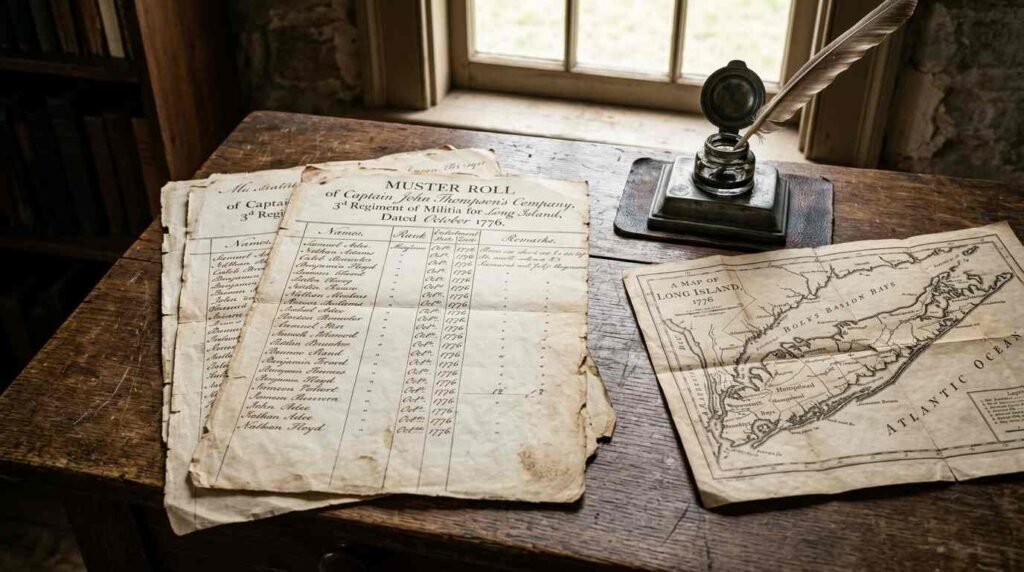
What most people don’t realize is that Long Island sent men to this war. The Suffolk County Historical Society in Riverhead holds War of 1812 militia muster rolls that document North Shore men called to service — farmers and shipwrights who picked up muskets and reported for duty along a coast they’d spent their whole lives on.
This wasn’t ceremonial. In early June 1814, a British landing party attempted to come ashore near Northville, Long Island, to destroy an American vessel. They were beaten off by local militia under Captain John Terry, who fired on the marines from the bluffs. The Sound wasn’t a distant theater — it was the front yard.
The New York State Archives holds records of powder magazine placements across coastal villages during this period. Gunpowder storage was a genuine logistics problem: you couldn’t keep it aboard vessels (too vulnerable to capture), you couldn’t leave it in private homes (too dangerous), and you couldn’t move it quickly once the British started patrolling. So communities designated specific structures as powder magazines — solidly built, ideally stone, away from the main cluster of buildings, but accessible enough to supply a militia company on short notice.
Port Jefferson had one such structure on or near what is now East Main Street. Mildred De Riggi, a local historian who documented early Port Jefferson military infrastructure in research for the Three Village Historical Society, identified this storage point in the context of the village’s broader wartime role. Its exact location is no longer marked. The building is gone. The street is the same street.
HMS Ramillies and the Psychology of Occupation
The ship that haunted Long Island Sound during the war’s middle years was HMS Ramillies, a 74-gun ship-of-the-line under Admiral Thomas Masterman Hardy — the same Hardy who had been at Nelson’s side at Trafalgar. Hardy was not a cruel commander, but he was effective. His squadron’s blockade was tight enough that American merchants complained they were “closely blockaded” and unable to move cargo.
The psychological weight of this is hard to overstate if you’re trying to imagine what daily life looked like in a harbor village. British warships were visible from the shore. Their presence determined whether fishing boats could go out, whether coastal traders could move, whether the economy of the village functioned at all. The Royal Navy didn’t need to come ashore to make its point.
This is part of why the gunpowder magazine mattered beyond its tactical function. It was a statement. The militia was organized, the powder was stored, the muster rolls were kept. The village was telling itself — and by extension the British squadron offshore — that it was prepared to resist.
What This Means If You’re Buying Here
Here’s where history becomes useful, not just interesting.
The military and commercial pressures of the War of 1812 shaped which properties along the North Shore got developed and which stayed empty for decades afterward. Powder storage infrastructure, militia assembly points, and naval threat zones all influenced where permanent structures were built — and where they weren’t. The blockade strangled commerce for nearly two years, which meant building projects stalled, capital dried up, and the physical development of harbor villages like Port Jefferson was effectively frozen during a critical period.
When the war ended with the Treaty of Ghent in December 1814, the villages that bounced back fastest were the ones with pre-existing maritime infrastructure — deep harbors, shipyard capacity, commercial networks. Port Jefferson had all of those things. That’s part of why, within twenty years of the war’s end, it had become the leading shipbuilding center in Suffolk County.
The land patterns you see today — where the commercial district sits, where the residential streets run, which parcels stayed undeveloped longest — carry traces of decisions made under British naval pressure two centuries ago. This doesn’t show up on a listing. But it’s embedded in the street grid.

The Erasure of Local Memory
Port Jefferson talks about its shipbuilding era constantly. It talks about P.T. Barnum and the ferry. It celebrates the Victorian architecture on the hill. The War of 1812 has been almost entirely erased from local memory — despite the fact that the blockade directly shaped the village’s economic trajectory, that local men served in the militia, and that someone, at some point, made the very specific decision to store gunpowder in a building on what is now one of the most photographed streets on the North Shore.
Part of this erasure is structural. The war ended in a technical draw. No decisive battles happened on Long Island soil (though the militia skirmishes were real enough). The records are scattered across the Suffolk County Historical Society, the New York State Archives, the Three Village Historical Society, and the National Archives — not consolidated, not commemorated, not on any walking tour.
I’ve written before about the buried history along this stretch of the Sound — the Old Field Point Lighthouse and what it meant for maritime navigation, the Culper Spy Ring and how Setauket’s geography shaped the Revolution. The War of 1812 is the gap between those stories, and it’s hiding in plain sight.
Walking It Now
Next time you’re walking up East Main Street — past the restaurants, the shops, the weekend foot traffic — consider that the ground has layers. The village you’re seeing is the product of decisions made under military pressure, by men who stored gunpowder and drilled with muskets while warships anchored in their harbor.
That’s not a metaphor. That’s the actual history of the place.
If you’re thinking about buying in Port Jefferson, Pawli at Maison Pawli a Boutique Modern Realty knows this village the way it deserves to be known — not just the listing data, but what the land has been through.
You Might Also Like
- The Old Field Point Lighthouse: Granite, Gale, and the Conscience of Long Island Sound
- Fire Across the Island: How Benjamin Tallmadge’s 1780 Raid on Coram Shaped Long Island’s Revolutionary Soul
- The Three Village Cemetery Codes: What the Symbols on North Shore Gravestones Actually Mean
Sources
- Suffolk County Historical Society, Riverhead, NY — War of 1812 militia muster rolls: www.suffolkcountyhistoricalsociety.org
- Three Village Historical Society — early Port Jefferson military infrastructure research: www.tvhs.org
- New York State Archives — War of 1812 collection, powder magazine records: www.archives.nysed.gov
- National Archives, RG 45 — Naval records, Long Island Sound operations: www.archives.gov
- Southold Historical Society — War of 1812 on Long Island, HMS Sylph and militia engagements: www.southoldhistorical.org/war-of-1812
- U.S. Naval Institute Proceedings — Robert Fulton’s Torpedo System in the War of 1812 (September 1946): www.usni.org