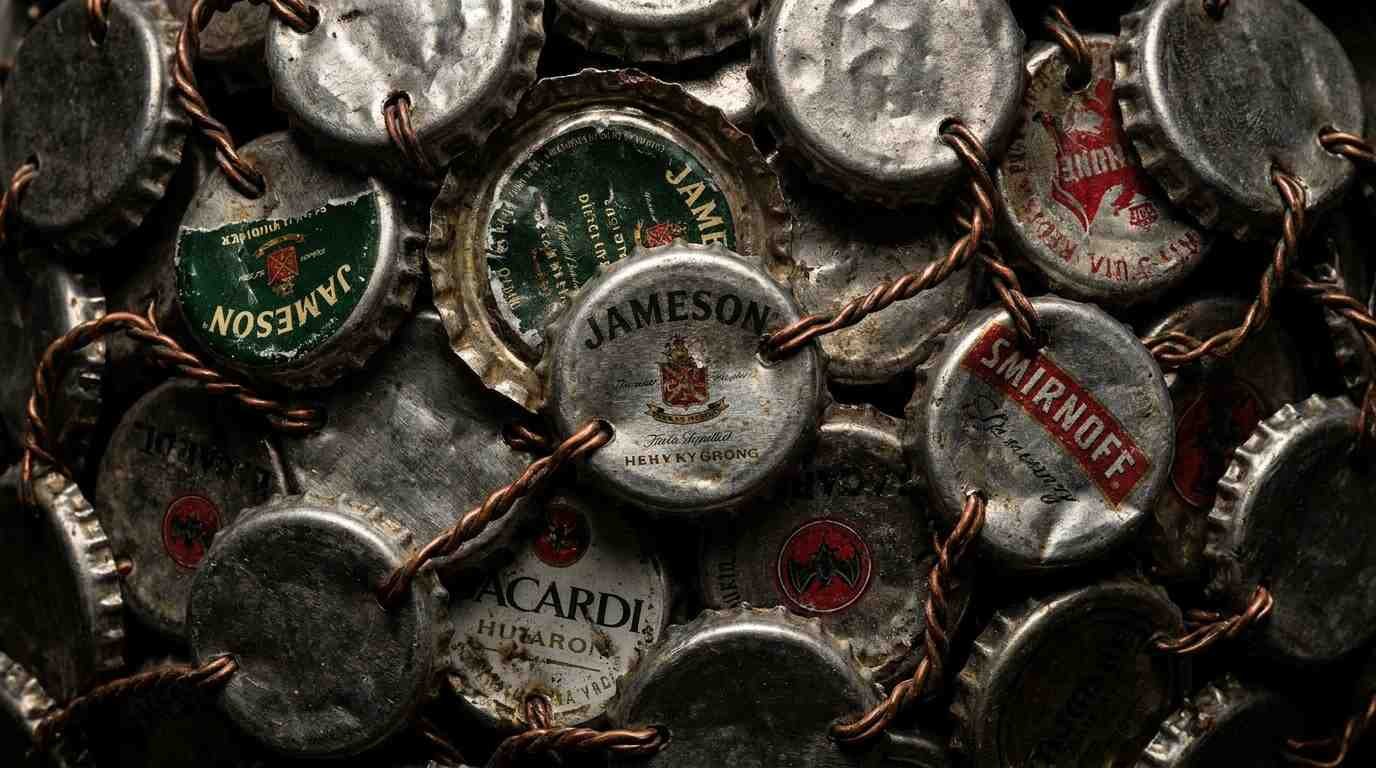
He collects bottle caps from Nigerian distilleries and gin producers. Then he stitches them into something that stops a room cold. The junk is the point.
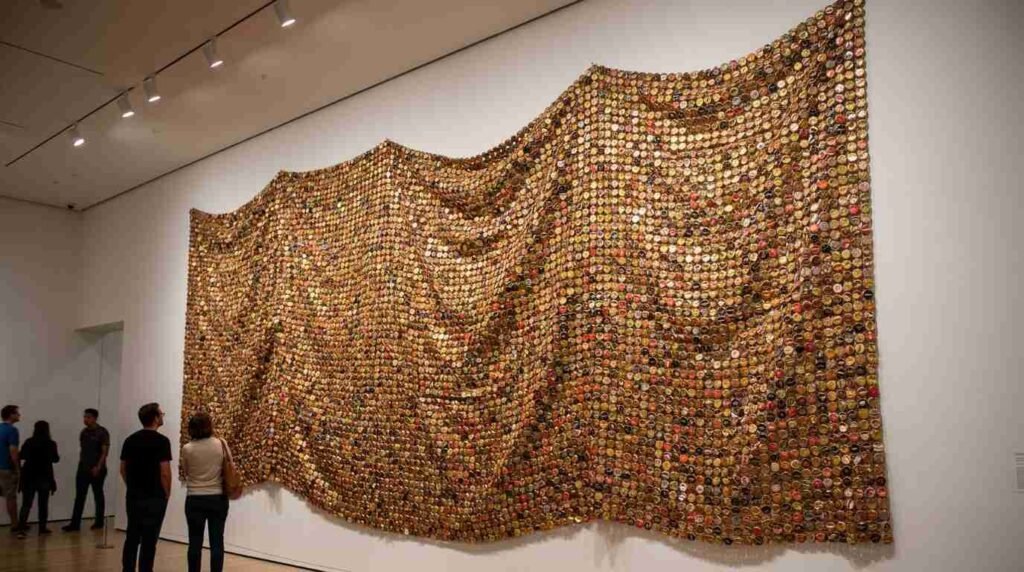
You walk into the Metropolitan Museum, or the British Museum, or the Tate’s Turbine Hall, and there’s this enormous shimmering thing hanging on the wall. It moves when the air shifts. It catches light the way a cloth does — soft, draping, almost textile. Then you get close enough to read the labels. Liquor. Schnapps. Palm wine. Bottle caps hammered flat and stitched together with copper wire, tens of thousands of them, by hand, by a crew working in relative silence in a studio outside Nsukka, Nigeria. And suddenly the whole thing reframes itself. You’re not looking at decoration. You’re looking at an argument.
El Anatsui — Ghanaian-born, Nigeria-based since 1975, winner of the Venice Biennale’s Golden Lion for Lifetime Achievement in 2015 — doesn’t make art that hides what it is. He makes art where the what-it-is is the whole conversation.
Why Bottle Caps and Not Something Easier to Work With
The first answer is accidental, which is how a lot of the best decisions get made. Anatsui found a bag of discarded bottle caps near his studio and saw material. Not metaphor yet — just material. He worked with wood and clay before this, carved objects that dealt with Ghanaian culture and history in quieter registers. The bottle caps broke something open.
What they gave him was flexibility — literal and conceptual. Unlike canvas, unlike stone, the caps could be assembled into any shape and then reassembled differently at the next installation. The pieces are never permanently fixed. They arrive folded or rolled, and whoever hangs them — the museum staff, the curator, sometimes Anatsui himself — makes decisions about how they drape, where they pool, which corners fall. The work changes every time it’s shown. That’s not a practical compromise. That’s a philosophical position: that a work of art is not a final object but an ongoing proposition.
The physical process is also worth understanding because it resists any easy romance about the solitary genius. Anatsui runs a studio operation. His team of assistants handles the assembly, working through complex patterns he initiates and demonstrates. He has described the studio as a place of reflection and silence — not a factory, but not a myth of one-man creation either. The labor is collaborative, distributed, and real. When you see one of these works in a museum, dozens of hands made it.
The Trans-Atlantic Slave Trade and What Liquor Has to Do With It
Here is where the material stops being just interesting and becomes necessary.
The alcohol bottle cap isn’t an arbitrary found object. Liquor was currency in the trans-Atlantic slave trade. European traders brought spirits — gin, rum, schnapps — to West African ports as trade goods, exchanged for enslaved people, for resources, for political influence. The bottle functioned as a unit of exchange in a system built on human destruction. When Anatsui sources his materials from Nigerian distilleries, from the recyclable aluminum caps of local liquor producers, he is pulling from that history without writing it on the wall. He doesn’t explain this in the work. He puts it in the work.
As Anatsui has said directly: “The link between Africa, Europe, and America is very much part of what is behind my work with bottle caps.” That’s not editorial. That’s a statement of material fact. The bottle cap carries the history the way a bone carries the shape of the life that used it.
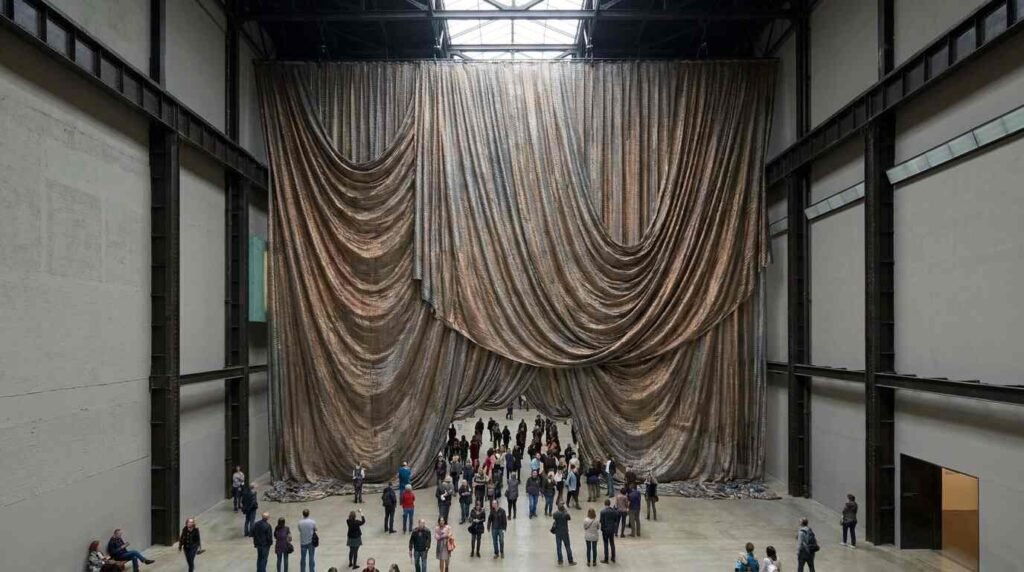
His 2023 Tate Modern commission, Behind the Red Moon, made this explicit in form if not in label. The first panel — a massive sail shape — references the slave ships that crossed the Atlantic. The materials are the same: flattened liquor seals, copper wire. The reference is built into the substance of the thing. You can read it without a wall text, or you can read it deeper with one. Both readings are true.
I’ve spent enough time behind a counter to know that the thing people are really consuming is never just the product in their hand. It’s the story attached to it, the status, the history they’re buying into without knowing it. Anatsui makes that invisible transaction visible. He holds up the bottle cap and says: look what this thing has been used for.
How the Works Change Shape Every Time They’re Installed
This is the aspect of Anatsui’s practice that institutions tend to either embrace or quietly struggle with, because it requires them to surrender a certain amount of control over what they’re displaying.
The works are shipped folded, sometimes in crates that give no clear indication of what orientation the final piece should take. Curators receive instructions that are more like guidelines: here are the dimensions, here is the approximate shape, here is what the artist has done before. Then they make choices. A corner might fold forward and create shadow. A section might pool on the floor. The copper wire connections mean the whole assemblage can be pulled wider or let sag lower depending on the wall and the light. Two installations of the same work look like two different works.
For a museum that is used to hanging a painting at exactly the right height with exactly the right lighting, this is disorienting. For a viewer who understands what’s happening, it’s the whole point. Anatsui is saying that a fixed, final form is a kind of lie — that meaning is always being renegotiated by context. The work that hangs in the Met is not the same work that hangs in a gallery in Cape Town or in Munich’s Haus der Kunst. It’s the same materials, differently arranged, differently read.
His 2007 Venice Biennale debut — three works in the Palazzo Fortuny, including Dusasa I and Dusasa II, enormous metal tapestries hanging between classical columns — made this internationally visible. Robert Storr, the Biennale’s artistic director that year, described the series as reaching back through the entire postwar period with an exhilaration he hadn’t encountered before. The works put a contemporary African practice into direct dialogue with European institutional space, and the tension between those two things was the conversation.
From Nigeria to the Venice Biennale: Tracing His Market Rise
Anatsui’s international reputation built steadily through the 1990s and accelerated sharply after Venice. His first important New York group show was at the Studio Museum in Harlem in 1990. He was represented by October Gallery in London and Jack Shainman Gallery in New York — the same gallery that spent years building Kerry James Marshall’s market before Marshall broke auction records, which is not a coincidence about the galleries involved. Jack Shainman has a particular history of patient, sustained investment in major African and African American artists.
The Biennale Golden Lion for Lifetime Achievement in 2015 was the institutional confirmation of a reputation that had been building for two decades. His works are now in permanent collections at the Metropolitan Museum of Art, the British Museum, the Centre Pompidou, the Smithsonian’s National Museum of African Art, and museums across Europe, Asia, and Africa. His Brooklyn Museum retrospective in 2013 — Gravity and Grace — brought the full scope of the practice to American audiences at scale.
None of this happened because the art world suddenly discovered Africa. It happened because the work is undeniably powerful, because Anatsui spent 40 years making it at the highest level, and because a specific set of curators and gallerists recognized what they were looking at early enough to build the architecture around it. In 2023, Time magazine listed him among the 100 most influential people in the world. Art historian Okeke-Agulu wrote that Anatsui’s work turns unassuming materials into magnificent constructions through a combination of experimental rigor and inspired vision.
That’s accurate. It’s also a clean description of what serious craft does at any scale — what a luthier does with wood, what a tanner does with hide, what anyone does who takes a material seriously enough to learn what it actually is.
What Museums Do (and Get Wrong) When They Hang His Work
The standard institutional response to Anatsui is to aestheticize. To focus on the shimmering quality, the optical richness, the way the work catches light. To hang it in a prominent space and let visitors respond to its beauty. This is not wrong. The works are beautiful. That is part of the argument.
But beauty in Anatsui’s work is never decorative. It is strategic. He makes something visually arresting precisely so that you stand close enough to read the labels. He makes it hang like a tapestry so that you feel the weight of craft, which then forces you to reckon with the specific material of that craft. The beauty is the mechanism that delivers the content.
Where museums sometimes get it wrong is in the wall text — either over-explaining the historical argument in a way that makes the material do less work, or under-explaining it in a way that lets viewers stop at pretty. The ideal encounter with Anatsui is when someone who walked in to see an African art exhibition finds themselves standing in front of something that looks like a jeweled textile and gradually realizes they’re looking at the history of colonial trade, distilled into aluminum and copper wire, hanging in a building that was itself built on the surplus capital of an empire.
That’s the work. The material is not illustrating the argument. The material is the argument.
I wrote previously about how Basquiat used his crown symbol as both reclamation and indictment — the mark as object and act simultaneously. Anatsui is doing something structurally similar at a much larger physical scale, with material that carries more historical freight than paint.
The next time you’re in a museum and you see something that looks like it shouldn’t be there — too large, too strange, too made-from-the-wrong-thing — get closer. The strangeness is usually the content.
You Might Also Like:
- Basquiat’s Crown Symbol: What the Three-Point Mark Actually Meant to the Kid from Brooklyn
- Nobody Talks in a Hopper Painting: A Diner Owner’s Guide to the 2 A.M. Silence
- Canvas, Craft & Community: Long Island’s Must-Attend Fine Art Festivals and Exhibitions, Spring 2026
Sources:
- Venice Biennale official records: universes.art — El Anatsui Golden Lion 2015
- El Anatsui — Wikipedia
- Artnet News — El Anatsui Honored with Golden Lion for Lifetime Achievement
- The Art Newspaper — El Anatsui wins Golden Lion for Lifetime Achievement
- Artlyst — El Anatsui’s Sublime Bottle Cap Curtains at Tate’s Turbine Hall
- ARTnews — The New Razzle-Dazzle: El Anatsui on His Tapestries (2008)
- Jack Shainman Gallery, New York — artist representation records
- Metropolitan Museum of Art, British Museum — permanent collection documentation