
Some links in this post are Amazon affiliate links. As an Amazon Associate, Heritage Diner earns from qualifying purchases at no extra cost to you.
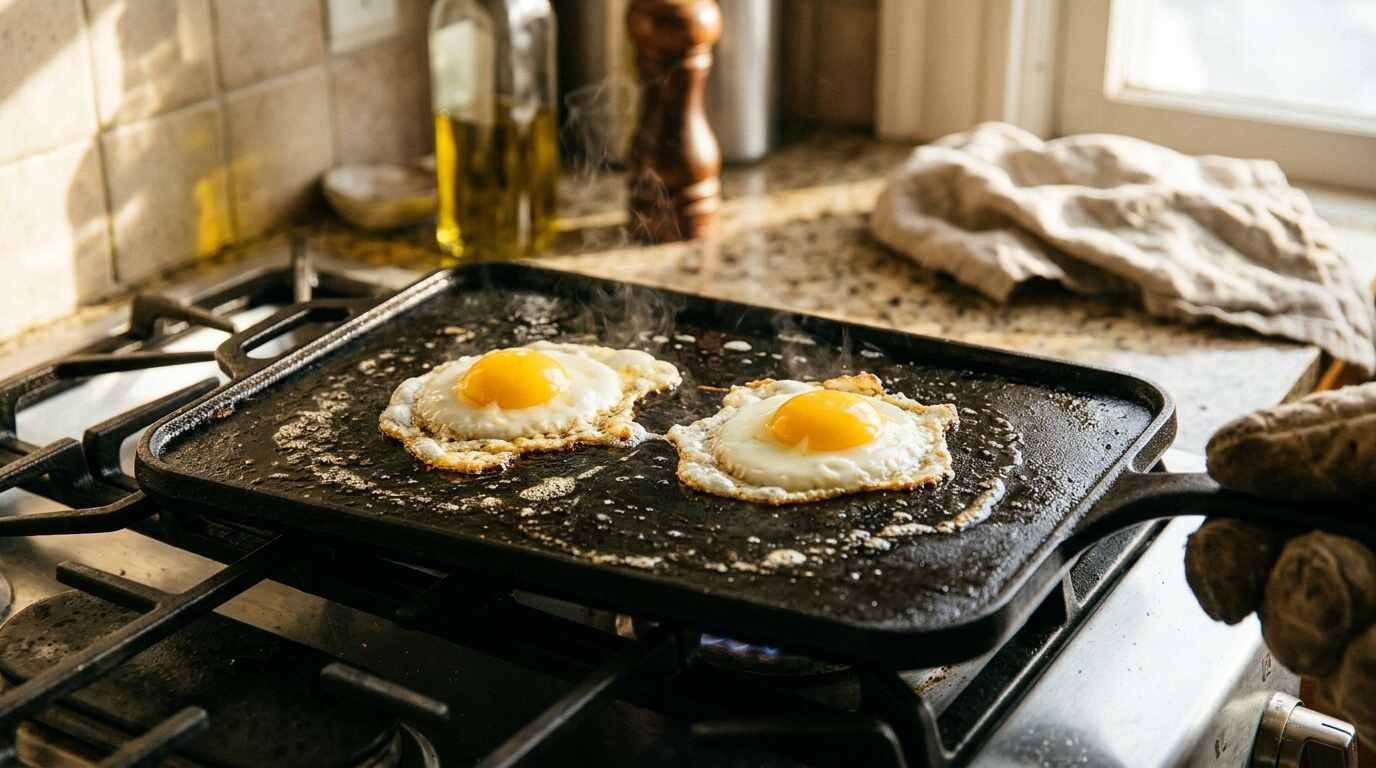
Eggs are the honest test of a griddle. They stick at the first sign of weakness, and a pan that cooks bacon and burgers without complaint may still glue an egg to the iron. If yours does, the cure is almost never a new pan. It is a better seasoning and a better routine.
Seasoning is not mysterious, and it is not a coating that someone applied at the factory. It is thin layers of oil baked onto the iron until they harden into a slick, dark surface.
What seasoning really is
When a thin film of oil is heated past its smoke point on iron, it breaks down and bonds to the metal in a process called polymerization. Layer on top of layer, and you get a hard, slightly glossy surface that resists sticking and rust. It is not a nonstick coating in the chemical sense, but a good one behaves like one.
The word to remember is thin. Thick oil bakes into a sticky, uneven finish that flakes. A film so light it looks like you wiped most of it off gives the best result.
Start with a clean surface. If the griddle is new, wash it with hot water and a little soap to remove the shipping oil, then dry it completely. If it is old and rusty, scrub the rust off with steel wool and a little water, rinse and dry immediately. Heat it on the stove for a minute or two to drive off every drop of moisture.
Check what the maker recommends. Some griddles ship preseasoned and only need a light touch-up. Others are bare and need the full process described below.
What goes wrong, and why
Most sticking problems come from one of three sources. The seasoning is thin or patchy, so raw iron is exposed. The pan is too cold, so the egg proteins bond to the metal before the heat can set them. Or the heat is too high, so the proteins grab and seize.
You can diagnose a griddle by looking at it. A matte, gray or brown surface with dull spots needs more seasoning. A sticky, tacky patch means the oil was applied too thickly and never fully cured. A smooth, dark, slightly satin surface is right.
Rust looks orange and powdery, and it lives where moisture sat. Scrub it off and re-season the area. It is almost always fixable.
Choose your oil. Use a neutral oil with a reasonably high smoke point, such as canola, vegetable, grapeseed or refined sunflower. Cooks argue about flaxseed oil, and the debate has outlasted most others, with some reporting flaking. A plain vegetable oil is a safe, boring choice, and boring works.
Skip butter and olive oil for seasoning. Butter contains milk solids that burn, and extra-virgin olive oil has a lower smoke point.
Season in the oven
Set the oven to somewhere between 400 and 500 degrees F, as the maker advises. Put a baking sheet or sheet of foil on the lower rack to catch drips. Apply a few drops of oil to the griddle and rub it over every surface with a lint-free cloth or paper towel, including the handle and the bottom. Then wipe it all off as if you had made a mistake. What remains is a barely visible sheen.
Place the griddle upside down on the upper rack so any extra oil drips off instead of pooling. Bake for an hour. Turn the oven off and let the griddle cool inside. Repeat the process three to four times. Each round adds a little to the finish, and the color deepens from gray to brown to black.
Ventilation matters. The process makes smoke, and some of it is acrid. Open a window and switch on the vent hood. A lint-free cotton cloth leaves no threads behind.
Cook it in
Seasoning also builds through cooking. Fat-rich foods like bacon, sausage and burgers add to it, so the first meals on a new griddle should not be delicate. Fry a pound of bacon, wipe the surface, and you will have added a layer while eating breakfast.
Avoid cooking highly acidic foods, such as tomato sauce or wine reductions, for long stretches on a young seasoning. The acid can dull the finish.
Flat griddles versus skillets. A flat griddle has no sides, so oil and grease run off more easily during seasoning, and a thin layer is simpler to achieve. It also has a larger surface, which means more variation in temperature across the cooking area. The center sits over the burner and runs hot, and the edges stay cooler.
To even it out, preheat longer than you think necessary, and place eggs in the middle zone where heat is most predictable. If your griddle is large enough to span two burners, light both and let it soak for several minutes, then adjust. A cast iron griddle for the stovetop with a smooth side is ideal for eggs, while the ribbed side suits other foods.
On an electric griddle, the same rules apply, but the thermostat handles the temperature. Set it to a moderate level and let it come fully to heat before the first egg.
Troubleshooting a griddle that has lost its seasoning
If your old griddle has gone sticky or flaky, strip it and start fresh. Scrub with steel wool and warm water until the surface is bare, dry it quickly and heat it on the stove to remove every trace of moisture. Then follow the oven method described above, with thin layers and plenty of patience.
Do not use harsh oven cleaners unless the maker approves, and wear gloves if you do. These products are caustic. For many cooks, plain scrubbing is enough.
Give a rebuilt seasoning a few weeks of use before judging it. The surface improves as it is cooked on, and the first dozen meals are part of the process.
How to cook eggs without sticking. Preheat is the secret. Set the griddle over medium-low heat and let it warm for five minutes or more. Cast iron heats slowly and unevenly, and a cold griddle makes eggs cling. Add a generous teaspoon of butter or oil, tilt the surface to coat it, and wait until the butter stops foaming.
Crack the egg onto the surface. You should hear a gentle sizzle, not a violent crackle. High heat sets the white too fast and glues it down. Leave the egg alone for a minute or two. When the white is set, a thin fish spatula slides underneath without tearing it.
If the egg resists, wait another few seconds. It tends to release by itself when it is ready.
Cleaning and care
Clean the griddle while it is still warm. Scrape off bits with a flat spatula, rinse with hot water, and use a brush or non-scratch scrubber if needed. A little mild dish soap is fine on a well-built seasoning, contrary to the old rule. What you want to avoid is soaking or leaving the griddle wet.
Dry it on the stove for a minute, then wipe on a very thin film of oil while it is warm. Store it in a dry place, and if you stack pans, put a paper towel between them.
Common mistakes.
- Too much oil in the seasoning, leaving a sticky, uneven film. Strip it and start again if needed.
- Skipping the preheat, so eggs hit cold iron.
- Heat too high for eggs.
- Soaking the griddle in the sink.
- Scrubbing aggressively with steel wool on a healthy seasoning.
If a patch flakes or turns sticky, scrub it off, rinse, dry and season that area again. It is a repair, not a failure.