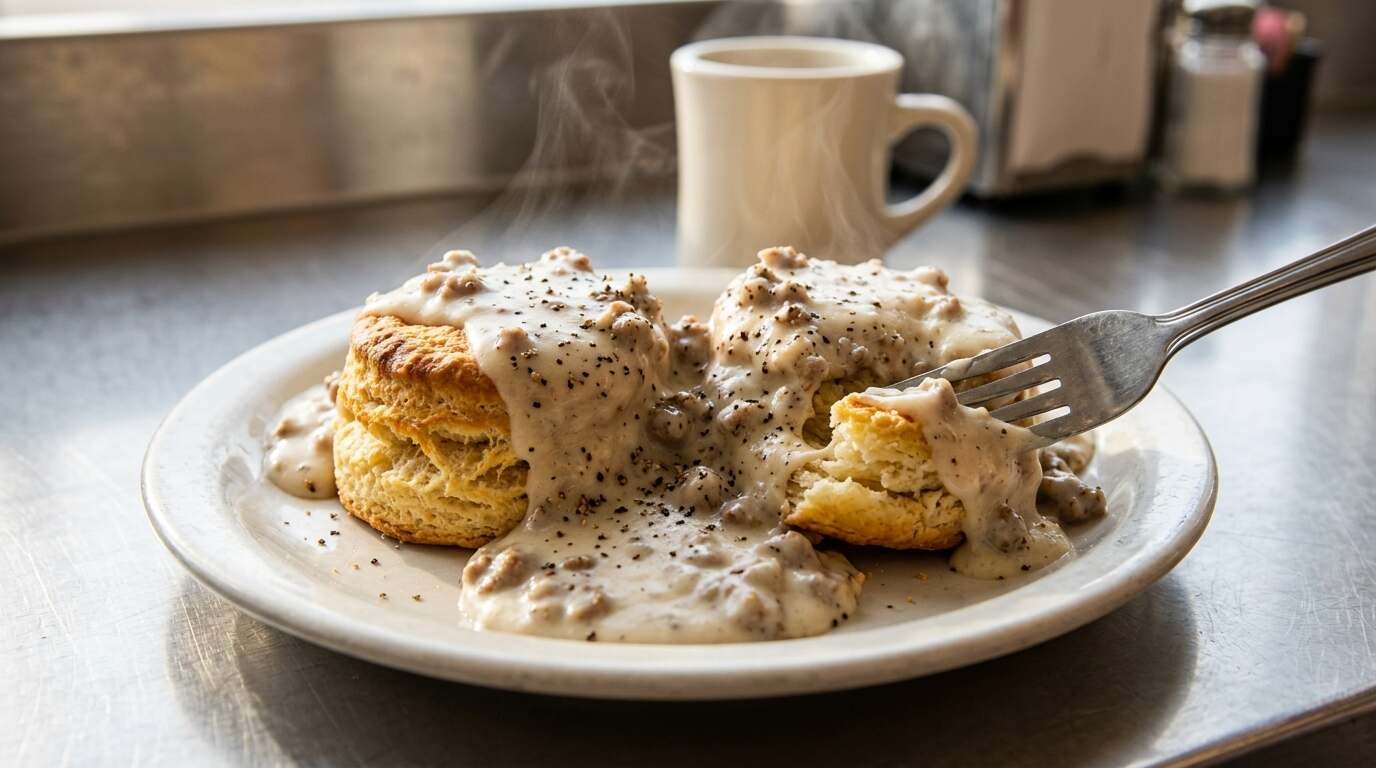
“That’s white. That’s not gravy.” So said a young British student in a JOLLY video, looking down at split biscuits under a blanket of pale, peppery sausage sauce, and the line sums up the first reaction a lot of visitors have to the dish. A bite later, by the Daily Meal’s account of the clip, the verdict flipped to delight. That reversal is the whole appeal of sausage gravy and biscuits, and it is why this plate, which looks like a mistake, has outlasted every breakfast trend that tried to replace it.
The Plate That Stumped Visitors During the 2026 World Cup
When international fans arrived in North America for the 2026 World Cup, breakfast became part of the tourism. The Daily Meal rounded up reactions in July 2026: British and Japanese visitors confronting biscuits and gravy for the first time, a Leeds United fan on X wondering whether scones and mushrooms were really what Americans eat in the morning, and a Brit at Cracker Barrel who got talked into ordering it.
The Leeds fan’s post is below, along with the JOLLY clip that produced the “not gravy” verdict.
The skeptical-then-converted arc is not new. A 91-year-old creator known as Grandad Joe, who lives with his daughter Sasha in the UK, filmed his own first taste for TikTok. He wondered aloud whether the biscuits were scones and perked up when Sasha mentioned the gravy had sausage in it, according to Upworthy’s write-up.
Everything that confuses a first-timer is also what a cook controls. The gravy is white because it is a milk-based sauce thickened with flour. The biscuit is not a cookie and not quite a scone; it is a chemically leavened bread, split and used as a plate. Get four things right (the sausage, the roux, the boil, and the biscuit’s fold) and the dish works every time.
Where Biscuits and Gravy Come From
Nobody can date the first plate. Tasting Table puts it plainly: “Precisely when the gravy became a common accompaniment is unknown.” What the food writers agree on is the shape of the story. Biscuits arrived in America with early settlers as hard, dry things baked for keeping. The soft Southern biscuit only became possible after baking soda and baking powder arrived in the mid-19th century, and the pairing with gravy is widely thought to have taken off in late-19th-century Appalachia, where pork was cheap and a heavy breakfast had to carry a person through manual labor.
The lumber trade left its fingerprints on the vocabulary. Tasting Table ties the region’s wood industry to sawmill gravy, the peppery sausage-and-milk version that shows up on menus today. Chowhound pushes the working-class thread further, noting that miners and loggers stretched small pay with cheap staples. Its line on the subject is brief: “Coal miners often ate beans, cornbread, and bulldog gravy.” Bulldog gravy, in that telling, was flour, water, and pork grease. Both articles are short on named historians and documents, so treat the exact timeline as folklore with a plausible spine. Wikipedia, citing the Food Timeline, offers an earlier date: a scarce-food breakfast after the Revolutionary War that had to be filling and cheap for plantation workers.
The dish never stayed in one place. Wikipedia lists Biscuitville, Tudor’s Biscuit World, and Biscuit Belly among chains built around it, and regional cousins include tomato gravy, chocolate gravy, and the military’s creamed chipped beef. On Long Island, a diner menu is the more likely place to meet it. Sweet Mama’s in Stony Brook lists eggs with grits, biscuits, and sawmill sausage gravy on its all-day breakfast menu, a nod to Southern tradition without pretending to be Southern.
What to Pull Off the Shelf Before You Start
This is a two-pan, one-bowl job, and a few pieces of equipment make it easier. A heavy skillet matters most. Cast iron keeps its temperature when cold milk hits the pan, which is the exact moment a thinner pan cools off and the sauce lags. If you are weighing cast iron against carbon steel or stainless, the skillet comparison on this blog lays out where each one wins.
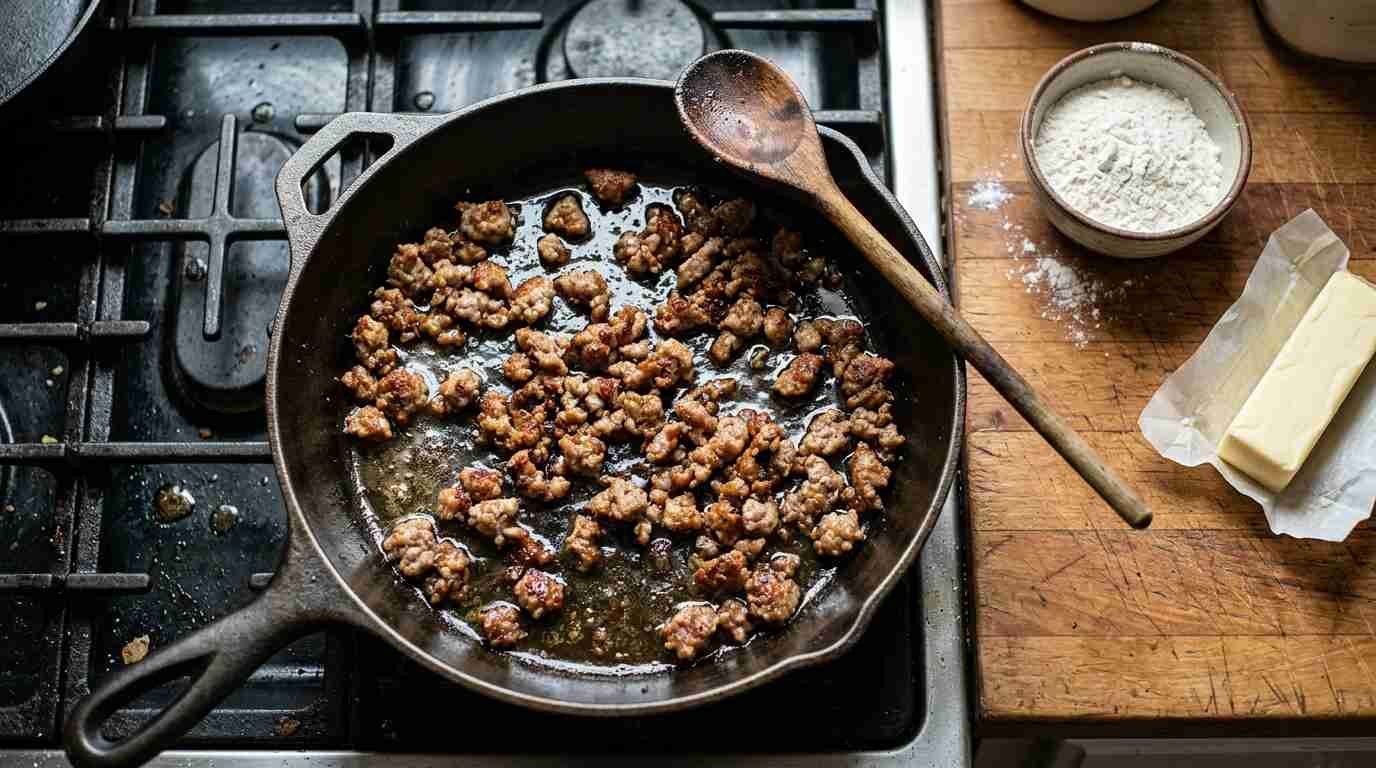
- Lodge Seasoned Cast Iron Skillet, 12 Inches: a pre-seasoned pan big enough to brown a pound of sausage and then hold four cups of milk. See it on Amazon (affiliate link)
- Lodge Silicone Hot Handle Holder: a heat-resistant cover for the skillet handle, made for pans 9 inches and larger, so the pan can come off the burner without a dish towel. See it on Amazon (affiliate link)
As an Amazon Associate I earn from qualifying purchases. A commission may be earned if you buy through this link, at no extra cost to you.
For the biscuits, any sharp round cutter about 2⅜ inches across works, and a bench knife lets you cut squares and skip the scraps. A whisk is the other essential, since the gravy needs constant stirring in its first minutes.
How to Make Diner Sausage Gravy and Biscuits
Start With the Biscuits
The biscuits go in first because they need the oven and the gravy needs only a few minutes. These quantities follow King Arthur Baking’s buttermilk biscuit recipe, which yields 12 biscuits at 425°F.
Heat the oven to 425°F with a rack in the upper third. Whisk 3 cups of all-purpose flour with 1 teaspoon of salt, 1 tablespoon of baking powder, and 1 tablespoon of sugar. Rub in 6 tablespoons of cold butter until the mix looks like coarse breadcrumbs. King Arthur notes that cold butter gives taller, flakier biscuits, while softer butter gives a finer, more tender crumb.
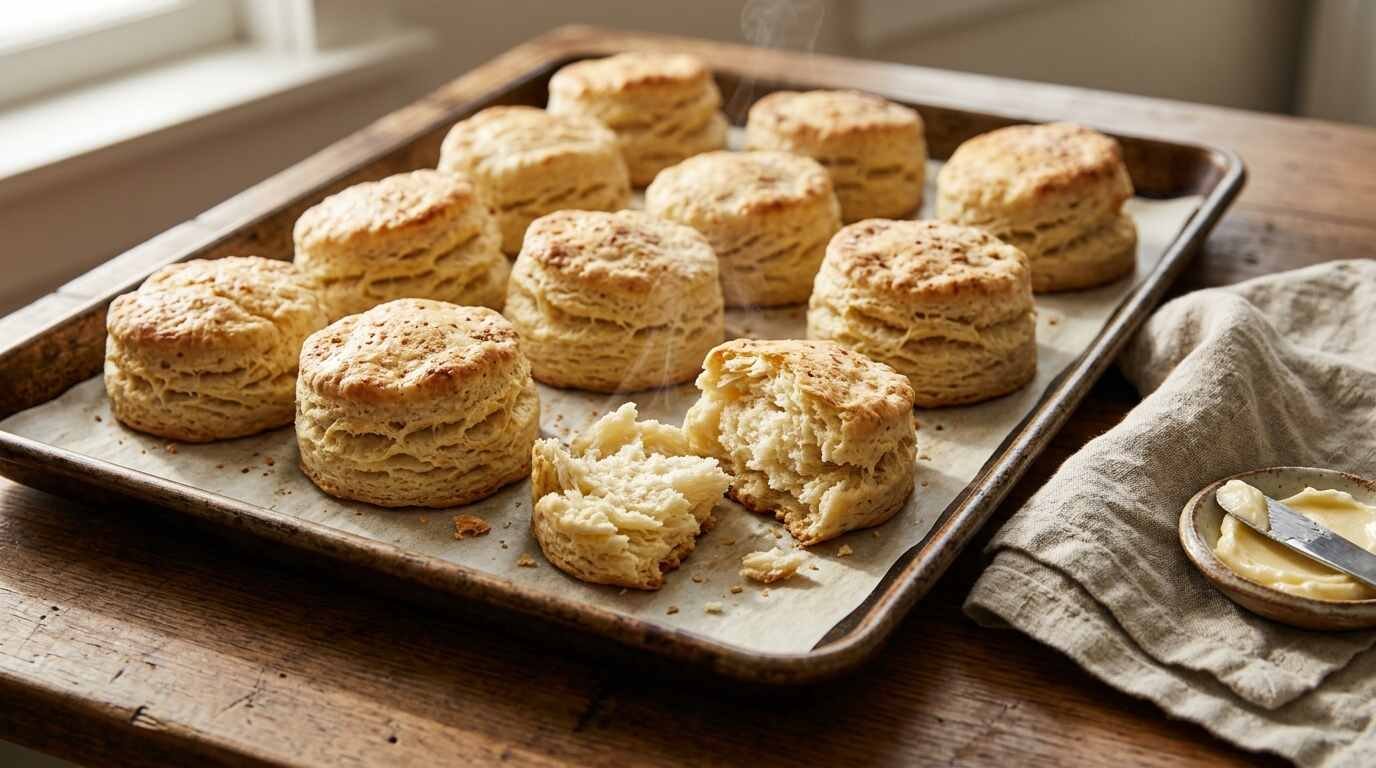
Drizzle in 1 cup of cold buttermilk and mix for about 15 seconds. If the dough is dry, add up to 2 more tablespoons, but stop as soon as it holds together. Pat it into a rough rectangle about ¾ inch thick, fold it in thirds like a letter, and pat it back to ¾ inch. That single fold builds the layers.
Cut the biscuits, set them on a baking sheet, and brush the tops with milk. Spacing them about ¼ inch apart helps them rise straighter and taller; leaving at least an inch between them gives crisper sides. If you have time, chill the cut biscuits for 20 to 30 minutes while the oven heats. Bake 15 to 20 minutes, until lightly browned.
Build the Gravy While They Bake
Chef Billy Parisi’s sausage gravy uses 1 pound of pork breakfast sausage, 1 tablespoon of butter, ¼ cup of flour, and 4 cups of whole milk, and it yields about 6 cups. Those proportions are a reliable starting point.
Brown the sausage in the skillet over low to medium heat, breaking it into small pieces as it cooks, about 6 to 8 minutes. Lift the sausage out with a slotted spoon and leave the fat in the pan. Add the butter, let it melt, and whisk in the flour to make a roux. Cook it for a minute or two so the flour loses its raw edge.
Pour in the milk gradually, whisking the whole time. Then raise the heat and bring the pan to a boil. Parisi’s marker for the right moment is a sauce that turns “very thick, like an alfredo sauce,” because the flour only works at a boil. Drop the heat to low and cook another 4 to 5 minutes, whisking now and then, until the starchy flavor is gone.
Return the sausage, season with salt and plenty of black pepper, and taste before adding more salt, since the sausage already carries some. Sage, thyme, or red pepper flakes are optional additions. Split two warm biscuits per plate and ladle the gravy over the top.
Fixing Gravy That Went Wrong, and Keeping Leftovers
Thin gravy almost always means the pan never reached a full boil after the milk went in. Bring it back up to a boil while whisking, then reduce the heat and let it cook again. If it overshoots and turns too thick, thin it with a splash of milk.
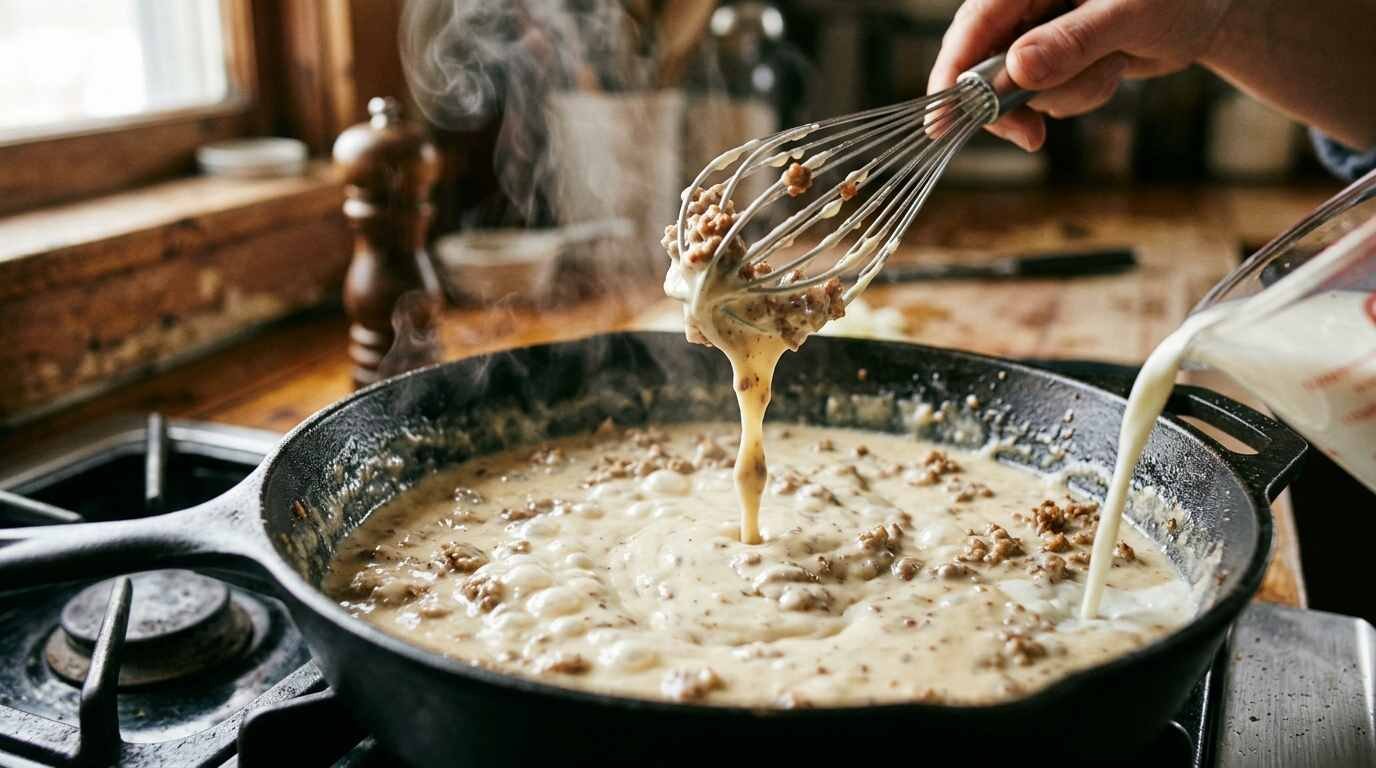
Lumps come from adding the milk too fast. Pour slowly, whisk hard, and strain out stubborn lumps if you have to. A gravy that tastes floury needs a few more minutes of simmering, not more seasoning.
Leftover gravy reheats best over low heat, with a little milk stirred in to loosen it. Parisi warns that freezing may cause the sauce to break, so plan on the refrigerator rather than the freezer. Biscuits are best the day they are baked.
Gravy is the thread that ties much of the diner menu together. The same roux-and-boil logic runs through the open-faced hot roast beef in brown gravy and the hot turkey in yellow gravy, and learning one makes the others easy.
Frequently Asked Questions
What is sawmill gravy, and is it the same thing?
Tasting Table connects the name to the lumber industry of Appalachia. On modern menus, such as the Sweet Mama’s listing above, “sawmill sausage gravy” describes the same idea: pork sausage, flour, milk, and a lot of black pepper.
Can I use regular milk instead of buttermilk in the biscuits?
King Arthur’s recipe allows either cold buttermilk or milk. Buttermilk adds tang; milk works fine if that is what you have.
Why does my gravy look thin right after adding the milk?
The roux does not reach full strength until the pan boils. Keep whisking, bring it to a boil, and it should thicken to the consistency of a thick cream sauce before you drop the heat.
Can I make the gravy ahead of time?
Yes, within a day or so in the refrigerator. Reheat it gently over low heat and whisk in a little milk. Avoid freezing it, since the sauce can break.
Recipe: Diner Sausage Gravy and Biscuits
Prep Time: 25 minutes
Cook Time: 20 minutes
Total Time: 45 minutes
Servings: 6 (two biscuits each)
Difficulty: Easy to medium
Ingredients
For the biscuits:
- 3 cups all-purpose flour
- 1 teaspoon table salt
- 1 tablespoon baking powder
- 1 tablespoon granulated sugar
- 6 tablespoons cold butter
- 1 cup cold buttermilk (up to 2 tablespoons more if needed)
- Milk for brushing
For the gravy:
- 1 pound pork breakfast sausage
- 1 tablespoon unsalted butter
- ¼ cup all-purpose flour
- 4 cups whole milk
- Salt and black pepper, to taste
Instructions
- Heat the oven to 425°F with a rack in the upper third.
- Whisk the flour, salt, baking powder, and sugar. Rub in the cold butter until the mix looks like breadcrumbs.
- Stir in the buttermilk for about 15 seconds, just until the dough holds together.
- Pat to ¾ inch thick, fold in thirds, and pat back to ¾ inch. Cut, set on a baking sheet, and brush with milk.
- Bake 15 to 20 minutes until lightly browned.
- While the biscuits bake, brown the sausage in a skillet over low to medium heat for 6 to 8 minutes, breaking it up. Remove the sausage and keep the fat in the pan.
- Melt in the butter, whisk in the flour, and cook 1 to 2 minutes.
- Whisk in the milk gradually, bring to a boil until very thick, then reduce the heat to low and cook 4 to 5 minutes more.
- Stir the sausage back in, season with salt and plenty of pepper, split the biscuits, and ladle on the gravy.
Notes
- Cold butter gives flakier biscuits; softer butter gives a finer crumb.
- The gravy thickens at a boil, so do not skip it.
- Refrigerate leftover gravy and reheat gently with a little milk. Do not freeze it.
You Might Also Like
- Open-Faced Hot Roast Beef Smothered in Brown Gravy on White Bread
- Open-Faced Hot Turkey on White Bread Smothered in Yellow Gravy
- Heritage Diner Salisbury Steak Smothered in Mushroom and Onion Gravy
Sources
- The Old-School Southern Dish That Surprised World Cup Visitors, The Daily Meal
- British grandpa blown away when he tries Southern style biscuits and gravy for the first time, Upworthy
- The Debated Origins Of Biscuits And Gravy, A Southern Classic, Tasting Table
- How Biscuits And Gravy Became The Historic Breakfast Of Appalachia, Chowhound
- Biscuits and gravy, Wikipedia
- Buttermilk Biscuits, King Arthur Baking
- Sausage Gravy, Billy Parisi
- JOLLY video, YouTube
- Grandad Joe, TikTok
- Leeds United fan post, X