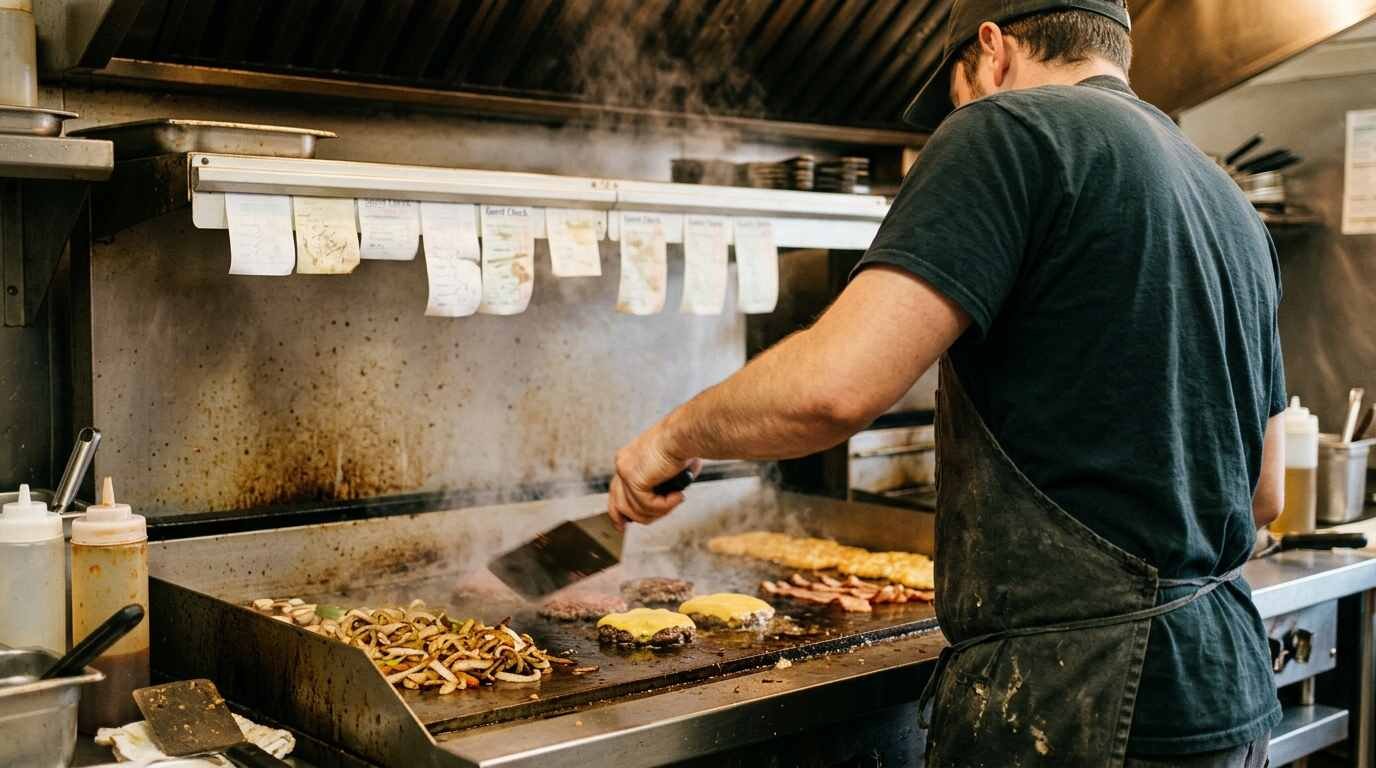
Watch a short-order cook on a Saturday morning and it looks like chaos handled by someone calm. Eggs, bacon, home fries, pancakes and toast, all for different tickets, all landing within a minute of each other. Nothing is rushed. It simply starts at the right moment.
The skill underneath is timing, which is another word for knowing what takes longest and starting it first. It is learnable, and it works at home just as well.
Start the slow things first
Every plate has a long item and a short item. Potatoes take fifteen to twenty minutes. Bacon takes eight or ten. Pancakes take a few minutes per side. Eggs take two or three. Toast takes two. A cook works the list backward from the plate: potatoes first, then bacon, then pancakes, then eggs, then toast, so everything meets at the same moment.
At home, write the finish time at the top of a sticky note and count back from it. The first time it feels silly. The second time, you will be eating a hot breakfast.
Know your zones
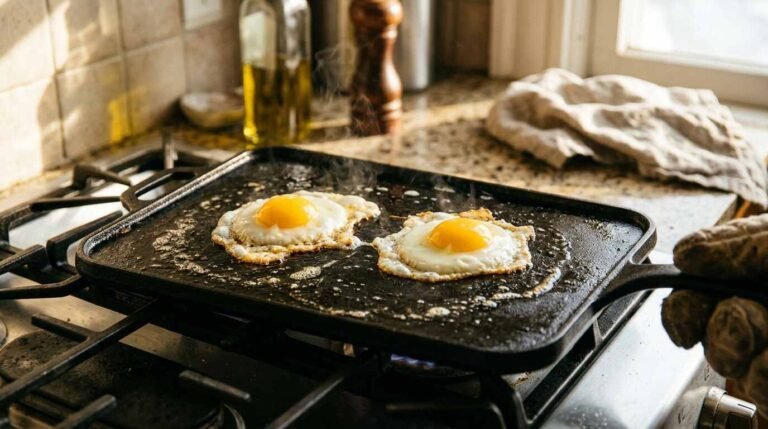
A flat-top griddle is not one temperature. The area over the burner runs hot, the edges run cooler, and a cook learns where each part sits. Bacon goes where it can render slowly, eggs go to the moderate middle, and a plate waiting to finish goes to the cooler edge.
Your stove has the same pattern. Cast iron especially holds heat unevenly. Find the hot spot by sprinkling flour in a dry pan and watching where it browns first. Use that knowledge deliberately instead of fighting it.
A sample Saturday, minute by minute
Say the plan is four plates at nine in the morning. At twenty to nine, the potatoes go into the pan, because they need twenty minutes and a few turns. At ten of nine, bacon goes onto a sheet pan in the oven, so it cooks without tending. Pancake batter is mixed and rested by then.
At five of nine, the griddle goes on for pancakes, two or three at a time. Toast waits. At two minutes to nine, the eggs go in. The toast drops. Plates come out of the warm oven, and everything is gathered and carried to the table within a minute.
Does it ever work perfectly? Not every time. Still, a plan with a finish line beats improvising, and even a late plate comes out better than a scramble from the start.
Hold what can wait, finish what cannot
Some foods wait well and some do not. Bacon, sausage and hash browns hold in a warm oven for fifteen minutes without harm. Pancakes keep on a rack in a low oven, uncovered so they do not steam. Eggs do not wait. Toast does not wait. Those go last.
Holding hot food needs care. Food safety guidance keeps hot food at 140 degrees F or above, and perishable food should not sit out for more than two hours. A 200 degree F oven is a reasonable holding temperature for most breakfast items.
Mise en place is the whole secret. The French phrase means everything in its place. Before the first order, the cook has the bacon sliced, the potatoes parboiled, the toppings chopped, the oil and butter within reach and the plates stacked and warm. Cooking is the easy part when prep is finished.
At home, take five minutes before you light the stove. Set out the eggs, the butter, the spatula, the plates. Measure the pancake batter. Cut the fruit. The kitchen that looks calm at seven o’clock was set up at six forty-five.
Work clean, and watch the whole board
A short-order cook wipes the griddle constantly. A burned crust from an earlier order will ruin the next egg. They scrape, wipe and oil between items, and the habit keeps flavors separate and food from sticking.
They also keep their eyes on every ticket, not just the one in hand. A glance ahead at the next three orders lets them combine tasks and keep the line moving. The practice has a name in kitchens: reading the board.
Taste and temperature, not just the clock. Timers are tools, not masters. Griddles run hot and cold, eggs vary, and a thick patty takes longer than a thin one. A cook looks, listens and touches. A sizzle that slows means the surface cooled. An egg white that turns opaque tells you it is ready.
For anything where safety matters, use a thermometer. Ground meat should reach 160 degrees F, poultry 165. Learning to read food by eye is a skill, and the thermometer is how you check it.
When the ticket changes
Orders change. Someone wants their eggs scrambled instead of fried, or a customer shows up with a party of six at the worst moment. A good cook adapts without panic: they finish what is almost done, drop the plan for what is not started, and look for what can share a pan.
At home, the equivalent is a guest who arrives early or a child who wants something else. Do not restart the whole sequence. Pull the earliest dish, hold it warm, and adjust the remaining ones.
Take the lesson home. Make a short plan on Saturday morning. Choose the slowest item, start it, and set a timer for the next step. Warm the plates. Let the eggs be last. If something falls behind, drop an item rather than rushing everything. A hot, simple breakfast beats a complicated cold one.
And when it works, notice how quiet the kitchen is. That is what good timing sounds like.