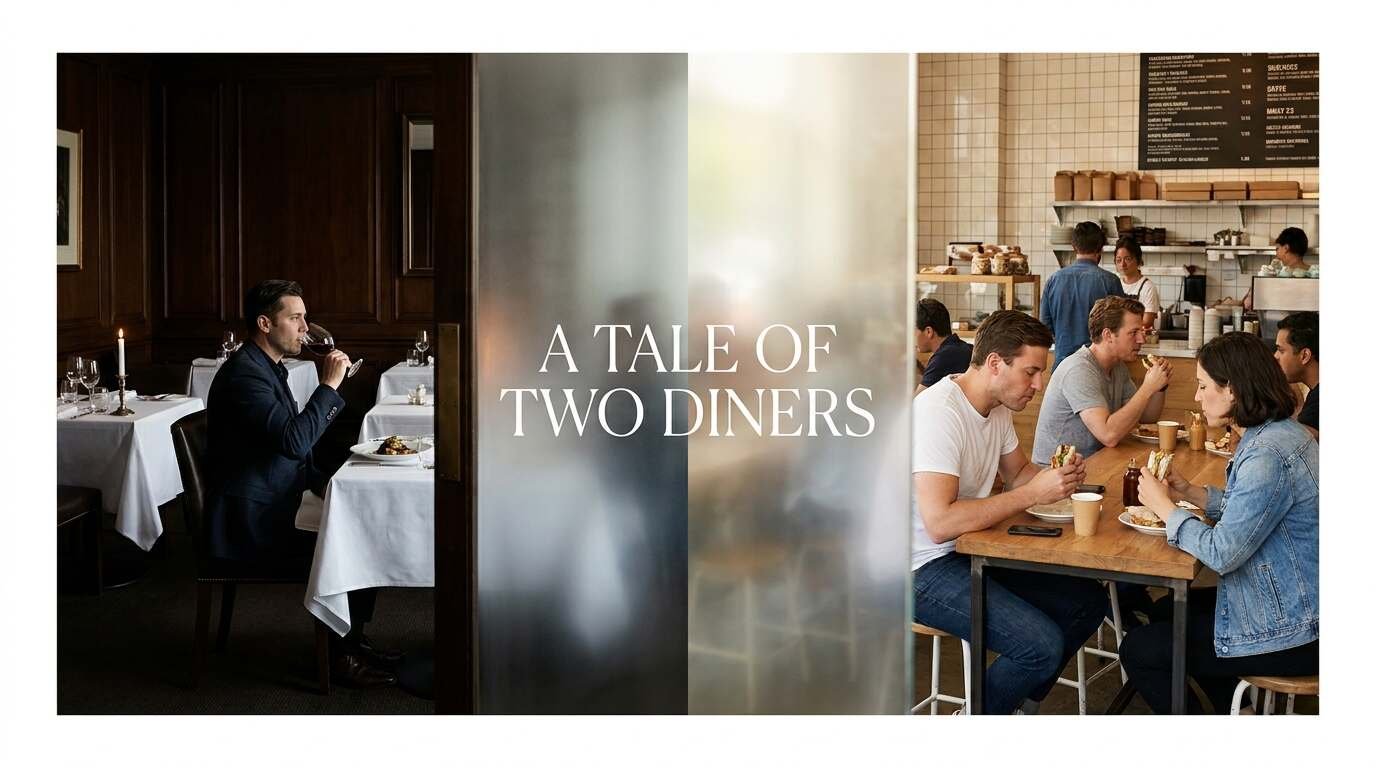
A man walked into a Ruth’s Chris in early 2026 wearing a ball cap, and the internet decided to have an argument about it. The chain’s website asked guests in hats to take a seat at the bar rather than the dining room, and that single line — paired with a list of banned items running from gym wear to exposed undergarments — set off weeks of commentary across social platforms and food media. What made the episode strange is that the policy was not new. Internet archives showed the language had been sitting on the company’s site for years. Nothing had changed except enforcement, and the willingness of strangers to film themselves being indignant about it.
That gap — between a rule that quietly existed and a sudden public reckoning with it — is the real story. Dress codes did not get stricter so much as they got visible, and the visibility exposed something diners had not quite noticed: the comfortable middle of restaurant dressing, the zone where “smart casual” once absorbed most of us without complaint, has thinned to almost nothing. On one side, rooms have dropped requirements entirely. On the other, a smaller set has hardened them into a brand signal. The space between is where the friction now lives.
What a Dress Code Was Actually For
Strip away the etiquette-guide language and a dress code is a social contract. The restaurant states the register of the evening it intends to provide, and asks guests to signal that they understand that register. Arriving at a three-Michelin-star room in athletic shorts is not an act of individuality; it reads as a failure to perceive what is happening at the surrounding tables. The reverse holds too. Show up in a tuxedo at a natural wine bar and you have committed the same error in the opposite direction — a misreading of the room, broadcast through clothing.
This is why the codes feel charged in a way that, say, a reservation policy does not. Clothing is legible. It tells the people near you how you have classified the occasion, and a mismatch implies either ignorance or contempt. The restaurant, by publishing a code, is trying to keep everyone in the same key. When the code worked invisibly, nobody thought about it. The moment it became a flashpoint, the underlying contract had already started to fray.
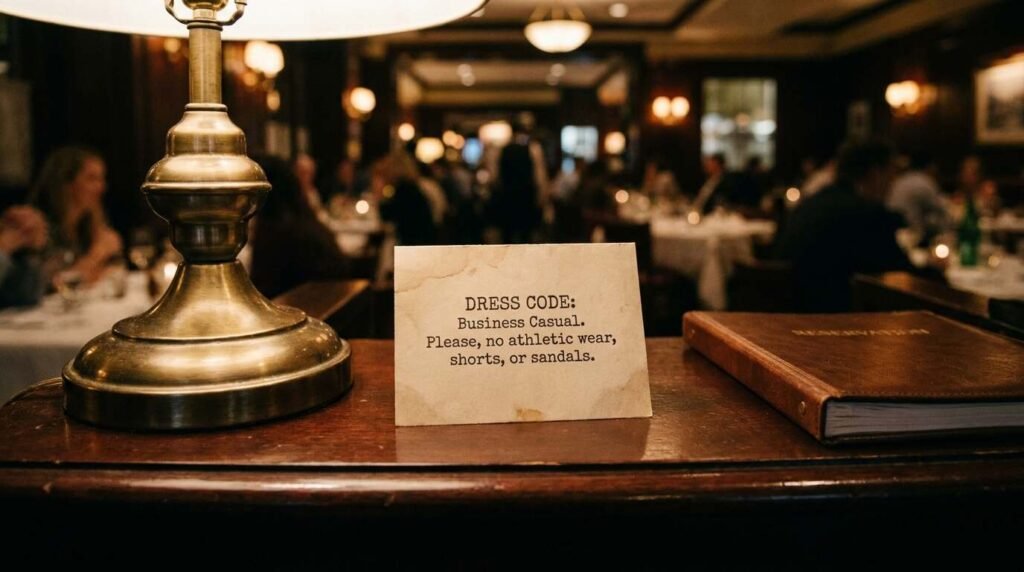
The Market Pulled Apart, and the Codes Followed
The dress code split did not happen in a vacuum. It tracks a broader fracture in the restaurant business that industry analysts spent all of 2025 describing with a single word: bifurcation. McDonald’s executives used it on earnings calls. Trade publications built their year-end retrospectives around it. The pattern is consistent — value-driven and casual concepts on one end, high-touch experiential dining on the other, and a hollowing-out of whatever used to occupy the center.
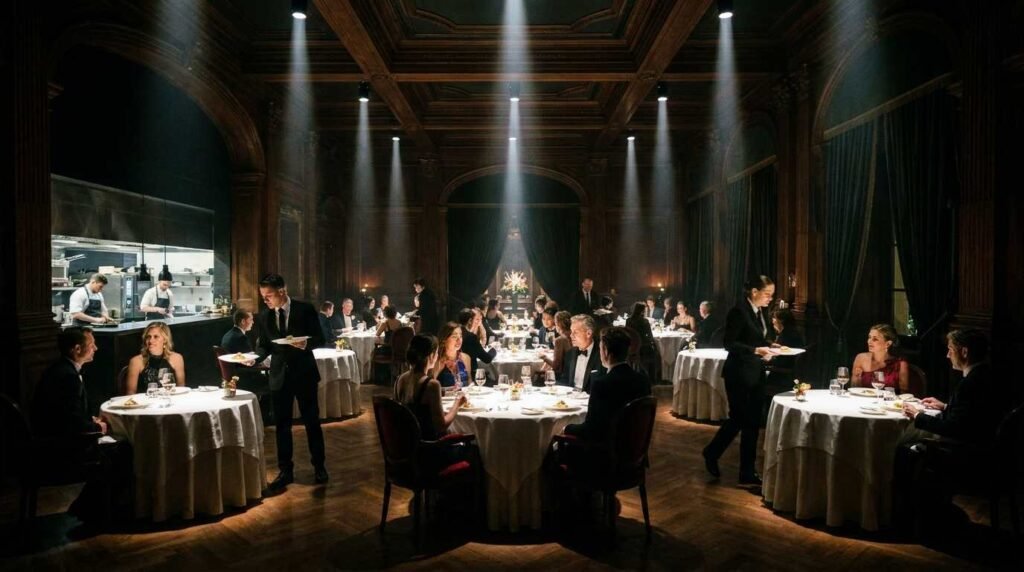
Fine dining, which makes up only about one percent of independent American restaurants, has responded to pressure not by competing on price — a fight it cannot win — but by leaning harder into experience. Themed lighting, multi-course tasting menus, tableside theater, soundscapes that shift with each plate. When a meal is being sold as an event rather than as food, the dress code stops being an arbitrary gatekeeping device and becomes part of the staging. You dress for the production because you are, in a sense, in it.
The Casual End Let Go
At the other pole, the calculus runs the opposite direction. A restaurant chasing volume, turnover, and the broadest possible base of diners has every incentive to remove friction at the door. Every rule is a reason for someone to choose elsewhere. So the codes quietly evaporated — not through any announcement, just through disuse. The host stopped checking. The sign came down. The word “casual” expanded until it covered nearly everything short of beachwear.
This is the half of the story that generates no viral moments, because nobody films themselves being welcomed. But it is the larger half. For most American restaurants most of the time, the dress code is functionally dead, and its death is a feature the operator is happy to provide. The absence of a rule is itself a message: come as you are, spend what you like, leave when you want, and we will not make you feel watched.
Why “Smart Casual” Stopped Working
The middle term collapsed because it depended on a shared cultural fluency that no longer reliably exists. “Smart casual” was always the vaguest of the codes — a request that the diner exercise judgment rather than follow an instruction. It worked when there was rough consensus about what counted as smart. That consensus has eroded under remote work, the casualization of nearly every dress context, and a generational shift in what people own and wear.
Ask ten people to assemble a smart-casual outfit in 2026 and you will get ten genuinely different results, several of which someone else at the table would read as wrong. The label that once smoothed things over now produces the friction it was meant to prevent. Restaurants noticed. The honest ones either spell out exactly what they mean — no hats, no gym wear, collared shirts — or they drop the pretense and say casual. The middle, which asked for interpretation, lost the interpreters.
Reading the Room Is the Real Skill
What replaces a reliable code is something older and harder to outsource: the ability to read a room before you are in it. The signal is usually available if you look. A tasting-menu room with a months-long waitlist and a single nightly seating is telling you to dress for an occasion, whether or not a code is printed anywhere. A place advertising late-night slices and counter seating is telling you the opposite. The restaurant’s own self-presentation — its photographs, its pricing, the language on its site — encodes the expectation more accurately than any one-word label.
For diners on the North Shore, where the range runs from chrome-counter diners to genuinely serious fine dining within a short drive, this matters in practical terms. The same wardrobe instinct will not serve both ends, and the cues that used to bridge them have weakened. The move is not to memorize codes that may or may not be enforced. It is to read what the room is selling, and dress for the version of the evening it is actually offering you.
What the Friction Reveals
The dress code debates are not really about hats or shorts. They are about a moment when restaurants are repositioning themselves socially with unusual clarity, and clothing is the most immediate place that repositioning becomes visible. A room that reinstates a code is staking a claim to a certain kind of occasion. A room that drops one is staking a claim to accessibility and ease. Both are deliberate. The diner caught in between, unsure which register applies, is feeling the seam where two strategies meet.
The comfortable ambiguity of the smart-casual era was a luxury of a less polarized market. As the middle thins, the burden shifts back to us to perceive what each room wants and respond accordingly — a small skill, but one worth keeping sharp. The rules did not disappear. They sorted themselves into two stricter, clearer piles, and left the work of telling them apart to you.
This is for informational purposes only — consult a licensed attorney or financial advisor for your specific situation.
You Might Also Like
- The Complete Guide to Dining on Long Island’s North Shore — From Diners to Fine Dining
- Empire Diner: When the Chrome Tarnishes Upward
- Googie architecture promised us the moon. We got a two a.m. steak-and-eggs special instead.
Sources
- Popular steakhouse’s dress code sparks backlash — Fox News
- Restaurant Dress Codes: How Operators Can Set and Enforce Standards — Toast
- 2025: A year of bifurcation, bold moves, and big wins — Nation’s Restaurant News
- A market of extremes: How 2026 will impact restaurant winners and losers — Restaurant Dive
- Fine Dining Restaurant Statistics — Restroworks