
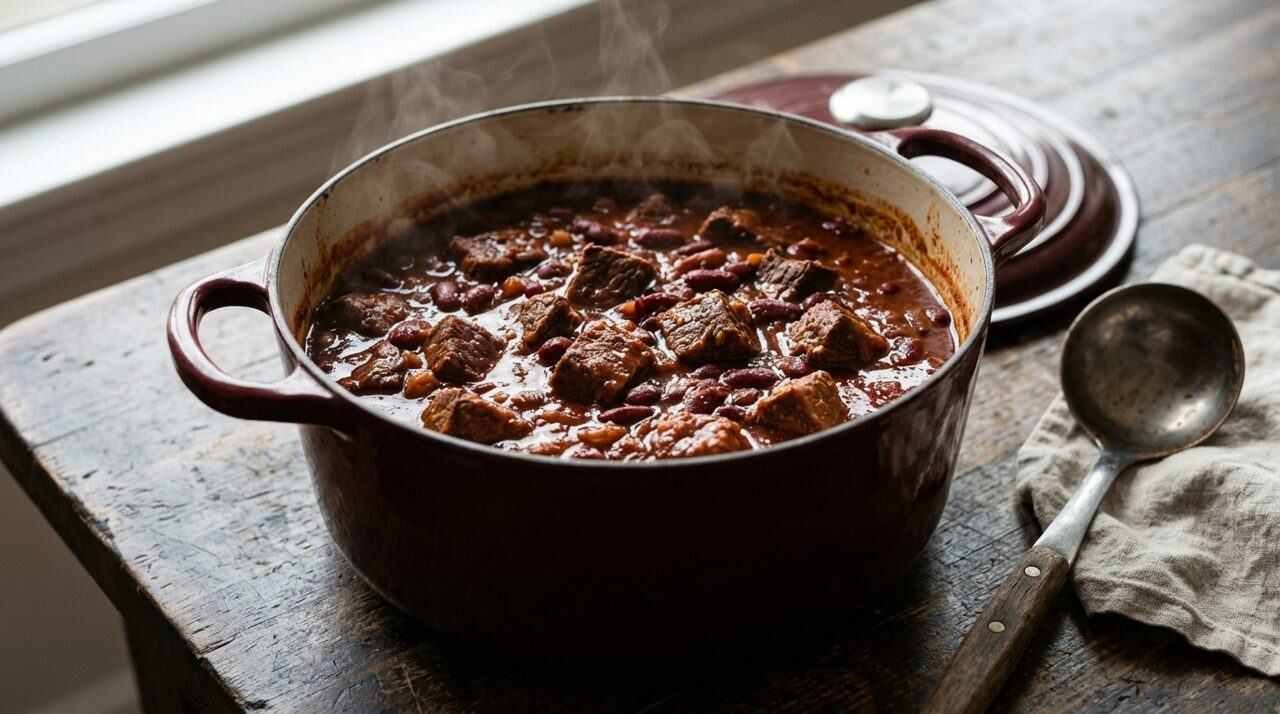
Chili has an argument built into it. Some Texans insist that a proper bowl contains no beans and no tomatoes; the diner counter has long assumed both. Each camp can point to history, which is why neither has ever conceded.
The version below sits on the diner side of the line: cubed beef chuck, a tomato base, kidney beans added late, and a long, unhurried simmer. The technique comes from published America’s Test Kitchen work on chili con carne rather than from any one restaurant’s pot, and the quantities have been adapted for a home stove.
A dish with eleven origin stories
Nobody can say for certain who made the first pot. Texas Monthly notes that one author catalogued eleven competing theories, among them a Blue Nun legend, California gold prospectors, and Texas convicts and cowboys. Food historian Robb Walsh, in the same account, credits the Canary Islander settlers who reached San Antonio in 1731.
The paper trail starts later. A Texian colonist, J. C. Clopper, described a dish he called “a kind of hash” in 1828, and a Kansas reporter wrote of “a dish called chili con carne” in 1877, the earliest print mention that Texas Monthly’s source could find.
San Antonio’s plazas carried the dish to strangers. According to Atlas Obscura, family food stands appeared there in the mid-1800s, the railroad arrived in 1877, and the travelers who stepped off it became the customers. The label “chili queens” dates only to the 1920s and came from outsiders; one historian interviewed for the piece says the cooks “didn’t call themselves ‘chili queens.'” The original dish, the article adds, had no tomato, and beans came on the side instead of in the stew. The University of the Incarnate Word’s history of the stands records that the city health department closed them for good in the early 1940s.
How beans and tomatoes got in
Beans have been associated with chili “as far back as the early 20th century,” although it is generally accepted that the earliest chilis lacked them. Texas made chili con carne its official dish in 1977, and in 1999 the Chili Appreciation Society International barred beans from its competitions. Tomato has its own champion in the same article: newspaperman Wick Fowler, who insisted on one 15-ounce can of tomato sauce for every three pounds of meat.
Cincinnati took the dish somewhere else entirely. The Wikipedia entry describes its chili as a substantially different preparation developed by Macedonian and Greek immigrants, traceable to at least 1922. A bowl with beans and tomato is a later arrangement rather than a mistake, and the Wikipedia entry itself notes that recipes provoke disputes among aficionados.
The stands themselves were a spectacle. Texas Highways describes lantern-lit tables that opened at dusk and served until dawn, with food cooked or reheated on portable stoves. Novelist Stephen Crane, visiting in 1895, called the chili “exactly like pounded fire-brick from Hades.”
Commerce followed the crowds. Texas Monthly reports that Captain William G. Tobin canned chili in 1882, reportedly with goat meat, and won a U.S. Army contract, earning him the label of San Antonio’s “forgotten Chili King.” The same year, 1882, is the date of Gould’s Guide to San Antonio, the earliest guidebook mention that historians cite.
Chuck, cut by hand and browned in batches
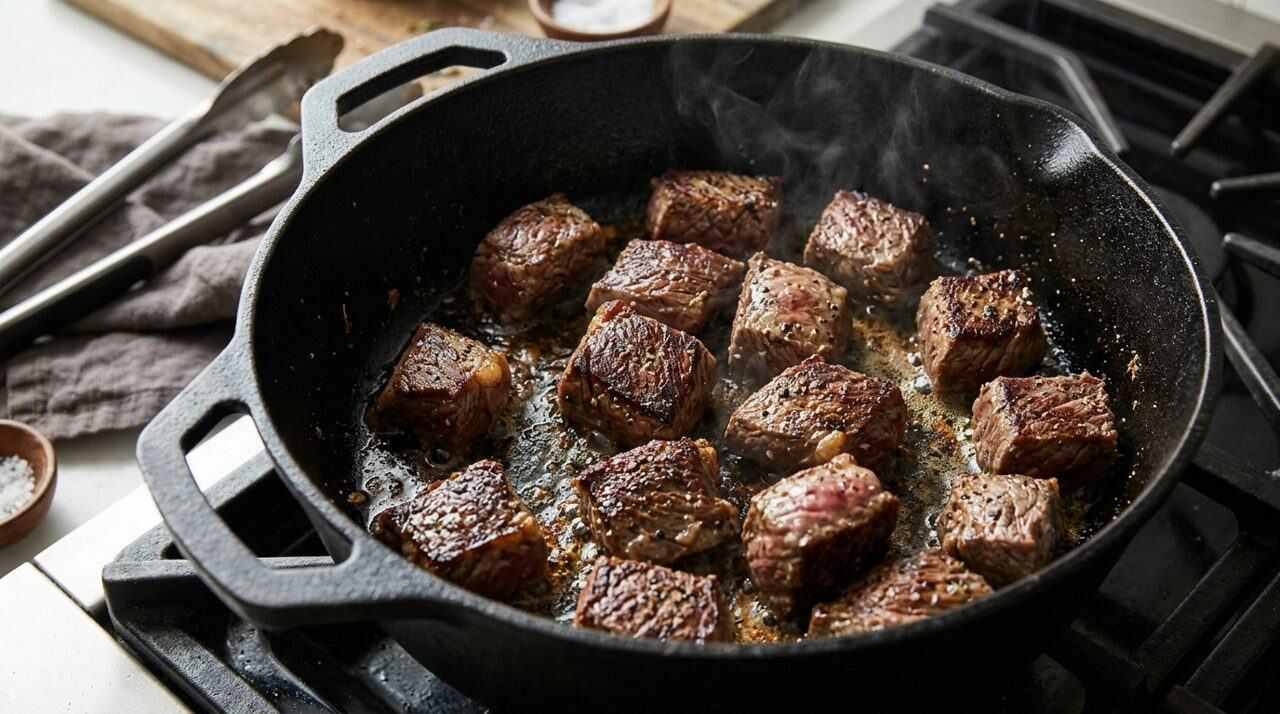
The test kitchen starts with a boneless chuck-eye roast, trimmed and cut into 1-inch pieces, then patted dry and seasoned with salt and pepper. The reasoning is marbling: ATK says chuck delivers “rich flavor and tender texture after prolonged cooking.”
The beef goes into the pot half at a time, in bacon fat heated until just smoking, for about 8 minutes per batch. Patience at this stage is the whole job. The pot should be loud, the cubes should darken, and the second batch should wait its turn.
A second ATK recipe, its slow-cooker Texas red chili, splits the meat into two sizes: ¾-inch pieces from one roast and 1¼-inch pieces from another. The small cubes help thicken the pot, and the larger chunks supply chew. That trick is worth borrowing for a larger batch.
Ground chuck can stand in for the cubes. The USDA gives 160°F as the safe minimum internal temperature for ground beef, a number a long simmer clears easily, though the texture will be closer to a sauce than a stew.

Blooming the spices in fat
Chili powder, cumin, and oregano go into the softened onions before any liquid does. In the ATK chili con carne recipe they cook with the garlic for about 30 seconds, until fragrant.
The step has a mechanism behind it. America’s Test Kitchen’s explanation of blooming in oil points out that the main flavor compounds in many spices are largely fat-soluble, so fat pulls them out far better than water. In its test, red pepper flakes steeped in oil yielded more than double the capsaicin of flakes steeped in water, and thyme-infused oil carried roughly ten times the thymol of thyme-infused water.
Both ATK chili recipes apply the step to chili powder and cumin, and the Texas red version gives them about 2 minutes in the oil, until “deeply fragrant.” Water added first would extract less of what the jar contains.
Ingredients
Serves 6 to 8. Adapted from the America’s Test Kitchen chili con carne method linked above.
- 3 pounds boneless beef chuck, trimmed and cut into 1-inch pieces
- 4 slices bacon, chopped
- 2 medium onions, chopped
- 1 jalapeño, seeded and minced
- 4 garlic cloves, minced
- 3 tablespoons chili powder
- 1½ teaspoons ground cumin
- ½ teaspoon dried oregano
- 1 can (14.5 ounces) diced tomatoes, pureed with 2 teaspoons minced chipotle in adobo
- 4 cups water
- 1 tablespoon brown sugar
- 2 cans (15 ounces each) kidney beans, drained and rinsed
- 2 tablespoons yellow corn muffin mix
- Salt and pepper
Method
- Cook the bacon in a Dutch oven over medium heat until crisp, about 8 minutes. Lift it out and reserve 3 tablespoons of fat, topping up with vegetable oil if needed.
- Pat the beef dry and season with salt and pepper. Heat 1 tablespoon of the bacon fat over medium-high heat until just smoking, brown half the beef for about 8 minutes, and transfer it to a bowl. Repeat with a second tablespoon of fat and the remaining beef.
- Add the last tablespoon of fat, the onions, and the jalapeño. Cook about 5 minutes until softened. Stir in the chili powder, cumin, oregano, and garlic and cook until fragrant, about 30 seconds.
- Pour in the water and the pureed tomato mixture, then add the brown sugar, the browned beef with its juices, and the bacon. Bring to a boil, reduce the heat to low, cover, and simmer for 1 hour.
- Skim the fat from the surface. Uncover and simmer another 30 to 45 minutes, until the beef is tender.
- Stir in the beans. Ladle 1 cup of the cooking liquid into a bowl and mix in the muffin mix. Cover and microwave for about 1 minute, until thickened, then whisk it slowly back into the pot. Simmer 5 to 10 minutes more and season with salt and pepper.
Total time runs about two and a half hours, which matches the time ATK lists for its own version.
Thickening without a roux
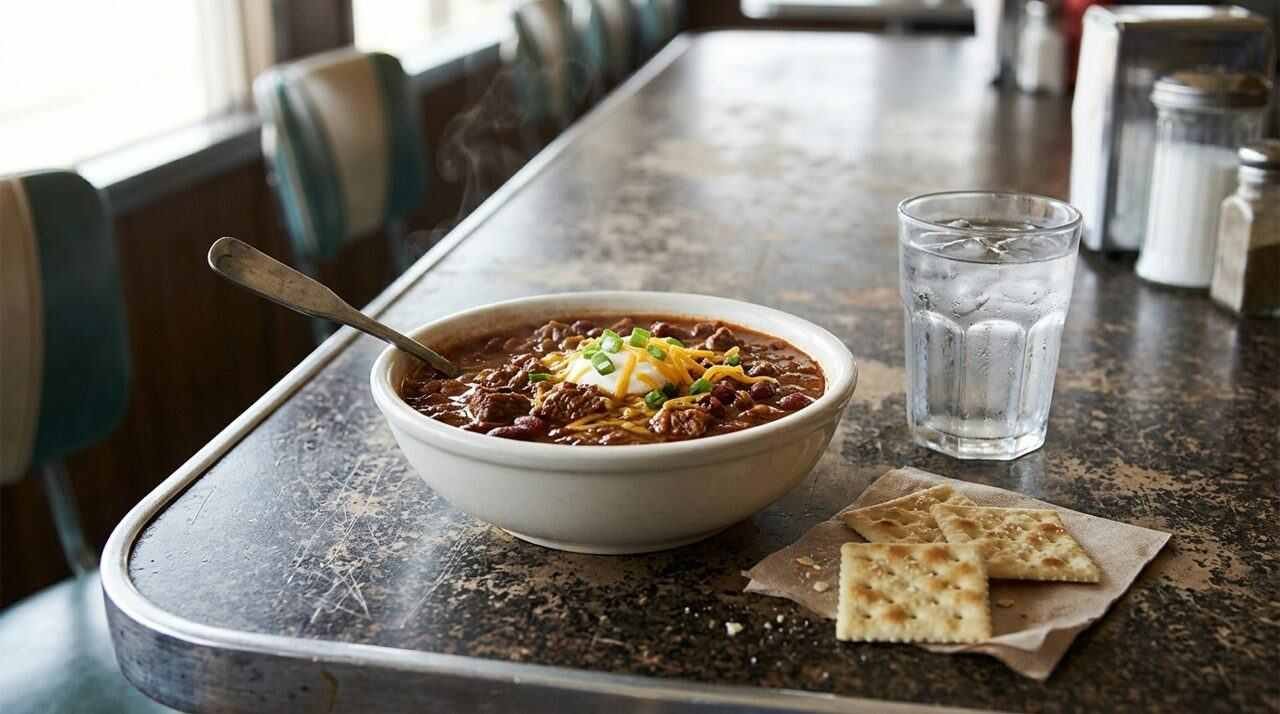
Chili thickened with flour tends to taste of flour. The test kitchen’s answer is corn: two tablespoons of yellow corn muffin mix stirred into a cup of hot cooking liquid and microwaved for about a minute, then whisked back into the pot. ATK says the mix gives “a silky texture and a hint of corn flavor.”
The Texas red recipe takes the same idea toward something more traditional, using pureed toasted corn tortillas as the thickener. The page notes that tortillas may be easier to find than masa harina, the classic choice. Six 6-inch tortillas are blistered in a dry skillet for about 2 minutes per side before they go into the pot with the broth.
That recipe also leans harder on heat: five canned chipotles in adobo blended with the tomatoes and four minced jalapeños cooked with the onions, with the option of eight jalapeños when chipotles are missing. A milder pot halves both.
In both versions the thickener goes in near the end, once the meat is tender and the liquid has reduced, so it adjusts the body of the pot instead of carrying it.
Cooling and keeping a big pot
A pot of chili holds heat for hours, which is its charm at the table and its liability in the refrigerator. The USDA’s leftovers guidance asks for refrigeration within 2 hours of cooking, with large batches of soup-like food divided into shallow containers so they reach 40°F or below quickly.
Refrigerated leftovers keep 3 to 4 days under that guidance, and frozen portions for 3 to 4 months. Reheat to 165°F, measured with a food thermometer. The test kitchen is a little more conservative on the refrigerator, listing up to 3 days for its own version.
A batch this size makes the 6 to 8 servings the recipe promises, and it divides neatly into shallow containers for the freezer.
Sources
- America’s Test Kitchen: Chili con Carne
- America’s Test Kitchen: Texas Red Chili con Carne
- America’s Test Kitchen: Blooming in Oil for Flavor
- Texas Monthly: Bloody San Antonio Origins of Chili con Carne
- Atlas Obscura: Where Did Carne con Chile Come From
- Texas Highways: Hot Dish, San Antonio Chili Queens
- University of the Incarnate Word: Popular Chili Queens Graced San Antonio Plazas
- Wikipedia: Chili con carne
- USDA FSIS: Ground Beef and Food Safety
- USDA FSIS: Leftovers and Food Safety