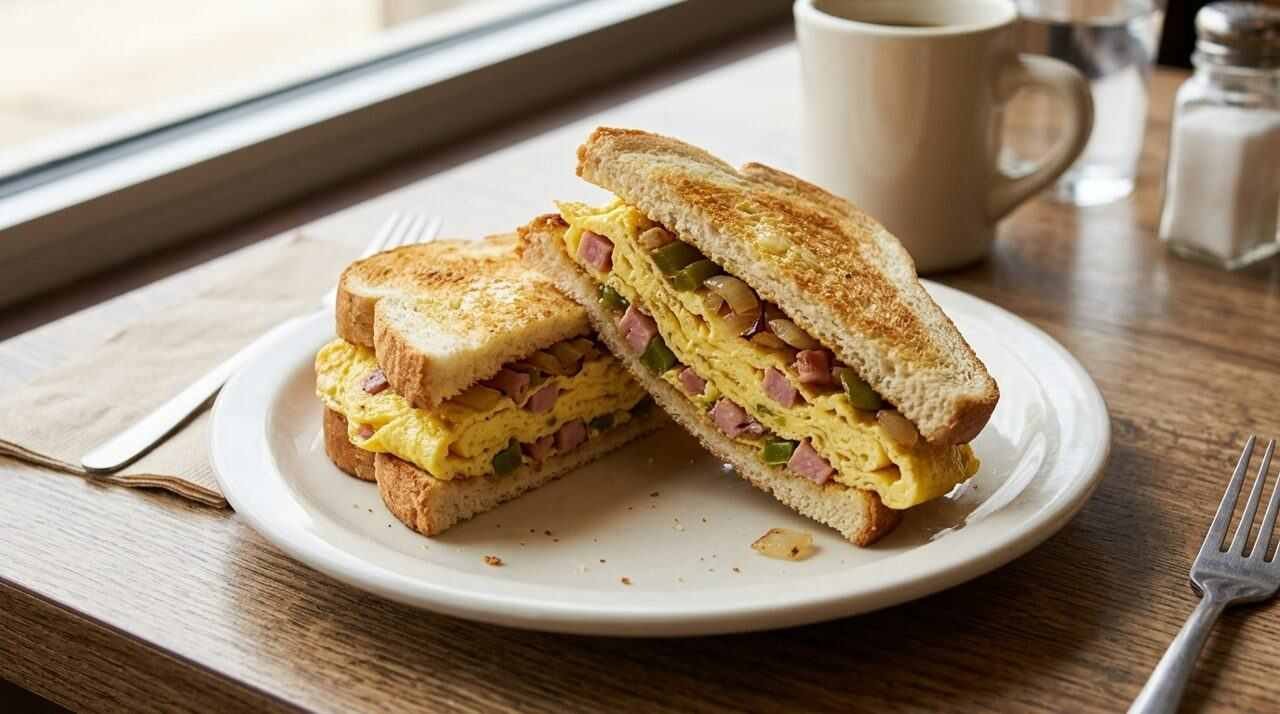
Nobody agrees on who made the first Denver sandwich, and the paper trail suggests nobody ever will. The dish itself is simple enough: eggs scrambled or folded with ham, onion and green pepper, served between slices of bread. The arguments around it, though, involve a Denver cafe, a Denver restaurateur, a hotel, a silver millionaire’s wife, Chinese railroad cooks, Basque settlers in Nevada, and a plaque downtown that nearly every writer on the subject has set aside. What follows sorts the claims by the evidence offered for each.
What the newspapers show
The most useful single resource is a dated list of print citations compiled by Barry Popik on his Big Apple blog. Its earliest entry is a 1903 Iowa newspaper that uses the sandwich as a figure of speech, comparing something to a “hungry hobo to a Denver sandwich.” An April 1905 menu in St. Paul, Minnesota, lists a Denver sandwich at 10 cents. In July 1908 the Chicago Daily Tribune printed a “Western Sandwiches” recipe built on bacon, peppers, onions and eggs, and by February 1909 a Montana paper described a Denver sandwich as minced ham, eggs and onions.
That is a national spread within six years, in Iowa, Minnesota, Illinois, Ohio and Montana. A sandwich that turns up in print in several states by 1909 was not invented in 1907. This is the first problem for any origin story dated 1907.
The same list records an odd skeptic. In March 1913 the Boston Cooking-School Magazine, according to Popik’s summary, said the editors were “not able to verify such a statement” about what a Denver sandwich contained. Even in print the dish was a rumor that cooks outside the West had heard of before they had eaten it.
Two cooks, both in 1907
Two named claimants share the year 1907. According to the Popik citations, in July 1950 the Amarillo Daily News reported that M. D. Looney of Borger said he invented the sandwich at the Manhattan Cafe in Denver in 1907. A 1954 Dallas Morning News item gave the same year to a different man, Albert A. McVittie, said to have invented the Denver sandwich then. Both claims arrive decades after the date they assert, and Popik’s page notes that McVittie does not appear in his many pre-1950 articles on the subject.
Looney’s claim also met a counterclaim in print. The next day, a reader from Portland, Maine, R. A. Olatz, said he had bought Denver sandwiches in that city as early as 1898, per the same compilation. Nothing in the list as summarized backs the 1898 recollection with a contemporary page, so it stays what it is, a reader’s memory. The Wikipedia entry on the Denver sandwich credits McVittie, a Denver restaurateur, and Looney, also of Denver, with 1907, and says newspaper mentions predate both.
The name that moved
The Popik page also offers a clue about the Manhattan Cafe link. The “Manhattan sandwich,” which appears in a 1909 citation as fried egg, minced ham and onion, matches what other sources call the St. Paul sandwich, and Popik suggests the name may have derived from the cafe in Denver. That is a suggestion, labeled as one, and it leaves the larger question where it was.
The Tabor Hotel and Baby Doe
A second Denver story puts the sandwich in a hotel kitchen. A 1973 California newspaper, quoted in the same Popik list, says it “was originated at the Taber Hotel in Denver,” a spelling of the Tabor Hotel that appears in the source. In 2002, the Seattle Post-Intelligencer credited “Baby Doe,” wife of a Colorado silver millionaire, with inventing it in the Tabor kitchen.
The story has charm and no found documentation. No document for it has turned up in these sources. According to the Sword and the Sandwich newsletter, which cites Colorado Life editor Matt Masich, it is among several unverifiable stories alongside Italian claimants and early-2000s local restaurateurs, and he calls the Baby Doe version apocryphal.

The pioneer plaque and the bad-egg theory
The most repeated Denver story involves covered wagons. Per the Food Republic account, a plaque in downtown Denver credits pioneers with creating the omelet as a way to mask the taste of eggs that had traveled by wagon. Food Republic calls the story colorful but probably untrue. The Denver Gazette notes that the theory holds that strong ingredients hid the flavor of bad eggs, and quotes the diner Sam’s No. 3 as saying many historians “have balked at this claim.”
The Buttondown writer takes the plaque apart on a technicality. Sweet bell peppers, the author says, citing Balazs Herzog of a Budapest fruit and vegetable inspection center, were first cultivated in Eastern Europe in the 1920s, while wagon-train traffic peaked in the 1860s. The reasoning is the writer’s, not a settled finding. It does underline a plain point: the sandwich appears in print in 1903, and no earlier document has surfaced for the wagon-train era.
Egg foo young and the railroad
The explanation with the most scholarly weight links the sandwich to Chinese cooking. The James Beard Foundation summarizes Beard’s argument in his book American Cookery, first published in 1972, that Chinese cooks working for logging camps and railroad gangs in the 1800s and early 1900s brought egg foo young to the United States, and notes that Beard’s book is unusual in claiming that egg foo young inspired the Denver or western sandwich. Wikipedia attributes the same theory to Beard and to Evan Jones, author of American Food: The Gastronomic Story (1981), and adds that the two believed early Denver sandwiches were in fact St. Paul sandwiches.
The idea has current defenders and a candid critic. Per the Buttondown newsletter, Denver historian Adrian Miller says the sandwich belonged to a national egg-sandwich craze in the 1950s, that newspaper references from earlier are scant, and that Chinese workers who built Denver’s tracks in the late 1860s may have made a portable version of egg foo young. Food Republic ranks the railroad idea as the most plausible of the lot, while stating there is “no definitive evidence” for it. The Denver Gazette cites Britannica for the same speculation and adds a cattle-drive alternative.
The record here is a hypothesis built by food writers on a resemblance in the food and a plausible set of cooks. It has not been tied to a menu, a recipe or a person. A fair summary is that it explains the combination of egg and chopped aromatics better than any other story, and proves nothing about Denver.
Basque kitchens and colonial ham
Two other theories surface in a Westword essay. One holds that the Western may be a corruption of piperade, the Basque dish of peppers and eggs, brought by Basque settlers to Nevada. The other traces the omelet to a seventeenth-century English colonial preparation called frizzled ham with eggs. Both are offered as possibilities. Neither is tied to a document that mentions the sandwich or omelet.
The same essay supplies a premise from the other direction: late-night cooks east of the Continental Divide, making eggs, peppers and cheese for truckers coming down from the Rockies. It reads as a description of how the dish lived on, not how it began.
Denver versus St. Paul, Western versus Denver
For readers hoping the names settle something, they do not. In June 1950 the columnist Wes Izzard of the Amarillo Daily News said the sandwich of scrambled eggs, chopped ham and green peppers “is known as a Denver or St. Paul sandwich,” according to the Popik list, and over the next days he printed conflicting recipes from readers, one with chopped raw onion and one without. In a 1963 Christian Science Monitor item, easterners are said to call it a “western” sandwich, sometimes a St. Paul and sometimes a Denver. By April 1977, Izzard concluded that the Denver version is scrambled eggs with diced ham and green peppers on toast, while the St. Paul adds onion.
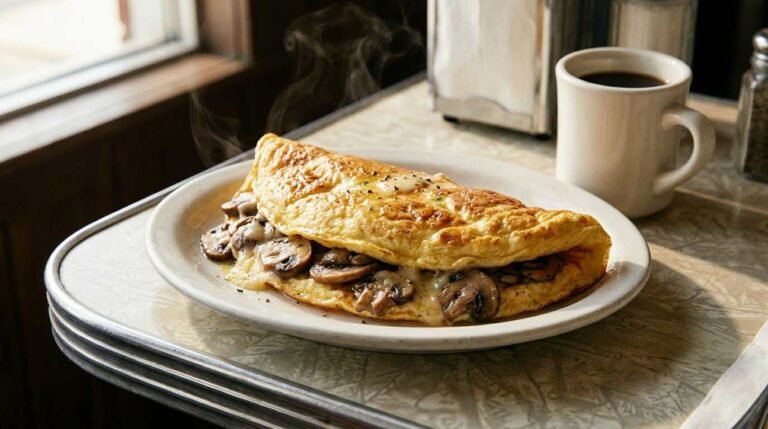
A 1926 Time magazine definition, cited on the same page, is as plain as any: “A western sandwich is a ham and onion omelet with bread above and below.” That sentence also hints at the omelet. By this point the sandwich was close enough to an omelet that dropping the bread required no new idea.
From sandwich to omelet
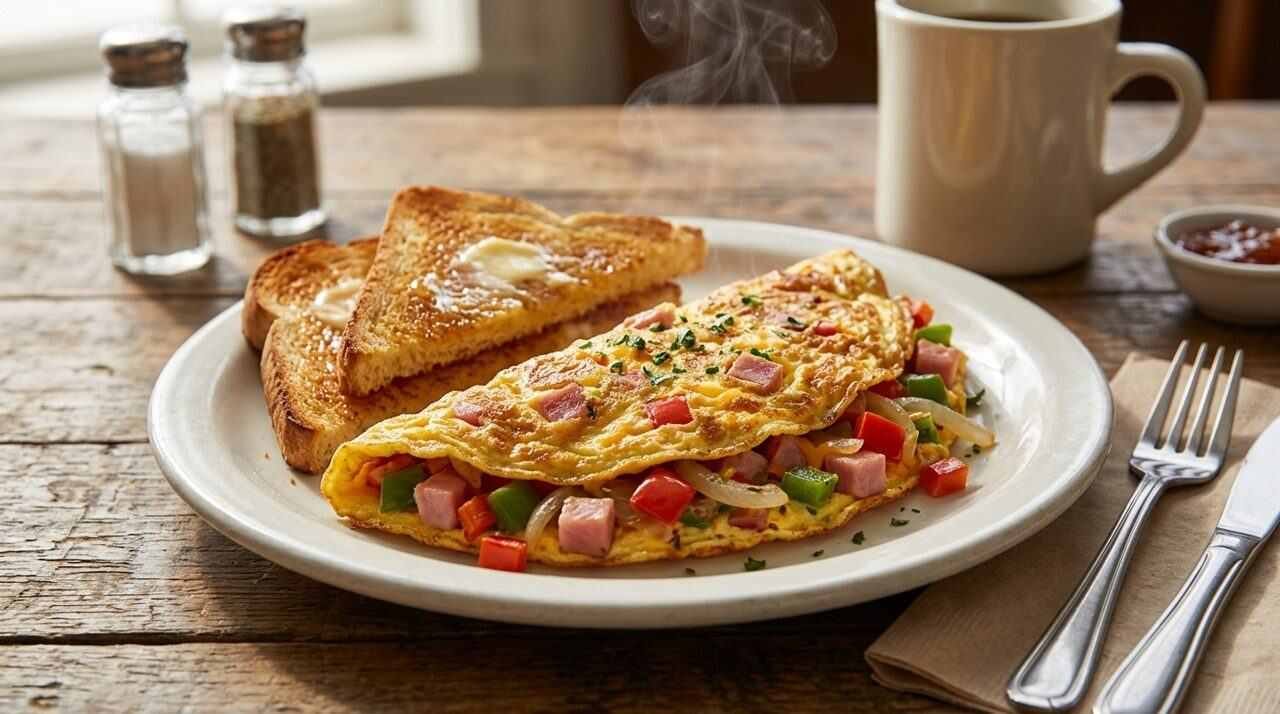
The omelet’s own dates are muddled by competing reference books. The Westword essay says John Mariani’s Encyclopedia of American Food and Drink gives 1935 for the first printed mention of “Western Omelette,” and that the Oxford Encyclopedia of Food and Drink in America dates the phrase “Denver Sandwich” to 1918, in a restaurant-industry publication. The two books disagree with each other and with the newspapers. Popik’s list shows a Pennsylvania paper listing a “Western Omelette” at 30 cents in March 1917, earlier than the 1935 date, and a Hotel Monthly menu with a Denver sandwich in June 1918. The 1903 and 1905 citations precede the Oxford date by a decade or more.
The Denver Gazette, in February 2026, repeats the view that the omelet came from the sandwich once it was served without bread, and says the dish was likely served before 1900 without the Denver name. Food Republic notes that food historians generally agree the omelet was not invented in Denver at all. By the 1980s, it adds, the bread version had largely disappeared from menus and the omelet had taken over.
Yet another lineage comes from Saveur, which says that according to America Cooks, early cowboys called the sandwich’s great-granddaddy “Ham Toast.” No date comes with it.
Anyone who wants the older, bread-bound form can follow the Saveur method: brown a quarter pound of diced smoked ham in butter, soften a chopped onion and half a green pepper, pour in four beaten eggs, cut the set eggs in half to flip, and tuck each half between two slices of buttered toast.
Sources
- Barry Popik, Western Sandwich (Denver Sandwich; Denver Omelet)
- Wikipedia, Denver sandwich
- Food Republic, The Denver Omelette Got Its Start As A Massively Popular Sandwich
- Westword, The Yolk’s on Us
- The Sword and the Sandwich, Notable Sandwiches 56: Denver
- Denver Gazette, Where did the Denver omelette come from
- James Beard Foundation, James Beard’s recipe box: Eggs Foo Yung
- Saveur, Denver Sandwich