Nobody has found the first blue plate special, and the people who have looked disagree about where to start. One camp points to a Fred Harvey menu from October 22, 1892. Another points to a railroad dining car in 1915. A third points to a plate itself, blue, divided, and cheap.
What the sources do agree on is the meal: a single price, a single plate, and almost no say in what arrived on it. That arrangement shaped the diner menu more than the color of any crockery did.
What the plate held
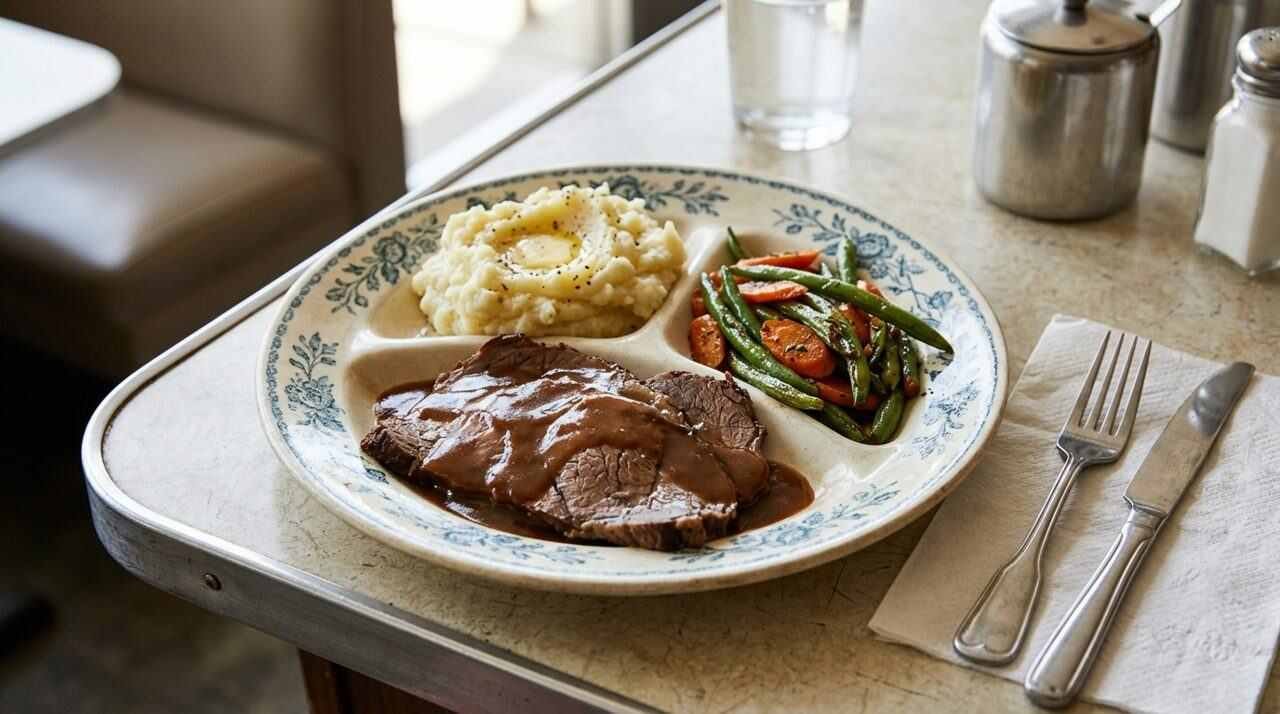
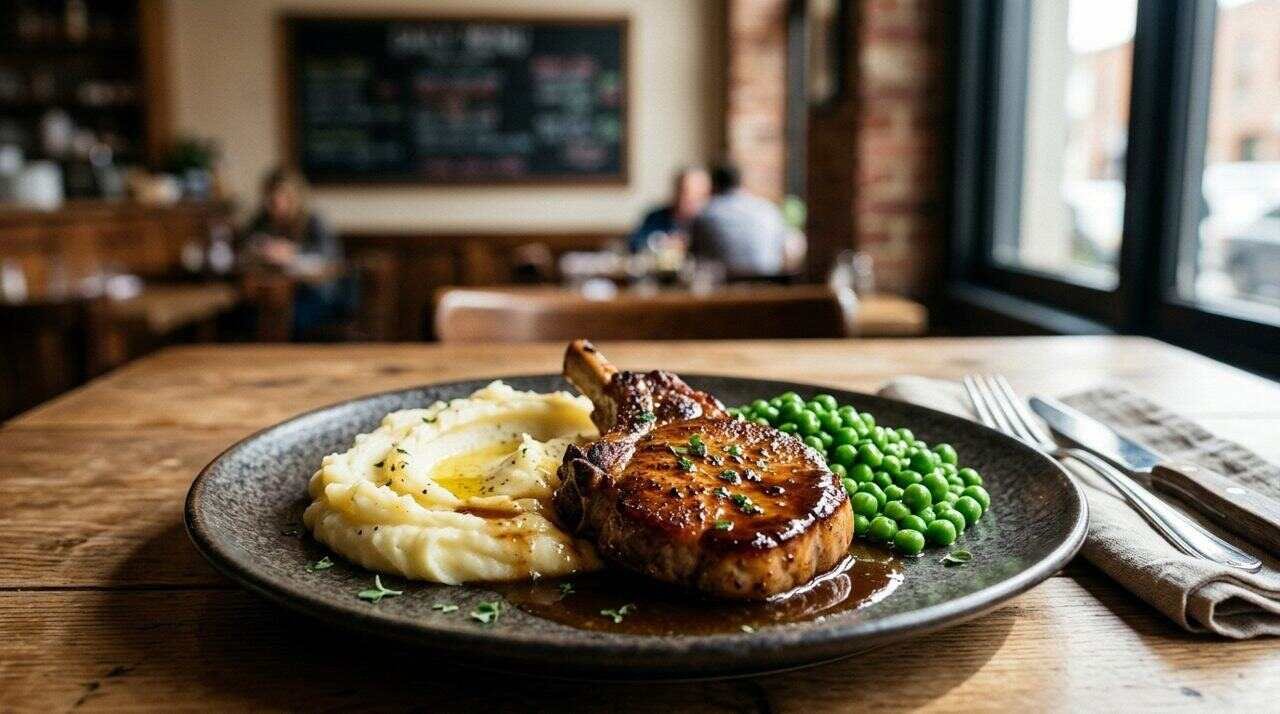
A blue plate meant a main course and sides, assembled in advance and sold at one price. Restaurant history blog Restaurant-ing Through History lists the typical contents as beef and gravy, pork chops, or ham, with mashed or fried potatoes, carrots, and green beans. The meal was billed as home cooking, the piece says, which set it apart from the ethnic cooking of table d’hôte restaurants, and it usually cost about 35 to 50 cents.
The price points are consistent with other accounts. A 1928 New York Times article, cited in Wikipedia’s entry, praised an Ann Street restaurant where a blue-plate special of meat and three vegetables was “purchasable for a quarter.”
The same entry records a 1930s definition of the special as “a low-priced daily diner special” and “a square for two bits.” Two bits is twenty-five cents.
Mental Floss reports that during the Great Depression, with budgets tight, the term became associated with generous portions of protein and side dishes. Under either of the main origin theories, it adds, the phrase came to signify good food, cheap food, or both. That double meaning explains why the name outlived the crockery.
Wikipedia, for its part, says the origin and meaning of the phrase are unclear, and that the special was a common sight from the 1920s to the 1950s. The honest position is that the plate, the railroad, and the price all contributed, and that no single moment has yet been shown to be the birth of the name.
Four stories about the name
The plate theory
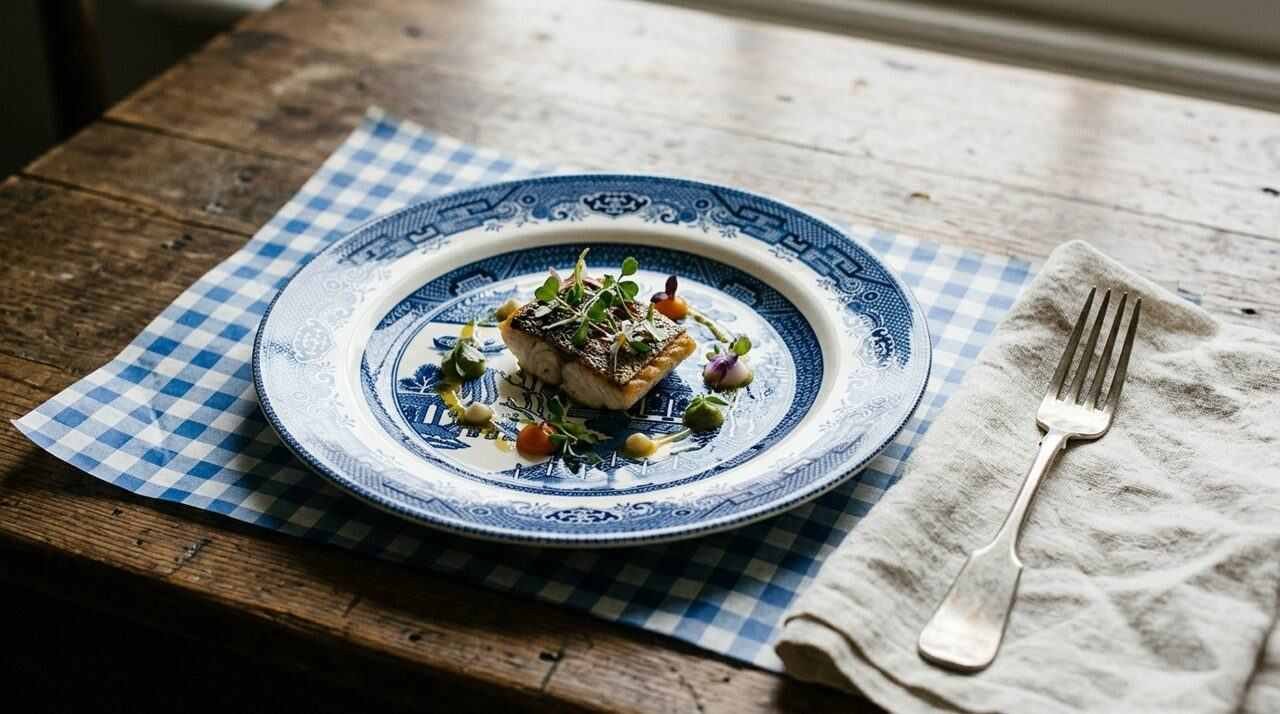
The most common explanation is the plain one. Etymologist Michael Quinion, on World Wide Words, considers it the likeliest that the name came from an actual blue plate, and cites a dictionary description of a blue, often willow-patterned plate divided into sections for separate foods. He treats the blue-ribbon explanation as doubtful, since that sense of the phrase dates from the early 1800s without any obvious tie to cheap meals. Mental Floss offers a version of the same idea, linking the phrase to Blue Willow porcelain on railroad dining cars.
The Fred Harvey claim
The Harvey House restaurants served railroad passengers along the Atchison, Topeka and Santa Fe line, and food writer Daniel Rogov is credited with the claim that a Fred Harvey menu of October 22, 1892, used the term. Quinion says in his column that he could not confirm it. The Phrase Finder author likewise has not seen the menu, though he finds so specific a date plausible. An entry on a restaurant-ware collectors’ wiki calls the idea something that “has been suggested,” pointing out that the term did not become widespread until some thirty years later.
The Depression-plate claim
Collector Kevin Reed has said that a manufacturer began making sectioned plates during the Depression, available only in blue. Wikipedia marks that statement as lacking a citation, and the dated record cuts against it: blue plate meals were being advertised well before the Depression began.
The Seaboard Air Line story
The earliest dated evidence points to a railroad. Etymology researcher Barry Popik lists a October 11, 1915 notice in The State, the Columbia, South Carolina newspaper, describing a fish or meat dish with two vegetables on a blue dish, served on Seaboard Air Line dining cars. Popik’s list continues with Seaboard advertisements through April 1916, and with a 1917 description of the Seaboard “Blue Plate Special” dinner in Julian Street’s book American Adventures.
The paper trail, in the order it was found
The evidence has been moving backward. Quinion could point only to a 1926 New York Times advertisement for the Sea Grill, which promised “Blue Plate Specials,” and suspected it was not the earliest. The Phrase Finder author had found a September 1924 YWCA advertisement in a Decatur, Illinois, newspaper. Popik’s list then reaches a 1920 Philadelphia Inquirer advertisement for the Cheri restaurant, an Atlanta Constitution item from 1919 linking blue-plate service to the Great Northern railroad, and a 1918 Miami tea room advertisement, before arriving at the 1915 Seaboard notices.
That sequence matters for the Fred Harvey story. If a menu from 1892 had used the phrase, the next documented appearance would be a gap of more than two decades. Possible, but thin.
By 1934 the phrase had moved from menus into literature. Damon Runyon’s short-story collection took the title Damon Runyon’s Blue Plate Special, according to Wikipedia, and by the 1940s a Hollywood columnist could write of studio executives who looked up from their blue plate specials.
The plate itself explains part of the appeal. The Reluctant Gourmet says the compartments in the divided earthenware kept gravy, sauces, and juices from running into the other foods, and that the pattern was usually Blue Willow, so the color was incidental rather than a marketing choice. The article also separates the blue plate from Howard Johnson’s fixed-price plates, which it calls similar but not sold under the name.
Wikipedia adds that the term became common in the late 1920s and that blue plate specials turned up everywhere from diners to greasy spoons in the United States and Canada through the 1950s. Literature kept pace. Graham Greene’s 1958 novel Our Man in Havana is among the later uses listed there, and a 1947 episode of the radio and television show Candid Microphone had Allen Funt trying to change a blue-plate order.
Steam tables and the economics of the plate
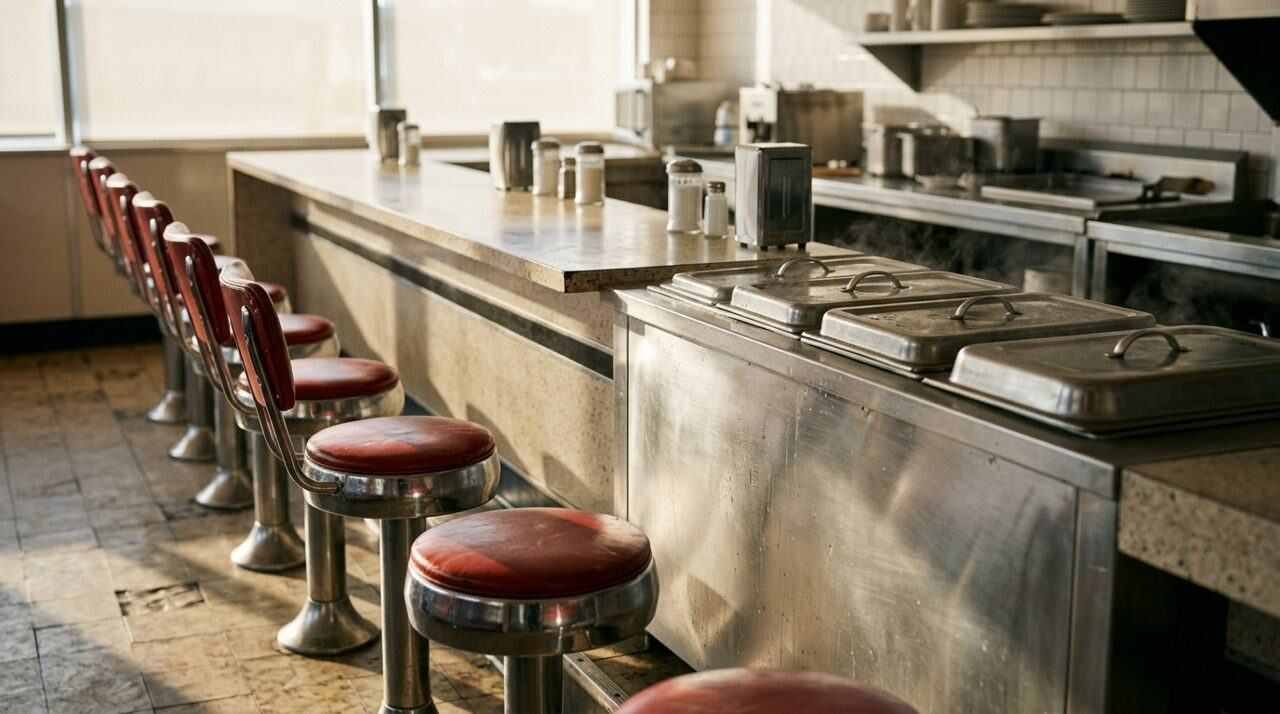
The kitchen logic was simple. Restaurant-ing Through History explains that the components were cooked before the lunch and dinner rushes and held on steam tables, which allowed fast service and quicker table turnover. Restaurants also used the special to move a good purchase or to clear stock nearing spoilage. The same piece ties the format to First World War conservation pressure and says it stayed popular afterward as a compromise for fast-paced city life.
The trade-off was quality. Steam tables, the piece says, “took their toll.” It cites a 1930 guidebook that singled out The Alps in New York City for blue plate dinners that were “more than mere collections of edibles, served en masse.” A compliment that specific implies how common the opposite was.
What it left on the diner menu
Several habits of the modern diner appear in that old arrangement. A fixed price printed beside a fixed dish. A daily rotation that lets the kitchen clear stock before it spoils. A plate assembled from the steam table, so that service is measured in seconds. Diners had little say in what the meal contained, a point the Restaurant-ing Through History piece makes outright.
The connection to later practice is a reading of the evidence, not a documented lineage, but the resemblance is hard to miss. The chalkboard special, the lunch combo, and the early-bird plate all trade choice for price and speed. The blue plate came first in the written record.
The Reluctant Gourmet adds that the special’s pitch in the 1930s was a single advertised price with no menu to read, a bargain that suited budget-conscious customers during the Depression. The same article names fried chicken, meatloaf, mashed potatoes and gravy, green beans, and pie among typical components, though it cannot confirm a single birthplace, and notes that the 1892 Harvey claim has never been independently verified. It also says the special survives mainly at independent diners in New Jersey, New York, New England, and Pennsylvania, though it names no source for that statement.
How the special faded and why the name stayed
By the end of the Second World War, the phrase sounded old-fashioned. Restaurant-ing Through History reports that it was used mainly in smaller towns by then, and that in 1952 columnist Hal Boyle mocked the meal as an “all-America culinary nightmare.”
The Reluctant Gourmet article dates the decline to the 1960s, when fast-food chains expanded and drew customers away from sit-down diners. The decline did not kill the name. Mental Floss observes that diners today often use the phrase without serving food on blue plates, and that it still signals a meal deal that is typically not customizable.
Cartoonists got there early. A 1964 Blondie strip, noted by Wikipedia, joked that the special was named after a cook called Oscar Blueplate.
Useful gear
- Blue Plate Specials and Blue Ribbon Chefs (Jane and Michael Stern): a practical item related to this topic. See it on Amazon (affiliate link)
As an Amazon Associate I earn from qualifying purchases. A commission may be earned if you buy through this link, at no extra cost to you.
Anyone who wants to settle the 1892 question would have to locate the Fred Harvey menu itself. Until a copy turns up in an archive, the 1915 Seaboard Air Line notices remain the earliest documented use, and every earlier date should be read as a claim.
Sources
- Wikipedia: Blue-plate special
- World Wide Words: Blue-plate special (Michael Quinion)
- Barry Popik: Blue Plate Special
- The Phrase Finder: Blue-plate special
- Mental Floss: What Is the Blue Plate Special, and How Did It Get Started?
- Restaurant-ing Through History: Blue Plate Specials
- The Reluctant Gourmet: What Was the Blue Plate Special?
- Restaurant Ware Collectors Network: Syracuse China