A diner is a building that began life as a delivery. Long before the stools and the pie case, the American diner arrived on a flatbed or a rail siding, built somewhere else by people who made nothing but lunch rooms, and the North Shore of Long Island still has places that carry that lineage in their names, their counters and, in one case, their wheels.
A Night-Lunch Wagon Outside a Newspaper
The story usually starts in Providence, Rhode Island. According to Art in Ruins, Walter Scott (1841 to 1924) began serving late-shift workers in 1857 because local restaurants generally closed at 8 p.m., and in 1872 he went into the “night lunch” business full-time from a former freight wagon parked outside the Providence Journal office. Wikipedia’s entry on the diner describes the same wagon as a “crude precursor of the diner” and notes that it had windows on each side.
Scott’s wagon was a horse-drawn convenience. The leap toward something with rooms and routines came a few years later, when, per the same Art in Ruins history, Samuel Messer Jones built the first cart with a full kitchen and space to eat inside in 1887, and Charles H. Palmer received the first lunch cart patent in 1891.
City governments soon pushed back. By the 1920s, according to The Henry Ford, night lunch wagons were viewed as “traffic hazards or eyesores,” and some entrepreneurs responded by moving to longer dining cars on permanent sites. A vehicle that had been chased from the curb became a building with a lease, which is a different kind of business altogether.
Why a Diner Looks Like a Railroad Car
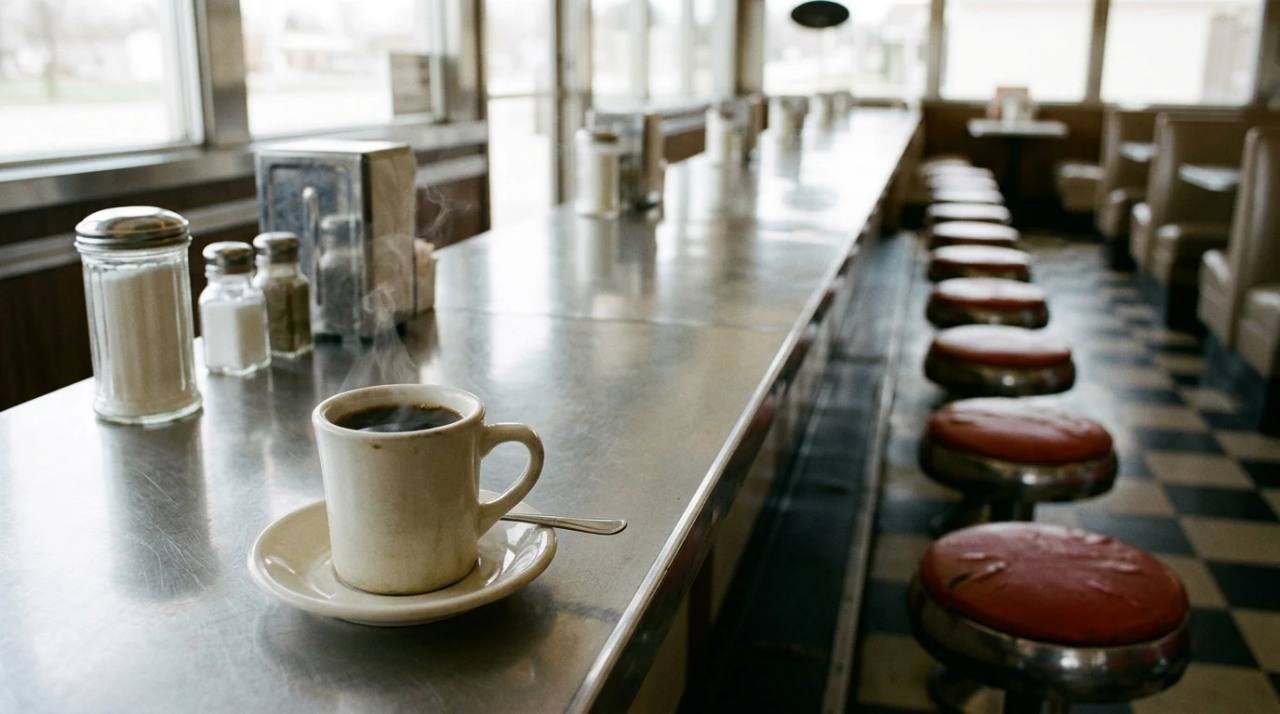
The shape owes a good deal to the railroad. History.com reports that manufacturers shipped prefabricated units by rail, which contributed to their boxcar-like proportions, and that a journalist suggested “dining car” as a name in 1924, a nod to the gourmet meals served on passenger trains. The name was later shortened to “diner.” Art in Ruins tells it slightly differently, crediting Patrick J. Tierney of New Rochelle, New York, who built longer wagons with counters running parallel to the sides and deliberately borrowed the railroad term.
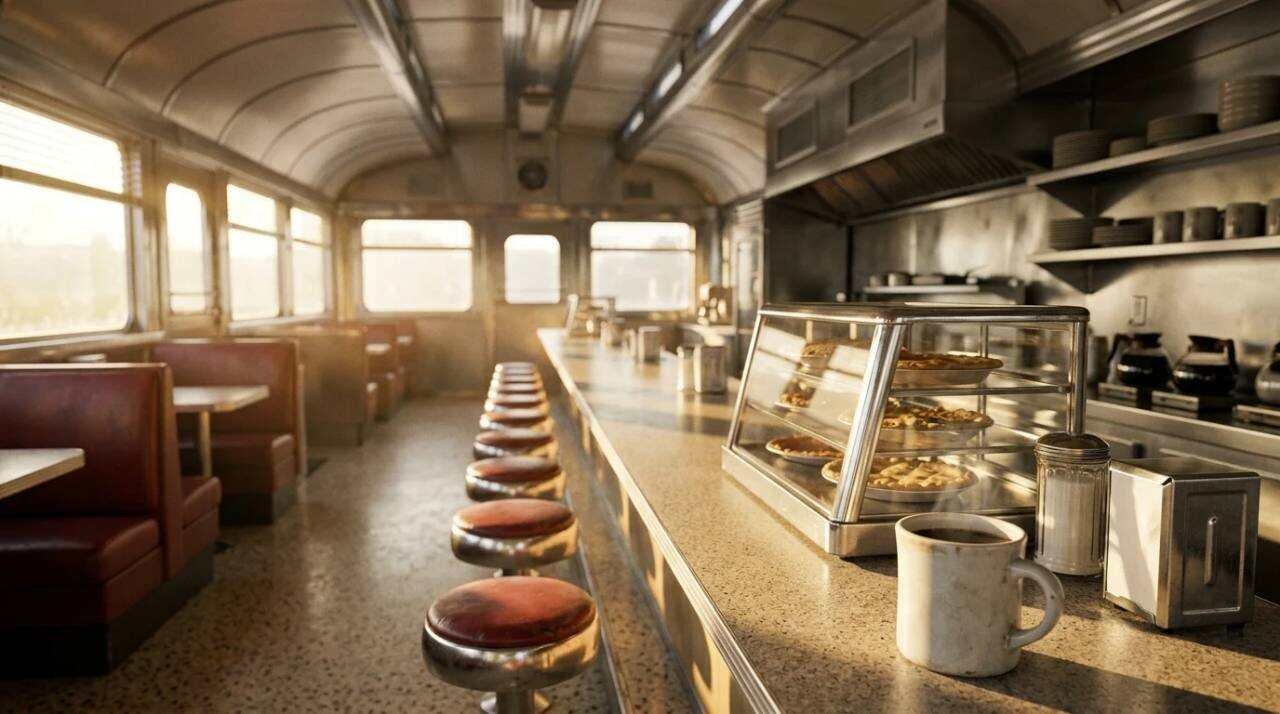
Three makers shaped the early industry. Per Art in Ruins, Tierney, the Jerry O’Mahony Company of New Jersey and the Worcester Lunch Car Company together turned lunch carts into larger, more permanent diners. Worcester, founded in 1906 by Philip H. Duprey and Grenville Stoddard, built 651 diners before manufacturing stopped, and by the 1920s its cars had marble counters, tile floors and plate-metal kitchen equipment. History.com credits Tierney with the long lunch counter lined with stools and the O’Mahony company with a door placed in the center between two long windows, a layout that remained unchanged for decades. Wikipedia puts the O’Mahony company in Elizabeth, New Jersey, and counts 2,000 diners from 1917 to 1952.
The interiors changed as well. In 1924, Tierney and others added table service alongside the counters, a move Art in Ruins says helped attract women, and The Henry Ford notes that owners who wanted women and families bought diners with booths and hired waitresses.
Stainless Steel, Streamlines and New Jersey
The 1930s brought a second skin. Diners picked up porcelain enamel, Formica and stainless steel, along with rounded and slanted ends, and the Judkins Company’s Sterling Streamliner, with bow ends and roof fins, became a prominent example, according to Art in Ruins. The same source describes a sectional construction method patented in 1937 by Bertron G. Harley that let an owner start small and add a section at a time as business grew, which made a diner something closer to a bookshelf than a monument.
New Jersey makers took the metal furthest. Fodero Dining Car Company, founded by the Italian immigrant Joseph Fodero and operating from 1933 to 1981 in Newark and later Bloomfield, is known for stainless steel exteriors and an art deco look, and its diners are found mainly in New Jersey, New York and Pennsylvania. The Empire Diner in Manhattan was among the Fodero diners still operating as of 2010.
Size became the quiet dividing line. A WGBH report on Worcester’s diner industry says that by the 1940s customers wanted larger diners, that New Jersey makers offered stainless steel models seating about 150 while Worcester’s seated about 60, and that the company declined to retool its small factory. The postwar boom favored the builders who could scale up. The Henry Ford adds that after World War II, diners were especially common in New England, New York and New Jersey.
Greek Families Behind the Counter
The people running the grills have their own history, and a large share of it is Greek. Wikipedia states that throughout much of the 20th century, diners, mostly in the Northeast, were often owned and operated by Greek-American immigrant families.
The figures are specific for New York City. Tasting Table cites a 1996 New York Times article saying about two-thirds of the city’s diners were Greek-owned, and reports that about 421,000 Greek immigrants left Greece between 1890 and 1921, settling mainly on the East Coast. The New York Public Library’s Kay Zakariasen Greek Diners collection holds about 400 color slides, interview transcripts and research from a 1976 photo-essay on Greek immigrants in New York restaurants, bakeries, grocers and street vending, and its research files include a 1972 HANAC survey finding that 92% of diners in the area were Greek-owned or managed.
How a trade becomes an inheritance is part of the answer. Michael C. Gabriele, author of The History of Diners in New Jersey, is quoted by Tasting Table saying, “A lot of Greeks had a hard time getting people to hire them.” Many arrivals began as bussers and dishwashers, saved their wages, and bought out the owners. Their diners, per the same article, took on the character of the Greek kaffenion, a homey restaurant with simple menus and a great deal of coffee.
No source fetched for this article documents Greek ownership of specific North Shore diners, so the Long Island places below are described only through what their own pages and local reporting say.
Tim’s Shipwreck Diner, Northport
On Main Street in Northport Village, Tim’s Shipwreck Diner is the North Shore’s most direct link to the railcar era. The Long Islander News lists the address as 46 Main St., and TBR News Media reports that the diner has stood there since 1924, first as the Northport Diner, “carved out of an early 20th century trolley car.” News 12 Long Island calls it a former train car, so the rolling-stock lineage is plain even where the exact vehicle is described differently.
The building keeps physical evidence. According to News 12, two wheels remain underneath the structure, one hangs broken off on an interior wall, and one belongs to the Northport Historical Society’s collection. The Society also gave the diner a Century Award, which News 12 says is only the fourth village business to receive it.
Ownership has stayed in a short chain of hands. Per TBR, Otto Hess bought the diner in 1972 and named it Otto’s Shipwreck Diner, his son Tim Hess took over in 1996, and Denis Beyersdorf with partners Ed McCallister and Jeffrey Wang bought it from Tim Hess on Dec. 20, 2022. The centennial was marked on Aug. 15, 2024, and Tim Hess summed up the room for News 12 this way: “It’s family. When you come into the diner, you will know 10 people.” In 2014 the diner was renovated for Food Network’s American Diner Rescue with help from Ty Pennington and local volunteers, the Long Islander reports.
Seaport Diner, Port Jefferson Station
Closer to Mount Sinai, the Seaport Diner sits at 5045 Nesconset Highway in Port Jefferson Station, and its official page gives the phone number as 631-928-7777. The site calls the place “Family owned since 1981” and “A Port Jefferson tradition,” and lists Mount Sinai among the areas it serves.
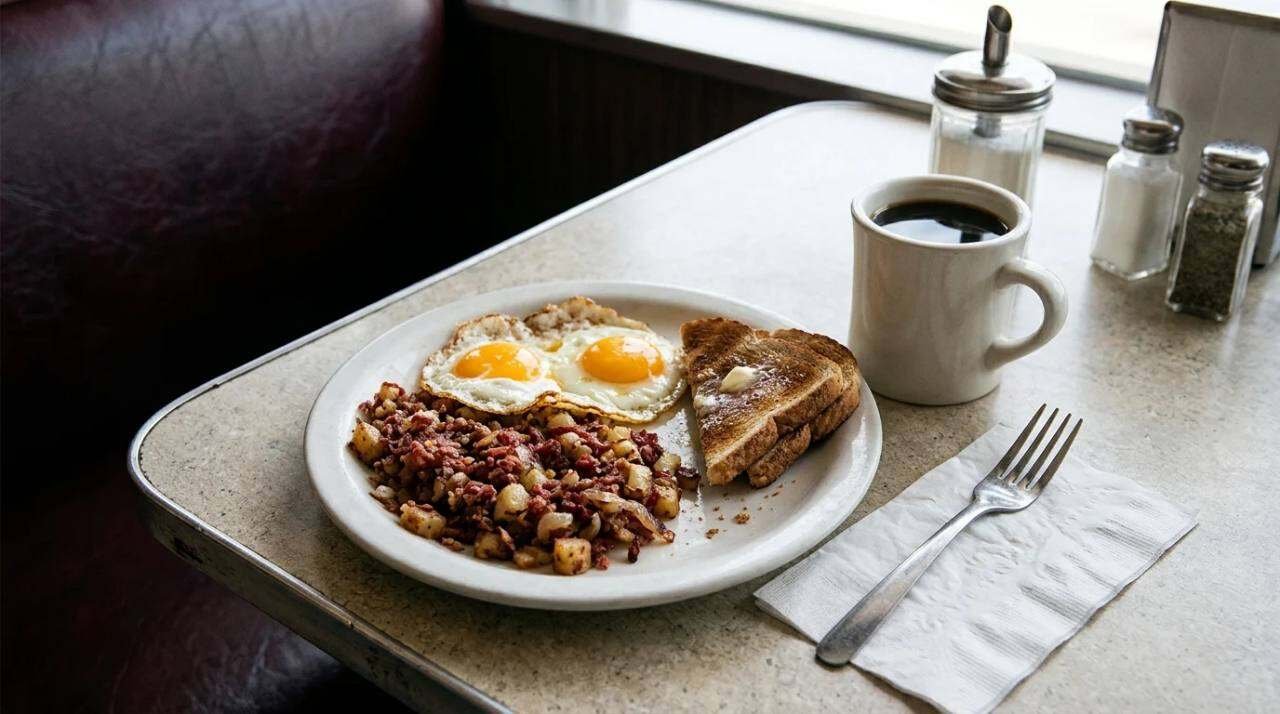
On the official page, alongside corned beef hash and eggs, baked mac and cheese and chicken and waffles, the menu names a Mason Burger, Manhattan clam chowder, vodka tacos and loaded milkshakes, and lists breakfast, lunch, dine-in, takeout and delivery as services.
The Heritage Diner in Mount Sinai
In Mount Sinai itself, The Heritage Diner at 275 Route 25A describes itself as family-owned since 2000, open daily from breakfast through dinner, with pickup, DoorDash and Uber Eats listed for ordering. Readers curious about the cooking behind that kind of counter can start with the explanation of why a flat-top browns food or the story of the blue plate special.
What the Record Leaves Behind
The industry that built these rooms thinned out. Art in Ruins says limited-menu fast-food chains gained ground from the late 1950s through the 1960s and 1970s, and that of an estimated 5,000 diners that once operated, fewer than half survived by the late 1970s. WGBH reports, according to Gutman, that about 80 of the more than 600 diners produced in Worcester still exist.
A counter on Main Street in Northport still keeps two wheels beneath it, and a family-owned diner on Nesconset Highway dates its ownership to 1981, each a working relative of the lunch wagon that once idled outside a Providence newspaper.
For informational purposes only. Hours and menus change, so check each diner’s official page before visiting.
Sources
- Art in Ruins, The History of Diner Cars and Lunch Wagons
- Wikipedia, Diner
- Wikipedia, Worcester Lunch Car Company
- Wikipedia, Fodero Dining Car Company
- History.com, Why Diners Look Like Trains
- The Henry Ford, Rise of the Diner: Lunch Wagons Pull Off the Road
- WGBH, Worcester Was Once a Center for Manufacturing Pre-Built Diners
- Tasting Table, The Reason So Many Diners Have Greek Roots
- New York Public Library, Kay Zakariasen Greek Diners collection
- TBR News Media, Shipwreck Diner in Northport
- News 12 Long Island, Northport’s Shipwreck Diner celebrates 100th anniversary
- The Long Islander News, Tim’s Shipwreck Diner: A Northport Landmark
- Tim’s Shipwreck Diner
- Seaport Diner
- The Heritage Diner
- Heritage Diner, The Maillard Reaction and the Diner Flat-Top
- Heritage Diner, The Blue Plate Special