 275 Route 25A, Mt Sinai, NY 11766



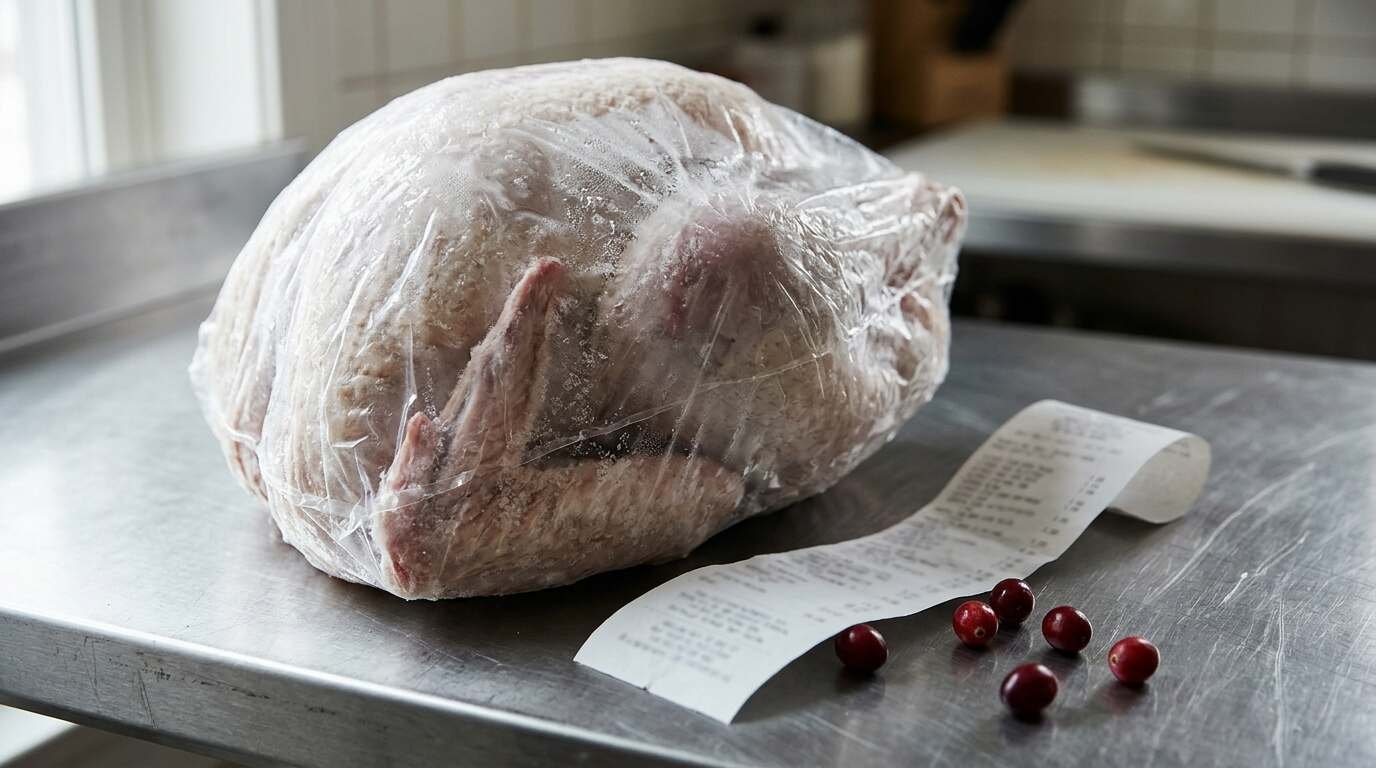
A 16-pound frozen turkey, priced by volunteer shoppers during the first week of November, came to $23.68 this year, or $1.48 a pound. Over roughly the same days, frozen basted hens in the 8-to-16-pound range traded wholesale at $1.81 a pound the week of Nov. 2 to 6, according to USDA market data compiled by Ohio State University and reported by The Shelby Report. The bird at the register came in 33 cents a pound under the trade quote for basted hens up to its size. That gap is the strangest number in this year’s Thanksgiving math, and it sits underneath a headline that otherwise reads like a plain grocery bill.
The headline itself is simple. The American Farm Bureau Federation released its 41st annual survey on Nov. 18, and the classic dinner for 10 now costs $58.63, about $5.86 a person, up more than 6% from 2025. It is the first year-over-year increase since 2022. The figure is still well short of that year’s record.
The $58.63 table, line by line
Twelve lines on the slip, and the bird carries two-fifths of the bill.
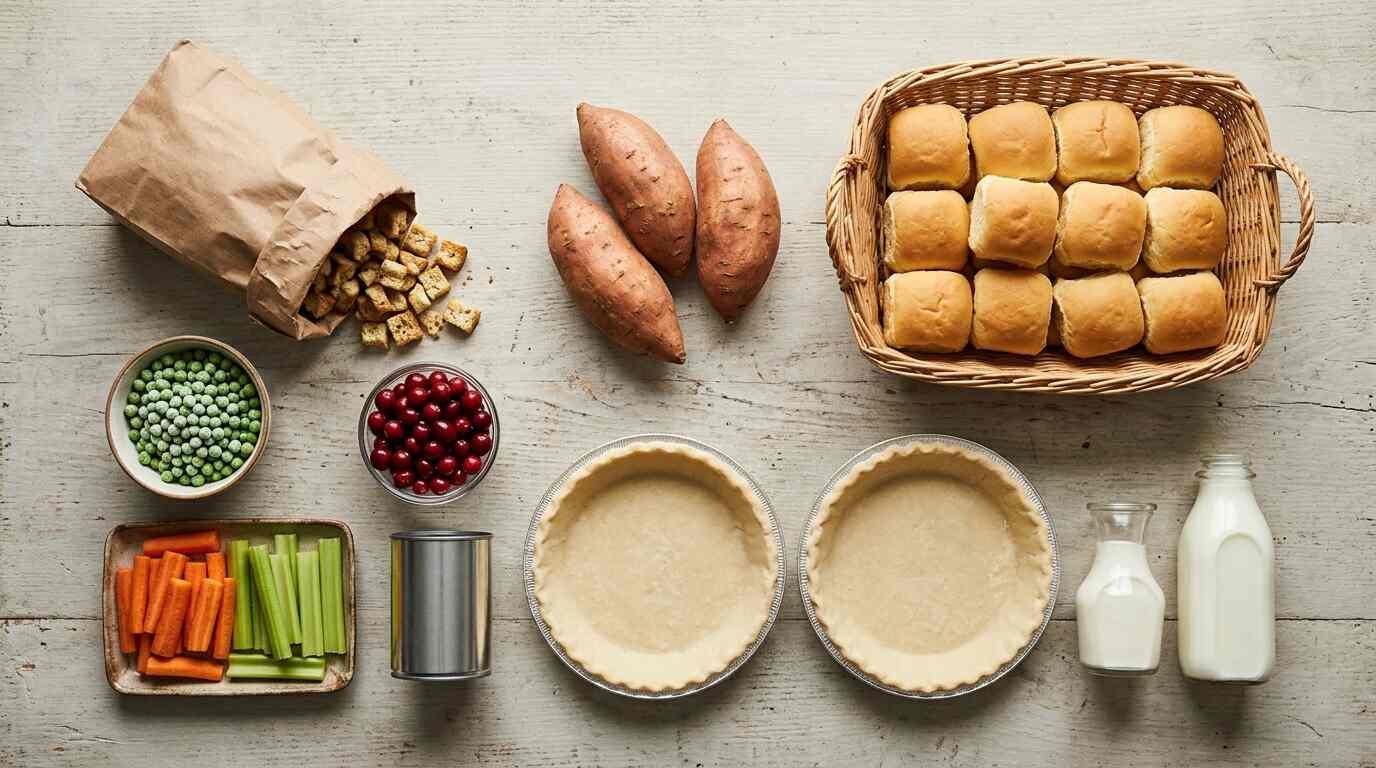
The survey has priced the same menu since it began in 1986: turkey, cubed stuffing, sweet potatoes, rolls, peas, cranberries, a vegetable tray, pumpkin pie mix, pie crusts, whipping cream, milk and a line of miscellaneous baking staples. The participation page for 2026 set the window at Nov. 1 to 5. Shoppers in all 50 states and Puerto Rico checked prices in stores and online, and they were told to find the best price available without coupons or deals that require buying something else.
Here is the receipt as the Farm Bureau printed it, with the change from 2025:
| Item | 2026 price | Change from 2025 |
|---|---|---|
| 16-lb frozen turkey | $23.68 | up 10.1% |
| 30-oz pumpkin pie mix | $4.24 | up 1.9% |
| 3 lbs sweet potatoes | $4.20 | up 5% |
| 1 gallon whole milk | $4.05 | up 8.6% |
| 14-oz cubed stuffing mix | $3.91 | up 5.4% |
| Misc. meal-prep ingredients | $3.84 | up 6.4% |
| 1 dozen dinner rolls | $3.81 | up 7% |
| 2 frozen pie crusts | $3.28 | down 2.7% |
| 12-oz fresh cranberries | $2.48 | up 8.8% |
| 1 lb frozen peas | $1.99 | down 2% |
| Half pint whipping cream | $1.84 | down 1.6% |
| 1-lb veggie tray | $1.31 | down 3.7% |
All figures from the AFBF 2026 release. The twelve lines add to exactly $58.63.
Subtract the turkey and the other eleven items come to $34.95. Last year, using the 2025 figures of $55.18 total and $21.50 for the bird, the same eleven came to $33.68. That is a rise of $1.27, under 4%. The turkey alone added $2.18. Of the $3.45 the whole table climbed, close to two-thirds came off one frozen carcass.
Produce behaved like a pendulum. In 2025 the Farm Bureau found the carrot-and-celery tray up more than 61% and sweet potatoes up 37%, the loudest jumps on that year’s list. This year the tray slipped 3.7%, the biggest percentage drop on the slip, and sweet potatoes rose a quieter 5%. Cranberries went the other way, from a 2.8% decline in 2025 to an 8.8% increase now. A table of fixed items, priced the same week every year, still never sits still.
Why the turkey rose 10.1%
Two bad years in the barn, one better year on the books.
The Farm Bureau’s market analysts attribute the higher bird to strong demand and tight inventories, citing USDA’s Livestock, Dairy, and Poultry Outlook. A separate AFBF analysis from Nov. 5 lays out the supply side in more detail, drawing on USDA reports. It opens on recovery: growers raised about 198.5 million turkeys in 2026, up roughly 3% and the first increase since 2023.
Recovery from a low floor still leaves a thin pantry. That same analysis puts turkey in cold storage at about 360 million pounds on Sept. 30, down about 4.5% from 2025 and nearly 16% from 2024. Avian metapneumovirus hit an estimated 60% to 80% of U.S. turkey flocks in 2024, according to Texas A&M AgriLife Extension figures cited there. Highly pathogenic avian influenza has not left either. In October 2026, seven detections in commercial turkey flocks affected more than 250,000 birds as of Oct. 27.
AFBF economist Bernt Nelson put the risk in one line: “Disease is the industry’s biggest wild card.”
Wholesale prices carry the scar. USDA’s November World Agricultural Supply and Demand Estimates put the 2026 average for frozen whole hens at $1.77 a pound, 30% above last year’s $1.36, as reported by The Shelby Report, with 2027 projected near $1.50. A wholesale price that climbs 30% and a retail survey price that climbs 10% are not telling the same story. Somewhere between the loading dock and the register, part of that difference is being absorbed.
Demand is the other half. The 2025 Farm Bureau analysis noted that Americans eat about 13 pounds of turkey a year, nearly 3 pounds less than six years earlier. Turkey is becoming a one-day-a-year protein, the way a tuxedo is a one-night-a-year suit. The 2025 analysts calculated turkey’s share of the dinner at 39%, its lowest since 2000, against a survey-long average of 43%. At $23.68 out of $58.63, the bird is back to about 40% this year.

The Northeast paid the most and rose the least
The national average is a blend, and the blend hides the split.
By region, the 2026 classic dinner came in at $61.57 in the Northeast, $58.74 in the West, $56.89 in the Midwest and $54.33 in the South. At the top, the Northeast sits about 5% above the national figure.
Lay the 2025 regional numbers alongside, and the map looks different. Last year the Northeast was $60.82 and the West $61.75, with the West on top. Running the arithmetic on the two releases gives this:
| Region | 2025 | 2026 | Change |
|---|---|---|---|
| Northeast | $60.82 | $61.57 | up $0.75 (1.2%) |
| West | $61.75 | $58.74 | down $3.01 (4.9%) |
| Midwest | $54.38 | $56.89 | up $2.51 (4.6%) |
| South | $50.01 | $54.33 | up $4.32 (8.6%) |
The Northeast took over the top spot by standing nearly still while the West dropped. The South, cheapest in both years, posted the steepest climb. For a Long Island household, the national “up 6%” overstates the change in its own region, where the classic dinner moved closer to 1%. In 2025 the Northeast ran about 10% over the national average; this year the premium is about 5%. The gap closed because everyone else caught up, which is a cold kind of comfort.
The expanded menu, which adds boneless ham, russet potatoes and frozen green beans, raises the national total to $81.72, with the Northeast at $86.62. Against 2025’s Northeast expanded figure of $82.97, that is up $3.65, about 4.4%. The ham, potatoes and beans pushed harder in the region than the classic list did.
No part of the survey prices a Suffolk County aisle. It publishes four regions, not counties. Last year’s look at Thanksgiving dinner at home and on Long Island in 2025 ran into the same wall, and it still stands.
Measured against 2022’s $64.05
The record holds, and the climb down has stopped.
The 2022 classic dinner hit $64.05, the survey’s all-time high. This year’s $58.63 sits $5.42 below it, about 8.5% lower. Between that peak and 2025’s $55.18, the total fell $8.87. Now the line has turned up.
Last year the Farm Bureau wrote that consumers have not fully recovered from the sharp increases that pushed the classic dinner to a record high in 2022. That sentence aged quickly. A decline of $8.87 over three years has given back $3.45 in one.
These are nominal dollars. Neither the 2026 release nor the 2026 market analysis offers an inflation-adjusted figure, so the comparison here stays in sticker prices. A reader who wants the real-dollar version has to supply a deflator, and the result will depend on which one is chosen.
The Farm Bureau’s own analysts framed the year this way: “For the first time since 2022, American shoppers will see an increase in the price of goods for Thanksgiving dinner.”
A separate forecast from PwC, covered on this site in October, reached its own number by its own method. Reading the two side by side means comparing baskets before comparing totals.
A receipt printed before the sale
The survey froze the price a week before the grocers started cutting it.
Here is the complication. The Farm Bureau priced its turkeys Nov. 1 to 5, and its rules exclude deals that require another purchase. The grocery trade, meanwhile, runs its real turkey war in the two weeks before the holiday. The 2026 release itself says stores often discount whole birds in the run-up to Thanksgiving, and that USDA data showed the average feature price for whole frozen turkeys fell during the second week of November, after the survey window closed. The AFBF analysis adds that some volunteers reported birds as low as 69 cents a pound.
The Shelby Report’s November roundup lists the advertised prices: Target’s frozen turkey at 79 cents a pound for a third straight year, Walmart’s Butterball at 97 cents, Tops at 48 cents with a $25 purchase. Its summary of the retail side was blunt: “At retail, the price on the bird has not moved.”
Run the 79-cent price on a 16-pound bird and it comes to $12.64, roughly half the survey’s $23.68. Same holiday, same frozen bird, two very different tickets. The survey is honest about its method and the method is consistent, which is what makes it useful year to year. It is a ruler, not a coupon. But anyone reading “$23.68” as the price of a turkey this week is reading a number that a determined shopper may beat by more than ten dollars.
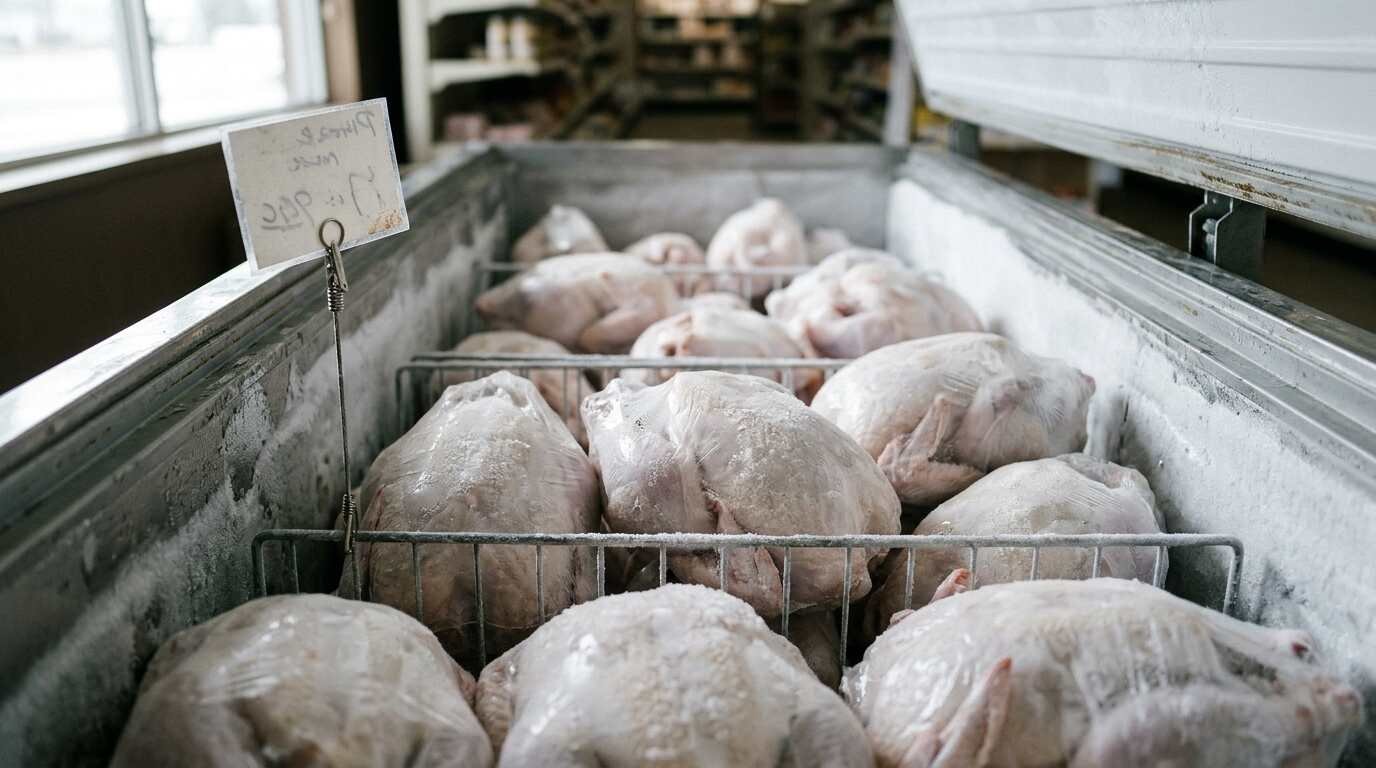
At 79 cents retail, with frozen hens quoted wholesale near $1.80, the advertised bird works less like merchandise and more like a hook in the water, cast to pull a shopper past the cranberries, the stuffing mix and the rolls on the way to the freezer case. The breakdown of September wholesale food prices and diesel published here earlier this fall traced the same pressure further upstream, where nobody runs a doorbuster.
So which number is the real Thanksgiving? The one on the survey, the one in the circular, or the one that shows up after the circular’s bird has dragged everything else into the cart?
Six cents of the dollar at the farm gate
The farm end of the receipt is the shortest line on it.
Faith Parum, the Farm Bureau’s deputy chief economist, tied the increase to costs between the field and the table: “The overall increase in our annual survey reflects the rising costs of getting food from the farm to your dinner table,” she said, pointing to high diesel prices and a farm labor shortage. The same release carries a USDA estimate that less than 6 cents of every food dollar goes back to the farm.
Set beside the survey, that estimate is the strangest companion to a turkey that rose 10%. On a $58.63 dinner, six cents on the dollar works out to about $3.52 for the farms behind all twelve lines, if the national food-dollar figure applied evenly to this menu, which it may not. The remainder pays for trucks, processors, packaging, refrigeration, shelf space and the light bill over the freezer case.
The market analysis put it plainly: “Farmers and ranchers are largely price-takers, not price-makers,” a description that fits a bird quoted wholesale near $1.80 and advertised in a circular at 79 cents.
The turkey that ends up in a hot turkey sandwich under a ladle of gravy the Friday after has passed through all of those hands. Each one took a slice before the carving knife got there.
What did the bird in the freezer case near home cost per pound this week, and did it come with a receipt long enough to make up the difference?
You might also like
- After the Bird: Eight Ways to Use Leftover Turkey
- Lump-Free Turkey Gravy: A Roux Timeline for Thanksgiving Week
- A Thanksgiving Timeline for a Small Kitchen, Counted Backward From the Table
For informational purposes only — consult a licensed attorney or financial advisor.
Sources
- American Farm Bureau Federation, “Cost of Thanksgiving Dinner Increases, Remains Below 2022 Record High,” Nov. 18, 2026: https://www.fb.org/news-release/cost-of-thanksgiving-dinner-increases-remains-below-2022-record-high
- Cameron Castillo and Faith Parum, Ph.D., “Thanksgiving Dinner Cost Ticks Upward in 2026,” Farm Bureau Market Intel, Nov. 18, 2026: https://www.fb.org/intel/markets/thanksgiving-dinner-cost-ticks-upward-in-2026
- Bernt Nelson, “Turkey Farmers Recovering From Two Years of Losses,” Farm Bureau Market Intel, Nov. 5, 2026: https://www.fb.org/intel/markets/turkey-farmers-recovering-from-two-years-of-losses
- American Farm Bureau Federation, 2026 Thanksgiving Dinner Cost Survey participation page: https://www.fb.org/2026-thanksgiving-dinner-cost-survey
- Samantha Ayoub and Faith Parum, Ph.D., “Thanksgiving Dinner Cost Analysis: Moderate Decline,” Farm Bureau Market Intel, Nov. 19, 2025: https://www.fb.org/intel/markets/thanksgiving-dinner-cost-analysis-moderate-decline
- The Shelby Report, “Wholesale Turkey Holds Near $1.80 a Pound as Grocers Advertise 79 Cents,” Nov. 13, 2026: https://theshelbyreport.com/2026/11/13/wholesale-turkey-holds-near-1-80-a-pound-as-grocers-advertise-79-cents/
Suggested category: Food & Dining
Leave a Reply