 275 Route 25A, Mt Sinai, NY 11766


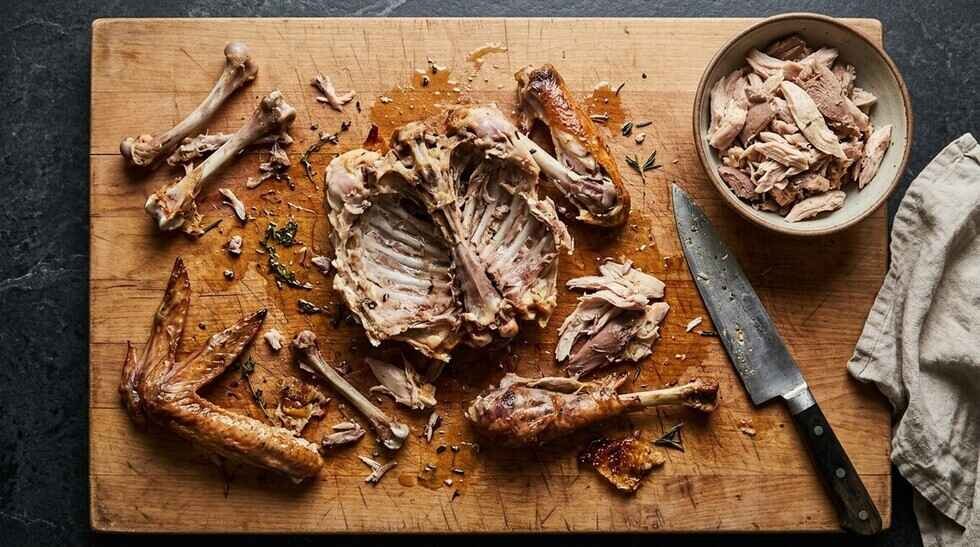
By late Thursday evening the most valuable thing left on a Thanksgiving table is the part nobody photographed. Picked clean down to the ribs, the turkey frame looks like scaffolding after the building came down. It still holds a surprising amount of material. Harold McGee’s On Food and Cooking puts it plainly: bones are around 20 percent collagen, and collagen is the raw stuff of the body a good stock carries on the spoon.
@@YOUTUBE@@ The video above goes one step past this recipe, into canning a batch of turkey stock at home. What follows stops earlier, at the pot, the strainer and the refrigerator, because those three are where most of the trouble with stock begins and ends.
What the frame is made of
Meat brings the taste. Bone brings the body.
McGee draws the line sharply. In his account, bones and skin are much better sources of gelatin and thickening power than meat, yet they carry only a small fraction of the soluble molecules that give a stock its flavor. In another passage on stock ingredients he calls bones and skins poor sources of flavor, but excellent sources of gelatin.
That split explains a habit cooks fall into without knowing why. A carcass scraped to bare white bone makes a stock with plenty of wobble and very little to say. America’s Test Kitchen’s Simple Turkey Stock asks the cook to pick off most of the meat and save it, but to leave some meat and skin on the frame for a fuller flavor, and to add drumstick and thigh bones if they are around.
Think of the carcass as two contractors on one job. The bones pour the foundation. The scraps of meat do the finish work.
How heat turns collagen into gelatin
The clock matters as much as the thermometer.
Collagen is structural protein. The Exploratorium’s Science of Cooking pages describe it wrapping individual muscle fibers and showing up in tendons, skin and bone, and they note that collagen dissolves in hot water. Dissolved, it becomes gelatin, the protein that gives a cold stock its set and a hot one its weight on the tongue.
The conversion has a threshold and a timetable. A summary of McGee’s work at ScienceOfCooking.com places the change at roughly 160°F, or 70°C, with melting that speeds up between 160°F and 180°F, and it describes collagen breakdown as “a function of both temperature and duration of heating.” Heat alone does little in ten minutes. Heat held for hours does a great deal.
This is the same physics that turns a chuck roast from shoe leather into something a fork can split, the subject of an earlier post here on how braising turns tough beef tender. A braise has a problem stock never faces. In the roast, the muscle fibers dry out while the collagen melts, and the cook has to balance the two. In a stockpot, nobody is going to eat the bones. The liquid is the whole point, so the long, low heat that punishes a roast costs the stock nothing.
Size matters too. McGee notes that the smaller the pieces, the more quickly their contents can be extracted into the water. The Test Kitchen recipe arrives at the same place by a practical route: wings cut at the joints, the backbone cut into three or four pieces, the ribs pulled off, about four pounds of bone in ten to twelve pieces.
The recipe
One frame, one pot, two hours of patience.
Quantities here come from America’s Test Kitchen’s Simple Turkey Stock, which yields about 8 cups.
Ingredients
- 1 carcass from a 12- to 14-pound turkey, with some meat and skin still attached
- Drumstick and thigh bones, if saved
- 10 cups cold water
Method
- Pick most of the meat from the carcass and refrigerate it for soup. Cut each wing into three pieces at the joints, separate the breastbone from the backbone, cut the backbone into three or four pieces and remove the ribs.
- Lay the pieces in a compact layer in a stockpot or Dutch oven. Pour in the water.
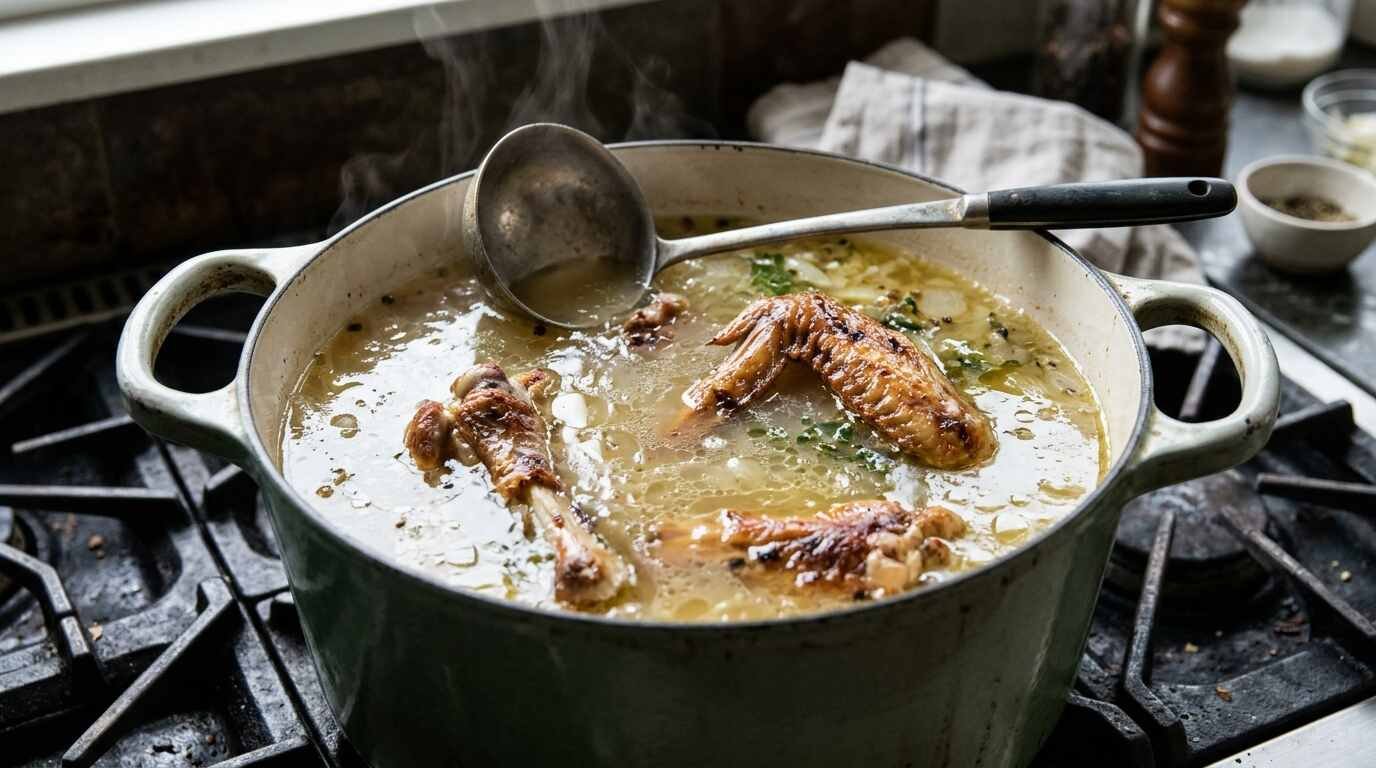
- Bring the pot up to a boil over medium-high heat, then turn the heat to low. The Test Kitchen recipe covers the pot and cooks it for 2 hours, skimming foam as needed.
- Strain through a fine-mesh strainer into a large container and discard the solids.
- Let the stock settle about 20 minutes, then skim the fat from the surface. The recipe suggests saving that fat for soup.
- Cool and refrigerate promptly (the cooling section below covers how).
The recipe’s own explanation is that gently simmering the bones for two hours “extracts enough gelatin” for rich flavor and body. It also skips the usual carrot, celery and onion so the turkey flavor comes through clean, and skips browning the bones in the oven, since the bird was roasted once already.
No salt goes in. A stock is an ingredient, and it will be reduced into gravy or folded into soup later, where salt can be judged against everything else in the bowl.
Why the pot should never boil
A boil does to stock what a blender does to vinaigrette.
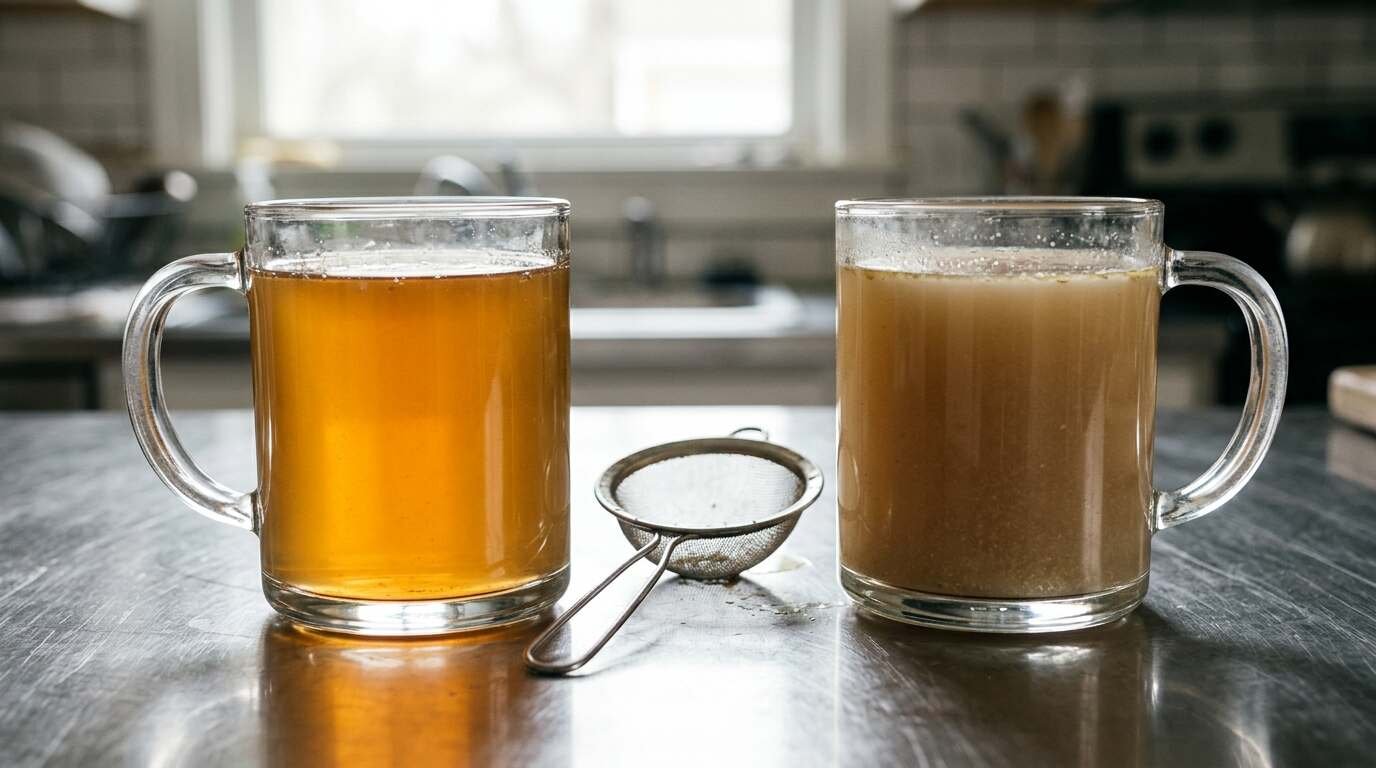
The difference between a clear stock and a murky one comes down to a few degrees and a lot of turbulence. McGee’s explanation is that soluble proteins leaving the bones need to clump slowly into large aggregates that can be skimmed, and that “a boil churns particles and fat droplets into a cloudy suspension and emulsion.” Cook’s Illustrated says much the same in its kitchen note on clear stock: boiling will cause soluble proteins and rendered fat to emulsify into the cooking liquid.
What a cloudy pot signals is fat beaten into the liquid instead of floating where a ladle can lift it.
The same Cook’s Illustrated note reports something that should calm the anxious skimmer. When its testers kept the pot at a gentle simmer, the scum simply settled to the bottom of the pot. A cook does not need to stand guard with a spoon for two hours. Skimming early, when the gray foam first gathers, handles most of it.
The lid argument
Two respected sources, two different answers.
Here the advice splits, and the reason matters more than the verdict. McGee prefers an uncovered pot. Evaporation cools the surface, he writes, which makes it less likely that the stock will boil, dries the surface scum so it skims more easily, and starts concentrating the flavor. The Test Kitchen’s turkey recipe covers the pot for its two hours on low.
Both can be right, because they are guarding against different failures. The open pot is insurance against an accidental boil on a burner that runs hot, and it trades some volume for intensity. The covered pot keeps the full 8 cups and relies on the cook to set the heat low and trust it. On a stove with a reliable low flame, the lid is a convenience. On an old range whose “low” is a rumor, the open pot protects the stock from its own burner.
What neither source endorses is the rolling boil left alone while the family watches football. The stove does not know what quarter it is.
Cooling a big pot without feeding bacteria
The real hazard starts after the burner goes off.
The cooking is the safe part. The danger lives in the hours afterward, when a large volume of warm, protein-rich liquid sits at temperatures bacteria like. The Centers for Disease Control and Prevention estimates that Clostridium perfringens causes nearly 900,000 foodborne illnesses in the United States each year, links outbreaks most often to foods cooked in large batches and held between 40°F and 140°F, and lists poultry such as turkey, along with gravy, among the common sources. Its page adds a line that reads like a calendar warning: “Most outbreaks happen in November and December.“
A stockpot is exactly a large batch. The USDA Food Safety and Inspection Service says leftovers must be refrigerated within 2 hours of cooking, that large amounts should be divided into shallow containers, and it names the exact problem: “A big pot of soup, for example, will take a long time to cool.” The same page says hot food can go directly into the refrigerator, or be rapidly chilled first in an ice or cold-water bath.
Nothing on that page asks for a long rest on the stovetop first. Even the Test Kitchen’s own timing, about 20 minutes plus another hour and a half before refrigerating, already brushes against the two-hour limit, and that assumes nobody gets distracted by pie.
Restaurants work to a stricter standard. A Texas Department of State Health Services fact sheet summarizing Food Code cooling requires food to drop from 135ºF to 70ºF within two hours, then to 41ºF or colder within an additional four hours, six hours in all. The methods it lists are the same ones a home kitchen can borrow: an ice bath with stirring, shallow pans, smaller portions, rapid-cooling sticks, and containers left uncovered and unstacked until the food is cold.
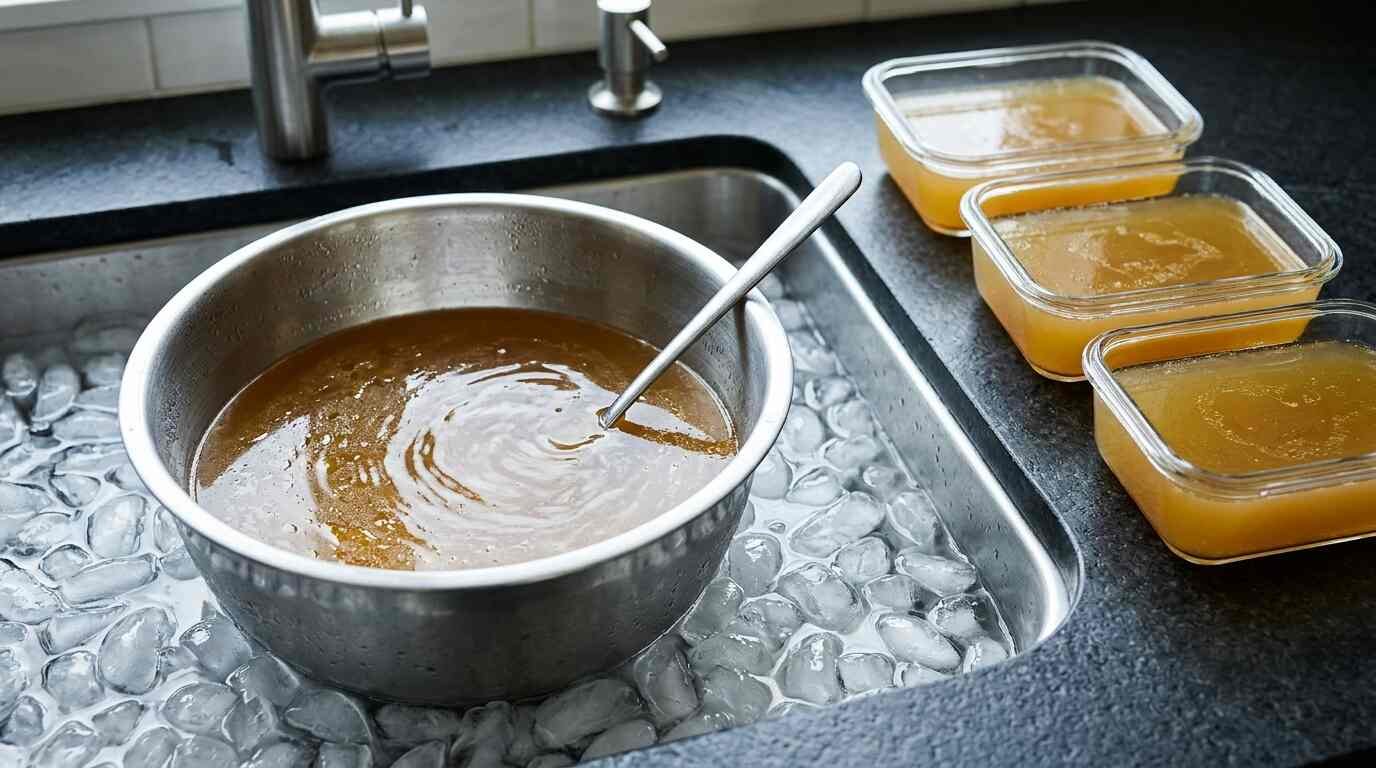
In practice, for 8 cups of turkey stock, that means straining into a metal bowl set in a sink of ice water, stirring until it stops steaming, then pouring it into two or three shallow containers before the refrigerator. A single deep pot pushed onto a crowded shelf is the arrangement the CDC’s statistics describe.
Storing and reheating
Two clocks, and they do not quite agree.
Two days is the Test Kitchen’s limit: its recipe gives the stock up to 2 days refrigerated or up to 4 months frozen. The USDA’s general guidance for leftovers allows 3 to 4 days in the refrigerator or 3 to 4 months in the freezer, and notes that frozen food stays safe indefinitely but loses moisture and flavor over time. The tighter number is the cautious one to follow for a liquid this hospitable to bacteria.
On reheating, the USDA asks that leftovers reach 165°F on a food thermometer and that soups, sauces and gravies be brought to a rolling boil. The stock that was never supposed to boil during cooking is supposed to boil before serving. Kitchens are full of rules that contradict each other until the reason behind each one becomes clear.
A cold, set stock is ready for the post-holiday rotation: the one-pot chicken noodle soup method works with turkey meat and turkey stock in place of chicken, and a cup or two will rescue a weak pan sauce in the steps laid out for turkey gravy from scratch.
The frame that looked like scaffolding on Thursday night becomes, by Saturday, a quart container that shivers when the refrigerator door closes. It all comes down to one question asked over the dishes, usually by whoever is still standing at 10 p.m.: does the carcass go in the pot, or in the trash?
You Might Also Like
- After the Bird: Eight Ways to Use Leftover Turkey
- Hot Turkey Sandwich
- A Thanksgiving Timeline for a Small Kitchen, Counted Backward From the Table
Sources
- Harold McGee, On Food and Cooking, “Extracting Gelatin and Flavor from Meats” (ckbk): https://app.ckbk.com/reference/food00011c11s001e003se002/extracting-gelatin-and-flavor-from-meats
- Harold McGee, On Food and Cooking, “The Choice of Ingredients” (ckbk): https://app.ckbk.com/reference/food00011c11s001e003se003se001/the-choice-of-ingredients
- Harold McGee, On Food and Cooking, “The Importance of a Cold Start and Uncovered, Slow Heating” (ckbk): https://app.ckbk.com/reference/food00011c11s001e003se003se002se001/the-importance-of-a-cold-start-and-uncovered-slow-heating
- America’s Test Kitchen, Simple Turkey Stock: https://www.americastestkitchen.com/recipes/10238-simple-turkey-stock
- Cook’s Illustrated, For a Clearer Stock, Simmer, Don’t Boil: https://www.americastestkitchen.com/cooksillustrated/how_tos/9260-for-a-clearer-stock-simmer-dont-boil
- Exploratorium, Science of Cooking, Ask the Inquisitive Cooks: https://annex.exploratorium.edu/cooking/icooks/11-25-02.html
- ScienceOfCooking.com, slow cooking and collagen: https://www.scienceofcooking.com/slow_cooking1.htm
- Centers for Disease Control and Prevention, About C. perfringens Food Poisoning: https://www.cdc.gov/clostridium-perfringens/about/index.html
- USDA Food Safety and Inspection Service, Leftovers and Food Safety: https://www.fsis.usda.gov/food-safety/safe-food-handling-and-preparation/food-safety-basics/leftovers-and-food-safety
- Texas Department of State Health Services, Cooling Methods Fact Sheet: https://www.dshs.texas.gov/sites/default/files/foodestablishments/pdf/GuidanceDocs/1-3CoolingMethodsFactSheet.pdf
Suggested category: Food recipes
Leave a Reply