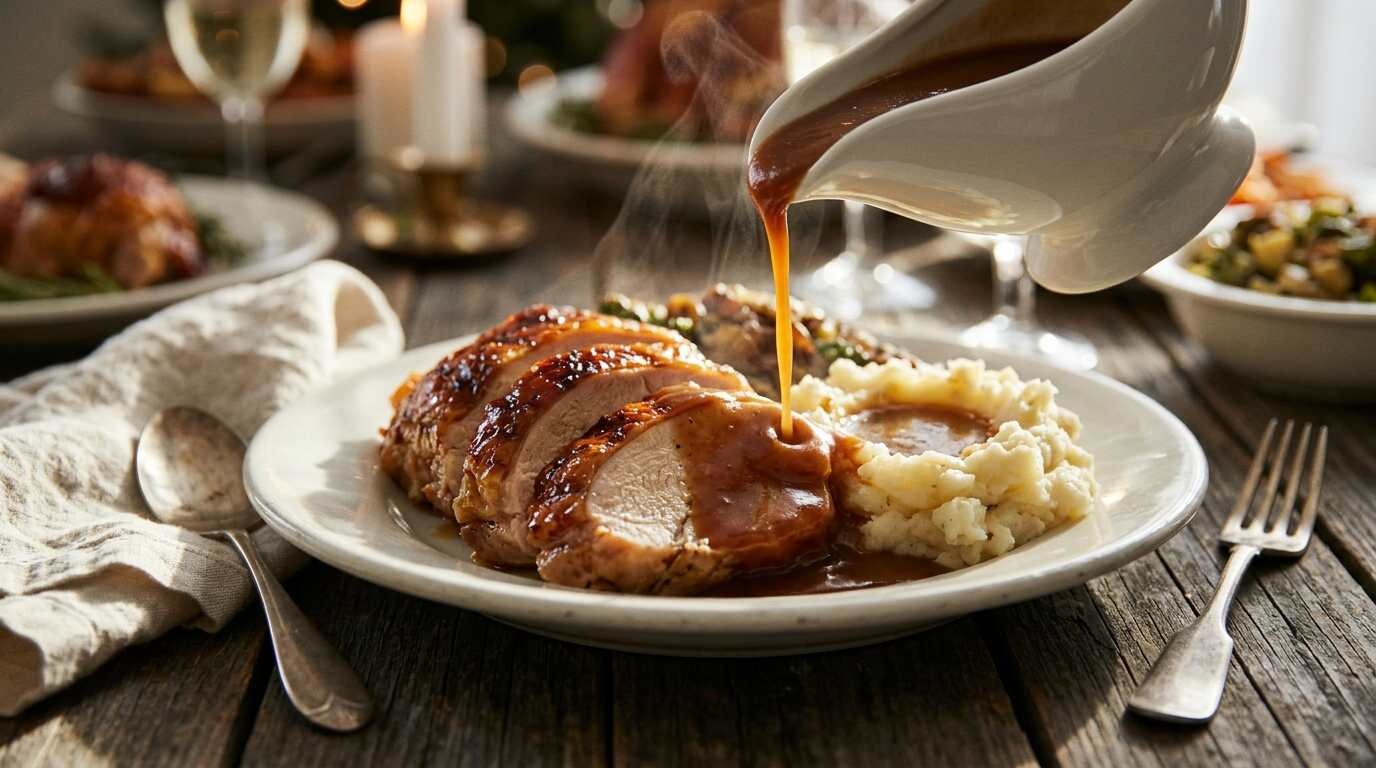
Gordon Ramsay’s gravy video runs three minutes and forty-nine seconds. Roughly fourteen years after it went up, it has gathered about 2.5 million views on his official YouTube channel, which is a startling amount of attention for a pan of brown sauce.
The channel’s own description sells the clip as simple, with time left over to enjoy the day, and that pitch explains the audience. Gravy is the dish that waits for the turkey to leave the oven, then demands full attention while ten hungry relatives drift toward the stove. Food Network’s roundup of Thanksgiving tips from TikTok quotes creator Kathleen Ashmore calling gravy “the most stressful part of Thanksgiving.” The pressure is real. Most of the work, though, does not have to happen on the day.
Thanksgiving lands on Thursday, November 26, which leaves 47 days to practice. The holiday table has other dated stops along the way, from a diner pie case countdown to the arithmetic of two checks for one turkey.
Start With the Broth, Not the Turkey
America’s Test Kitchen builds its “Best Turkey Gravy” in two halves, and the split is what takes the panic out of it. The first half happens on the stove before the bird is done: giblets and neck are browned with an onion, simmered with chicken broth, water, thyme and parsley stems, and strained. That broth goes into a roux of butter and flour, simmers for about half an hour, and then waits, covered, until the turkey comes out.
The second half belongs to the roasting pan. Its drippings and browned bits are deglazed and stirred in at the last minute, which is where the roasted flavor arrives. The recipe makes about six cups, enough for a 12- to 14-pound turkey with leftovers, and the test kitchen says to double it in a Dutch oven for a bigger bird.
Anyone who wants to cook even earlier has a freezer. Jessica Gavin’s turkey gravy page puts frozen storage at up to four months. A base made before the turkey roasts has no drippings in it yet, so the pan juices still go in on the day.
Two Videos Worth Watching Before the Stove Gets Hot
Two older clips from official channels sit at the top of YouTube’s gravy results, and they suit different moods. The first is Ramsay’s, 3 minutes 49 seconds long, with about 2.5 million views. His channel describes it as gravy for a Christmas turkey that is simple and leaves time to enjoy the day.
The second is Martha Stewart’s “How To Make Basic Turkey Gravy,” at 7 minutes 9 seconds and about 1.3 million views. Its description says Stewart and TV chef Sarah Mastracco cover the fundamentals of gravy with the right consistency and suggest flavor variations.
Both uploads are years old, so neither carries news. They are simply the cooks’ own demonstrations, which is a better teacher than any paragraph about whisking.
The Method, From Giblets to a Pourable Gravy
Four stages carry the whole recipe, and each one has a visual cue.
Brown the giblets and neck in a little oil for about five minutes, add the chopped onion for three more, then cover and cook over low heat for 20 minutes. Pour in the chicken broth and water, scrape the bottom of the pan, add thyme and parsley stems, and simmer for 30 minutes while skimming foam. Strain it, dice the heart and gizzard, and chill both.
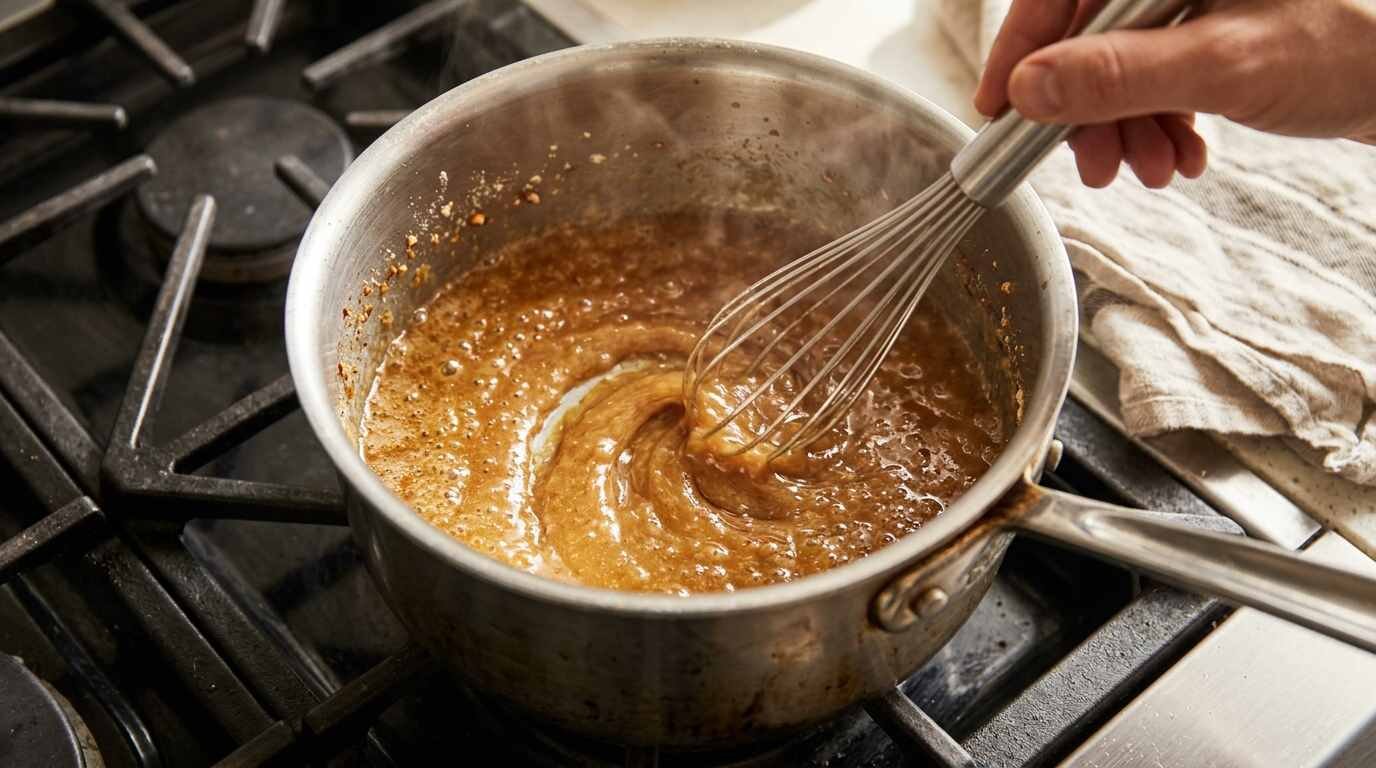
Next comes the roux. Melt three tablespoons of butter over medium-low heat, whisk in a quarter cup of flour, and keep stirring for 10 to 15 minutes, until the paste turns nutty brown and smells toasted. That long, slow color is the difference between gravy with depth and a pot of floury milk-colored sauce. Set aside one cup of the warm broth for the roasting pan, then whisk the rest in gradually, and simmer about 30 minutes until the gravy coats a spoon.
Lump prevention is the one place where cooks disagree. America’s Test Kitchen adds hot broth to its roux with steady, vigorous whisking. Gavin recommends adding liquid in small amounts, around a quarter cup at a time, and warns that hot liquid can cook the starch too fast. Either way works when the whisk never stops. A strainer is the safety net.
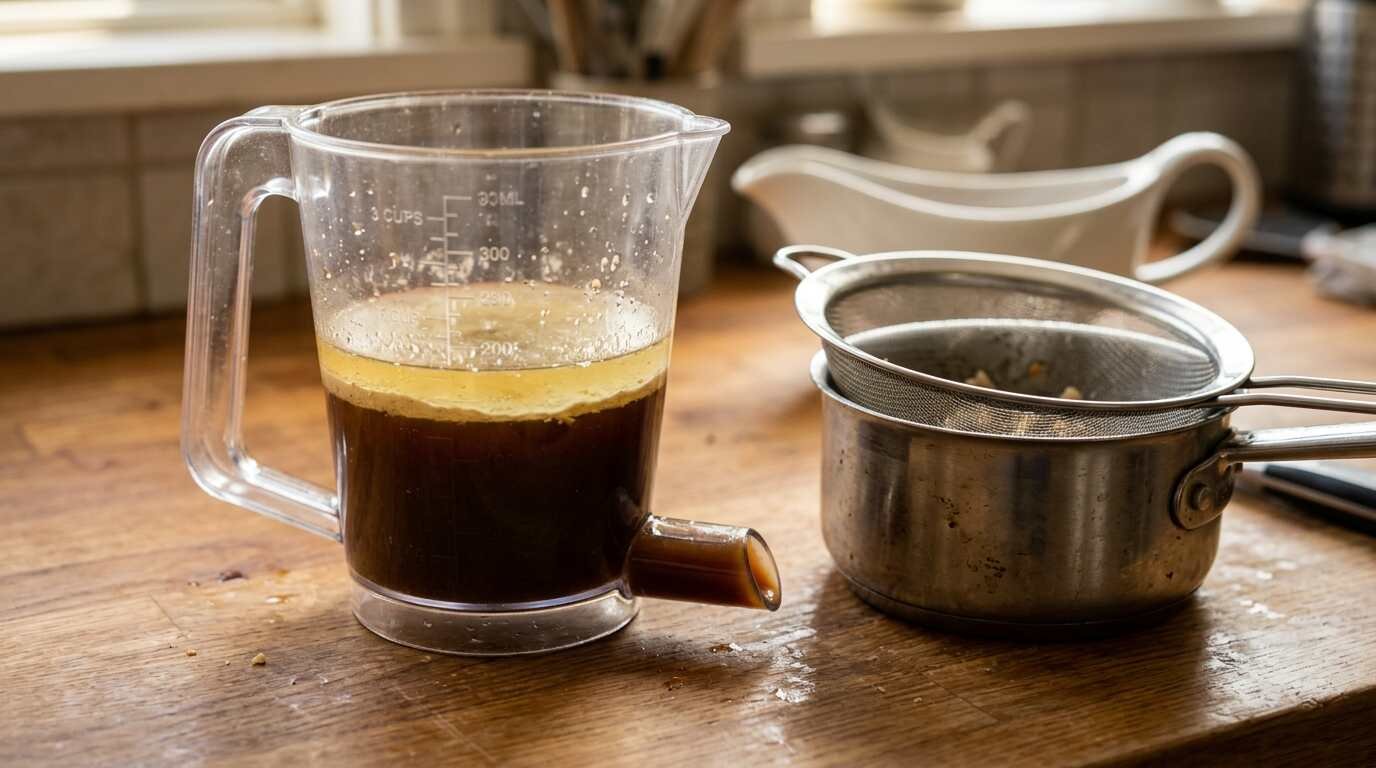
The finish happens after the turkey is out. Strain the roasting-pan drippings into a measuring cup, wait for the fat to rise, and skim it off. Set the roasting pan over two burners at medium-high heat, pour in a cup of dry white wine and the reserved cup of broth, and scrape up the browned bits until the liquid reduces by half, about five minutes. Press it through a strainer into the gravy, stir in defatted drippings to taste, and add the diced giblets.
No drippings, no problem. Gavin’s no-drippings version swaps in half a cup of unsalted butter, with an equal amount of flour and four cups of stock. It will taste leaner than a gravy made with roasting-pan juices, and good stock closes most of the gap.
When the Gravy Goes Wrong
Every gravy goes sideways at least once, and almost every problem has a short fix. The sources below agree on most of them.
| Problem | What to do | Source |
|---|---|---|
| Too thin | Keep simmering; the test kitchen’s roux-thickened broth simmers about 30 minutes before it coats a spoon | America’s Test Kitchen |
| Too thick, or tight after chilling | Whisk in a splash of stock while reheating on the stove | Jessica Gavin |
| Lumps | Strain the gravy through a fine-mesh strainer | Jessica Gavin |
| Flat flavor | Deglaze the roasting pan with dry white wine for acidity, or use more chicken broth if wine is out | America’s Test Kitchen |
| Too salty at the end | Start with unsalted stock and season after the gravy has simmered | Jessica Gavin |
| Gluten-free guests | Whisk a slurry of cornstarch and water into the boiling liquid, and make it the day it will be eaten | Jessica Gavin |
Tools for the Job
Four tools earn their drawer space on gravy day. Each one below was checked on its Amazon product page for title and ASIN before it went into this list.
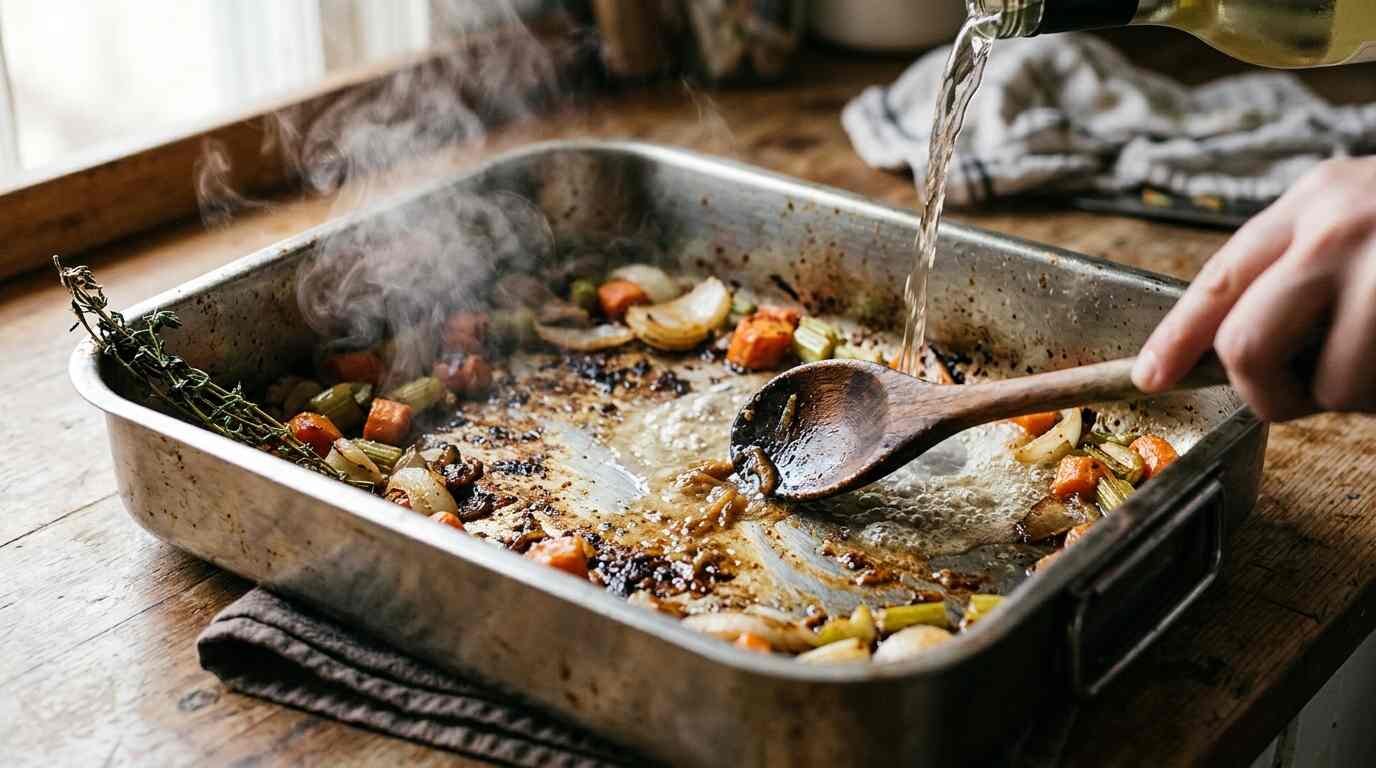
- OXO Good Grips 4 Cup Fat Separator: a built-in strainer and stopper hold the fat back while the roasting-pan juices pour out. See it on Amazon (affiliate link)
- OXO Good Grips Balloon Kitchen Whisk, Stainless Steel, 11 Inch: this whisk handles the constant stirring that the roux asks for. See it on Amazon (affiliate link)
- OXO Good Grips 8-Inch Double Rod Strainer: its fine mesh catches stray lumps and solids when the broth and pan liquid go through. See it on Amazon (affiliate link)
- Cuisinart Chef’s Classic Roasting Pan w/Rack, Stainless, 16″, 7117-16UR: the roasting pan with rack gives the drippings somewhere to collect, though the deglazing step needs a pan the maker says is safe on the stovetop, so check the manufacturer’s instructions first. See it on Amazon (affiliate link)
As an Amazon Associate I earn from qualifying purchases. A commission may be earned if you buy through this link, at no extra cost to you.
Storing and Reheating
Cooling comes first. The USDA’s food safety page says leftovers belong in the refrigerator within two hours of cooking, and that refrigerated leftovers keep about three to four days, with frozen ones lasting three to four months. Gavin’s gravy page lands in the same place, at up to four days in the refrigerator and up to four months in the freezer. Gluten-free gravies thickened with cornstarch or arrowroot reheat less well, so Gavin suggests making them the day they will be eaten.
Reheating has a rule of its own. The USDA says leftovers should be reheated until they “reach 165° F as measured with a food thermometer,” and for gravies it recommends a rolling boil. Whisk in a little stock if the gravy has tightened up in the fridge.
Leftover gravy has a natural second life on open-faced hot turkey over white bread, a plate that depends on gravy more than on turkey.
Recipe: Turkey Gravy From Scratch
Prep Time: 15 minutes
Cook Time: about 1 hour 45 minutes, mostly unattended (estimated from the step times)
Servings: 10 to 12 (about 6 cups)
Difficulty: Medium
Adapted from America’s Test Kitchen’s Best Turkey Gravy, with no-drippings and gluten-free notes from Jessica Gavin.
Ingredients
- 1 tablespoon vegetable oil
- Turkey giblets and neck, reserved from the bird
- 1 onion, unpeeled and chopped
- 4 cups low-sodium chicken broth
- 2 cups water
- 2 sprigs fresh thyme
- 8 parsley stems
- 3 tablespoons unsalted butter
- ¼ cup all-purpose flour
- 1 cup dry white wine (or more chicken broth)
- Defatted roasting-pan drippings, to taste
- Salt and pepper, to taste
Instructions
- Heat the oil in a large saucepan over medium-high heat. Brown the giblets and neck for 5 minutes, add the onion for 3 more, then cover and cook over low heat for 20 minutes.
- Add the broth and water, scrape the pan bottom, and bring to a boil. Add the thyme and parsley stems and simmer 30 minutes, skimming foam.
- Strain the broth. Dice the heart and gizzard. Refrigerate both until needed.
- In a large saucepan over medium-low heat, melt the butter, whisk in the flour, and cook 10 to 15 minutes, stirring constantly, until nutty brown and fragrant.
- Warm the broth to a simmer and set aside 1 cup. Whisk the remainder into the roux gradually.
- Simmer about 30 minutes, skimming now and then, until thickened. Cover and hold until the turkey is done.
- Strain the roasting-pan drippings into a measuring cup, let the fat rise, and skim it off. Return the strained vegetables to the pan.
- Bring the gravy back to a simmer. Put the roasting pan over two burners on medium-high, add the wine and reserved broth, scrape up the browned bits, and boil about 5 minutes, until reduced by half.
- Strain the pan liquid into the gravy, pressing on the solids. Stir in defatted drippings to taste and the diced giblets. Season and serve hot.
Notes
- Before the turkey goes into the oven, put 1 cup each of chopped onion, carrot and celery, a few thyme sprigs and 1 cup of water in the roasting pan, as the test kitchen does.
- No drippings: use ½ cup unsalted butter, ½ cup flour and 4 cups stock.
- Gluten-free: whisk ¼ cup cornstarch mixed with ½ cup water into boiling stock, and serve it the same day.
Questions People Ask
Can I make turkey gravy without drippings? Yes. Gavin’s version uses unsalted butter, flour and stock, and it takes a few minutes on the stove.
Why is my gravy lumpy? Flour clumps when liquid goes in too fast or the whisk stops. Strain it through a fine-mesh strainer to fix it.
How far ahead can I make gravy? Gavin puts refrigerated gravy at up to four days and frozen at up to four months. The USDA gives three to four days for refrigerated leftovers generally.
What temperature should leftover gravy reach? The USDA says 165°F, measured with a food thermometer, and recommends bringing gravies to a rolling boil.
Is there a substitute for white wine? Yes. The test kitchen says to use more chicken broth.
Sources
- America’s Test Kitchen, Best Turkey Gravy
- Jessica Gavin, Turkey Gravy
- USDA Food Safety and Inspection Service, Leftovers and Food Safety
- Food Network, 18 Genius Thanksgiving Tips and Tricks We Found on TikTok
- YouTube, The Most Amazing Gravy, Gordon Ramsay
- YouTube, How To Make Basic Turkey Gravy, Martha Stewart
- Amazon, OXO Good Grips 4 Cup Fat Separator (affiliate link)
- Amazon, OXO Good Grips Balloon Kitchen Whisk, 11 Inch (affiliate link)
- Amazon, OXO Good Grips 8-Inch Double Rod Strainer (affiliate link)
- Amazon, Cuisinart Chef’s Classic Roasting Pan w/Rack, 16″ (affiliate link)