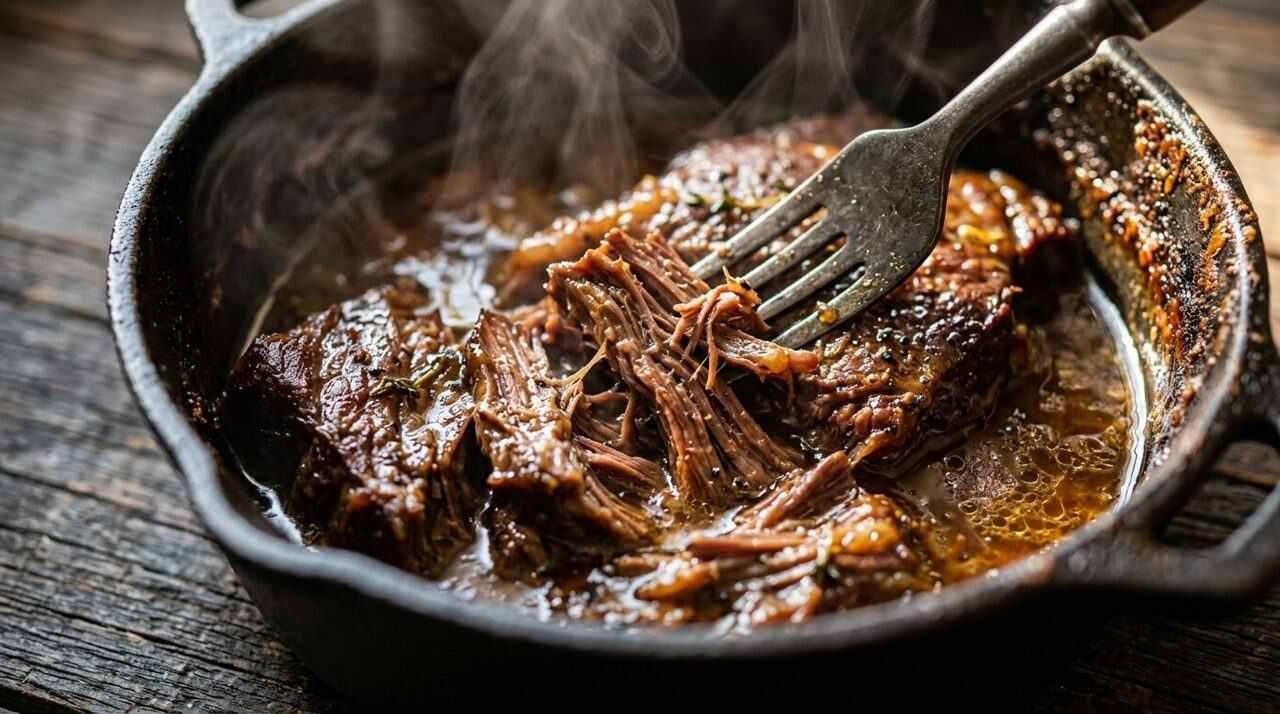
A chuck roast taken to 210°F inside should, by every steak-house rule, be ruined. A strip steak at that temperature would be gray, dry and stiff. Yet the roast that comes out of a Dutch oven after four hours collapses under a fork. America’s Test Kitchen’s simple pot roast says as much, crediting a full hour at about 210°F for the tenderness.
The reversal has a cause, and it sits in a single protein.
The protein that makes tough meat tough
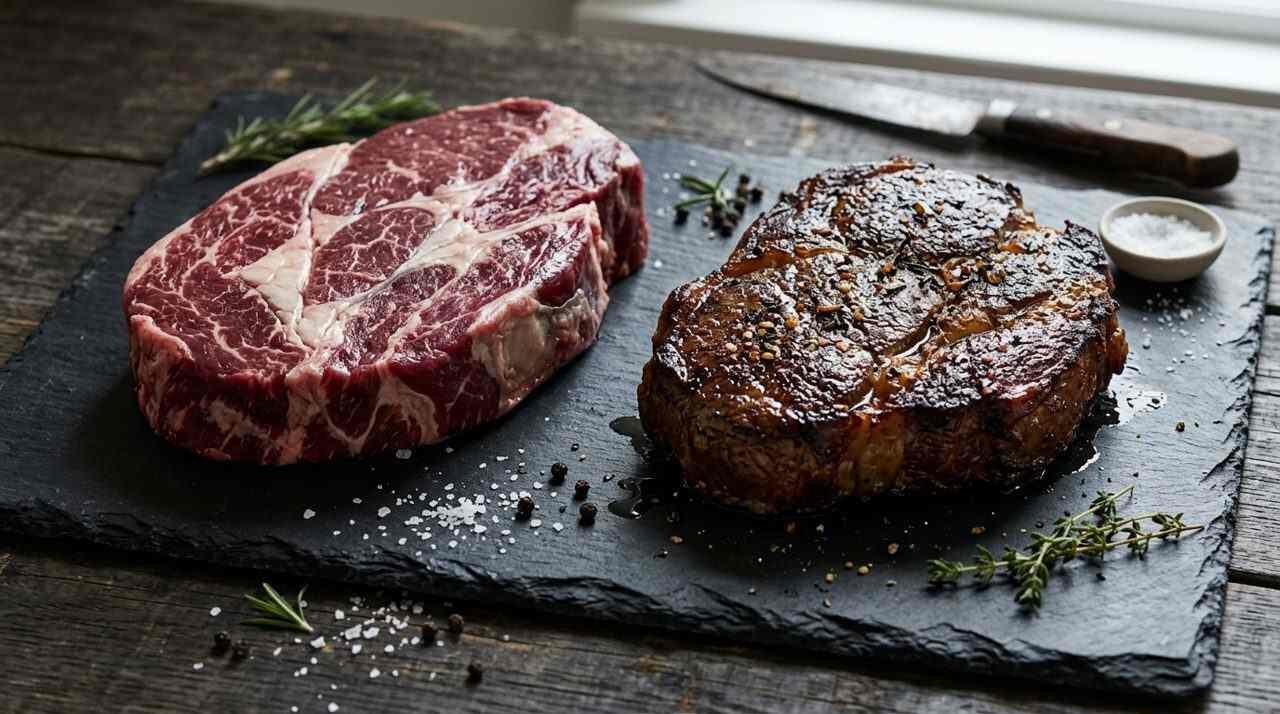
Collagen wraps each muscle fiber and binds bundles of fibers together. It is also found in tendons, skin and bones, and in the Exploratorium’s Science of Cooking column it is described as a major contributor to toughness in older, well-exercised animals. Heavily used muscle carries more of it.
This is why the same animal yields two kinds of beef. An Iowa State University food science course page notes that tougher cuts have larger muscle fibers, less marbling and more heavily used muscle and connective tissue, and its moist-heat lab lists beef chuck blade steak and chuck stew meat among the cuts. Tender cuts, in the words of a University of Nebraska-Lincoln beef bulletin, come from the rib, loin, sirloin and tenderloin, and can be cooked almost any way.
Cook collagen fast and dry, and it behaves badly. That same Nebraska bulletin warns that collagen cooked with dry, high heat turns “tough as shoe leather.”
What heat does to it, stage by stage
The temperatures involved are described in a summary drawn from Harold McGee’s On Food and Cooking at ScienceOfCooking.com. At about 140°F, myoglobin converts to a tan pigment and the meat shifts from pink to brown-gray, and collagen shrinkage starts squeezing out juice, making the meat chewier. At about 160°F, connective-tissue collagen begins dissolving into gelatin. At about 180°F, the page says, collagen liquefies, though by then the meat is well past well-done and can dry out.
Two details matter more than the numbers. The first is that the process is slow. The same page describes collagen breakdown as “a function of both temperature and duration of heating”, and says melting accelerates between 160°F and 180°F. Ten minutes in that range accomplishes almost nothing. Several hours accomplish a great deal.
The second is the trap built into the first. A steady, low heat that melts collagen has to be held long enough that muscle fibers pay a price along the way.
The squeeze: why braised beef can still be dry
The ScienceOfCooking.com summary spells out the conflict. Keeping moisture loss low calls for temperatures below 130°F, while converting collagen calls for temperatures above 160°F held for extended periods, and a slab of meat can lose 20% or more of its weight to shrinkage in the process. A braise cannot escape that bargain. It makes a different one.
Moisture still leaves the fibers. What a braise provides is a surrounding bath, so that much of what the meat gives up ends up in the sauce clinging to each slice. The temperature window matters too. America’s Test Kitchen’s brisket braise aims for 180 to 200°F, and its testers found that most of the collagen in brisket softens enough to tenderize the meat without converting to gelatin completely.
Why the lid and the liquid are not optional
Water sets a ceiling. It boils at 212°F, and a pot full of liquid cannot be pushed much past that. America’s Test Kitchen’s brisket work puts the target zone at 180 to 200°F, below water’s boiling point, which keeps the meat in the range where collagen dissolves and out of the range where fibers wring themselves dry.
Evaporation works against the cook. Evaporative cooling begins at about 160°F, according to the same test, and a 250°F oven alone proved too slow: after six hours the brisket never passed 165°F inside. That is why braising demands a covered pot. A tight lid limits that evaporation. The University of Nebraska-Lincoln guidance to keep roasts tightly covered with foil or a lid during slow cooking says the same thing in plainer terms.
The oven’s setting
Practicing cooks settle near 300°F. America’s Test Kitchen’s pot roasts run at 300°F, Michael Ruhlman’s recipe starts the oven at the same number, and the brisket test began at 325°F until the meat hit 180°F and then dropped to 250°F. Heat is the lever, but the liquid is the governor: the pot rarely allows the meat to climb far past the boiling point of water no matter how hot the oven is set.
Browning comes first because the wet stage cannot do it
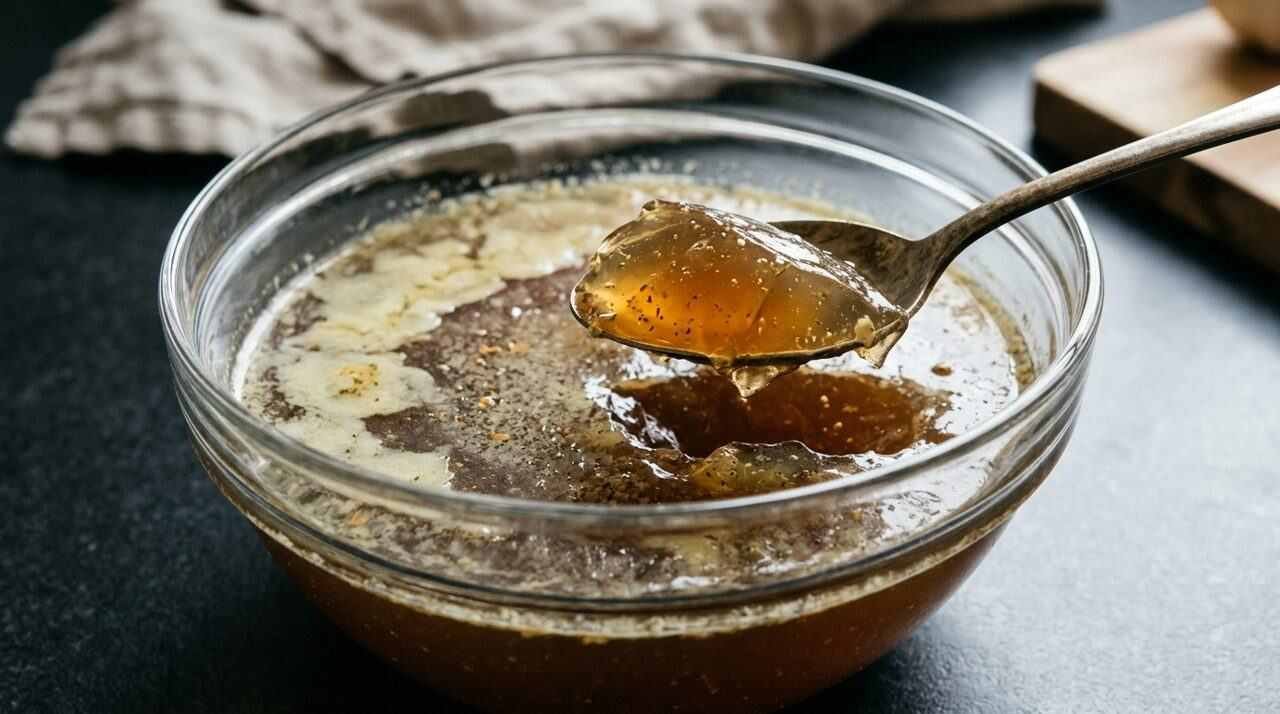
Searing belongs before the liquid for a chemical reason. The browning reactions between sugars and amino acids, a University of Richmond chemistry-of-cooking exercise explains, require intense heat, around 250°F, above the boiling point of water. Inside a braising pot, a wet surface stays near the boiling point, so the flavorful brown crust never forms. It has to be built in the hot, dry skillet stage or the pot’s first minutes, and then carried into the braise as flavor.
Ruhlman’s recipe states the purpose directly: searing and browning build flavor. One America’s Test Kitchen pot roast skips the step and leans on browned onions, tomato paste and wine, which suggests how much of the work can be shifted elsewhere.
Not every cut gives up the same amount of collagen
A 2021 Kansas State University report, published in the Kansas Agricultural Experiment Station Research Reports, stewed beef shanks from eight carcasses to see what predicted tenderness afterward. Raw pyridinoline density, a measure of cross-links between collagen strands, tracked cooked toughness (r = 0.730 with shear force), and the researchers describe the cross-link as heat-stable and “difficult to degrade even with extensive heat treatment.” In other words, some collagen is tied up in ways that long cooking never fully undoes.
Older animals make the problem worse. The Exploratorium column points to age and exercise as the sources of toughness, and it adds that elastin, the yellowish tissue butchers usually trim away, is not tenderized by moist heat; no amount of waiting in the pot softens it.
What the chemistry asks of the cook
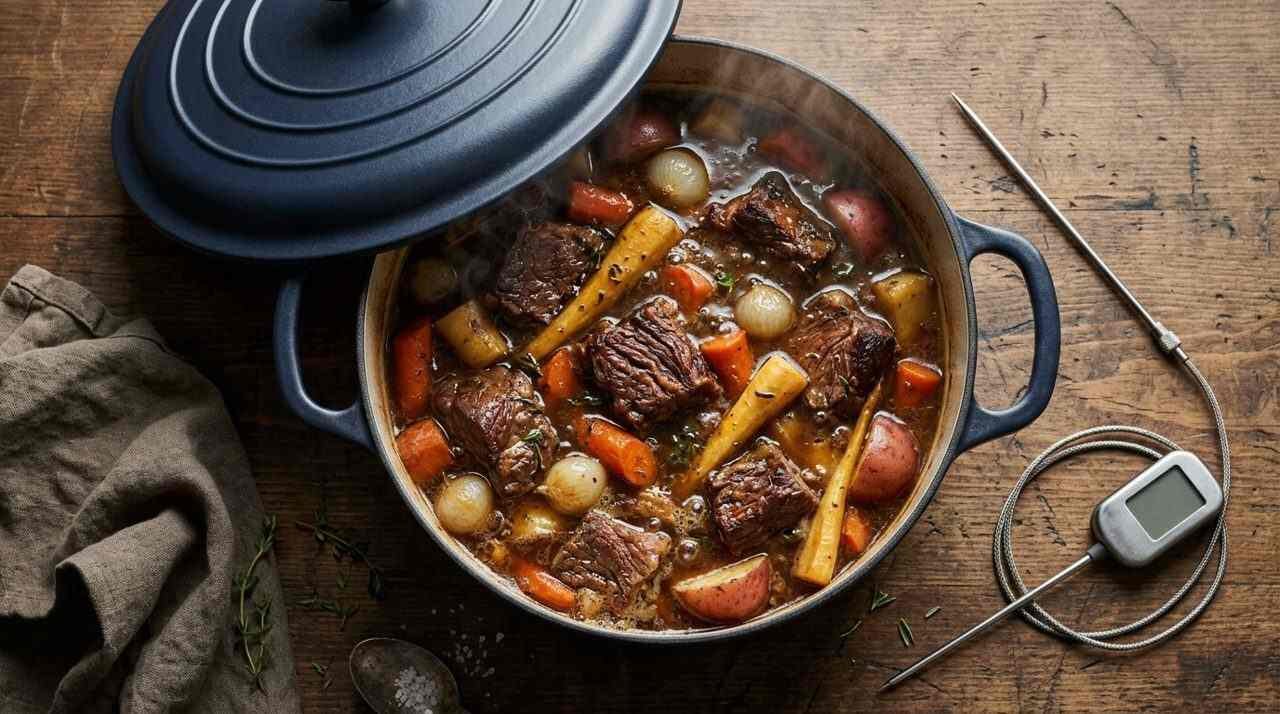
Moist heat has a simple job description. In the Nebraska bulletin’s phrasing, “Slow moist heat is an easy way to tenderize collagen,” and the Iowa State page puts the result in one line: connective tissue softened with heat and moisture breaks down into gelatin. Everything else in a pot roast recipe is arrangement around that fact.
Size is one such arrangement. The America’s Test Kitchen classic splits its chuck-eye roast at the natural seam, because two smaller roasts, in the recipe’s own reasoning, shorten the cooking time and let the salt season the meat more deeply. The fat trimmed first is the interior kind that, in the recipe’s words, refused to render. Both choices serve the collagen indirectly, by getting heat to the middle of the meat without overcooking the outside.
Hours, not minutes
Time scales with weight. Tasting Table gives a working figure of about one hour per pound at 300°F, which lines up with the 3½-to-4-hour braise of the 3½-pound America’s Test Kitchen roast and the roughly four hours Ruhlman allots a five-pound one. The numbers do not match perfectly, and they do not have to. Pot, lid, oven and cut all vary, so recipes agree on the method and quarrel mildly over the clock.
That variability is the argument for testing by feel. A thermometer would be reading a meat whose safety was settled long before it became tender: the USDA’s floor for beef roasts is 145°F followed by a three-minute rest, and a braise passes it comfortably on the way to 200°F and beyond. Safety and tenderness are two separate thresholds, and braising lives entirely on the second.
After the oven comes a slower, quieter stage. The America’s Test Kitchen simple pot roast leaves its liquid undisturbed for about five minutes so the fat rises before skimming, and the recipes in this group direct slicing against the grain, into pieces about half an inch thick.
From the pot to the plate
Gelatin explains the body of a good pan sauce. Gelatin is also what the brisket testers at America’s Test Kitchen reached for when the sauce came out thin: since most of the collagen had not converted, they added powdered gelatin and flour. The chuck recipe from the same kitchen needs neither; it blends the cooked vegetables back into the strained, skimmed liquid.
The cold-sauce habit pairs with the cold-roast habit. America’s Test Kitchen suggests chilling the cooked roast overnight for flavor and easier slicing, and Ruhlman says braises generally improve when made a day or more ahead. The craving for a pot of braised beef at the first cold evening of fall has its own physiology, laid out in a separate post on why the body wants stew when the temperature drops.
Useful gear
- On Food and Cooking: The Science and Lore of the Kitchen (Harold McGee): a practical item related to this topic. See it on Amazon (affiliate link)
As an Amazon Associate I earn from qualifying purchases. A commission may be earned if you buy through this link, at no extra cost to you.
The practical rule that falls out of all this is short. Judge a braise by whether a knife slides in and out easily, not by the number on the thermometer, and give it the hours the collagen needs.
Sources
- ScienceOfCooking.com: Slow cooking (summarizing Harold McGee, On Food and Cooking)
- Exploratorium Science of Cooking: collagen and tough meat
- University of Nebraska-Lincoln: Cooking Tenderness into Every Beef Cut
- Iowa State University: Moist Heat Methods Introduction
- Kansas State University: Mature collagen crosslinks and cooked meat toughness (stewed beef shank)
- America’s Test Kitchen: How to Braise Brisket
- America’s Test Kitchen: Simple Pot Roast
- America’s Test Kitchen: Classic Pot Roast with Root Vegetables
- Cook’s Illustrated: Classic Pot Roast
- WNYC: Michael Ruhlman’s Pot Roast
- University of Richmond Chemistry of Cooking: Browning
- Tasting Table: Ideal Oven Temperature for Chuck Roast
- USDA FSIS: Safe minimum internal temperatures