 275 Route 25A, Mt Sinai, NY 11766


A Samsung washing machine sat on John Lewis’s site at £399 for Black Friday 2024, presented as a deal. The consumer group Which? went back through a year of prices and found that the same machine had been at that price or lower on 108 occasions before the sale and 115 after it. The banner was real. The bargain was a recurring weekday.
@@YOUTUBE@@ Kitchen gear lives in the same machinery. A cast iron pan, a sheet tray, an instant-read thermometer: none of them changes from one season to the next, which makes them ideal props for a price tag that moves while the product stands still. Three studies from the last sales cycle, one from a personal finance site, one from a consumer magazine in Washington, one from a British consumer group, measured the gap between the word “sale” and the number underneath it. Their methods differ. Their conclusions point the same way.
The WalletHub count: a third of the ads saved nothing
Fewer duds than last year, still plenty of them.
WalletHub’s approach is the simplest of the three. It records what an item costs in the weeks leading up to the holiday, then compares that figure with the price printed in the Black Friday ad. For the 2024 report, the company collected advertised Amazon.com prices from Oct. 21 to Nov. 18 and compared them with Black Friday ad prices, and found that 41% of goods offered no savings against their pre-holiday price.
The 2025 edition moved in the right direction, though not far. WalletHub determined that 36% of items offer no savings compared with their pre-Black Friday prices, according to the report as summarized by LongIsland.com. Cookware did make the good list. A Calphalon Premier 11-piece stainless steel set ranked seventh among the report’s top deals, with a $150 discount.
A third of the circular, in other words, was decoration. The ads were printed, the doorbusters were scheduled, the countdown clocks ran, and for roughly one item in three the shopper could have paid the same amount on an ordinary weekday in the weeks before.
P.K. Kannan of the University of Maryland, quoted alongside the 2025 numbers, put the practical advice plainly: “it is best to check out the prices and shop around a bit for good deals given this uncertainty.”
The limit of WalletHub’s method is its window. A four-week lookback catches the retailer who raised a price in late October to make a November cut look deeper. It cannot catch the retailer whose “regular” price has not been charged since spring.
Consumers’ Checkbook and the price nobody paid
Twenty-four weeks of checking the same shelf.
Consumers’ Checkbook, the Washington consumer magazine, ran the longer experiment. Starting in February 2025, its researchers checked prices weekly for 24 weeks at 25 national chains, tracking 25-plus items at each store. The question was not whether a price dropped on one day. It was how often the “regular” price was ever the price.
The answer was brutal for most of the field. In 2018, the group found six retailers that had fake discounts on at least half their tracked items more than half the time. In the 2025 study, 21 of 25 did. Bed Bath & Beyond, Wayfair, JCPenney and Nordstrom were among the stores whose tracked items were always or almost always on sale, while Apple, Costco and Dell consistently offered real discounts. Kohl’s was tracked for clothing and housewares, the aisle where skillets and stand mixers live. Walmart landed in the middle, with items on sale 48% of the time overall.
Kevin Brasler, the magazine’s executive editor, called the inflated originals “anchor prices” and told WTOP that such a figure is often simply fabricated. In the group’s own release, he reduced the problem to one line: “Seeing 50 percent or 60 percent off a regular price doesn’t mean anything.”
An anchor price works the way a cracked gauge works on a boiler. The needle points somewhere official, the room trusts it, and the reading has nothing to do with the pressure in the pipe.

Which? and the year-long ledger
The cheapest day was not the day on the calendar.
The British study is the one that ran longest. Which? tracked 175 home, tech and health appliances at eight retailers, including Amazon, Argos and Currys, from May 2024 to May 2025. It defined the sales period generously, as the four weeks from 15 November to 12 December 2024, and still found that 83% of products were cheaper or the same price at least once outside that window.
The finding that matters most for anyone shopping on the Friday itself is shorter. None of the tracked deals was at its cheapest of the year on Black Friday. At Amazon, 88% of deals were the same price or cheaper outside the sales period, and 63% were actually cheaper at some other point.
Which? also caught the “RRP” trick in action. At Boots, an electric toothbrush advertised as “save £25, RRP £50” had carried that £50 recommended price for only 13 days in the previous six months. A reference price that exists for less than two weeks is less a price than a costume.
Reena Sewraz, the group’s retail editor, summed it up: “for the majority of shoppers, Black Friday is a false economy.” These are British retailers and British rules, and the figures should not be read as American ones. The pattern, though, rhymes with the Checkbook results almost line for line.
What federal pricing rules say about a “former price”
The rulebook is old, and it is clear.
The Federal Trade Commission’s Guides Against Deceptive Pricing, codified at 16 CFR Part 233, address the exact move the studies describe. Section 233.1 says a former price comparison is legitimate when the advertised figure was the price at which the item was offered “to the public on a regular basis” for a reasonably substantial period. When the former price is fictitious, the guide says, the bargain is a false one and the “reduced” price is really the seller’s regular price.
Checkbook’s report leans directly on that language, arguing that retailers advertising perpetual markdowns are violating the federal rules on former price comparisons, as WTOP reported.
Here the tidy story starts to come apart. If the rule is that clear, and the violations are that common, why does the practice keep growing from six chains to twenty-one? Guides describe what deception looks like; they do not stand in the aisle. A strikethrough price is cheap to print and expensive to challenge, and the person best positioned to notice the fiction is the shopper holding a phone in the checkout line.
There is a second complication, and it cuts against the studies themselves. A fake discount does not mean a bad price. A skillet “marked down” from a price it never had can still be the lowest figure that skillet has seen all year. Which?’s own data show the reverse case as well, real deals sitting inside the same sales period as the costumes. The anchor is a lie about the past. It says nothing, on its own, about whether today’s number is good.
Reading a price history chart before buying
Ignore the strikethrough, read the line.
That is why price history tools matter more than any discount percentage. Two free ones dominate for Amazon listings. Keepa, installed as a browser extension, shows price history charts directly on Amazon’s product pages and can send alerts on price drops for single items or whole wish lists. CamelCamelCamel’s extension, the Camelizer, opens from an icon in the browser bar and displays a graph of the price over the last week, month, year or all time. Neither requires an account, according to Trusted Reviews.
Reading the chart is a short exercise. Look at the flat stretches, because a long flat line is the item’s real regular price. Look at the floor, the lowest point in the past year, and compare it with today’s figure. A “40% off” tag that lands exactly on a floor the item visits every few weeks is a routine price wearing a party hat. A figure below any floor on the chart is the rare thing the ad promised.
No chart supplies a number by itself here, and none is quoted. Prices on Amazon change through the day, and a figure printed in a post on Thanksgiving week would be stale before the coffee cooled. The honest tool is the live graph.

Five pieces of kitchen gear, and how to price-check each
The products stay the same. Only the tag moves.
The kitchen tools this blog has already reviewed make a useful test set, because each one is a long-running model rather than a seasonal release.
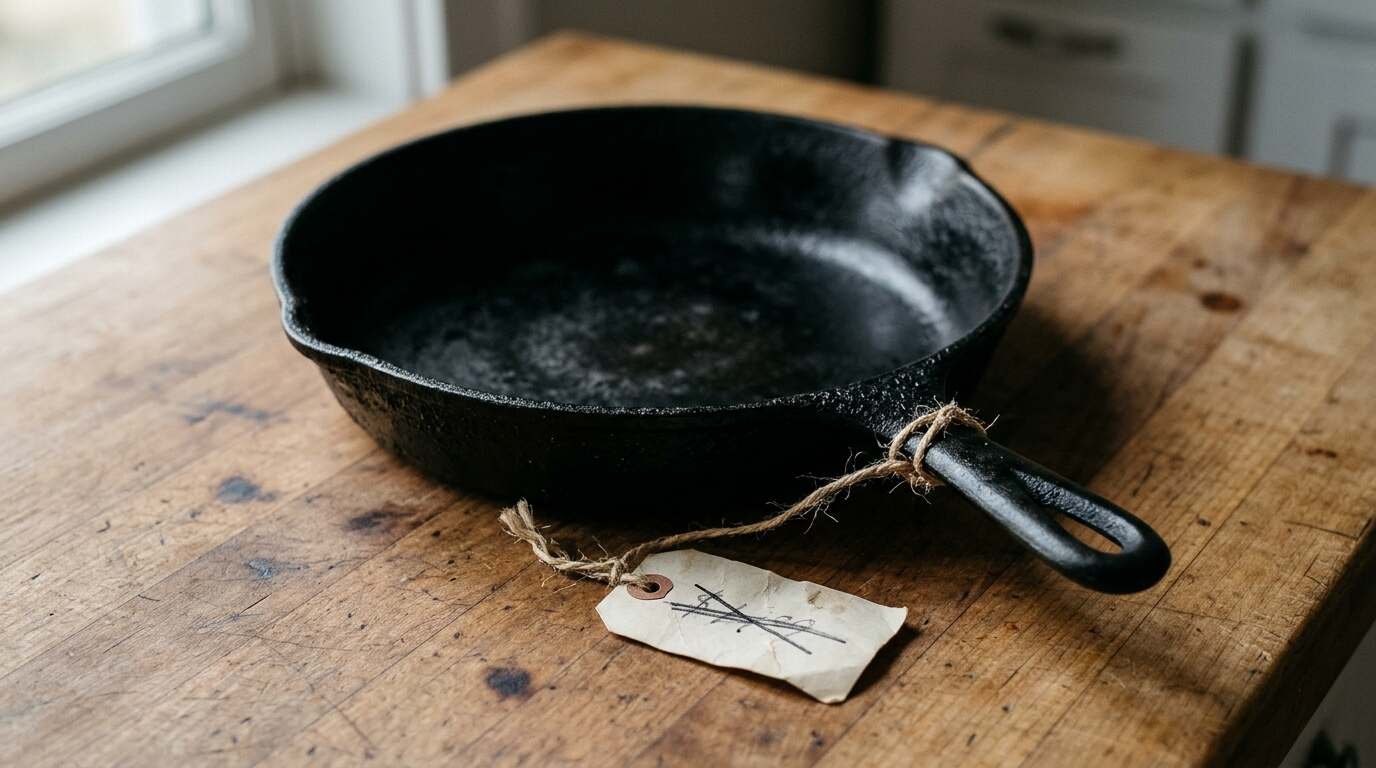
The Lodge 12-inch cast iron skillet(See it on Amazon (affiliate link)) is a plain test of the method. Open the chart, find the flat line, find the floor, and only then look at the banner.
The ThermoWorks ThermoPop 2(See it on Amazon (affiliate link)) is small enough to land in a cart as an impulse add-on, which is exactly when the strikethrough does its best work. A Keepa alert set a few weeks ahead takes the impulse out of it.
The Nordic Ware half sheet pan(See it on Amazon (affiliate link)) needs one extra check: confirm the listing on sale is the same size and the same count as the one in the chart, since a graph for a two-pack and a graph for a single pan tell different stories.
The Presto 22-inch electric griddle(See it on Amazon (affiliate link)) is the kind of countertop appliance sold in the housewares aisles of chains like Kohl’s, which Checkbook tracked for housewares, and Bed Bath & Beyond, which landed on its list of stores with near-permanent sales.
The Hamilton Beach HMD200 drink mixer(See it on Amazon (affiliate link)) is a case for comparing more than one store, because a history chart only covers the shop it reads, and a second retailer’s live price takes a minute to find.
The broader question of which of these are worth owning at all, at any price, sits in Kitchen Gear Worth Buying Once and Gear Worth Skipping. A deal on a tool that ends up in the back of the cabinet is still money in the cabinet.
The studies leave one gap open. They count how often a sale is fake, but no one has published the count that would matter most on a counter: how many people bought a second skillet because the first one was marked down. Which kitchen tool in the house was bought on a sale that, in hindsight, never existed?

You Might Also Like
- One Skillet Per Job: Where Carbon Steel, Cast Iron, and Stainless Each Win
- Menus Are Rising Nearly Twice as Fast as Grocery Bills, September Prices Show
- A Thanksgiving Timeline for a Small Kitchen, Counted Backward From the Table
As an Amazon Associate I earn from qualifying purchases. A commission may be earned if you buy through this link, at no extra cost to you.
For informational purposes only — consult a licensed attorney or financial advisor.
Sources
- Which?, “Don’t believe the hype: most Black Friday deals the same price or cheaper at other times of the year” (25 November 2025): https://www.which.co.uk/policy-and-insight/article/dont-believe-the-hype-most-black-friday-deals-the-same-price-or-cheaper-at-other-times-of-the-year-which-finds-a3TbD5x5KADs
- FOX 26 Houston, WalletHub 2024 Black Friday findings (November 22, 2024): https://www.fox26houston.com/news/black-friday-best-worst-product-categories
- LongIsland.com, “36% of Black Friday items offer no savings: report” (November 26, 2025): https://www.longisland.com/news/11-26-25/36-of-black-friday-items-offer-no-savings-report.html
- FOX 13, “36% of Black Friday sales offer no deal at all, experts say” (November 21, 2025): https://www.fox13news.com/news/36-black-friday-sales-offer-no-deal-all-experts-say
- Consumers’ Checkbook, Sale Fail 2025 press release (November 13, 2025): https://www.checkbook.org/pdfDocs/doc/Sale_Fail_2025_press_release.pdf
- WTOP, “Looking forward to Black Friday sales? ‘They’re really just lying to you,’ warns DC consumer expert” (November 2025): https://wtop.com/business-finance/2025/11/looking-forward-to-black-friday-sales-theyre-really-just-lying-to-you-warns-dc-consumer-expert
- 16 CFR § 233.1, Former price comparisons (Cornell Legal Information Institute): https://www.law.cornell.edu/cfr/text/16/233.1
- Trusted Reviews, “How to find out price history on Amazon this Black Friday”: https://www.trustedreviews.com/news/how-to-find-amazon-price-history-4176417
Suggested category: Food & Dining
As an Amazon Associate I earn from qualifying purchases. A commission may be earned if you buy through this link, at no extra cost to you.
Leave a Reply