Some links in this post are Amazon affiliate links. As an Amazon Associate, Heritage Diner earns from qualifying purchases at no extra cost to you.
A confession from the kitchen floor: most of what lasts is plain. The tools that pay for themselves over decades are heavy, simple and unglamorous. The ones that disappoint are clever, specialized and used twice.
What follows is opinion, not law. Where a claim is a preference, we say so. Your kitchen and your habits may point somewhere else.
Buy once: a chef’s knife
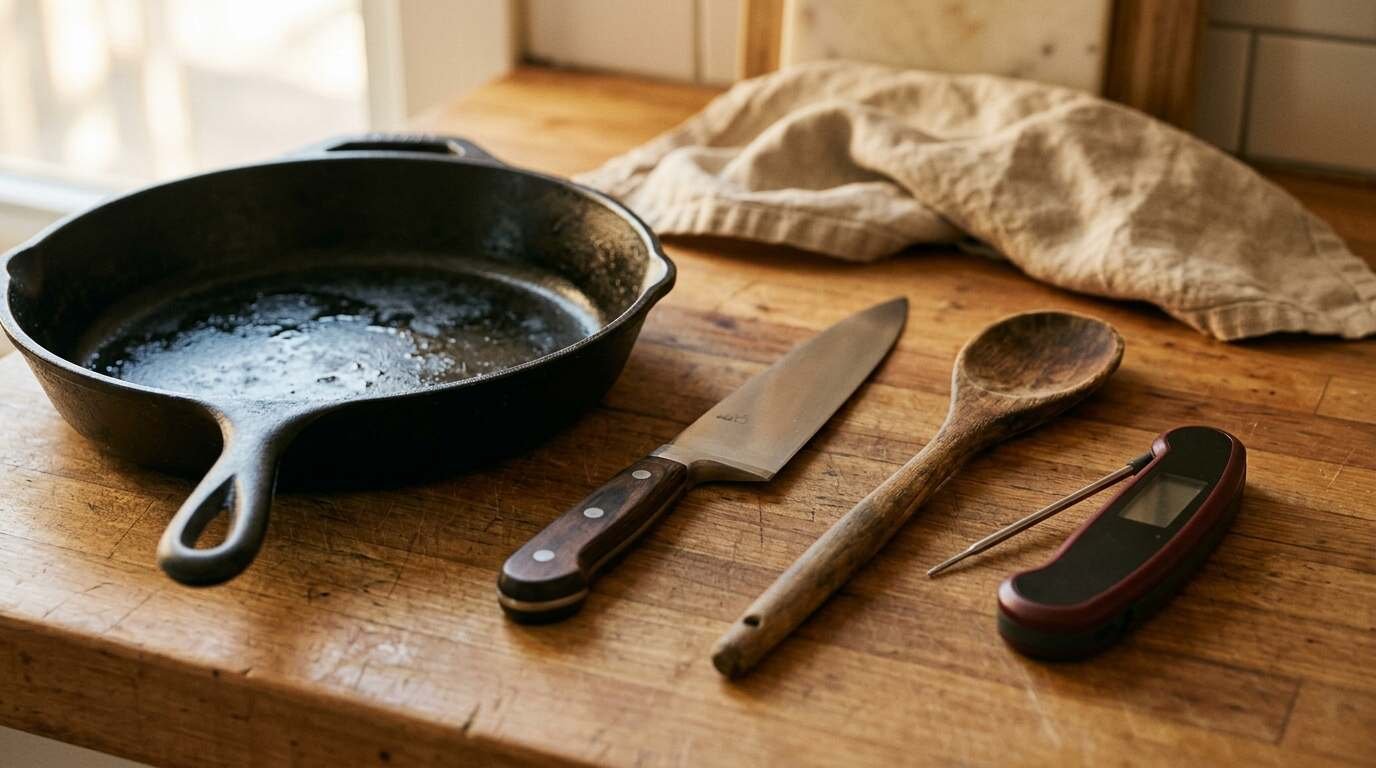
One sharp eight-inch knife does most of the cutting in a home kitchen. Buy a good one and learn to hone and sharpen it. A decent chef knife and a plain wooden or plastic cutting board are worth more than an entire block of mediocre blades. Opinion: skip the giant set.
Buy once: a cast-iron skillet. It sears, fries, bakes cornbread and goes from stovetop to oven. A new one is cheap, and an old one found at a yard sale can be cleaned and re-seasoned. Heavy and slow to heat, but nearly indestructible. A cast iron skillet is the first pan we would hand a new cook.
Buy once: an instant-read thermometer
This is not a luxury. It is how you know chicken has reached 165 degrees F, a pork chop 145 and a burger 160. Guesswork either overcooks the food or sends someone home sick. A digital instant-read thermometer answers the question in seconds.
Buy once: heavy rimmed baking sheets. Thin sheets warp in a hot oven and brown unevenly. A thick aluminum half-sheet pan roasts vegetables, bakes cookies and catches drips. Buy two. Add a wire rack that fits inside for crisping bacon and cooling. Opinion: nonstick coatings on these are rarely worth it; line with parchment instead.
Buy once: a heavy-bottomed saucepan and a Dutch oven
A medium saucepan with a thick base handles sauces, rice and oatmeal without scorching. A lidded Dutch oven braises, simmers soup and bakes bread. Both last for decades if you do not abuse them.
Buy once: wooden spoons, a fish spatula and tongs. A few simple utensils handle most jobs. A thin, flexible metal spatula slides under eggs and fish. Spring-loaded tongs flip, lift and serve. Wooden spoons do not scratch pans. None of this needs a designer label.
Buy once: a kitchen scale. Weighing flour is more accurate than scooping, which can vary by an ounce or more. A small scale also helps with portions and portioned sausage patties. It costs little and makes baking more consistent.
Skip: the single-purpose gadgets. Opinion territory. An egg slicer, an avocado tool, a banana hanger, a pancake dispenser, a hot dog roller. Each does one job that a knife or a spoon does nearly as well, and each lives in a drawer. If a tool earns its place by being used weekly, keep it. If it appears twice a year, the knife can do it.
Skip: the giant knife block and the multi-piece cookware set. Sets often include pieces you will never use, at a price that could have bought a few excellent individual items. Buy the pieces you need, one at a time.
How to decide on a new purchase
A few questions have saved plenty of money. Will I use this at least once a week? Can a tool I already own do the job? Is it easy to clean? Will it still work in ten years? A tool that passes all four is a keeper. One that fails two is a drawer ornament.
Secondhand shops, estate sales and family kitchens are rich sources for cast iron, enameled pots and solid utensils. Older tools were often made to last. Inspect them for cracks, rust and loose handles, and clean them thoroughly.
Another habit: buy tools when you need them, not before. A cook who has made soup twice and found the saucepan too small knows exactly what size to look for. A cook who bought a ten-piece set on a whim does not.
What opinion looks like here
Everything in the lists above comes from experience on a busy line and a home stove, and it reflects taste as much as fact. Another cook might pick a carbon steel pan over cast iron, or a bench scraper over a spatula. That is fine. The test is the same: does the tool get picked up every week, and does it do its job without fuss?
The only claims here that go beyond preference are the safe cooking temperatures for chicken, pork and ground meat, which come from the USDA. A thermometer is the one tool on this list that is about safety, and not only convenience.
One last test
Look at the tools you reach for without thinking. Those are the ones that belong. The rest can be donated, given away or sent to the back of the cabinet. A smaller kitchen with good tools cooks better than a larger one that overflows.
Skip: the novelty small appliances you will use twice. Some countertop appliances are worth it for the right household. But many end up in a cabinet. Before buying one, ask whether the thing it makes is something you cook every week, and whether you have the space to leave it out.
A note on caring for good tools. Buying well is half the job. Hand-wash knives and cast iron, dry them, and store them with care. Replace thermometer batteries. A tool kept in good condition earns its price back many times over.