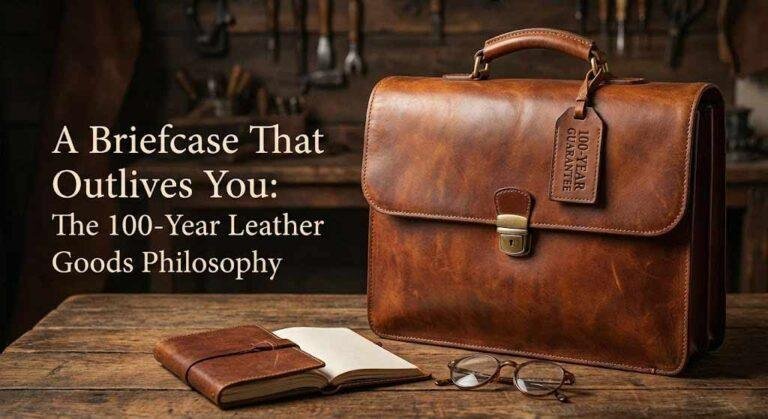
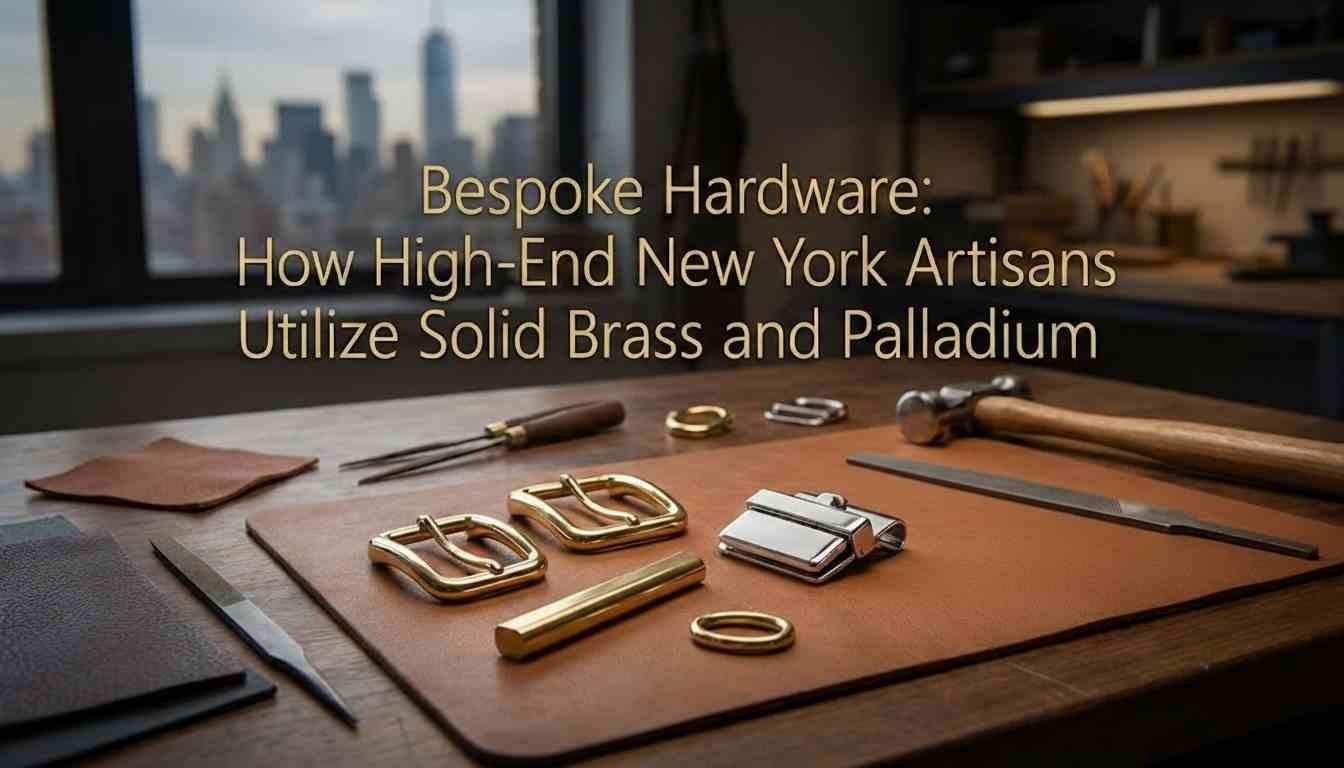
Reach into a drawer filled with decades-old leather goods and you’ll immediately know which pieces were built to last. Not by their stitching, not even by the leather itself, but by the weight of the hardware — that unmistakable density of a solid brass ring or buckle, cold and purposeful in the hand, utterly indifferent to the passage of time. Hardware is the skeleton of any fine leather object. It is the part that endures when dyes fade and stitching relaxes. And in New York’s bespoke leather community — a small, serious world that exists well beneath the noise of fashion weeks and retail rollouts — the choice between solid brass, palladium, and their countless lesser substitutes defines the fundamental character of everything made.
The Metal Beneath the Object
Walk through any serious leather workshop in the five boroughs or along the North Shore and you’ll encounter a quiet war between materials that most consumers never consider. On one side: solid brass, the workhorse of the heirloom world, an alloy of copper and zinc that has been used in fine goods since the 18th century. On the other: palladium, the cool-white member of the platinum group, discovered in 1802 by English chemist William Hyde Wollaston and now occupying the summit of bespoke hardware specification. Below both of them, in the undifferentiated valley of mass production, sits zinc alloy — lighter, cheaper, and about 18% less dense than solid brass, a fact that reveals itself the moment you tap it against any hard surface. The sound is hollow. The feeling is wrong.
Solid brass does not merely look like quality. It is quality in its most elemental form. Brass is naturally corrosion-resistant, strong, and ideal for long-term durability, developing a beautiful patina that darkens and deepens with time — making it the material of choice for heirloom goods, tack, belts, and high-end builds. Weaver Leather Supply Its malleability allows foundries to cast complex, small-form hardware — the kind of D-rings, turn-clasps, and strap keepers that define a briefcase’s functional architecture — with a precision that harder metals cannot easily achieve. This is the hardware New York’s independent leather artisans have built their reputations upon.
Palladium: The Platinum Group’s Quiet Aristocrat
If solid brass is the foundation, palladium is the elevation. Palladium hardware is one of the classic hardware fixtures used for Hermès Birkin bags Hgbagsonline — a fact that tells you everything about the material’s positioning in the global luxury conversation. Palladium-plated hardware offers a premium, corrosion-resistant white-platinum hue Leeline Bags, distinct from the colder flatness of nickel and the yellowed warmth of gold. It reads simultaneously modern and classical, which is exactly what a serious New York client expects from a piece meant to travel boardrooms and courtrooms for the next thirty years.
The technical specification behind genuine palladium work is precise. At Hermès, palladium hardware is constructed on a brass base, initially plated with a 1µm layer of silver, followed by a 2µm layer of palladium Substack — a layering system that demands exacting electroplating standards and zero tolerance for shortcuts. The brass substrate remains critical even here: luxury brands invest in solid-metal hardware with palladium finishes that resist tarnish, where the weight, finish, and engraving quality signal authenticity and longevity. Szoneierleather Strip away the brass base and replace it with zinc alloy, and the palladium finish becomes theater — cosmetically convincing until the first stress fracture tells the truth.
New York’s Bespoke Artisan Tradition
New York has always maintained a parallel economy of craft alongside its commercial one. The Lower East Side produced generation after generation of leather workers and cobblers, their skills transplanted from Italian, Eastern European, and Greek immigrant communities who brought Old World standards into the New World’s grinding pragmatism. Artisans like Barbara Shaum — the legendary Manhattan leather craftsperson who trained generations of makers from her East Village studio — established a lineage that continues today. Sabine Spanjer and Kika Vliegenthart of Kika/NY trained under Shaum in Manhattan’s Lower East Side, honing their skills in traditional leather craft, sourcing hand-tooled solid brass hardware cast in small batches by an English foundry. KIKA/NY LLC That English foundry detail is not incidental. The finest bespoke hardware — the pieces that serious New York artisans specify — still comes predominantly from British and European foundries with centuries of metallurgical tradition behind them.
This is a community that understands material provenance the way a sommelier understands appellations. The foundry matters. The alloy specification matters. Whether the hardware is cast solid or plated over base metal matters enormously, not as a marketing distinction but as a structural one that determines whether a buckle holds for five years or fifty.
The Anatomy of a Bespoke Fitting
Commissioning bespoke hardware for a serious leather piece is not a catalog exercise. It begins with a conversation about function — how will the piece be used, how often, under what conditions — and then moves into the metallurgical decisions that most clients never see but always feel. A briefcase destined for daily use in a Manhattan law firm operates under different stress conditions than a weekend bag or a saddle. The hardware must be sized accordingly, specified accordingly, and sourced accordingly.
For custom bespoke work, artisans define proprietary hardware elements like logo plates, lock bodies, and signature zipper pulls through custom molds, with explicit contractual ownership of the tooling to prevent the foundry from repurposing the design. Leeline Bags This is not paranoia — it is the structural reality of working at the intersection of craft and intellectual property. The hardware on a truly bespoke New York briefcase is as identifiable to its maker as a brushstroke is to a painter.
The finishing standards are equally exacting. Electroplating thickness specifications for high-touch parts demand a minimum of 2–3 µm, with a precise layer stack — substrate, acid copper, nickel, gold or palladium, and electrophoretic lacquer Leeline Bags — ensuring that the finish does not merely look refined but survives years of friction, moisture, and the particular punishment of a daily-carry object. Anything short of this standard, regardless of how it photographs, will begin to betray itself within a year of serious use.
Brass Patina and the Philosophy of Aging
What separates the heirloom philosophy from the luxury-brand philosophy is this: heirloom objects are designed to age beautifully, not to resist aging entirely. Solid brass hardware, over years of handling, develops a patina that deepens the object’s character rather than diminishing it. The warmth shifts, the highlights soften, and the hardware begins to tell the story of the hands that have worked it. This is not a flaw. It is the material’s autobiography.
Palladium behaves differently — cooler, more resistant, slower to show its history — which is precisely why it appeals to a certain kind of client who wants their object to look almost exactly the same in twenty years as it did in the first week. Both are legitimate philosophies. The choice between them says something about how a person relates to time, accumulation, and the visible evidence of a life well-used.
Heidegger wrote about objects revealing themselves through use — that a hammer becomes fully itself only in the act of hammering, not when hanging on a wall. Hardware, in this sense, is the most philosophical element of any leather piece: it is the interface between the object and the world, the point where the abstract idea of the thing meets the concrete reality of daily life. The solid brass D-ring that takes the weight of a briefcase’s contents, thousands of times over, without cracking or tarnishing into failure — that is the ring performing its essential being.
What the Market Demands in 2025 and Beyond
The broader luxury market has noticed what serious artisans have known for decades. The luxury leather segment is projected to grow at a 4–5% CAGR through 2030, driven by sustained North American demand Szoneierleather, and within that growth, discerning consumers are increasingly asking the questions that once belonged only to specialists: Is this solid brass or plated zinc? Is that palladium over a brass substrate or nickel over base alloy? The vocabulary of hardware specification is migrating from the workshop to the client conversation.
There has been a noticeable increase in the popularity and valuation of palladium hardware, attributed to shifting fashion trends and a growing appreciation for the modern, sleek look it offers, with the trend toward minimalism playing a role as consumers lean toward understated luxury. Substack This tracks precisely with what serious New York leather artisans are seeing in their commission inquiries: clients who arrive knowing what they want, having done the research, and who are no longer satisfied with vague assurances of quality. They want material specifications. They want to know where the hardware was cast and by whom.
The Standard Worth Keeping
At the Marcellino NY atelier, the hardware specification is never a secondary consideration — it is part of the initial design conversation. English bridle leather sourced from traditional Midlands tanneries like J&E Sedgwick demands hardware that honors the same standard: solid brass, British or European-sourced, properly sized to the piece’s function, and finished with the same attention paid to every hand-saddle stitch in the body of the case. When a client waits six months for a commission, they are not waiting for leather to arrive. They are waiting for every element of the object to be right — and hardware is no exception.
The lesson that New York’s most serious bespoke leather artisans have always understood is the same lesson that has governed every traditional craft since before the industrial age: the unseen specification determines the visible result. Nobody sees the palladium layer stack under a Birkin’s clasp. Nobody sees the solid brass core inside a handsome fitting. But everyone feels it — in the weight, in the sound, in the particular authority of an object that knows exactly what it is and makes no apologies for being built to outlast the hands that commissioned it.