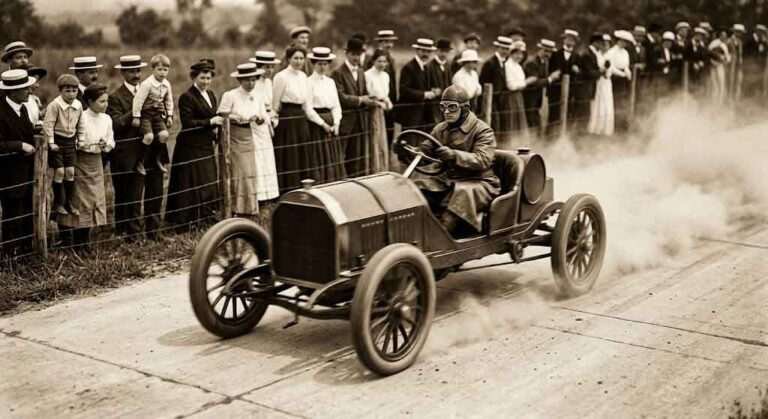
Before the subdivisions came, before the strip malls and the gas stations and the suburban grid settled over everything like a layer of asphalt forgetting — there was a road. Not a highway in any modern sense. A path, really, worn into the glacial till by wagons and horses and later by Model T’s with their headlamps killed after midnight, riding low on their springs.
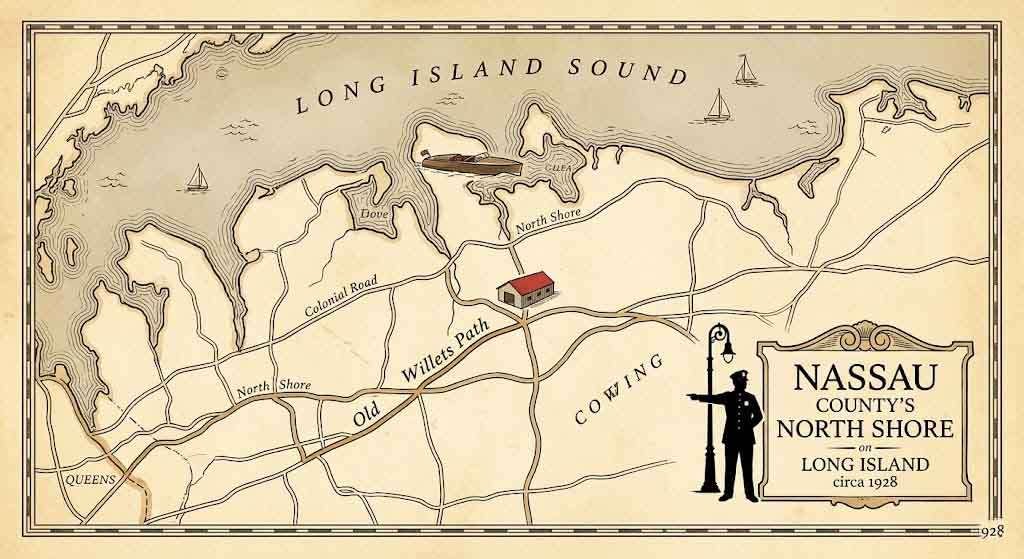
Old Willets Path. It ran from the north shore of Long Island south through what is now Nassau County into Queens, connecting the cold-water landings of Long Island Sound to the speakeasies of Manhattan. Between 1920 and 1933, it was one of the most strategically important roads in America. Nobody put a sign on it. That was the point.
Where the Liquor Came From
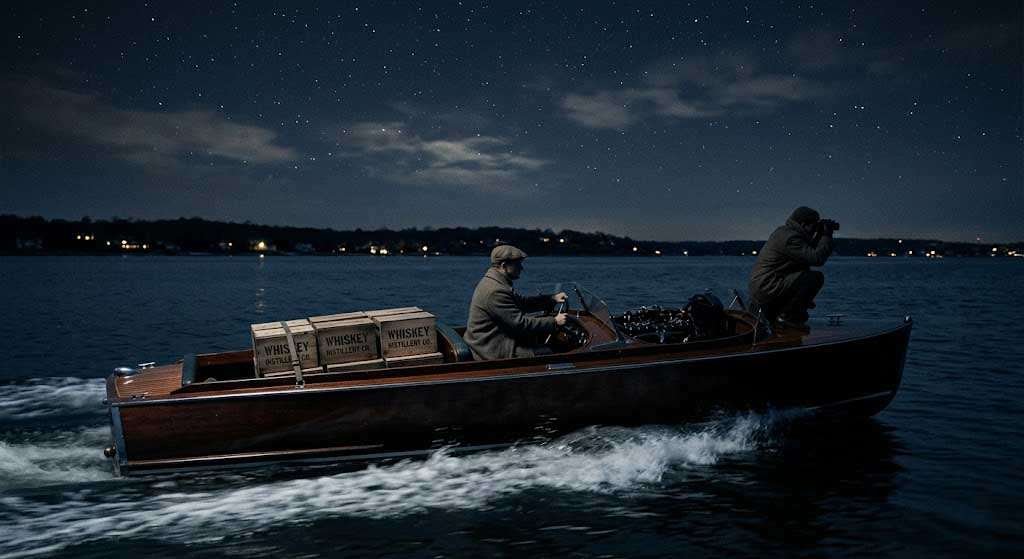
To understand Willets Path, you have to start offshore. During Prohibition, the supply chain for illegal liquor was sophisticated, international, and astonishing in its scale. Canadian distillers — Seagram’s, Hiram Walker, others — never stopped making whiskey. They simply redirected it. Ships loaded with cases of rye and Scotch would anchor beyond the three-mile territorial limit off the Long Island and New Jersey coasts, in a stretch of open water that journalists dubbed “Rum Row.” From there, small fast powerboats — speedboats converted for the trade, often with their engines stripped of everything that wasn’t horsepower — would make the run to shore.
I wrote about the offshore side of this operation in an earlier piece on Rum Row and the Freeport Bootleggers — the clandestine war on the water that played out just off the south shore. But Long Island Sound, on the north side of the island, was equally active, and in some ways more useful. The Sound was calmer than the open Atlantic. The runs were shorter. The channels between Connecticut and Long Island could be navigated in darkness by men who had spent their lives on the water.
The North Shore was dotted with small coves and private docks, the kind of waterfront real estate that belonged to old WASP families who were sometimes willing participants and sometimes just looking the other way. Liquor that landed at Bayville, Centre Island, Oyster Bay, and Cold Spring Harbor often found its way south through the interior of Nassau County along paths that followed the older colonial road network — including Willets Path.
The Infrastructure of Evasion
What made Willets Path useful was what it wasn’t. It wasn’t a primary artery. It wasn’t well policed. It ran through stretches of farmland and second-growth forest that predated the suburban build-out by decades, connecting small settlements without attracting the attention that a main road would. The bootleggers who used it weren’t stupid men — they were businessmen operating a supply chain under constrained conditions, and they understood that speed mattered less than invisibility.
The route wasn’t Willets Path alone. Think of it as a network, with Willets Path as one critical segment. Liquor landed on the Sound, moved by truck or car through the back roads of Nassau County, hit Willets Path as a north-south connector into Queens, and from there spread into the distribution infrastructure of the city. The trucks that made these runs were often legitimate commercial vehicles — laundry trucks, bakery trucks, produce haulers — loaded at the back with cases of whiskey underneath the cover cargo.
The drivers knew which precincts were paid. This was not a small consideration. Prohibition enforcement in Nassau and Queens was notoriously inconsistent, which is another way of saying it was notoriously corrupt. The Nassau County Police Department of the 1920s was riven with political influence and supplementary income from the bootleggers whose routes it was theoretically supposed to shut down. A truck moving through the right roads at the right hours, with the right arrangement in place, could make the run from a North Shore landing to a Queens warehouse without a serious risk of interception.
The Coast Guard was a different problem — more professional, more aggressive, especially after Congress gave them increased funding and faster boats in the mid-1920s. But the Coast Guard’s jurisdiction was the water. Once the liquor was ashore, it was a land problem, and the land apparatus that was supposed to address it was largely captured by the industry it was policing.
The Men Who Ran It
The bootleggers of the North Shore weren’t all gangsters in the Hollywood sense. Some were. Arnold Rothstein — the New York gambling boss who may have fixed the 1919 World Series — was deeply involved in the wholesale import of Canadian liquor through Long Island during the early 1920s before his murder in 1928. Rothstein understood distribution as a systems problem. He invested in boats, trucks, warehouses, and police relationships as a portfolio. Long Island’s north shore waterfront was a significant piece of that portfolio.
But below Rothstein’s level, the trade was full of smaller operators — local men who owned boats and knew the Sound, farmers who rented barn space for staging, tavern owners who were simultaneously customers and distribution nodes, former commercial fishermen who found that running Canadian whiskey paid better than running striped bass. These were people embedded in North Shore communities, people with families and properties and reputations in local churches. Prohibition forced a moral reckoning on American communities that is often discussed in the abstract; on Long Island’s North Shore, it played out in specific, local, human terms.
A tavern keeper in Port Washington who took a delivery of rye whiskey at 3 AM was not an abstraction. He was a neighbor. The cop who looked the other way was someone’s brother-in-law. The whole system ran on social networks that predated Prohibition and survived it.
Driving the Route Today
The modern driver on Old Willets Path in Albertson and New Hyde Park is moving through a landscape that has been so thoroughly suburbanized that the road’s history is almost entirely invisible. The path is a two-lane connector running through a tight residential grid, lined with mid-century houses and the occasional strip commercial building. Nothing marks it as historically significant. There is no plaque.
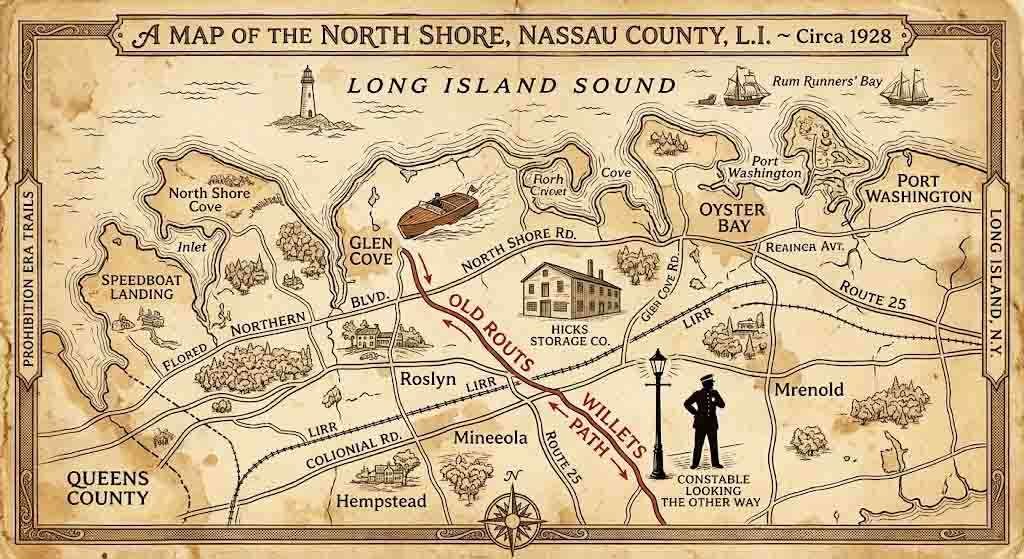
But the bones of the route are still there if you know how to read a map. Old Willets Path runs roughly north-south through Nassau County in a line that predates the modern street grid, which means it bends and angles in ways that make no sense in terms of the current suburban layout but make perfect sense as a pre-development path connecting older settlements. It crosses several other colonial-era roads at odd angles — the kind of intersections that only exist because both roads were already there before anyone thought about planning a grid.
If you trace the likely Prohibition-era route northward from Willets Path, you move through Albertson and Roslyn Heights toward the incorporated villages of the North Shore — Roslyn, Port Washington, Manhasset — and eventually reach the waterfront communities where the Sound landings happened. Drive it on a grey November morning and something of the operational logic is still visible: the narrowness of the roads, the way they dip through small valleys and run along ridge lines, the pockets of older trees that survived the suburban clear-cut. This was a road designed by topography, not by planners, and topography was what made it useful.
The ride down Route 25A covered some of the North Shore’s oldest colonial road infrastructure — 25A itself is one of the oldest continuous routes on Long Island, and its sideroads include sections that date to the 17th century. Willets Path feeds into that same network. These roads are older than the country. The bootleggers didn’t build the infrastructure; they just understood it better than the people trying to stop them.
What Corruption Looked Like on the Ground
The popular image of Prohibition corruption involves dramatic payoffs — envelopes of cash, police captains on retainer, political machines extracting tribute from bootleggers in exchange for operational immunity. All of that happened. But on the North Shore of Long Island, corruption was often quieter and more mundane.
A station house sergeant who didn’t schedule patrol cars on certain roads at certain hours. A desk officer who filed incomplete reports on seized vehicles. A customs inspector at a Sound marina who processed paperwork slowly enough to allow a previous night’s business to clear. These weren’t dramatic criminal acts. They were institutional accommodations, the kind of organizational behavior that spreads through a bureaucracy when the law being enforced is unpopular, the financial incentives for non-enforcement are significant, and the political leadership responsible for oversight is itself compromised.
Nassau County politics in the 1920s was dominated by the Republican machine of G. Wilbur Doughty, which maintained its power through a patronage network that included the police department. The bootleggers understood this better than most reformers. They didn’t need to corrupt the whole machine. They needed to identify and compensate the specific individuals who controlled enforcement on specific routes. That was a much smaller, more tractable problem.
This is the part of Prohibition history that doesn’t make it into the cocktail revival narrative — the way that large-scale law evasion required, and produced, institutional rot that lasted long after repeal. Nassau County’s police corruption was a documented problem well into the postwar era, in part because the organizational habits established during Prohibition didn’t disappear when the law changed.
What Was Left Behind
Repeal came in December 1933. The bootleggers pivoted. Some moved into legitimate liquor distribution — they already had the supplier relationships, the trucks, the warehouses, the customer networks. Others moved into other businesses. The roads stayed. The barns stayed. The waterfront properties where the speedboats had docked were sold or converted or simply absorbed into the growing wealth of the North Shore’s established families.
The oral history largely didn’t get recorded. These were not people who kept diaries about their Prohibition-era activities. What survives is fragmentary: newspaper accounts of arrests and seizures, court records, the occasional memoir published decades later by someone who no longer had anything to fear. The Long Island archives at the Hauppauge branch of the Suffolk County Historical Society contain some of this material, though the Nassau County side of the story is more scattered.
What you can still find — if you know what you’re looking for — are the physical traces. Old barns on the properties that back up to the North Shore waterfront, constructed in the 1920s with unusually heavy flooring and wide doors, as if they were built to accommodate large vehicles and heavy loads. Houses in the interior that changed hands with suspicious regularity in the early 1930s. A few marinas where the ownership history, if you trace it back through deed records, leads to names that appear in federal rum-running prosecution records from the same period.
The road is still there. Most people drive it without thinking about it, moving between one suburb and the next, late for something or going home. The asphalt has been repaved so many times the original surface is many layers down. But the route is the same. The topology doesn’t change.
I think about this every time I drive these North Shore back roads — the way the landscape holds memory even when the people who made it have been gone for a century. The subdivisions covered the farms. The farms covered the colonial plots. The colonial plots followed paths that the Matinecock and Massapequa had already been walking for generations before Europeans arrived. None of that is visible from the car. But it’s all still there, stacked up underneath.
You Might Also Like
- Rum Row and the Freeport Bootleggers: Long Island’s Clandestine War on the Water
- The Ride Down 25A: A Historic Motorcycle Journey Along Long Island’s North Shore to The Heritage Diner
- North Shore vs. South Shore: The Lifestyle Comparison Nobody’s Done Right
Sources
- Okrent, Daniel. Last Call: The Rise and Fall of Prohibition. Scribner, 2010. simonandschuster.com
- Allen, Frederick Lewis. Only Yesterday: An Informal History of the 1920s. Harper & Brothers, 1931. archive.org
- Pietrusza, David. Rothstein: The Life, Times, and Murder of the Criminal Genius Who Fixed the 1919 World Series. Carroll & Graf, 2003.
- Tuohy, John William. “Rum Row.” American Mafia History. americanmafiahistory.com
- Nassau County Museum Collection / Long Island Studies Institute, Hofstra University. hofstra.edu
- “Rum Runners of Long Island Sound.” Connecticut History. connecticuthistory.org