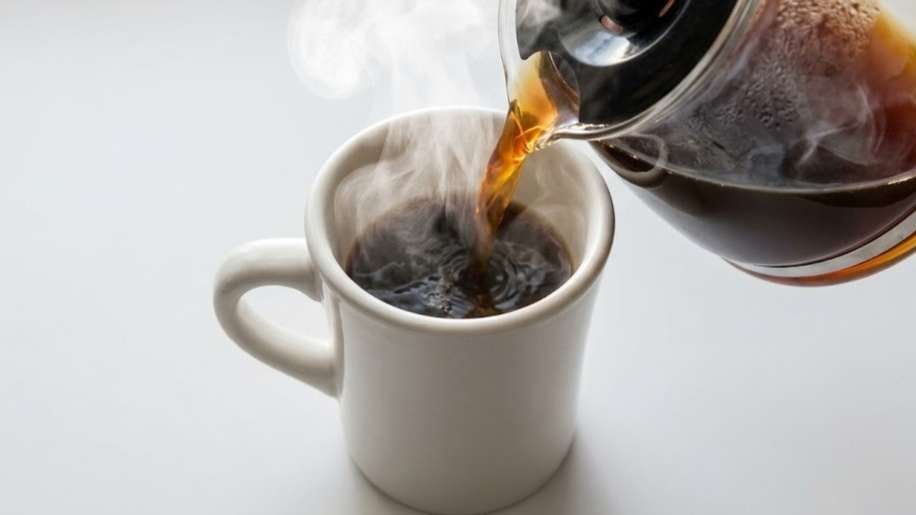
The first cup of diner coffee is honest. It tastes like what it is — hot, dark, slightly industrial, reliably caffeinated, and made for a person who needs to start their day, not contemplate it. The second cup is acceptable. The third cup you accept because it is offered and because the word “bottomless” operates on the American psyche the way “all-you-can-eat” does — as an invitation to test a principle.
The third cup is a different beverage. Not noticeably different in color, not dramatically different in smell. But different on the palate in a way that patients with a certain sensitivity to bitterness detect immediately and most people register subconsciously as “coffee I probably should have stopped at two.” The difference is chemical. The coffee you are drinking in that third cup has been sitting on a heating element at approximately 185 degrees Fahrenheit for somewhere between forty minutes and three hours, and what sustained heat does to brewed coffee is not gentle.
What Happens Inside the Urn
Coffee’s complexity at the moment of brewing involves hundreds of chemical compounds in transient balance. The compounds that matter most to bitterness are chlorogenic acids and their derivatives — specifically the chlorogenic acid lactones that form during roasting. Research published in the Journal of Agricultural and Food Chemistry has established that these lactones — caffeoylquinic acid lactones, primarily 3-CQL and 4-CQL — are among the key contributors to coffee bitterness, with bitter threshold levels that make them detectable at very low concentrations.
What sustained heat does is continue to drive these chemical reactions after brewing has stopped. Chlorogenic acids that survived the roasting process degrade further under heat. Their lactone derivatives undergo additional transformation, producing phenylindans — compounds with what sensory researchers describe as a harsh and lingering bitter taste profile, distinct from the cleaner bitterness of a freshly brewed cup. The UC Davis Coffee Center, which has published extensively on coffee chemistry, has established that brewed coffee degrades measurably with every minute it sits on heat. This is not subjective impression. It is a documented chemical process.
The compounds in the third cup are not the same compounds as the first cup. You are drinking a different beverage in a literal, molecular sense.
Bunn-O-Matic and the Architecture of the Bottomless Cup
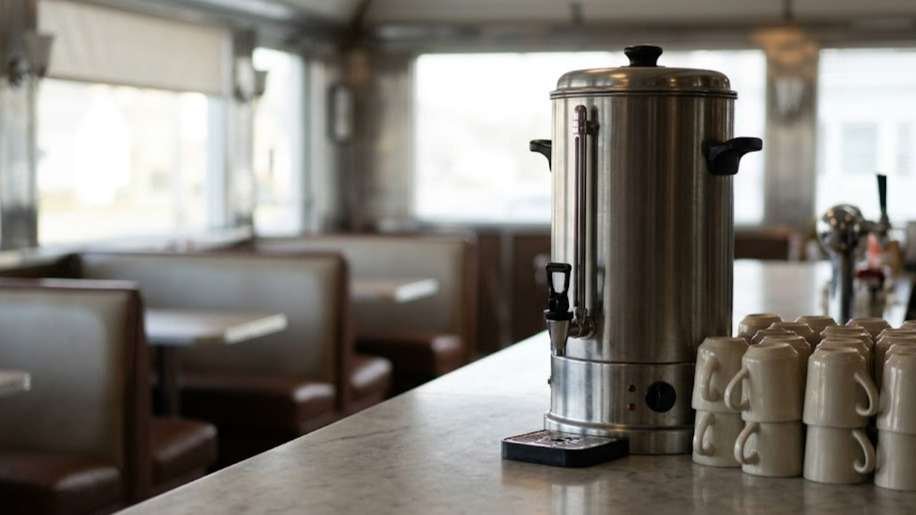
The commercial coffee urn that standardized the Long Island diner’s bottomless-cup service was not an accident of preference. It was an engineered solution to a specific commercial problem: how do you keep large volumes of brewed coffee available to a dining room full of people across a four-hour service window without the complexity of brewing to order?
Bunn-O-Matic Corporation, founded in 1957 in Springfield, Illinois, solved this problem with a commercial brewer that kept coffee at a precise holding temperature and enabled fast, consistent brewing cycles. By the late 1950s and through the 1960s, Bunn systems became the standard equipment in American diners, including the wave of Greek-owned diners that expanded across Long Island in that era. The economics were sound: one urn, maintained by a single counter person, could service an entire dining room without the labor complexity of individualized brewing.
The holding temperature — typically between 175°F and 185°F — was chosen for a reason. At those temperatures, coffee stays hot enough to be satisfying and doesn’t present scalding liability issues at the cup. What that temperature range also does is maintain the precise heat that accelerates the chemical degradation of brewed coffee most efficiently. It is, in terms of coffee quality, exactly the wrong temperature at which to hold a brewed beverage for an extended period.
The hot plate under a glass carafe operates on the same principle. It keeps the coffee warm. It also keeps it actively deteriorating.
The Bottomless Cup as Economics and Contradiction
The bottomless cup is a diner institution that makes economic sense at scale. A cup of diner coffee costs, in ingredient terms, almost nothing — the wholesale cost of commercial-grade coffee, measured in cents per ounce, is low enough that unlimited refills represent a meaningful hospitality gesture at negligible per-customer cost. The cup itself, the counter service, the refill labor — these are already priced into the margin structure of a diner plate. The coffee is the lubricant of the relationship.
Which makes it an interesting contradiction. The diner offers you unlimited coffee precisely because coffee is cheap. The coffee is cheap partly because it is purchased in large commercial quantities from suppliers who optimize for consistency and cost, not for cup quality. The holding system that makes the bottomless cup possible — the urn, the hot plate, the commercial brewer — actively degrades the product as the service window extends. The customer who arrives at 7 AM gets meaningfully better coffee than the customer who arrives at 10 AM, assuming the same batch, and neither customer necessarily knows this.
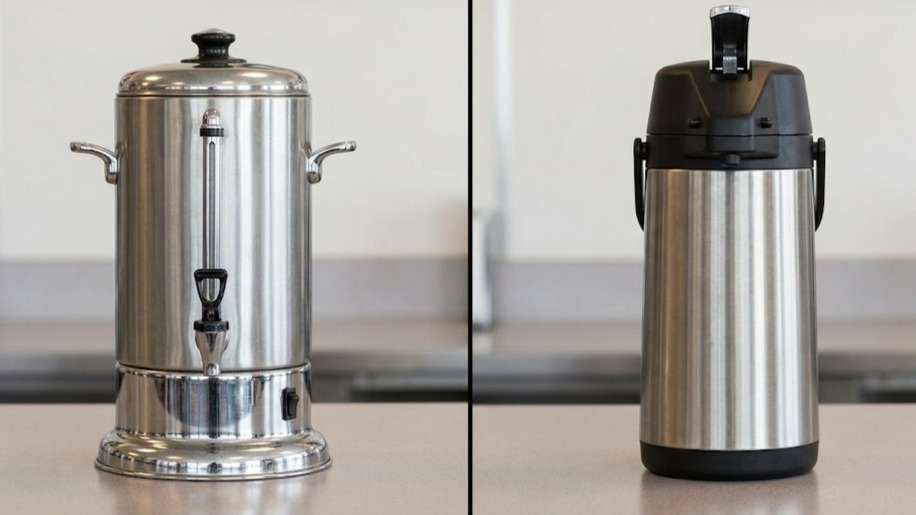
Some Long Island diners have moved to thermal carafes — vacuum-insulated servers that hold coffee without an active heat source. Thermal carafes do not prevent coffee degradation entirely — brewed coffee continues to oxidize and lose volatile aromatics even in an insulated environment — but they significantly slow the process by removing sustained heat from the equation. A coffee held in a thermal carafe for an hour degrades less than a coffee held on a hot plate at 185°F for the same period. The chemistry is not ambiguous on this point.
The trade-off is atmospheric. There is something about the diner urn — its stainless steel body, its spigot, its implicit promise of volume — that is inseparable from the experience of a Long Island diner. The thermal carafe is more practical and produces better coffee. It is also, in some hard-to-quantify way, slightly less of a diner. A counter person walking toward you with a thermal carafe is a server. A counter person walking toward you with the urn is an institution.
The Sensory Argument for the Upgrade
I’ve had coffee at Long Island diners where the upgrade had already happened, where someone — an owner who read enough or tasted enough or complained enough to themselves in the kitchen — had replaced the hot-plate setup with thermal systems and was brewing in smaller, fresher batches. The cup was genuinely better. Brighter. The bitterness was there — diner coffee is not specialty coffee and shouldn’t try to be — but it was the bitterness of the roast rather than the bitterness of sustained heat. The finish was clean rather than lingering.
I’ve also had coffee at diners where the urn had clearly been running since before the first customer sat down and would continue running until well after the last one left, and the third cup tasted like the inside of a warm metal container. Both experiences are authentically Long Island diner experiences. Only one of them is coffee.
The Heritage Diner breakfast platter is built around the assumption of a good cup of coffee alongside it — the coffee is not a secondary element, it is the frame around everything else on the plate. The eggs, the toast, the bacon, the home fries: these are the content. The coffee is the rhythm, the thing you return to between bites, the thing that signals the meal is still happening. When it degrades to institutional bitterness by the second refill, the meal degrades with it.
What the Third Cup Is Actually Telling You
The third cup of bottomless diner coffee, accepted out of politeness or habit or a genuine misunderstanding of what your palate is registering, is a small document on commercial food infrastructure. It tells you that the system was designed around availability, not quality. That the economic logic of the bottomless cup depends on the cost of the product being low enough that the customer never does the math. That sustained heat — 185°F across an extended service window — turns chlorogenic acid lactones into phenylindans in a process that is not reversible and not preventable without a fundamental change to the holding system.
It also tells you that the diner has not changed this, across most of Long Island, in seventy years. Not because diner owners don’t care. Because the cup is part of the atmosphere. Because the urn is part of the institution. Because the customer arriving at the counter expects to see it, and the coffee inside it tastes close enough to what coffee tastes like that the transaction completes without complaint.
James Beard had opinions about the club sandwich. Michael Sivetz, writing Coffee Technology in 1979, had opinions about what commercial coffee-holding systems do to brewed coffee. The chemistry has not changed. The urns have not changed. The refills keep coming.
The first cup is worth it. Order two.
You Might Also Like
- How to Build the Perfect Diner Breakfast Platter — Step-by-Step Assembly Guide
- The Classic New York Egg Cream: Chocolate, Seltzer, and Milk Done Right
- The Flour Beneath the Bread: What Goes Into a Proper Sourdough Loaf
Sources
- Journal of Agricultural and Food Chemistry, “Effect of Roasting on the Formation of Chlorogenic Acid Lactones in Coffee” (2005): pubs.acs.org
- ScienceDirect, “Selective enzymatic hydrolysis of chlorogenic acid lactones” — phenylindane bitter taste research: sciencedirect.com
- UC Davis Coffee Center: coffeecenter.ucdavis.edu
- Michael Sivetz, Coffee Technology (AVI Publishing, 1979)
- Bunn-O-Matic Corporation, founded 1957, Springfield, Illinois: bunn.com
- General Warfield’s Coffee, “Is Chlorogenic Acid in Coffee Healthy?”: generalwarfieldscoffee.com
- Tandfonline, “Acids in coffee: A review of sensory measurements” (2021): tandfonline.com