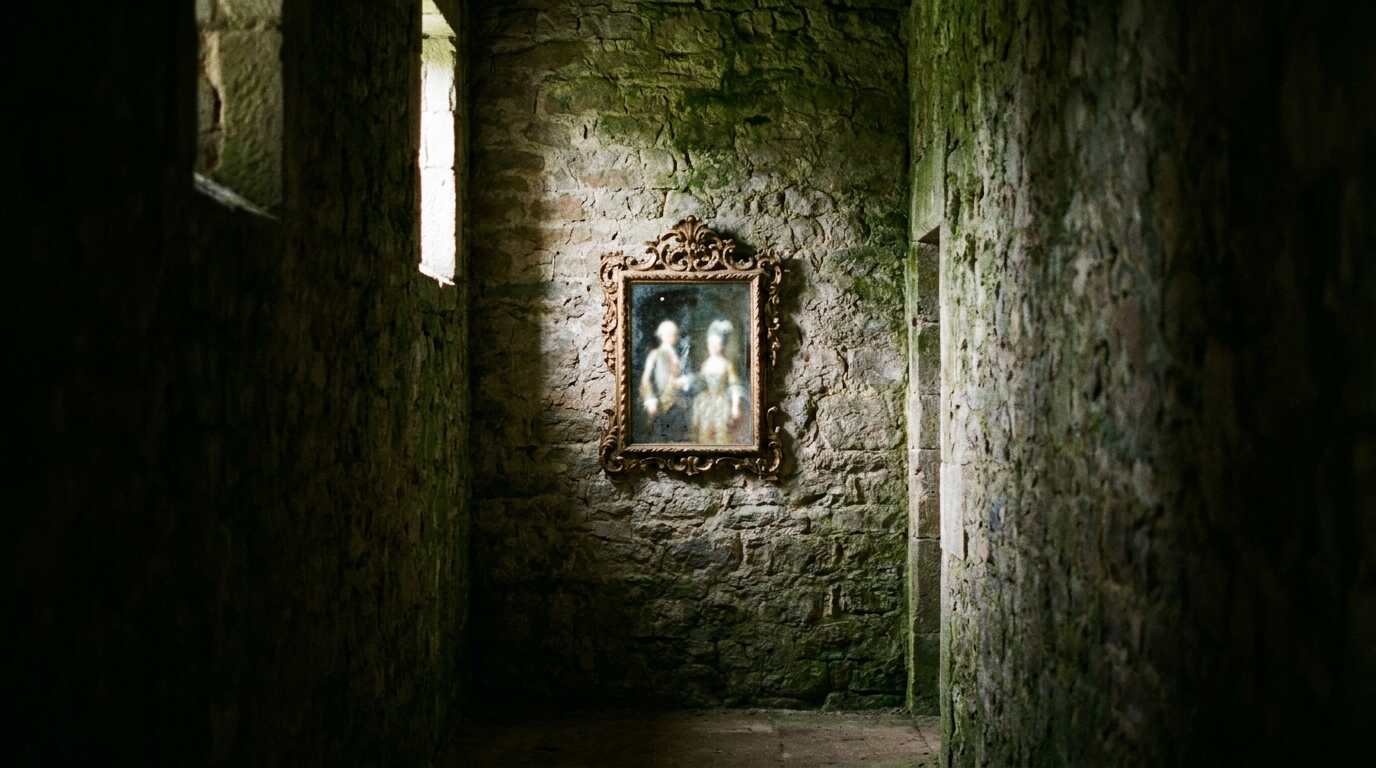
Every art history class mentions chiaroscuro. Almost none of them explain what Caravaggio was actually doing with it — or why it was so destabilizing.
The standard treatment goes like this: light contrasts with dark, the drama is theatrical, the effect is cinematic. True enough. But if that’s all you take away from standing in front of The Calling of Saint Matthew or Judith Beheading Holofernes, you’ve seen the surface and missed the argument underneath it. Caravaggio wasn’t decorating scenes with shadow. He was using darkness the way a prosecutor uses silence — to make something impossible to ignore.
What Chiaroscuro Actually Means (And What People Get Wrong About It)
The word breaks down cleanly. Chiaro — light, clear. Scuro — dark, obscure. Italian painters had been working with the interplay of light and shadow since the Renaissance. Leonardo used it to model volume, to give faces the illusion of three-dimensional form. That’s chiaroscuro in its foundational sense: light as a sculpting tool.
Caravaggio took it somewhere else entirely.
What he developed — and what art historians eventually named tenebrism, from the Italian tenebroso, meaning gloomy or dark — is chiaroscuro turned up to a level where shadow stops being background and becomes an active force. Near-black backgrounds. Figures illuminated as though a single spotlight has been turned on them in an otherwise lightless room. The darkness isn’t just what the light hasn’t reached. It’s what the painting has chosen not to show you. That distinction matters.
Leonardo’s light transitions gradually. It breathes. In Caravaggio, the edge between light and dark is a hard cut. There’s no elegant graduation. You’re either in it or you’re not.
How Caravaggio Used Light as a Narrative Tool
Look at The Calling of Saint Matthew (1600, Contarelli Chapel, Rome). Christ enters from the right with a companion, his arm extended, a beam of light falling diagonally across a table of tax collectors. Matthew sits there — whether he’s actually Matthew has been debated for centuries — and the light hits him. His companions, to varying degrees, fall into shadow.
The light picks the story’s subject. Not the architecture. Not the whole room. Just this man, at this moment, being singled out.
This is light operating as theological argument. In religious painting before Caravaggio, divine presence was typically communicated through halos, golden backgrounds, or elevated composition — conventional codes the viewer had learned to read. Caravaggio abolished almost all of that. No halos here. The light just arrives, the way a life change arrives: without warning, not particularly dignified, in the middle of an ordinary day.
The genius of this is that it’s formally indistinguishable from natural light. It looks like late afternoon sun cutting through a high window. But it functions as the hand of God. Caravaggio collapsed the sacred and the everyday into a single light source and refused to explain which was which. That ambiguity is the whole point.
The Violence Underneath the Technique
Judith Beheading Holofernes (c. 1598–1599, Galleria Nazionale d’Arte Antica, Rome). Judith’s face is concentrated, slightly disgusted. The general’s face has already gone slack. The maidservant watches from the shadow with an expression that reads as grim familiarity. The act is in progress — not symbolic, not finished. In progress.
The light falls on Judith’s white sleeves. On the blade. On Holofernes’ grimacing face. The dark pulls everything else away.
Here’s what Caravaggio understood that others didn’t: moral weight attaches to what you illuminate. To put the blade and the expression and the blood all in the same pool of light is to force the viewer to look at the physics of violence — the actual labor of it — rather than the narrative abstraction. Earlier treatments of this scene made it heroic, distant, allegorical. Caravaggio made it local. You can’t aestheticize it when the light keeps dragging your eye back to exactly what’s happening.
The darkness doesn’t soften anything. It isolates what matters and makes you stay with it.
That’s not a stylistic choice. That’s an argument about how to see.
Why Other Painters Couldn’t Just Copy What He Did
They tried. The Caravaggisti — his followers and imitators across Italy and Spain — replicated the dark backgrounds, the dramatic illumination, the street-level models. Some of them did it with real skill. But most of them got the technique without the intention, and the gap shows.
As the art blog ArtGeek has noted, the distinction between chiaroscuro and tenebrism is not merely technical — it involves inferring the artist’s intent from the way light is deployed compositionally. That’s precisely the problem for Caravaggio’s imitators. They could reproduce the contrast ratio. They couldn’t reproduce the moral logic.
Caravaggio’s light always lands on something the painting needs you to confront. The light is never incidental. With his followers, the dramatic shadow often becomes atmosphere — a mood, a look, a marketable style. The stakes drop.
What made Caravaggio’s technique irrecoverable by imitation was that it grew from a particular way of seeing human beings — as physical, flawed, capable of both degradation and dignity, deserving of direct attention rather than idealized distance. That’s a philosophical position, not a painting trick. You can copy the technique without holding the position, but the work doesn’t lie. You can tell the difference.
What to Look For When You’re Standing in Front of a Caravaggio
Most people scan. They take in the composition, register the drama, move on. Here’s a different approach.
Find the edge. Not the illuminated figure — the border where the light stops. In a Caravaggio, that border is doing work. Ask what it’s choosing to leave in darkness. Then ask whether that exclusion is neutral or whether it’s a judgment.
In The Supper at Emmaus (1601, National Gallery, London), the disciples are in the light. The innkeeper standing between them is lit too, but his face is ordinary, unseeing. He doesn’t recognize Christ. The light hits him and does nothing, because he doesn’t know what he’s looking at. That’s a painting that uses light to distinguish between people in the same room who are experiencing fundamentally different realities. Same light source. Different illumination in the deeper sense.
Look also at the models. Caravaggio used people off the street — laborers, prostitutes, the kind of faces that had never appeared in religious painting before. Their hands are dirty. Their feet are dirty. They look like the people outside the church, not the saints inside it. Putting those faces in the light of a divine narrative was a deliberate provocation. The church didn’t always love it. Several commissions were rejected.
He painted what he thought was actually true about the world: that the sacred, if it showed up, would show up for regular people, in regular settings, wearing regular clothes. The chiaroscuro wasn’t the argument. It was the delivery mechanism.
If you want more on how light functions as meaning in Baroque painting, I wrote about Caravaggio’s treatment of the Saint Matthew calling in an earlier post — Caravaggio’s The Calling of Saint Matthew — When Divine Light Walked Into a Tax Office — which goes deeper into that specific work. And for a Spanish painter working in the shadow of the same tradition, El Greco’s View of Toledo takes the chiaroscuro tradition somewhere stranger.
Sources
– The Calling of Saint Matthew (1600) — Contarelli Chapel, San Luigi dei Francesi, Rome: Web Gallery of Art – Judith Beheading Holofernes (c. 1598–1599) — Galleria Nazionale d’Arte Antica, Rome – The Supper at Emmaus (1601) — National Gallery, London: nationalgallery.org.uk – Chiaroscuro and Sfumato — The Art Story: theartstory.org – Wikipedia: Chiaroscuro: en.wikipedia.org/wiki/Chiaroscuro – ArtGeek: Is it Chiaroscuro or Tenebrism?: blog.artgeek.io – Setdart Magazine: Chiaroscuro in Baroque Painting: blog.setdart.com