 275 Route 25A, Mt Sinai, NY 11766


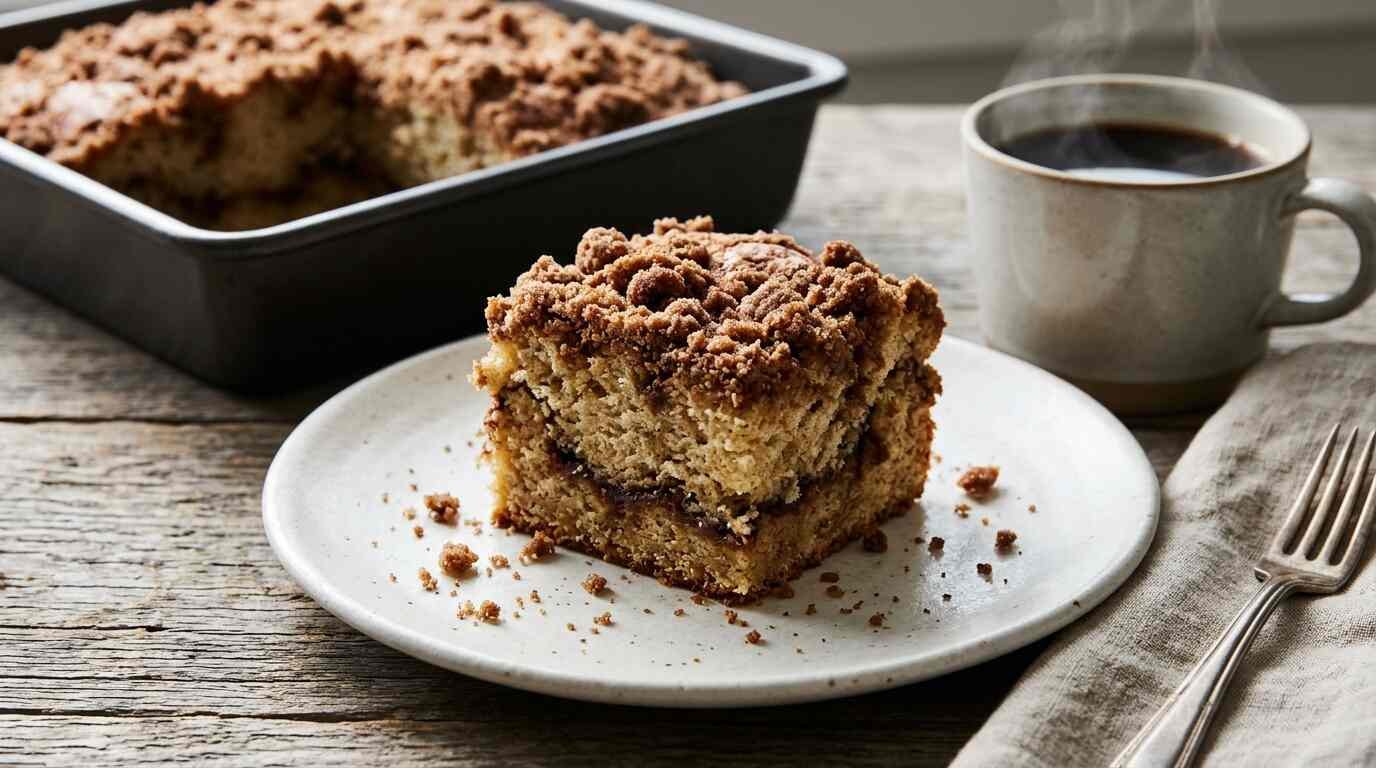
In the United States, coffee cake is a sweet bread or single-layer cake meant to be eaten with coffee, and as a rule it contains none, according to the Wikipedia entry on American coffee cake). Across much of the rest of the world the same two words describe a cake flavored with coffee, which is why a British tea table and an American church-hall buffet can hold two unrelated cakes under one name.
Video: a streusel-infused sour cream coffee cake, baked on The Food Charlatan’s YouTube channel.
The confusion has a simple source. The name was never a recipe note. It was a seating arrangement: the cake that sits beside the cup. Where it came from, who baked it first, and when sour cream and crumbs entered the picture are harder questions, and the published answers disagree with one another more than most food writing admits.
Why Coffee Cake Has No Coffee in It
The name describes a place at the table, not an ingredient
A food-and-drink article at Sprudge puts the matter plainly: the cake is named for what it accompanies, and coffee does not have to be inside it. The Takeout draws the same line between countries. American coffee cake has no coffee; the British version is built from coffee-flavored sponge, coffee buttercream and a walnut topping, and is served at afternoon tea.
Older American recipes complicate the tidy story. CooksInfo reports that Fannie Farmer’s 1896 Boston Cooking-School Cook Book lists three recipes called coffee cake, and that two of them call for coffee, in spiced, fruit-studded batters, one enriched with brandy. The third, a glazed sweet brioche flavored with lemon or cardamom, contains none. The CooksInfo entry on coffee cake concludes that early recipes under the name often did contain coffee and that the name no longer implies it. The Wikipedia entry offers a related explanation, that nineteenth-century American cooks used leftover coffee as an ingredient to cut waste and add flavor.
Even now the definition shifts by region. Perfect Daily Grind notes that some places accept any cake eaten with coffee while others expect coffee in the cake itself. Both usages are current, and neither is a mistake.
The slot in the day where the American version lands, the late-morning meal built around eggs and pastry, carries a contested history of its own, traced in a Heritage Diner piece on how brunch began as Oxford slang.
Kaffee und Kuchen: The German Afternoon
Coffee and cake as a fixed hour
In Germany the pairing is a custom with a clock attached. The Local describes Kaffee und Kuchen as a mid-afternoon habit, usually between three and four o’clock, taken with colleagues, friends or family. It dates the practice to the seventeenth century, when coffee first arrived in Germany and only the aristocracy could afford it, and says that by the nineteenth century the price had fallen far enough for it to become a cultural staple.
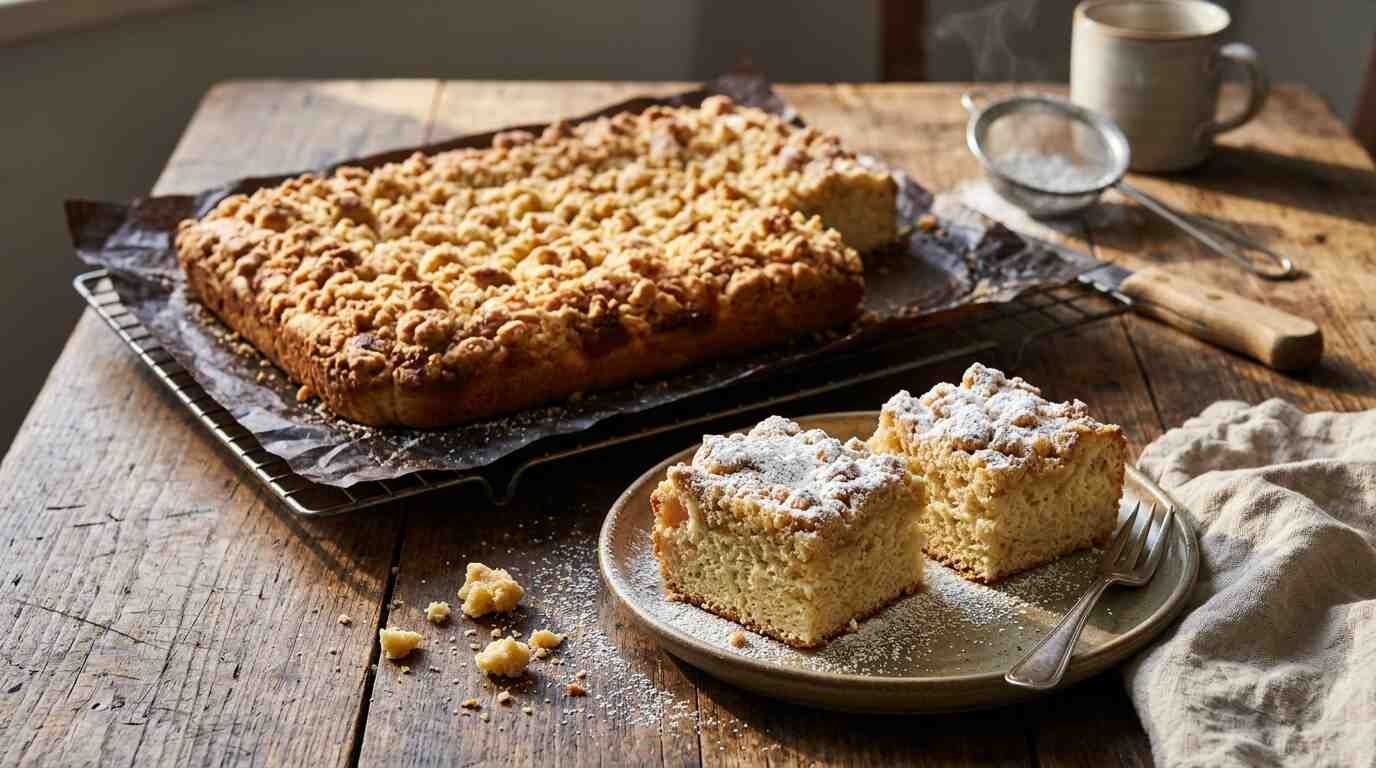
The cakes on that table are a long list: Black Forest cherry torte, Bienenstich, Baumkuchen, Frankfurter Kranz, Stollen. A separate piece at Germany Footsteps adds Streuselkuchen, apple cake and cheesecake. Of these, Streuselkuchen is the direct ancestor of the American crumb-topped coffee cake, and it has the better paper trail.
German Wikipedia’s article on Streuselkuchen gives the earliest known record as 1584, in a broadsheet by Kaspar Füger, where two farmers from Meissen mention eating something called “Christwecken oder Streusselen.” The cake is often credited to Silesia, but the same article states that no written evidence supports that, and points to Upper Saxony as the likelier origin. The cake was widely baked in Silesia and the neighboring Prussian provinces during the nineteenth century, and regional names multiplied: Riwwelkuchen in the Palatinate and southern Hesse, and in the Rhineland a name that translates as funeral cake, from its place at post-funeral meals.
A second German word turns up early. The Wikipedia entry on American coffee cake cites a 1763 German text that mentions the gugelhupf, the tall, ring-shaped yeast cake, as the earliest reference in its chain of evidence.
Germany, Austria, Denmark: Who Claims the Cake
Three countries, no document that settles it
Sprudge names Germany, Austria and Denmark as the countries that lay claim to coffee cake, and places its likely beginning in northern or central Europe in the seventeenth century, roughly a century after coffee reached the continent. The Wikipedia entry is hedged in the same way, saying northern and central Europeans are “thought to have” begun eating sweet cakes with coffee in that century and tracing the American cake to sweet dishes from Vienna.
Each claimant has a different story. Perfect Daily Grind says it is believed that Germany was the first country to pair coffee with cake, pointing to coffeehouses that spread through Hamburg, Dresden, Nuremberg and Berlin by the mid-1600s. It also describes the Nordic coffee-and-cake habit, from Swedish fika to Danish brunsviger, as long-standing but gives it no start date, and it reports that Nordic countries call their sweet yeast pastry “Viennese bread,” a name that points back toward Vienna without proving anything. The article itself concedes that the history is less straightforward than it looks.
A Danish-American bakery, O&H Danish Bakery, offers yet another version on its blog: that the earliest forms were sweet yeast breads called “Kaffee kuchen” eaten with coffee in Dresden, while the Danes popularized pairing sweet pastry with coffee. None of those statements carries a citation, and the page is part of a bakery’s own marketing, so it counts as a claim and not as evidence.
CooksInfo, for its part, skips Europe and describes coffee cake as a North American development, built from sweetened bread recipes that Germans and Scandinavians brought over. The more cautious reading holds all of this at arm’s length. A pairing as natural as coffee and something sweet probably arose in several kitchens, and the written record is too thin to crown one of them.
From Kuchen to Coffeecake in America
Immigrant bakers, Pennsylvania manuscripts and a changing recipe
Mass German migration to the United States began in the 1840s, and baking terms and coffee habits came with it, according to a history of the sour cream coffeecake on Tori Avey’s site. The same page says Streuselkuchen began appearing in Pennsylvania manuscripts in the 1860s, that C.F. Pfau’s 1887 A Book of Cooking and Pastry is the first American cookbook record of “streusel,” and that Bertha Kramer’s 1889 Aunt Babette’s Cook Book separates chemically leavened cakes from yeast-raised “Coffeecakes.” Those “first” claims are the site author’s reading of the cookbooks she cites, and the page does not prove them.
The earliest recipes were bread in everything but name: yeast, flour, dried fruit and sweet spice, per the Wikipedia entry. They were close cousins of the yeasted sweet doughs still baked today, such as the pan-caramelized sticky buns that Heritage Diner published last month. Over time cheese, sugared fruit, yogurt and sour cream went in, and the structure moved from bread toward a denser cake.
Dating the phrase itself produces another small dispute. Wikipedia points to an 1850 appearance of “coffee cake” in a book called The Gift, while CooksInfo says the term was in popular use by the 1880s. These are compatible: a rare early use and a common later one. Perfect Daily Grind adds that by the 1920s American coffee cake had its own recipe headings, and cookbooks devoted to it were published in the late 1960s.
Cincinnati has made the most public bid for the cake in America. Wikipedia reports that several food writers have called the city the coffeecake capital of the world, a title linked to its heavy German immigration. That is a claim about reputation, repeated by journalists, and it is not a ruling on where the cake began.
The American Sour Cream Crumb Version
How a pantry acid and a refrigerated tub changed the batter
Sour cream coffee cake looks like an ancient recipe and is a fairly recent one. The Avey history says that in the early 1800s American cooks discovered clabbered cream, commonly called sour cream then, reacted with pearlash and baking soda, and that Eliza Leslie’s 1828 cookbook noted sour cream beat sweet cream for her cream cakes. The chemistry is the same one used today. Acid in sour cream activates baking soda, which lifts the batter, and it also adds tartness and a tender, moist crumb, as the Wikipedia entry on American coffee cake explains.
Credit for the modern version is where the sources split. Wikipedia, citing the Avey page, says that pasteurization reaching America after World War I produced a new type, sour cream coffee cake. Avey’s own account is slightly different: pasteurization largely eliminated old-fashioned clabber, and commercial cultured sour cream took over in baking. Sprudge ties the rise of sour cream to refrigerated grocery sections, and dates German migration to the late nineteenth and early twentieth centuries. No source here shows a single inventor or a single year.
The printed milestones are firmer. According to Avey, Irma Rombauer’s 1939 Streamlined Cooking carried an early “Sour Cream Coffee Cake,” and the recipe reached her Joy of Cooking in the 1941 edition. The same page notes that the cake was sometimes called “Russian coffeecake,” though it does not say why.
Streusel Structure and a Short Technique
Three ingredients, one ratio, and a warning about warm butter
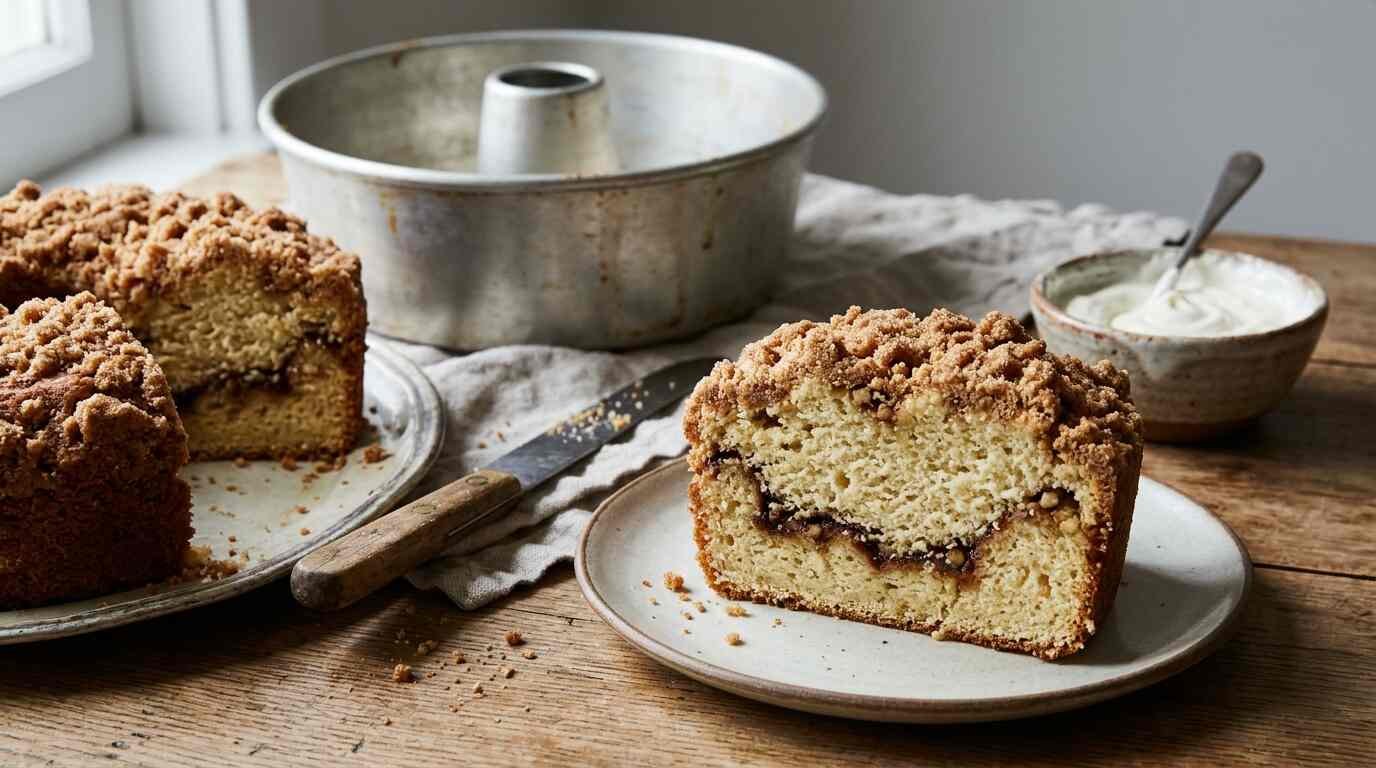
The word comes from German streuen, to strew or scatter, and names a crumbly mixture of butter, flour and sugar, per Wikipedia’s Streusel entry. In the American coffee cake it is scattered over the batter, and in many versions it is also layered or ribboned through the middle, so that the cake has a stripe of crumbs inside as well as a crust of them on top. The American crumb cake is a close relative, with more topping and a thinner base, and the Wikipedia entry on American coffee cake says it resembles the German Streuselkuchen.
German practice supplies a ratio. The Streuselkuchen article gives streusel as sugar, fat and flour in a 1:1:2 proportion, laid over a flat yeast dough that is dampened first, with water, milk, cream, egg wash or jam, so the crumbs stick. It is baked at about 220 degrees Celsius until roughly two-thirds done, then finished with powdered sugar or glaze. Under German food guidelines quoted there, a butter streusel cake needs at least 30 parts butter per 100 parts flour and starch across dough and topping, and no other fat.
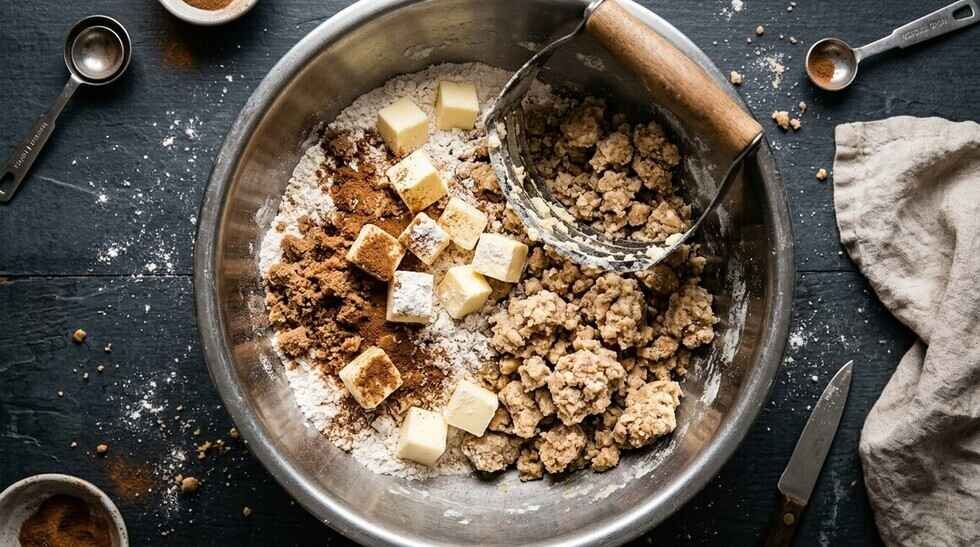
Technique comes down to how the butter enters. Preppy Kitchen describes two routes. Melted and cooled butter stirred into the dry ingredients with a fork forms large, uneven clumps quickly. Cold diced butter worked into the flour and sugar by hand or with a pastry cutter yields crumbs about the size of a dime. Butter that is still warm melts the sugar and gives a paste in place of crumbs. The site’s own version uses about 150 grams of flour, 110 grams of packed light brown sugar, 50 grams of granulated sugar, cinnamon, salt and 113 grams of butter, with the finished topping chilled until the batter is ready, and it reports that brown sugar brings moisture and a molasses flavor to the mix.
Browning is the last variable. The sugar and butter in the topping darken by the same chemistry that colors a diner flat-top, which is covered in the Heritage Diner piece on the Maillard reaction and the griddle. Clumps that sit proud of the batter brown deeply; those pressed in stay pale and soft. Both textures show up in a good slice.
Sources
- Wikipedia, “Coffee cake (American)”: https://en.wikipedia.org/wiki/Coffee_cake_(American)
- Wikipedia, “Streusel”: https://en.wikipedia.org/wiki/Streusel
- Wikipedia (German), “Streuselkuchen”: https://de.wikipedia.org/wiki/Streuselkuchen
- Sprudge, “Why Is It Called Coffee Cake?”: https://sprudge.com/why-is-it-called-coffee-cake-176802.html
- The Takeout, “Does Coffee Cake Actually Contain Any Coffee?”: https://www.thetakeout.com/1801274/is-coffee-in-coffee-cake/
- CooksInfo, “Coffee Cake”: https://www.cooksinfo.com/coffee-cake
- Perfect Daily Grind, “What Is Coffee Cake?”: https://perfectdailygrind.com/2022/04/exploring-the-history-of-coffee-cake/
- The Local (Germany), “Kaffee und Kuchen: a very German tradition”: https://www.thelocal.de/20200902/kaffee-und-kuchen-a-very-german-tradition
- Germany Footsteps, “All About Kaffee & Kuchen”: https://germanyfootsteps.com/kaffee-and-kuchen/
- O&H Danish Bakery, “The History of Coffee Cake”: https://www.ohdanishbakery.com/hygge-blog/dessert-guide/history-of-coffee-cake
- Tori Avey, “Sour Cream Coffeecake History & Recipe”: https://toriavey.com/sour-cream-coffeecake-history-recipe/
- Preppy Kitchen, “Streusel”: https://preppykitchen.com/streusel/
- The Food Charlatan, “Streusel-Infused Sour Cream Coffee Cake!” (YouTube): https://www.youtube.com/watch?v=Shgr3i5IJd4
Leave a Reply