Cold cheese pizza didn’t arrive on Long Island through a Michelin-starred kitchen or a celebrity chef’s creative epiphany. It arrived the same way most great food traditions do — carried in the back pocket of a broke, hungry college kid who missed something from somewhere else and asked a local pizzaiolo to just try it.
That’s the honest origin story. And on the North Shore, where Route 25A threads through towns filled with universities, dive bars, and late-night legends, that story has found some of its most devoted chapters.
Born in Oneonta, Carried Home to Long Island
The cold cheese slice traces its roots to a small upstate New York college town, where SUNY Oneonta and Hartwick College students made up a substantial portion of the nocturnal foot traffic. At Tino’s Pizza on Main Street in Oneonta, the cold cheese slice was born in the 1980s out of the late-night post-bar ritual of students descending en masse after last call, forcing the shop to funnel pies straight from the oven into the hands of hungry undergrads.
The mechanics were entirely practical. Tino Garufi, owner of Tino’s, explains it plainly: “The line would form so long and we were selling the pizza so fast — once it was coming out of the oven, the pizza was already being sold. It was piping hot. It was being cut and then onto a plate, and then they were eating it.” His father’s solution was to throw a handful of cold mozzarella on top of a freshly cut slice. What happened next surprised everyone. The slice didn’t just become tolerable — it became transcendent.
The first request, according to Tino Jr., came from a customer at the counter who asked for cold mozzarella on top because the pizza was too hot to eat right away. Thinking it a little strange, Tino Sr. shrugged and complied, tossing a handful of cold cheese on top. Within months, the cold cheese slice had a following. Within a few years, it had a cult.
The migration south to Long Island followed the natural circuit of college life. Kids went upstate, discovered cold cheese, and when they came home for breaks or graduated back to the Island, they wanted what they’d had. Dan Rossi, manager of Little Vincent’s in Huntington, introduced cold cheese to his shop in 1985 when college students returning home from Oneonta waxed poetic about their experience. He decided to give them what they wanted. He didn’t know what he was starting.
Little Vincent’s and the Huntington Late-Night Rite
Pull up to Little Vincent’s Pizza at 329 New York Avenue in Huntington on a Friday night after midnight and you’ll understand what the word “institution” actually means in the context of food culture. Cash only. No decor to speak of. A menu so stripped down it’s almost philosophical. And a line that tells you everything you need to know about what Long Island tastes like at 1 a.m.
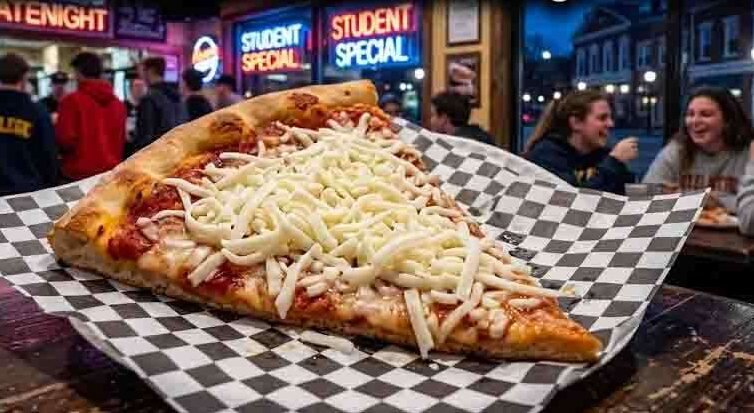
Little Vincent’s “Cold Cheese Slice” earned a spot on The Daily Meal’s 101 Best Pizzas in America for 2018, ranking at number 69. The slice offers three distinct textures of cheese simultaneously: hot and melted, warm and beginning to melt, and cold, unmelted, refreshing mozzarella. For a slice of pizza to earn national recognition based on an act as simple as adding cold cheese, the base has to be exceptional. And Little Vincent’s base is exceptional — thin, crispy on the bottom, the sauce carrying just enough acidity to cut through the fat of the cheese.
Visit Little Vincent’s on a Friday or Saturday night and the pizza of choice may overwhelmingly be cold cheese. The Huntington location stays open until 2 a.m. on weekdays and 4 a.m. on weekends, which tells you everything about its primary constituency. Stony Brook University students, Hofstra alumni, weekend revelers from across Suffolk County — they all find their way here eventually. As one local reviewer put it: “This is to Huntington as Joe’s Pizza is to the West Village.”
That comparison is not hyperbole. It is provable geography.
The Science of the Temperature Contrast
To dismiss cold cheese pizza as a drunk-food gimmick is to misunderstand what’s actually happening in your mouth when the combination works. There is a legitimate culinary principle at play here, and it deserves examination.
Heat activates fat. A hot slice of pizza pulls the oils from the mozzarella to the surface, creating that familiar grease slick on a paper plate. When cold cheese lands on top of a hot slice, it does three things simultaneously: it absorbs excess surface oil, it dramatically slows the heat transfer to your palate, and it introduces a textural architecture that a standard slice simply cannot offer.
As Rossi explains it: “It’s a different texture, a different feel. You get the warm and cold at the same time. The pizza isn’t even supposed to be too hot. If it’s too hot it’s melting the cheese and then you lose the texture.” That last point is critical. The window of perfection for a cold cheese slice is narrow. Too hot and the cold cheese capitulates, collapsing into the melted layer below and losing its identity. Too cold and the base goes limp. The ideal cold cheese slice is a study in controlled contrasts — a hot-but-not-scalding base meeting cold-but-not-refrigerator-stiff mozzarella.
The result is three distinct flavor and texture phases in a single bite: the cool, fresh snap of cold mozzarella; the warm, melted layer below; and the crisp, sauced crust providing structure at the bottom. It is, in its own unassuming way, layered cooking.
The North Shore Circuit: Where the Slice Travels
Beyond Huntington, the cold cheese phenomenon has spread quietly across Long Island’s late-night landscape, following the geography of bars, campuses, and the particular insomnia that comes with being twenty-two years old on a Saturday night.
The slice is available at Little Vincent’s locations in both Huntington and Ronkonkoma, Rosa’s Pizza in Huntington, and ZA Late Night Pizzeria in Rockville Centre — and the late-night crowds keep coming. In Stony Brook, Cataffo’s Pizza has acknowledged the upstate origins of the slice. Al Fortina, part owner of Cataffo’s Pizza in Stony Brook, puts it plainly: “I know it’s an upstate thing.” That kind of intellectual honesty about provenance is rare in the food world and worth respecting.
On Fire Island — which operates on its own temporal logic entirely — Town Pizza in Ocean Beach serves cold cheese, and regulars recommend ordering it with their boom boom sauce. An employee there estimated that more than 60 percent of late-night customers order the cold cheese slice. In a business built on serving summer crowds who’ve been in the sun and the bars all day, that number makes complete sense.
The cold cheese slice thrives wherever three conditions converge: a good base pizza, a late-night crowd with lowered inhibitions about trying something unusual, and a pizzeria with the institutional confidence to keep cold shredded mozzarella behind the counter as a standard operating supply. On the North Shore, those conditions are remarkably common.
Why Cult Foods Survive When Everything Else Doesn’t
There is a deeper pattern in the cold cheese story that food historians and restaurant industry veterans recognize immediately. The foods that achieve cult status — the dishes that outlast trends, survive decades of culinary fashion cycles, and still draw lines at midnight — are almost never the products of marketing or innovation labs. They emerge from necessity, from improvisation, from the unglamorous intersection of hunger and circumstance.
Despite its growing recognition, cold cheese pizza has largely remained a small-town fixture, failing to penetrate the major urban markets that typically drive national food trends. That is not a weakness. That is the source of its power. Scarcity and geography create pilgrimage. You don’t stumble into a cold cheese slice at a national chain. You have to know where to go. And knowing where to go — being the person in your friend group who knows about Little Vincent’s, who remembers the Tino’s trip from sophomore year — is a form of cultural capital that no amount of advertising can manufacture.
This is the distinction between a menu item and a food legend. A menu item can be replicated and franchised. A food legend is embedded in a specific geography, a specific era, a specific set of conditions that produced it. Cold cheese pizza belongs to upstate New York, to Long Island’s late-night hours, to the particular intersection of college towns and pizza ovens and people who weren’t yet willing to let the night end.
The restaurants that understand this — that understand why their particular version of a thing matters and resist the urge to dilute it — are the ones that survive. Long Island’s cold cheese adherents are operating on exactly that principle, whether they’ve articulated it that way or not.
The Proper Way to Order
A few operational notes, because the cold cheese slice rewards the informed eater.
First, the base matters enormously. The cold cheese slice works best when the base pizza is already excellent. Do not attempt to construct a cold cheese experience on a mediocre foundation. You will be disappointed, and the cold cheese will take the blame for sins it did not commit.
Second, if you’re taking your slice to go, get the cold cheese on the side. Cold cheese ordered on top of a take-out pizza will melt by the time you reach your destination, leaving a giant cheese mess. Get it on the side and add it yourself later.
Third, fold the slice before eating. The fold concentrates the cold cheese in the center crease and prevents the mozzarella from cascading off the sides before you’ve had a chance to experience the full textural stack.
Finally, manage your heat expectations. The slice should be fresh from the oven but given thirty seconds to settle before the cold cheese goes on. The goal is a hot base, not a molten one. Get that window right and you’ll understand why the lines form at midnight.
The cold cheese pizza is, at its core, an accident that became a tradition — the kind of happy accident that only happens when someone is paying attention, when the right person behind a counter takes an unusual request seriously instead of dismissing it. From Tino’s on Main Street in Oneonta to Little Vincent’s on New York Avenue in Huntington, the slice has traveled the way real food culture always travels: person to person, town to town, one late night at a time.
It is not trying to be elevated cuisine. It does not need to be. What it is — a hot, crispy, impeccably sauced slice wearing a crown of cold mozzarella at two in the morning — is already exactly enough.
Sources
- The Daily Meal — Little Vincent’s Cold Cheese Slice (2010): https://www.thedailymeal.com/little-vincents-cold-cheese-slice/
- InsideHook — Oneonta’s Cold-Cheese Pizza is the Holy Grail of Drunk Food (2021): https://www.insidehook.com/food-new-york/cold-cheese-pizza-oneonta
- Tasting Table — Cold Cheese Pizza: The Lesser-Known New York Slice You Should Try (2023): https://www.tastingtable.com/1194862/cold-cheese-pizza-the-lesser-known-new-york-slice-you-should-try/
- Long Island Press — The Big Chill: Cold Cheese Pizza Craze Heats Up (2013): https://www.longislandpress.com/2013/10/04/the-big-chill-cold-cheese-pizza-craze-heats-up/
- Foodigenous — Not Cold Pizza, It’s Cold Cheese Pizza (2021): https://www.foodigenous.com/post/not-cold-pizza-it-s-cold-cheese-pizza
- Brentwood Daily Voice — Huntington’s Little Vincent’s Known For Cold Cheese Pizza, Late Hours (2019): https://dailyvoice.com/ny/brentwood/lifestyle/huntingtons-little-vincents-known-for-cold-cheese-pizza-late-hours/770945/