Hume finished this book in 1776 and then refused to publish it. He died that same year, and it came out three years later, over the objections of everyone around him who worried it would destroy his reputation. Three years posthumous, and it still felt too hot to hand people.
That tells you something. Not about the book’s radicalism — though it is radical — but about the nature of the question it asks. Whether God exists is one of those questions that, when you really press it, makes people nervous. Not because the answer is obvious in either direction. Because it isn’t. Because Hume understood that, and most people don’t want to sit with that discomfort long enough to think it through.
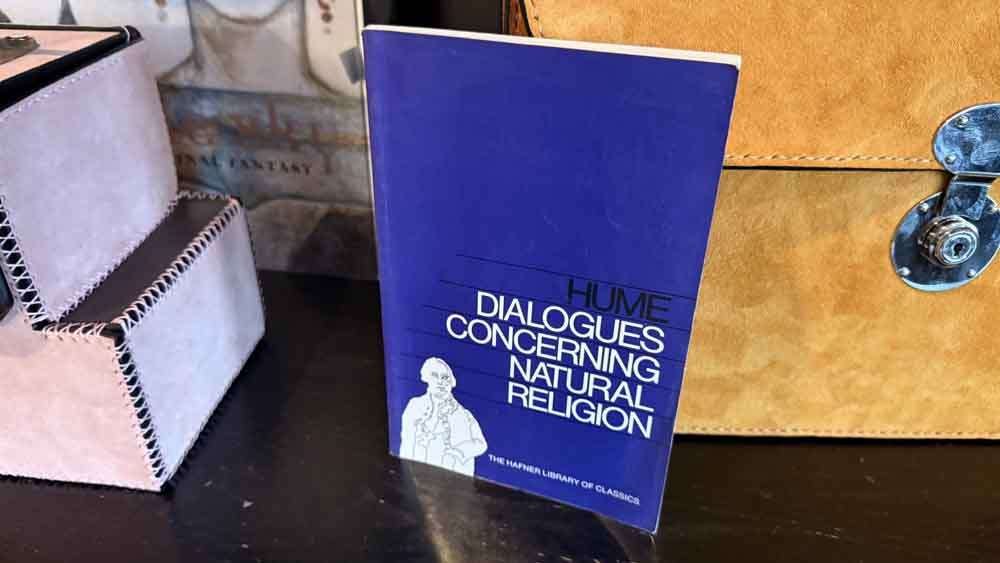
I read this in the Hafner Library of Classics edition — a little blue paperback that’s been on my shelf long enough to have earned its cracked spine. The image on the cover is a small illustration of Hume himself, arms folded, looking like a man who has heard your argument before and isn’t impressed. Fair enough.
What the Book Actually Is
The Dialogues are a philosophical conversation between three characters: Cleanthes, who argues that God’s existence can be reasoned out from the design we observe in nature; Demea, who holds that God is beyond human reason entirely; and Philo, the skeptic, who dismantles everything both of them say with the kind of precision that makes you want to close the book and go for a walk.
The dialogue form is not a dodge. Hume wasn’t hiding behind fictional characters to avoid responsibility for the arguments — he was staging a genuine intellectual contest. He lets each position breathe. Cleanthes makes a serious case. But Philo — widely understood to be Hume’s own voice — is the one who takes the whole structure apart at the foundation.
The argument Cleanthes leans on is what philosophers call the argument from design. Nature is so ordered, so intricate, so apparently purposeful, that it must have had a designer. A watch implies a watchmaker. An eye implies something that intended eyes to see. He’s not inventing this — it’s one of the oldest theological arguments in Western philosophy, and it had real weight for centuries. It still has real weight in plenty of pews and living rooms today.
Philo’s response is elegant and brutal. He doesn’t deny that nature is complex. He denies that complexity implies intention. Order can arise from other sources. Repetition, selection, time — these can produce the appearance of design without any designer behind the curtain.
The Darwin Problem — or Rather, Hume’s Problem With Darwin’s Timing
Here is what stops me cold every time I come back to this book: Hume wrote these arguments in the 1770s. Darwin published On the Origin of Species in 1859. Eighty years apart.
Hume didn’t have natural selection. He didn’t have the mechanism. He had the intuition that the appearance of design didn’t require a designer — that nature could, in principle, produce order on its own — but he couldn’t explain how. He could knock down the watchmaker argument philosophically, but he couldn’t replace it with anything that would satisfy someone who demanded a working alternative.
Darwin supplied the mechanism. He showed, with evidence, how complexity arises without intention — how variation and selection, grinding away across deep time, produce structures of staggering intricacy from nothing but struggle and differential survival. The eye Cleanthes pointed to as proof of God’s handiwork was, Darwin demonstrated, the output of a blind process that didn’t care whether anything could see.
I’ve written about Darwin before — On the Origin of Species is one of those books I think everyone should read at least once, not because it settles everything, but because it changes how you see everything. And Dawkins, in The Selfish Gene, took that mechanism and showed what it looked like all the way down to the replicator level. The gene doesn’t design anything. It just persists, or it doesn’t.
Read those two alongside Hume’s Dialogues and what you get is a 200-year conversation that arrives at the same place from different directions: the appearance of purpose in nature does not establish that purpose exists. It establishes only that certain configurations of matter outlast other configurations of matter.
That is not nothing. But it isn’t God, either.
The Honest Core of the Book
What I respect most about the Dialogues is that Hume doesn’t pretend the question is settled. Philo wins the philosophical argument — Cleanthes’ design reasoning doesn’t hold up under pressure — but Hume doesn’t let Philo walk away clean. The book ends in genuine ambiguity. There is something, Hume concedes, that demands explanation. Why is there order at all? Why this universe and not chaos? Natural selection answers how organisms look designed without being designed. It doesn’t answer why there’s a universe capable of hosting natural selection in the first place.
That gap is where serious thinkers still live. Not the gap-of-the-gaps God that creationists invoke whenever science hasn’t explained something yet — that move Hume and Darwin together demolished — but the deeper question, the one about why anything exists and whether the existence of anything at all implies something we don’t have language for yet.
I don’t have an answer to that. Hume didn’t pretend to have one either. That’s the reason this book still matters — not because it closes the question, but because it insists the question be asked honestly, with the kind of rigor that makes comfortable answers collapse.
Kierkegaard, whom I revisited not long ago in A Kierkegaard Anthology, thought the leap to faith was the only honest response to exactly this kind of uncertainty. He and Hume are in conversation across the centuries, even if they’d have been a disastrous dinner party together. Nietzsche — I’ve been through Thus Spoke Zarathustra and The Gay Science — came later and simply kicked the whole structure down and walked away from the rubble. Three very different responses to the same impasse Hume identified.
The Signature Move
Philo, in one of the later dialogues, makes an observation that I think about more than almost anything else in philosophy: even if we grant the existence of a designer behind the universe, we can say almost nothing about the nature of that designer from looking at the product. The universe is full of waste, cruelty, failed experiments, mass extinctions, suffering at every scale. If a designer made this, the designer’s values and capacities are not what the theologians have been advertising.
It’s a devastating move. It doesn’t disprove God. It just points out that the God you can infer from the evidence of the natural world is not the omnipotent, benevolent God of the Abrahamic traditions. It’s something stranger, more indifferent, harder to pray to. The gap between the God you can argue for and the God religion actually requires is enormous.
I’ve carried that around for a long time. It has the ring of something a man figured out the hard way rather than the easy way — which is why I think it’s true.
You Might Also Like
- The God Delusion by Richard Dawkins — A Review
- On the Origin of Species by Charles Darwin
- No Exit by Jean-Paul Sartre
Sources
- Hume, David. Dialogues Concerning Natural Religion. Hafner Library of Classics, 1948. https://www.gutenberg.org/ebooks/4583
- Darwin, Charles. On the Origin of Species. John Murray, 1859. https://www.gutenberg.org/ebooks/1228
- Dawkins, Richard. The Selfish Gene. Oxford University Press, 1976.
- Gaskin, J.C.A. Introduction to Dialogues Concerning Natural Religion. Oxford World’s Classics, 1993.
- Popkin, Richard H. “David Hume: His Pyrrhonism and His Critique of Pyrrhonism.” The Philosophical Quarterly, 1951. https://www.jstor.org/stable/2217105
- Stanford Encyclopedia of Philosophy: David Hume. https://plato.stanford.edu/entries/hume/
- Stanford Encyclopedia of Philosophy: Hume on Religion. https://plato.stanford.edu/entries/hume-religion/