
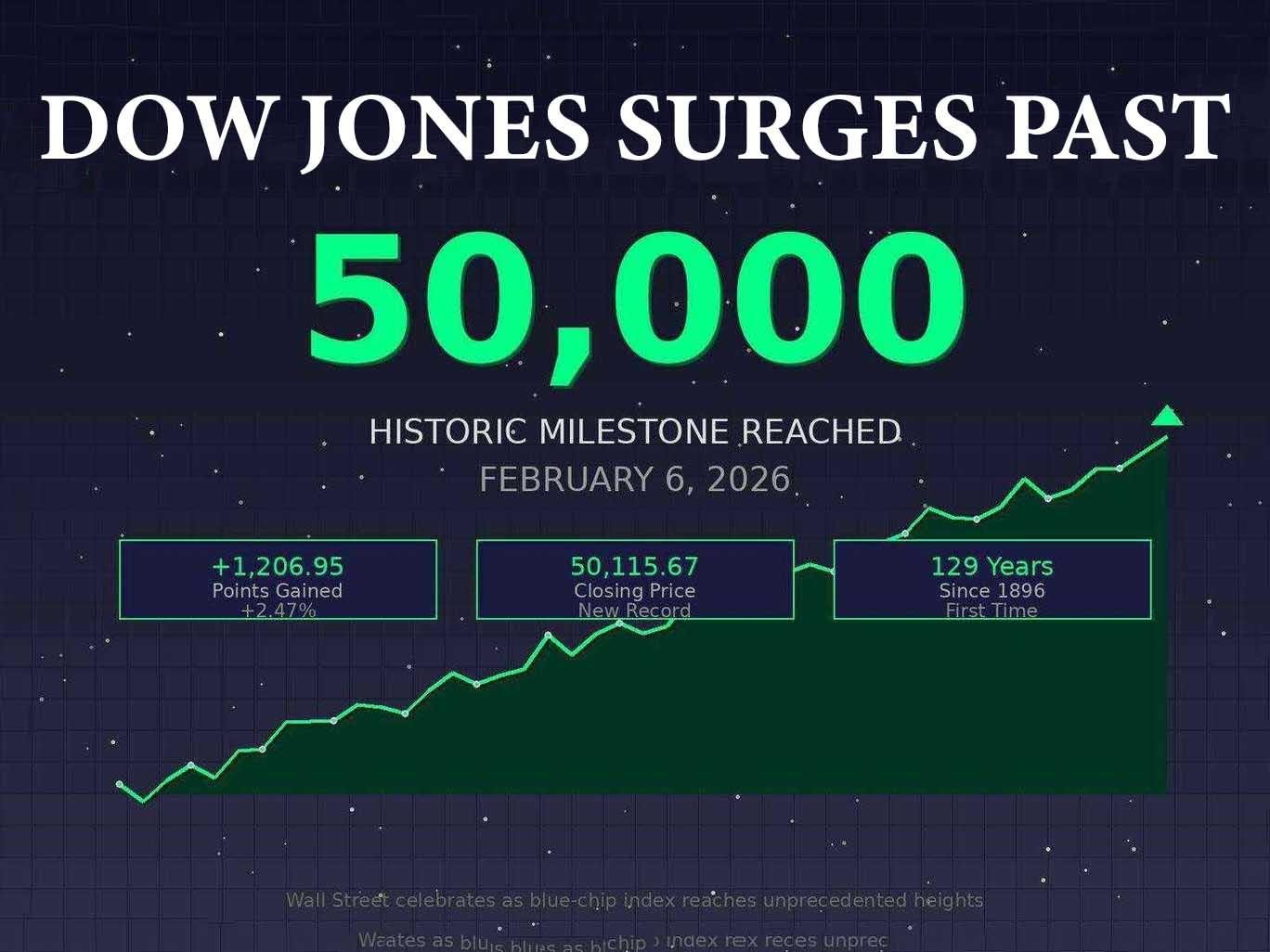
In a stunning display of market resilience, the Dow Jones Industrial Average closed above 50,000 points for the first time in its 129-year history today, marking an unprecedented achievement for the blue-chip index and Wall Street as a whole.
A Day of Celebration
The venerable 30-stock index surged 1,206.95 points, or 2.47%, to close at 50,115.67 on Friday afternoon. The milestone was met with cheers on the trading floor of the New York Stock Exchange, where traders watched history unfold in real-time.
President Donald Trump quickly took to social media to celebrate the achievement, posting: “The Dow Jones Industrial Average just hit 50,000 for the first time in History. CONGRATULATIONS AMERICA!”
Recovery After Tech Turbulence
This historic climb comes as a remarkable rebound following several days of heavy selling in the technology sector. The broader market had been weighed down by concerns about artificial intelligence spending and competition, with software companies facing particular pressure amid questions about valuations and the potential impact of new AI tools on traditional software margins.
The S&P 500 also rallied strongly, gaining 1.97% to end at 6,932.30, while the tech-heavy Nasdaq Composite advanced 2.18% to 23,031.21. With these moves, the S&P 500 climbed back into positive territory for 2026.
Broadening Market Strength
Market analysts are viewing the Dow’s achievement as evidence of a healthy broadening in market leadership beyond just the technology sector. The index has benefited from rotation into economically cyclical stocks, with companies in financials, industrials, and healthcare drawing increased investor interest.
“The positives of the Dow getting to that new milestone is it’s showing we’re seeing a broadening in the market,” said Matt Dmytryszyn, chief investment officer at Composition Wealth. “It’s not just tech stocks and AI. We’re seeing more broader financial and industrial and healthcare companies starting to become more broadly bought and recognized in the market.”
Caterpillar, a Dow component, exemplified this trend by surging 6% on Friday, helping lift the index. The company has become what Barclays analysts call “the ultimate story stock,” benefiting from AI infrastructure spending, construction demand, and critical minerals production.
Tech Sector Rebounds
Despite earlier week losses, major technology stocks participated in Friday’s rally. Nvidia jumped more than 8%, while Broadcom and Advanced Micro Devices both rose over 7%. These gains came on expectations that chip companies would benefit from continued heavy spending on artificial intelligence data centers by tech giants like Amazon and Alphabet.
The semiconductor sector’s performance highlighted ongoing investor confidence in the long-term prospects for AI, even as some concerns about near-term spending persist.
Consumer Sentiment Improves
Supporting the market’s advance, the University of Michigan Survey of Consumers showed improving sentiment, with a headline reading of 57.3 that beat expectations. Particularly encouraging was the one-year inflation outlook, which fell to 3.5%—the lowest level since January 2025.
“Market sentiment improved after today’s positive report out of the University of Michigan,” said Jeffrey Roach, LPL Financial chief economist. “Median 1-year inflation expectations hit the lowest since January 2025, providing some comfort for investors eager to see improving inflation metrics.”
Survey director Joanne Hsu noted an interesting divergence: “Sentiment surged for consumers with the largest stock portfolios, while it stagnated and remained at dismal levels for consumers without stock holdings.”
Historical Context
The Dow’s journey to 50,000 has been marked by numerous milestones and challenges. Established in 1896 by journalists Charles Dow and Edward Jones, the index initially tracked just 12 industrial stocks. It expanded to 30 stocks in 1928 and has maintained that composition size ever since, though the specific companies have evolved to reflect America’s changing economy.
Key historical milestones include:
- November 14, 1972: First close above 1,000
- March 29, 1999: First close above 10,000
- May 7, 2013: First close above 15,000
- January 25, 2017: First close above 20,000
- November 24, 2020: First close above 30,000
- May 17, 2024: First close above 40,000
- January 6, 2026: First close above 49,000
The push from 49,000 to 50,000 took just one month, underscoring the market’s strong momentum entering 2026.
Expert Perspectives
Wharton professor emeritus Jeremy Siegel offered a bullish long-term view on CNBC, particularly regarding artificial intelligence. “This is probably one of the greatest technological revolutions that we’ve ever experienced. It’s going to change the world in many ways that we don’t know,” Siegel said. “It’s going to be for the better, because we can produce more and do more with less effort.”
Siegel also characterized the Dow hitting 50,000 as evidence of “a lot of fundamental strength in this economy,” forecasting that the recent market broadening is “just the beginning.”
Ken Mahoney, president and CEO at Mahoney Asset Management, reflected on the remarkable recovery: “50k is an incredible milestone, especially considering we are getting close in a couple of months to the anniversary of the tariff tantrum period where the Dow traded into 36,000, so it has been quite the recovery and trend.”
Economic Fundamentals Remain Solid
Despite pockets of market volatility and ongoing geopolitical uncertainties, analysts point to solid underlying economic fundamentals. Rob Haworth, senior investment strategy director at US Bank Asset Management, noted: “Fundamentals remain solidly in place, meaning improving earnings growth and resilient consumer spending.”
The Dow’s composition—featuring household names like Goldman Sachs, Coca-Cola, JPMorgan Chase, and Procter & Gamble—continues to serve as a barometer for the broader American economy. Recent changes to the index, including the addition of Nvidia in place of Intel in late 2024, reflect the evolving importance of artificial intelligence and advanced technology to the US economic landscape.
Looking Ahead
As the market closes the week with the Dow’s historic achievement, investors will be watching several key factors in the coming days and weeks:
- Corporate earnings reports continue to roll out, providing insights into the health of American businesses
- Federal Reserve policy decisions, with Kevin Warsh nominated to chair the Fed
- Economic data releases, particularly employment figures and inflation metrics
- Developments in the technology sector and AI spending patterns
- Geopolitical developments and their potential market impacts
The 50,000 milestone represents not just a numerical achievement but a testament to American economic resilience, corporate innovation, and the enduring appeal of equity markets to investors worldwide.
Market Performance Summary
Friday, February 6, 2026:
- Dow Jones Industrial Average: +1,206.95 points (+2.47%) to 50,115.67
- S&P 500: +1.97% to 6,932.30
- Nasdaq Composite: +2.18% to 23,031.21
Week Performance:
- Dow: +2.5%
- S&P 500: -0.1%
- Nasdaq: -1.8%
Year-to-Date:
- Dow: +4%
This historic day on Wall Street will be remembered as a defining moment in the market’s continued climb, demonstrating that even after 129 years, the Dow Jones Industrial Average continues to reach new heights and reflect the dynamism of the American economy.