Copy
Keens Steakhouse — 72 West 36th Street, New York, NY 10018
By Peter, The Heritage Diner | Mount Sinai, NY Peter holds graduate degrees in Philosophy from Long Island University and The New School University in NYC
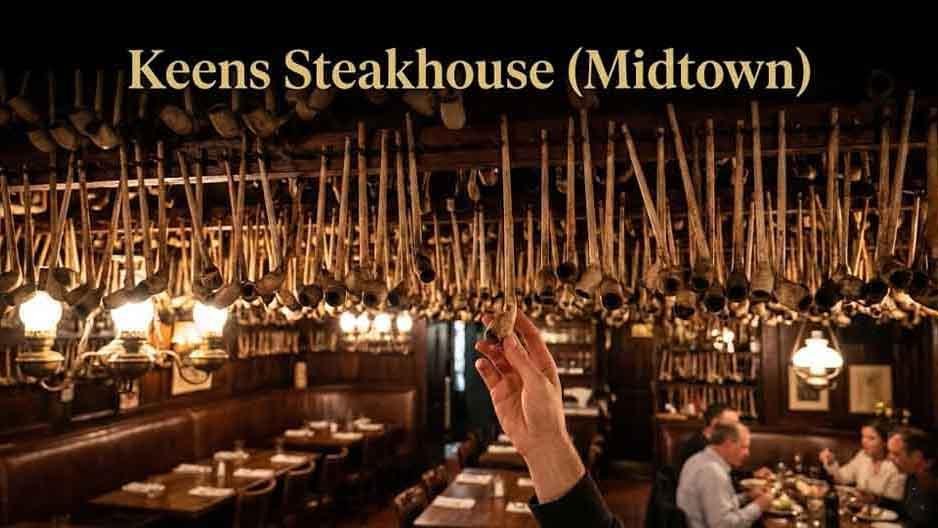
Forty-five thousand clay pipes hang from the ceilings of a Midtown Manhattan chophouse, each one a ghost of someone who once sat exactly where you are about to sit, ordering the same two-inch-thick saddle of lamb that has been served on these premises since Grover Cleveland occupied the White House. Keens Steakhouse is not merely one of New York City’s oldest restaurants — it is a living reliquary, a place where the act of dining becomes an act of communion with 140 years of American ambition, theater, political bravado, and the primal satisfaction of perfectly broiled meat. For a man who has spent a quarter century behind the griddle at The Heritage Diner in Mount Sinai, who hand-stitches English bridle leather at Marcellino NY for clients who measure quality in decades rather than seasons, who is preparing with his wife Paola to launch a boutique real estate venture on Long Island’s North Shore — a place like Keens registers not as a restaurant review but as a case study in what happens when human beings commit to a single location, a single craft, and refuse to leave.
The Founding: Albert Keen and the Herald Square Theater District
The year was 1885. The Statue of Liberty had just arrived in New York Harbor in pieces, awaiting assembly. Theodore Roosevelt was publishing his Dakota Territory hunting memoirs. And on West 36th Street, between Fifth and Sixth Avenues, a theater producer named Albert Keen opened an independent chophouse that would outlast every other establishment in what was then Manhattan’s pulsing Herald Square Theater District (Wikipedia, 2025). Keen had managed the American chapter of the Lambs Club, a London-founded theatrical and literary society whose members included the playwrights, actors, and producers who defined late-nineteenth-century American entertainment (Clio, 2024). His restaurant — originally called Keen’s English Chop House — functioned as a backstage canteen for the Garrick Theatre next door. Actors in full stage makeup reportedly sprinted through the rear entrance between acts to fortify themselves with mutton and ale before returning to the footlights (Keens.com, 2025).
What Keen understood, and what every restaurateur who has survived more than a decade instinctively knows, is that a restaurant must become more than a place to eat. It must become a room where a neighborhood’s identity takes physical form. At The Heritage Diner, that identity is the working families of Route 25A, the teachers and tradespeople and commuters who have been sitting in the same booths for a generation. For Albert Keen, it was the theatrical elite of Gilded Age Manhattan — and the genius mechanism he deployed to bind them to his establishment was tobacco.
Ninety Thousand Pipes: The World’s Largest Collection
Keen launched a Pipe Club in the early 1900s that would eventually enroll over 90,000 members (The Takeout, 2026). The concept was elegant in its simplicity: churchwarden pipes — those long, slender clay instruments with curved stems too fragile to survive a crosstown carriage ride — were stored at the restaurant under individual serial numbers. A diner would present his membership card, and a pipe boy would retrieve his personal pipe from the collection. After the meal, the pipe was returned to its resting place on the ceiling or in the back room. The tradition had roots in seventeenth-century English coaching inns, where travelers kept their clay pipes at their favorite stopping points along the road (Pipedia, 2025).
The roster of Pipe Club members reads like a compressed encyclopedia of American accomplishment: Theodore Roosevelt, Albert Einstein, J.P. Morgan, Babe Ruth, “Buffalo Bill” Cody, General Douglas MacArthur, Stanford White, George M. Cohan, and Red Foxx, among thousands of others (Wikipedia, 2025). When a member died, the stem of his pipe was ceremonially broken, and the pipe was returned to its place above the tables — a tradition that persists in the restaurant’s iconography today. The late artist Kiki Kogelnik, wife of the man who would later rescue Keens from oblivion, conceived the idea of mounting the pipes across the ceilings as sculptural installations rather than keeping them in storage (Edible Manhattan, 2015). The effect is staggering. You dine beneath a canopy of white clay that looks like a flock of birds frozen in mid-flight, each one carrying a name and a story that the walls have absorbed for over a century.
As someone who works in English bridle leather at Marcellino NY — a material that accumulates character and patina with every year of use — I recognize what these pipes represent. They are not decorations. They are evidence of time well spent, of the compounding value that accrues when objects and places are allowed to age rather than being discarded for the next trend.
Lillie Langtry, Lincoln’s Playbill, and the Weight of History
Every serious institution accumulates legends. Keens has two that rise above the rest.
The first belongs to Lillie Langtry, the English actress and companion to King Edward VII, who arrived at Keens in 1905 expecting to be seated for dinner. She was turned away — the establishment was, at the time, exclusively for men. Langtry did not retreat. She sued the restaurant in court, prevailed, and returned in her feathered boa to order the mutton chop that had been denied her (Keens.com, 2025). The restaurant commemorated the episode with characteristic New York wit: they hosted an honorary dinner in her name, presented a specially designed menu featuring clear green turtle soup and roast partridge, and eventually named one of the upstairs dining rooms after her (Daily Meal, 2014). The framed menu from that honorary dinner still hangs on the wall outside the Lillie Langtry Room.
The second legend is darker and more haunting. In the Lincoln Room — a wood-paneled chamber on the second floor dedicated to artifacts of the sixteenth president — hangs a playbill from Ford’s Theatre dated April 14, 1865. It is purportedly the program Abraham Lincoln was holding when John Wilkes Booth fired the shot that killed him during a performance of Our American Cousin (Untapped New York, 2020). Brown stains on the playbill are said to be Lincoln’s blood. A newspaper clipping mounted nearby tells the story of how a carpenter’s assistant retrieved the playbill from beneath Lincoln’s chair after the assassination and eventually passed it along through a chain of theater people until it found its way to Keens. The Lincoln Room also houses a handwritten copy of the Gettysburg Address and, as of February 2026, the 37-star American flag that covered Lincoln’s casket during the 1865 funeral train procession — purchased at auction by Keens’ current owner, Tilman Fertitta, for $656,250 (The Takeout, 2026). Director Steven Spielberg and actor Daniel Day-Lewis are said to have shared dinner in this room when the film Lincoln premiered in 2012 (Daily Meal, 2014).
The gravity of these artifacts transforms a steakhouse dinner into something philosophical. Heidegger wrote about the way objects carry the residue of their histories, how a bridge is never merely steel and stone but an accumulation of every crossing ever made across it. Keens understands this. Its 500-plus artifacts — Thomas Nast prints, antiquated playbills, nude classical paintings, metal lions and bulldogs crouching on banisters — are not a curated museum exhibit. They are the sediment of a century and a half of continuous habitation.
The Resurrection: Dr. George Schwarz and Kiki Kogelnik
By the late 1970s, Keens was dead. Rising utility costs, declining patronage in a deteriorating Herald Square neighborhood, and the inability to attract younger diners drove the restaurant into bankruptcy in 1977 (Wikipedia, 2025). The building sat vacant, its artifacts covered with auction tags, its kitchen dark.
Enter Dr. George Schwarz — a Frankfurt-born radiation oncologist who had fled Nazi Germany as a child and become, improbably, one of the most important restaurateurs in downtown Manhattan. Schwarz and his wife, the Austrian-born pop artist Kiki Kogelnik, had already opened One Fifth, Elephant & Castle, NoHo Star, and Temple Bar, venues that helped define the emerging dining cultures of Greenwich Village and NoHo (Westview News, 2017). In 1978, while walking through Midtown searching for a new restaurant property, Schwarz peered through Keens’ windows and saw a shuttered chophouse draped in auction tags. He bought it.
What he estimated would be a $20,000 to $30,000 renovation ballooned into a $1.4 million, three-and-a-half-year overhaul — new floors, a longer bar, air conditioning, structural repairs, and the painstaking restoration of every piece of memorabilia on the walls (Clio, 2024). Kogelnik oversaw the design, including the decision to mount the pipe collection on the ceilings. In the summer of 1981, Keens reopened for lunch. Dinner service followed shortly after. Schwarz died in December 2016, leaving the restaurant to an estate managed by longtime general manager Bonnie Jenkins and executor Jesse Fink (Cigar Aficionado, 2019).
The Schwarz resurrection is a story that resonates deeply with anyone who has spent decades building a business with their hands. At Marcellino NY, every briefcase I produce is a bet on the idea that quality survives where novelty perishes. Schwarz made that same bet on Keens — and the return has been compounding for over forty years.
The New Chapter: Tilman Fertitta and the $30 Million Acquisition
In November 2024, billionaire Tilman Fertitta — the Houston-based CEO of Landry’s hospitality corporation, owner of the NBA’s Houston Rockets, and now the United States Ambassador to Italy and San Marino — purchased Keens Steakhouse and its 16,000-square-foot building for $30 million (Bloomberg, 2024). Fertitta bought the property as an individual, not through Landry’s, and it will remain a separate entity from the corporation’s portfolio of Morton’s The Steakhouse, The Palm, Del Frisco’s, and Rainforest Café (Robb Report, 2024).
The acquisition represented a rare alignment of commercial ambition and preservationist instinct. Fertitta, whose net worth Bloomberg estimates at approximately $15.2 billion, described Keens as a “New York jewel” and pledged to maintain the restaurant’s traditions (Bloomberg, 2024). Jenkins, speaking on behalf of the Schwarz estate, stated that the team sought a buyer who would allow them to continue operating in the same manner they had for 140 years (Eater NY, 2024). Fertitta has since demonstrated his commitment to the restaurant’s identity as a repository of American history by purchasing the Lincoln casket flag at auction and unveiling it in the Lincoln Room during a birthday celebration for Lincoln on February 12, 2026 — complete with chicken fricassee bites, fried oysters, and milk-bourbon punch, all favorites of Honest Abe (New York Times, 2026).
I have a particular connection to this story. Fertitta is a client of Marcellino NY. When a man who has built a $15 billion empire across hospitality, sports, and diplomacy chooses to carry a hand-stitched English bridle leather briefcase from a workshop in Huntington, Long Island, it confirms something I have believed for twenty-five years: the people who build real things recognize real things. Fertitta’s stewardship of Keens is the same instinct that leads someone to commission a briefcase designed to last a hundred years rather than buying something off a department store shelf.
The Menu: USDA Prime, Mutton, and Two Hundred Scotches
Keens is a USDA Prime-only steakhouse, meaning every cut of beef that leaves its kitchen meets the highest federal grading standard for marbling and tenderness (Keens.com, 2025). The menu is anchored by dry-aged prime steaks — New York sirloin, filet mignon in multiple cuts, T-bone, and porterhouse for two or three — but the dish that defines the restaurant, the one that has been on the menu since 1885 and has never been removed, is the Legendary Mutton Chop.
The name is a historical artifact. Keens served true mutton — meat from sheep over two years old — through the early twentieth century, when the cut was considered one of the essential proteins in American dining. The millionth mutton chop was sold in 1935. After World War II, as American palates shifted toward milder flavors, Keens transitioned to yearling lamb — specifically, Colorado-raised saddle-cut chops weighing approximately 26 ounces, two inches thick, skirted with fat and served with a jar of mint jelly and sautéed escarole (James Beard Foundation, 2018). The preparation is deceptively simple: generous salt, a searing under the kitchen’s scorching broiler, and a finish in a hot oven. The result is a cut of meat so large and so precisely cooked that it has achieved the rare status of a dish people travel across continents specifically to eat.
Beyond the mutton chop, the menu features prime rib in English and King’s cuts, Dover sole sautéed in butter, jumbo shrimp in beurre blanc, double Colorado lamb chops, roasted buttermilk chicken, and slow-braised short ribs. Appetizers include fresh oysters (available by the half-dozen, dozen, or in Lincoln-themed platters of 30 or 50), lobster salad, lump crab cocktail, and house-cured salmon. The restaurant serves up to 600 diners per night across its multiple dining rooms (The Takeout, 2026).
The bar is a destination in its own right. Keens maintains one of Manhattan’s largest single-malt Scotch whisky collections — over 200 expressions lined up across the back wall — along with an extensive selection of bourbons, American whiskeys, and craft cocktails (NYC Tourism, 2025). The signature Bloody Mary, made with balsamic vinegar, and the New York Sour — bourbon and lemon juice topped with a red wine float — are among the house specialties. Bartender Manolo Morales, a fixture behind the bar for over a decade, maintains that the only proper martini is one shaken with London dry gin (Punch, 2023).
Visiting Keens: What You Need to Know
Keens Steakhouse is located at 72 West 36th Street, between Fifth Avenue and Sixth Avenue, in Manhattan’s Garment District — steps from Herald Square, Penn Station, and Madison Square Garden. The restaurant occupies two floors with multiple dining rooms: the pub room and main bar downstairs; the Lambs Room, Lincoln Room, Bull Moose Room, and Lillie Langtry Room upstairs.
Hours: Monday through Friday, 11:45 AM to 10:30 PM. Saturday, 5:00 PM to 10:30 PM. Sunday, 5:00 PM to 9:30 PM. The kitchen operates continuously with no break between lunch and dinner service on weekdays.
Reservations: Call (212) 947-3636 or email info@keens.com. Keens is not on the OpenTable network. For banquet inquiries (the restaurant can accommodate groups of up to 400), email banquets@keens.com.
Delivery and Takeout: Keens offers local delivery through DoorDash (doordash.com/store/keens-steakhouse-new-york-45830) and takeout orders. For nationwide overnight shipping of premium cuts — including dry-aged T-bone steaks, filet mignon, lamb chops, mutton chops, and burger kits — visit keens.com/orderinfo. Items ship via FedEx Monday through Friday.
Parking: Special rate parking is available across the street from the bar entrance, 5:00 PM to midnight.
Website: keens.com
Phone: (212) 947-3636
Price Range: Entrées range from approximately $32 to $177. Expect to spend $100 to $200 per person for a full dinner with drinks.
Ratings: 4.5 out of 5 on TripAdvisor (7,000+ reviews). Health Score: A.
Dress Code: Smart casual. Keens is not the kind of place that demands a suit, but it is the kind of place that rewards one.
Pro Tips: The bar is first-come, first-served and gets extremely busy from 5:00 PM to 8:30 PM, particularly on Knicks and Rangers game nights. The best window for walk-in bar seating is after 9:00 PM. If you want to explore the memorabilia — and you should — the staff is exceptionally knowledgeable and will often offer informal tours to interested guests, even those who are only stopping in for a drink.
Keens Steakhouse has survived the extinction of the Herald Square theater district, the financial devastation of the 1970s, the death of its savior, and the relentless New York real estate machine that has consumed nearly every other establishment of its era. It has done so not by modernizing or pivoting or disrupting, but by doing one thing — broiling meat, pouring Scotch, and honoring the room — with such unwavering discipline that 140 years have passed and the essential experience remains unchanged. As someone who operates a twenty-five-year diner on Route 25A, who hand-stitches leather in a tradition that predates the Industrial Revolution, and who is building a boutique real estate practice with Paola on the principle that the North Shore’s old-world character is its most valuable asset — I recognize Keens for what it is. It is proof that the unseen details, the accumulated years, the refusal to chase the next trend, are what separate a restaurant from a landmark and a meal from a memory.