Call it a small civic act of deception. Every diner counter from Merrick to Montauk that lists an egg cream on the menu is participating in a century-old compound fraud: the drink contains no egg, no cream, and — if made correctly — exactly one permissible syrup. That last part is the one that actually starts arguments.
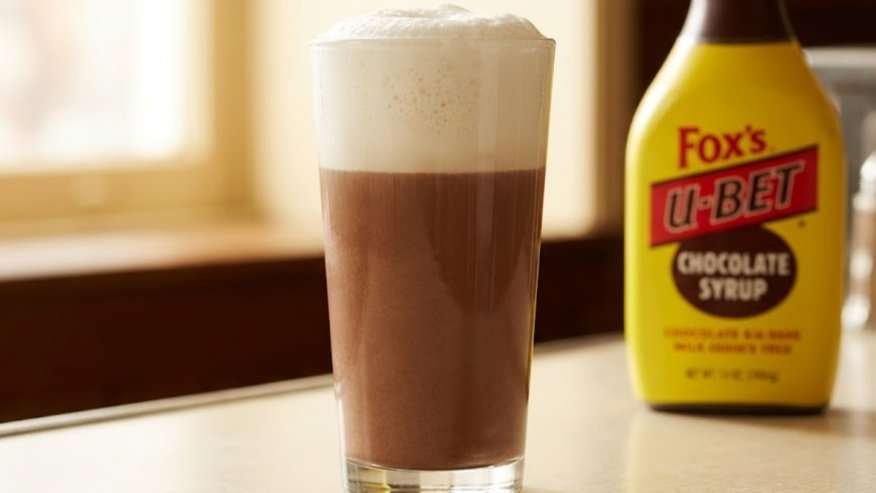
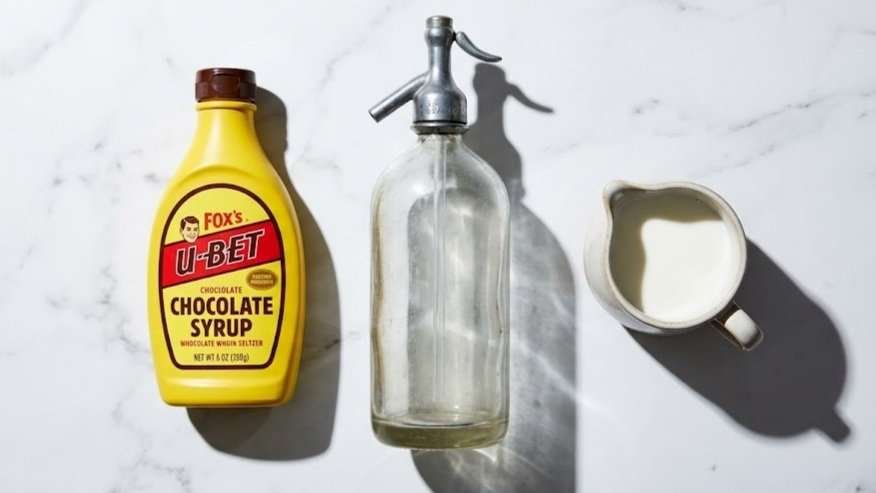
The egg cream is three ingredients. Cold whole milk, pressurized seltzer, and Fox’s U-Bet Chocolate Syrup. In that order, with particular technique, in a clean chilled glass. You mix the syrup and milk first, add the seltzer hard against a long spoon so it erupts into a white head, then drink it before the head dies. The whole thing takes sixty seconds. The margin for error is narrower than it looks.
The Most Defensible Origin Story
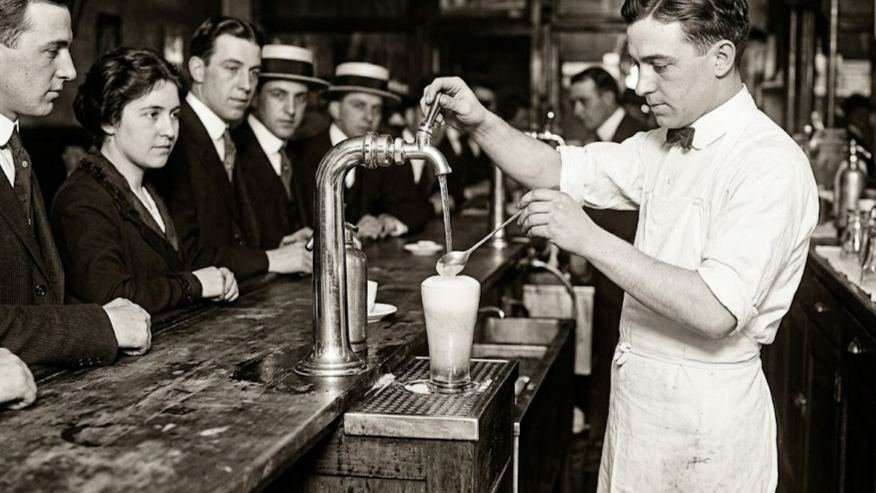
Nobody owns the egg cream uncontested. The dispute about its invention is old enough and ornery enough that food historians have essentially agreed to acknowledge the argument rather than resolve it. But if you’re going to assign credit to someone, Louis Auster has the best claim. A Jewish immigrant who arrived in New York City around 1890, Auster opened his first candy store on the Lower East Side and eventually settled his most famous location at the corner of Second Avenue and Seventh Street — the heart of what was then the Yiddish Rialto, a stretch of theaters, restaurants, and shops running up Second Avenue that served as the cultural center of Jewish immigrant New York.
At the height of Auster’s empire, on a hot summer day, his stores reportedly moved three thousand egg creams apiece. That number is staggering. It means that the drink was not a soda fountain novelty — it was a mechanism of community life. People did not sit down with an egg cream. They stood at the counter, drank it, and talked. The egg cream was the coffee of the Lower East Side before coffee was the coffee of everywhere.
Auster made his own chocolate syrup in the basement and refused to reveal the formula to anyone who wasn’t family. When Schrafft’s, the national ice cream chain, offered to buy the recipe, Auster turned them down. An executive responded with a racial slur. Auster reportedly said he would take the formula to his grave. He did. Louis Auster died in 1955 without revealing it, and his family has kept that silence to this day.
This is where Fox’s U-Bet fills the vacuum. Auster’s formula vanished with him. Every egg cream served since has used some commercial syrup, and the question of which one is non-negotiable to anyone raised within twenty miles of Brooklyn.
Why Fox’s U-Bet Is Not Interchangeable
Herman Fox founded H. Fox & Company around 1900, cooking syrup over an open flame in his tenement home in Brownsville, Brooklyn. The name came later, in the late 1920s, after Herman went to Texas to drill for oil, came back broke, and returned with a phrase the oilmen used constantly: “you bet.” As his grandson David Fox told the story, Herman arrived back in Brooklyn saying he came back broke but with a good name for the syrup.
The syrup stayed in Brooklyn for over a century. H. Fox & Company was eventually acquired by Westminster Foods in 2016, and production moved to Farmingdale — technically still on Long Island, which the company’s defenders find acceptable. What matters to purists is not just the name but the formulation.
Fox’s U-Bet runs lighter and less viscous than commercial competitors like Hershey’s. This is not incidental. When pressurized seltzer hits the lighter syrup in a cold glass with cold milk already present, the turbulence creates the characteristic emulsified foam — a white head sitting on top of a chocolate-milk base, with the syrup not fully incorporated until you drink through it. The result is a layered drink with different flavors at different points in the glass. Thicker syrups drag in the liquid differently. They don’t produce the same emulsification. The foam dies faster or doesn’t form correctly. Substitute any other chocolate syrup and you get a chocolate soda. You don’t get an egg cream.
David Fox made this argument directly: that the egg cream is not simply a recipe but a relationship between specific ingredients — and that anyone who claims otherwise has never made both and compared them with honest attention.
There is also the Passover question, which only dedicated egg cream people know about. The year-round U-Bet is sweetened with high-fructose corn syrup. The Passover version, manufactured with cane sugar to meet kosher requirements, produces a noticeably different and more complex flavor profile. Egg cream obsessives stock up every spring. It is, among a certain demographic of Long Islanders, as serious as people elsewhere get about hunting seasons or NFL drafts.
The Technique Is Also Not Negotiable
Auster used carbonators — pressurized seltzer-making machines — rather than pre-bottled seltzer. Modern soda fountains accomplish the same thing with CO2 systems. The pressure matters because it produces finer bubbles that create a more stable foam head. A freshly opened seltzer bottle at home achieves a reasonable approximation. Flat seltzer, or seltzer that has been open too long, produces a dead drink.
The order of assembly is another contested territory, though the dominant method among serious practitioners goes syrup first, then milk, then seltzer poured hard over the back of a long spoon so it aerates on contact. The spoon directs the pressure, creates turbulence, builds the foam. Stir only at the bottom after the pour, very gently, so the chocolate incorporates into the milk below while the white head remains intact above. Do not fully mix it. Do not use a milkshake technique. Do not let anyone near it with a cocktail shaker.
The glass should be chilled, straight-sided, and ideally twelve ounces. Auster served his egg creams in special chilled glasses — never paper cups. The temperature of the liquid affects the foam’s behavior. Cold milk, cold seltzer, cold glass. There is no room here for improvisation.
What Long Island Diners Are Actually Doing
The egg cream has mostly survived on Long Island through inertia rather than rigor. It is on menus — you can order it from Mineola to Port Jefferson — but the execution varies considerably, and the syrup choice is the first diagnostic.
Diners that hand-mix to order with Fox’s U-Bet, whole milk, and proper seltzer are preserving a form of institutional memory. They have someone who knows what the drink is supposed to be, who has been making it long enough that the motion is automatic. Syrup first. Cold milk. Hard pour on the spoon. White head.
Diners that pre-mix or use generic chocolate syrup are producing something else. It might taste acceptable. It will not taste like an egg cream. The distinction matters if you grew up with the drink, and it doesn’t much if you didn’t — which is why the egg cream is slowly vanishing from diner counters that serve customers who’ve never had the real thing and can’t miss what they don’t know.
This is a problem specific to institutional memory in the diner trade. The knowledge of how to make something correctly is not written down. It is transmitted through demonstration, the way Auster’s son Mendy learned the formula by watching his father make it. When the person who knows leaves, the knowledge sometimes leaves with them. A diner that once served correct egg creams can drift, imperceptibly at first, toward premixed shortcuts and generic syrup. The drink remains on the menu. The drink is gone.
I’ve been behind a counter long enough to recognize this pattern. The menu is the last thing to change. The quality changes first, quietly, in the back, where nobody is watching.
The Name’s Origins Are Also a Mystery
The drink contains no eggs and no cream. This is the one fact about the egg cream that everyone agrees on. Why it’s called an egg cream is less settled.
The most charming theory involves Boris Thomashevsky, a Yiddish theater star who allegedly tasted a drink called chocolat et crème in Paris in the 1880s, brought the idea back to New York, and the name got mangled in translation from French to Yiddish to English. The phonetics are arguable.
A more pragmatic theory holds that “egg cream” is an Americanization of the Yiddish echt keem, meaning pure sweetness. A third theory notes that Grade A milk was once called “A cream,” and the drink’s name drifted from “chocolate A cream” to “egg cream” through the usual erosion of spoken language over decades.
Food historian Andrew Coe frames the drink’s invention as a project of aspiration in a poor neighborhood — a Lower East Side version of the uptown soda fountain experiences that the wealthier half of the city was already enjoying. Three cents got you a drink that looked expensive, foamed like something fancy, and tasted rich. Egg and cream were words that signaled exactly that richness, even if neither ingredient was present.
The name was marketing before anyone had a word for marketing. It worked. It’s still working.
The Egg Cream as Diagnostic Test
For the full recipe and step-by-step assembly instructions, I put together a detailed breakdown in my earlier piece on The Classic New York Egg Cream: Chocolate, Seltzer, and Milk Done Right.
What that post can’t tell you is what the drink reveals about the counter serving it. An egg cream made correctly, with U-Bet, cold milk, proper seltzer pressure, and the right technique, tells you that someone in that diner kitchen has paid attention to something old and impractical and worth preserving. In the diner trade, this is not a given. Most of what makes a diner good is not on the menu. The menu tells you what they sell. The egg cream tells you who they are.
Order one the next time you sit down at a Long Island counter. If it arrives pale and flat with a generic chocolate taste, you’ll know. If it arrives with a two-inch white head, the chocolate sitting deep in the glass, the cold building at the back of your throat on the first pull through the straw — you’re somewhere worth returning to.
You Might Also Like:
The Forgotten Montauk Surfman’s Chowder: Cooking with Seawater at the 1800s Life-Saving Stations
Depression-Era Clam Pie: Foraging the Great South Bay When Meat Was Scarce
Sources
- H. Fox & Company / Gold’s Pure Foods product history: https://www.goldshorseradish.com/fox-s-syrups
- Barry Joseph, “Making Egg Creams for 111 Years, Even on Passover,” The Forward, 2011: https://forward.com/food/136844/making-egg-creams-for-111-years-even-on-passover/
- NYC Eats, Louis Auster profile: https://www.newyorkcity-eats.com/louis-auster
- Grub Americana, “Egg Cream: New York City’s Iconic Beverage”: https://grubamericana.com/2025/01/22/egg-cream-new-york-citys-iconic-beverage/
- Edible Manhattan, “Egg Cream: The Classic Sparkly, Sweet Beverage”: https://www.ediblemanhattan.com/topics/history/egg-cream/
- What’s Cooking America, New York Egg Cream Recipe and History: https://whatscookingamerica.net/history/nyeggcreamhistory.htm
- Elliot Willensky, When Brooklyn Was the World: 1920–1957 (Harmony Books, 1986)
- The Kitchn, “I Went on a Quest to Make the Perfect Diner-Style Egg Cream”: https://www.thekitchn.com/diner-style-egg-cream-recipe-23156949