

You’re not experiencing keto flu. You’re experiencing what happens when insulin stops hoarding water and takes your minerals with it.
This is the physiology nobody explains when they hand you a list of approved foods and tell you to stay under 20 grams of carbohydrates. The headache on day three, the leg cramp at 2 a.m., the strange spaciness that makes you feel like you’re thinking through wet sand — none of this is ketosis doing something wrong. It’s ketosis doing exactly what it’s supposed to do, and your electrolyte levels not keeping up with the pace of the transition.
On Long Island in summer, the stakes are higher. Humidity on the Sound corridor runs consistently between 65 and 85 percent from late June through August. Anyone doing physical work, running the sand at Jones Beach, or simply existing without air conditioning on a July afternoon is sweating at a rate that compounds the already-elevated electrolyte demand of a ketogenic diet. The protocol that works in January does not work in August. The targets need to adjust.
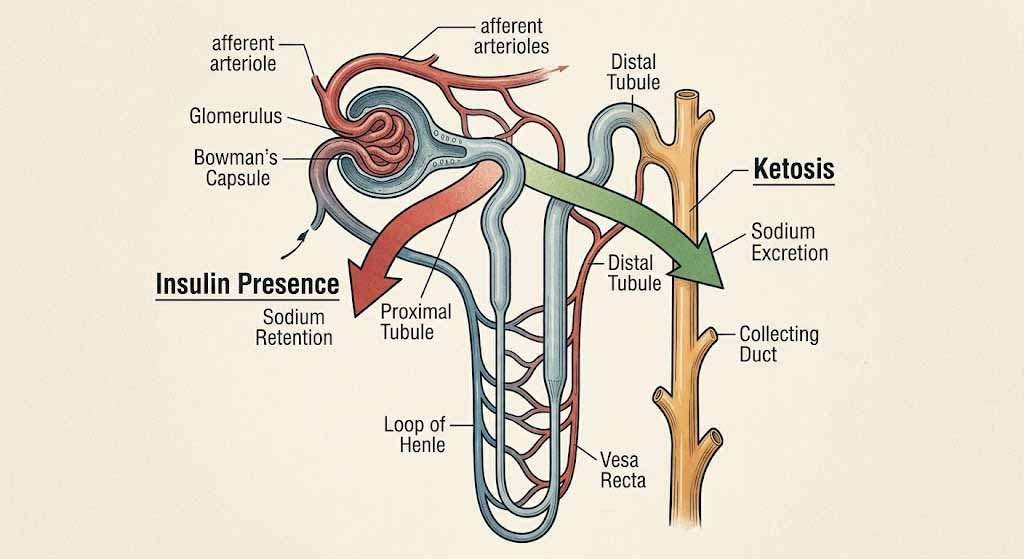
What Insulin Does to Sodium — and Why Keto Changes Everything
The renal connection between insulin and sodium retention is well-documented in metabolic research and, for reasons that remain slightly mysterious, almost never mentioned in consumer keto guides.
Insulin signals the kidneys to retain sodium. Specifically, insulin activates the sodium-hydrogen antiporter in the proximal tubule of the nephron — the functional filtration unit of the kidney — causing sodium to be reabsorbed rather than excreted in urine. When insulin levels are chronically elevated, as they are on a high-carbohydrate diet, the kidneys hold onto sodium and, with it, water. This is why high-carbohydrate diets are associated with fluid retention, and why dropping carbohydrates produces rapid initial weight loss that is almost entirely water.
When you shift to a ketogenic diet, insulin drops. The renal signal to retain sodium disappears. Sodium flushes. Water follows. And with the water goes potassium and magnesium — both of which are lost through increased urinary output and through the same sweat rate that now carries less buffering capacity than it did before.
This is not a side effect. It’s the mechanism. The goal is to replace what the mechanism removes before the deficit becomes symptomatic.
The 2012 research by Volek and Phinney in The Art and Science of Low Carbohydrate Performance established daily sodium targets for keto-adapted adults at 3,000–5,000 mg. More recent work from Dr. Eric Westman’s group at Duke suggests that active adults in hot climates should be at the higher end of that range or slightly above it during summer months. The potassium target sits at 1,000–3,500 mg daily (with the upper bound reserved for those with specific athletic demands and no contraindicated conditions). Magnesium: 300–500 mg daily, with glycinate or malate forms preferred over oxide, which has poor bioavailability.
Sodium: The Primary Deficit and How to Address It
The body under ketogenic conditions needs more sodium than the standard dietary guidelines suggest — and the standard dietary guidelines (roughly 2,300 mg daily, per the American Heart Association) are calibrated for a population eating significant amounts of processed food, which is already high in sodium. Someone eating clean keto — meat, eggs, vegetables, minimal processed food — is often running below 1,500 mg of sodium without realizing it.
The fix is direct. Salt food aggressively. Use a quality mineral salt — Himalayan pink salt or a coarse sea salt — rather than iodized table salt, which is fine metabolically but contributes nothing beyond sodium chloride. Drink broth. Specifically, bone broth. A cup of quality bone broth carries 500–900 mg of sodium depending on preparation and has the additional advantage of providing glycine, which supports sleep quality in a way that matters when you’re adapting to ketosis.
On Long Island, bone broth sourcing is straightforward. The farm stands on the North Shore — Rottkamp’s York Hill Farm in Wading River, Lewin Farms in Wading River and Calverton, Sang Lee Farms in Peconic — often stock locally-made broth or provide the raw materials (feet, knuckle bones, marrow bones) for making it yourself. A six-hour simmer is sufficient. It does not require twenty-four hours, though a longer cook increases mineral extraction from the bone matrix.
If you’re sweating heavily — beach days, physical work, outdoor runs along the Sound — sodium replacement through food and broth should be supplemented with electrolyte drinks. Read the label. Most commercial electrolyte products are formulated for glycolytic athletes on a carbohydrate-based diet and contain significant added sugar or maltodextrin. Look for products with sodium, potassium, and magnesium but no sugar, or mix your own: ¼ teaspoon of cream of tartar (potassium), ¼ teaspoon of pink salt (sodium), and a small amount of magnesium glycinate powder in water.

Potassium: The Electrolyte Nobody Sources Correctly
Potassium on a ketogenic diet is where most protocols fall short, because the most potassium-dense foods in the mainstream nutrition canon — bananas, potatoes, orange juice — are exactly the foods you’ve removed from the diet.
The keto-compatible potassium sources require some deliberate sourcing. Avocado: one medium avocado contains approximately 700 mg of potassium. It is the single highest-yield potassium source available without triggering insulin through carbohydrate load. Spinach: one cup cooked delivers about 840 mg of potassium and 2g net carbs. Salmon: a 3-oz fillet provides approximately 400 mg of potassium. Pork loin: about 380 mg per 3 oz. Swiss chard: one cup cooked, approximately 960 mg.
For Long Island residents in summer, the sourcing picture gets interesting. The North Shore’s coastal geography puts you within striking distance of wild Atlantic salmon and local catch at the Centerport and Port Jefferson area fish markets. Fresh clams — another potassium-rich protein source at roughly 500 mg per 3-oz serving — are available directly at waterfront markets along the Sound. This is coastal keto at its most literal: the minerals you need exist in the water your food came from.
Farm stands along Route 48 and Route 25 in the North Fork carry seasonal chard, spinach, and other potassium-dense greens through the summer. The quality difference between commercial spinach and a bunch pulled that morning at Harbes Family Farm in Mattituck is not marginal. It is significant — both in flavor and in mineral density, since mineral content in vegetables is directly tied to the soil microbiome of the farm producing them, as I explored in a previous piece on regenerative agriculture and nutrient density.
Magnesium: The Mineral That Does Everything and Gets Replaced Last
Magnesium participates in over 300 enzymatic reactions in the human body. It is involved in ATP synthesis, DNA repair, protein synthesis, and the regulation of muscle and nerve function. It is also the mineral most commonly depleted by a combination of ketogenic eating, summer sweating, and chronic low-level dietary deficiency that predates the diet change.
The American dietary magnesium deficit is real and well-documented. According to data from the National Health and Nutrition Examination Survey, roughly 48 percent of Americans consume less than the estimated average requirement for magnesium from food sources alone. That baseline deficiency becomes acute under the diuretic pressure of ketosis.
Symptoms of insufficient magnesium on keto are the ones most people associate with “keto flu” and most commonly misattribute to something else: muscle cramps (particularly at night), disrupted sleep, constipation, irregular heartbeat, and a background irritability that doesn’t quite resolve with sleep.
The food sources for magnesium on a keto diet: pumpkin seeds (1 oz = 156 mg), dark chocolate at 85 percent or above (1 oz = 65 mg), almonds (1 oz = 76 mg), mackerel (3 oz = 82 mg), spinach cooked (½ cup = 78 mg). The challenge is that reaching 300–500 mg through food alone requires consistent intentionality. Most people supplement.
Supplement form matters more than most people know. Magnesium oxide, which is cheap and common, has bioavailability of approximately 4 percent. You are essentially buying expensive urine. Magnesium glycinate absorbs at rates closer to 80 percent and has the additional advantage of crossing the blood-brain barrier more readily, which contributes to the sleep-quality improvement many people report. Magnesium malate is useful for individuals dealing with muscle fatigue, as the malate component participates in the citric acid cycle. Start at 200 mg before bed and increase gradually.
The Summer Adjustment: Long Island-Specific Protocol
The baseline keto electrolyte protocol assumes moderate ambient temperature and moderate activity. Long Island summers are neither.
From late June through August, average daily high temperatures in Suffolk County sit between 82°F and 88°F, with humidity that makes the effective temperature feel significantly higher. A person working a physical job, doing outdoor yard work, or spending time at the beach is sweating 1–2 liters of fluid per hour under exertion — and each liter of sweat contains approximately 900 mg of sodium, 200 mg of potassium, and 36 mg of magnesium.
The adjustment protocol for summer:
Sodium: 4,000–5,000 mg daily baseline, plus active replacement during and after outdoor exertion. A practical method: a 16-oz cup of broth in the morning, salt food at every meal, and a homemade electrolyte drink during any outdoor activity lasting more than 45 minutes.
Potassium: Target the upper range of 3,000–3,500 mg daily through food, not supplement, since potassium supplementation in tablet form is restricted by the FDA to 99 mg per dose (the over-supplementation risk with potassium is real, particularly for individuals with compromised kidney function). Build meals around avocado, leafy greens, and local fish.
Magnesium: 400–500 mg daily. Supplement with glycinate at night. Add a magnesium-rich food source — pumpkin seeds as a snack, mackerel twice a week — to build toward the target from food as much as possible.
Hydration timing: Drink before thirst. On ketogenic diets, thirst response is slightly blunted compared to high-carbohydrate eating because the kidneys are clearing fluid more aggressively. By the time you feel thirsty on keto in summer, you’re already behind. A practical target is 3–4 liters of fluid daily for active adults from June through August — more if you’re spending extended time outdoors.
What Restoration Feels Like
A correctly replenished electrolyte baseline on ketosis in summer doesn’t feel like anything dramatic. That’s the point. The leg cramps stop. The 2 a.m. wake-up disappears. The mental clarity that people associate with fat adaptation — and which can be masked by electrolyte deficit for weeks — becomes consistent and stable rather than intermittent.
The body under ketosis, properly mineralized, is running on a clean energy system without the insulin fluctuations that drive hunger, cognitive fog, and afternoon energy crashes. That’s what the diet is supposed to deliver. Electrolyte deficit is the static that keeps most people from hearing the signal clearly.
Replace the minerals. Let the system do what it’s built to do.
The Sound is three miles away. The farm stands are open. The protocol is not complicated.
You Might Also Like
- The Best Cuts of Meat for Keto — and How to Cook Each One
- What Happens to Your Body When You Cut Ultra-Processed Food for 30 Days?
- The Biomechanics of Sand Running: Coastal Conditioning from Jones Beach to Montauk
Sources
- Volek, J.S. & Phinney, S.D. — The Art and Science of Low Carbohydrate Performance (Victory Belt Publishing, 2012)
- Unwin, D. et al., “It is the glycaemic response to, not the carbohydrate content of food that matters in diabetes and obesity,” Journal of Insulin Resistance, 2016
- National Institutes of Health — Magnesium Fact Sheet
- National Institutes of Health — Potassium Fact Sheet
- Westman, E.C. et al., “Low-carbohydrate nutrition and metabolism,” American Journal of Clinical Nutrition, 2007
- Swaminathan, R., “Magnesium metabolism and its disorders,” Clinical Biochemist Reviews, 2003